
The proliferation of grid-connected photovoltaic (PV) systems has positioned solar inverters as critical interfaces between renewable energy sources and the utility network. A primary challenge for these power electronic converters is maintaining stable and high-quality operation under non-ideal grid conditions. Among these, grid voltage asymmetry—characterized by unequal magnitudes and/or phase shifts between the three phases—is a frequent occurrence due to unbalanced loads, asymmetrical transformer windings, or single-phase faults. Under such unbalanced conditions, conventional control strategies designed for balanced operation often lead to detrimental effects, including significant oscillatory power injection, increased harmonic distortion in the output current, and potential instability. Therefore, developing robust control algorithms for solar inverters under unbalanced voltage scenarios is paramount for ensuring grid code compliance, enhancing system reliability, and maximizing the utilization of PV generation assets.
This article delves into the control challenges for solar inverters during grid voltage unbalance. We begin by establishing the mathematical model of a standard three-phase, two-level voltage source inverter (VSI), which forms the backbone of most modern PV systems. Subsequently, we analyze classical control reference generation strategies, namely Instantaneous Active-Reactive Control (IARC) and Average Active-Reactive Control (AARC), highlighting their inherent trade-offs between power oscillation and current harmonic content. Building upon this analysis, a novel Flexible Active-Reactive Control (FARC) strategy is proposed. This method introduces a tunable parameter that allows for a flexible compromise between suppressing double-frequency power pulsations and minimizing output current harmonics. To validate the theoretical framework, detailed simulations are performed, and the control structure employing a Proportional-Resonant (PR) controller in the stationary reference frame is discussed for effective simultaneous regulation of positive- and negative-sequence current components.
System Modeling of a Grid-Connected Solar Inverter
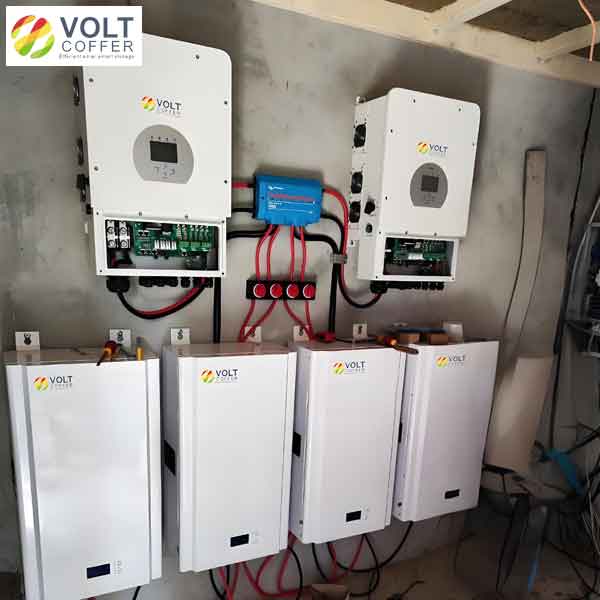
The topology of a standard three-phase grid-connected solar inverter is depicted conceptually below. It typically consists of a DC-link capacitor fed by the PV array, a three-phase VSI bridge, and an L- or LCL-filter to connect to the grid.
For analysis, we consider the fundamental model with an L-filter. The voltage equation in the three-phase (abc) domain is given by:
$$ \mathbf{u}_{abc} = R \mathbf{i}_{abc} + L \frac{d\mathbf{i}_{abc}}{dt} + \mathbf{e}_{abc} $$
where \(\mathbf{u}_{abc}\), \(\mathbf{i}_{abc}\), and \(\mathbf{e}_{abc}\) represent the inverter output voltage vector, output current vector, and grid voltage vector, respectively. \(R\) and \(L\) are the equivalent resistance and inductance of the filter and grid connection.
Applying the Clarke transformation to the stationary \(\alpha\beta\)-frame decouples the equations and simplifies control design:
$$ \begin{aligned}
u_{\alpha} &= R i_{\alpha} + L \frac{di_{\alpha}}{dt} + e_{\alpha} \\
u_{\beta} &= R i_{\beta} + L \frac{di_{\beta}}{dt} + e_{\beta}
\end{aligned} $$
Under unbalanced grid conditions, the grid voltage contains both positive-sequence (\(+\)) and negative-sequence (\(-\)) components. Transforming these to synchronous rotating \(dq\)-frames (positive \(dq^+\) and negative \(dq^-\)) is insightful for control. The positive-sequence \(dq\)-frame rotates at the grid frequency \(\omega\), while the negative-sequence frame rotates at \(-\omega\). The dynamic model in these decomposed frames is:
$$ \begin{aligned}
u_{d}^+ &= (R + sL)i_{d}^+ – \omega L i_{q}^+ + e_{d}^+ \\
u_{q}^+ &= (R + sL)i_{q}^+ + \omega L i_{d}^+ + e_{q}^+ \\
u_{d}^- &= (R + sL)i_{d}^- + \omega L i_{q}^- + e_{d}^- \\
u_{q}^- &= (R + sL)i_{q}^- – \omega L i_{d}^- + e_{q}^-
\end{aligned} $$
Here, \(s\) denotes the differential operator \(d/dt\). The cross-coupling terms (\(\omega L i_q\) and \(\omega L i_d\)) are evident and must be compensated for high-performance current control.
Power Theory and Classical Reference Generation Strategies
The core task of the inverter control under unbalance is to compute the appropriate current reference \(\mathbf{i}^*_{abc}\). This computation is directly linked to the chosen power control objective. Using instantaneous power theory, the three-phase instantaneous active power \(p\) and reactive power \(q\) are defined as:
$$ p = \mathbf{u}_{abc} \cdot \mathbf{i}_{abc} = u_a i_a + u_b i_b + u_c i_c $$
$$ q = \mathbf{u}_{abc}^{\perp} \cdot \mathbf{i}_{abc} $$
where \(\mathbf{u}_{abc}^{\perp}\) is an orthogonal vector leading \(\mathbf{u}_{abc}\) by 90 degrees. For a general unbalanced voltage with positive-sequence amplitude \(U^+\), phase \(\phi^+\), and negative-sequence amplitude \(U^-\), phase \(\phi^-\), the voltage vector can be expressed as:
$$ \mathbf{u}_{abc} =
\begin{bmatrix}
U^+ \cos(\omega t + \phi^+) + U^- \cos(\omega t + \phi^-) \\
U^+ \cos(\omega t + \phi^+ – \frac{2\pi}{3}) + U^- \cos(\omega t + \phi^- + \frac{2\pi}{3}) \\
U^+ \cos(\omega t + \phi^+ + \frac{2\pi}{3}) + U^- \cos(\omega t + \phi^- – \frac{2\pi}{3})
\end{bmatrix} $$
The squared norm of the voltage vector, \(|\mathbf{u}|^2 = \mathbf{u}_{abc} \cdot \mathbf{u}_{abc}\), becomes a crucial term. Under unbalance, it is not constant but contains a double-frequency oscillating component:
$$ |\mathbf{u}|^2 = |\mathbf{u}^+|^2 + |\mathbf{u}^-|^2 + 2 \mathbf{u}^+ \cdot \mathbf{u}^- = (U^+)^2 + (U^-)^2 + 2U^+U^-\cos(2\omega t + \phi^+ – \phi^-) $$
Instantaneous Active-Reactive Control (IARC)
The IARC strategy aims to deliver the exact instantaneous reference powers \(P^*\) and \(Q^*\) at all times. The current reference is derived directly from the instantaneous power definitions, projecting the desired power onto the voltage vectors:
$$ \mathbf{i}^*_{\text{IARC}} = \frac{P^*}{|\mathbf{u}|^2} \mathbf{u} + \frac{Q^*}{|\mathbf{u}|^2} \mathbf{u}^{\perp} $$
Substituting this current into the power definitions yields \(p = P^*\) and \(q = Q^*\) perfectly, without any double-frequency ripple. This ideal power tracking, however, comes at a significant cost. Because \(|\mathbf{u}|^2\) oscillates at \(2\omega\), the current reference \(\mathbf{i}^*_{\text{IARC}}\) will contain high-order harmonics (primarily third and fifth) in the abc frame, leading to a highly distorted output current from the solar inverter.
Average Active-Reactive Control (AARC)
To address the high harmonic distortion of IARC, the AARC strategy replaces the oscillating \(|\mathbf{u}|^2\) with its average value over one cycle, denoted as \(\langle |\mathbf{u}|^2 \rangle\) or \(|\mathbf{u}|^2_\Sigma\). This average value is constant: \(|\mathbf{u}|^2_\Sigma = (U^+)^2 + (U^-)^2\). The current reference is then:
$$ \mathbf{i}^*_{\text{AARC}} = \frac{P^*}{(U^+)^2 + (U^-)^2} \mathbf{u} + \frac{Q^*}{(U^+)^2 + (U^-)^2} \mathbf{u}^{\perp} $$
This formulation eliminates the harmonics in the current reference, resulting in a sinusoidal, albeit unbalanced, output current. The trade-off is that the delivered instantaneous powers are no longer constant. They now exhibit double-frequency oscillations around their average values:
$$ \begin{aligned}
p_{\text{AARC}} &= P^* + \frac{2P^* U^+ U^-}{(U^+)^2 + (U^-)^2}\cos(2\omega t + \phi^+ – \phi^-) \\
q_{\text{AARC}} &= Q^* + \frac{2Q^* U^+ U^-}{(U^+)^2 + (U^-)^2}\cos(2\omega t + \phi^+ – \phi^-)
\end{aligned} $$
These power oscillations can stress the DC-link capacitor of the solar inverter and are undesirable for the grid.
Proposed Flexible Active-Reactive Control (FARC) Strategy
Analyzing IARC and AARC reveals a fundamental compromise: perfect power tracking (IARC) induces high current distortion, while sinusoidal current injection (AARC) induces large power oscillations. To navigate this compromise flexibly, we propose a novel reference generation strategy that introduces a tuning parameter \(k\).
The proposed FARC current reference is defined as:
$$ \mathbf{i}^*_{\text{FARC}} = \frac{P^*}{|\mathbf{u}|^2_\Sigma + k (\mathbf{u}^+ \cdot \mathbf{u}^-)} \mathbf{u} + \frac{Q^*}{|\mathbf{u}|^2_\Sigma + k (\mathbf{u}^+ \cdot \mathbf{u}^-)} \mathbf{u}^{\perp} $$
Where \(\mathbf{u}^+ \cdot \mathbf{u}^- = U^+ U^- \cos(2\omega t + \phi^+ – \phi^-)\) is the oscillating part of the voltage squared norm. This formulation elegantly bridges the gap between AARC and IARC. The tunable parameter \(k\) lies in the range \(0 \le k \le 2\).
- When \(k = 0\), the denominator becomes constant \(|\mathbf{u}|^2_\Sigma\), and FARC reduces to AARC.
- When \(k = 2\), the denominator becomes \(|\mathbf{u}|^2_\Sigma + 2\mathbf{u}^+ \cdot \mathbf{u}^- = |\mathbf{u}|^2\), and FARC reduces to IARC.
By selecting \(k\) between 0 and 2, the solar inverter controller can achieve a desired balance between power oscillation and current distortion. The resulting active and reactive powers when using FARC are:
$$ \begin{aligned}
p_{\text{FARC}} &= P^* + \frac{(2-k) P^* U^+ U^-}{(U^+)^2 + (U^-)^2 + k U^+ U^- \cos(2\omega t + \Delta\phi)}\cos(2\omega t + \Delta\phi) \\
q_{\text{FARC}} &= Q^* + \frac{(2-k) Q^* U^+ U^-}{(U^+)^2 + (U^-)^2 + k U^+ U^- \cos(2\omega t + \Delta\phi)}\cos(2\omega t + \Delta\phi)
\end{aligned} $$
where \(\Delta\phi = \phi^+ – \phi^-\). For analysis, we define the voltage unbalance factor (VUF) as \(\epsilon = U^- / U^+\). The peak-to-peak power oscillation ratio \(\Delta\) and the output current Total Harmonic Distortion (THD) can be derived as functions of \(\epsilon\) and \(k\).
Power Oscillation Ratio:
$$ \Delta_p = \Delta_q = \frac{(2-k)\epsilon}{1 + \epsilon^2 + k\epsilon} $$
Current THD (approximate for phase A):
$$ \text{THD} \approx \sqrt{ \frac{(1+\epsilon^2 – k\epsilon)^2}{(1+\epsilon^2 + k\epsilon)^2} – 1 } $$
The following table summarizes the performance metrics for the key strategies at a fixed unbalance factor (\(\epsilon = 0.3\)):
| Control Strategy | Parameter \(k\) | Power Oscillation Ratio (\(\Delta\)) | Current THD (%) | Primary Feature |
|---|---|---|---|---|
| AARC | 0 | \(\frac{0.6}{1.09} \approx 0.55\) | ~4% | Low THD, High Power Ripple |
| FARC (Example) | 1.0 | \(\frac{0.3}{1.39} \approx 0.22\) | ~15% | Balanced Compromise |
| FARC (Optimal Compromise) | 1.5 | \(\frac{0.15}{1.54} \approx 0.097\) | ~23% | Good Balance |
| IARC | 2.0 | ~0 | ~31% | No Power Ripple, High THD |
The trends are clear: increasing \(k\) reduces power oscillation but increases current THD. The value \(k \approx 1.5\) often provides a practically favorable compromise, significantly reducing the power oscillation of AARC (from 55% to under 10%) while maintaining a lower THD than IARC (23% vs. 31%). This flexibility is the key advantage for the solar inverter operator.
Control System Implementation with PR Controller
Once the current reference \(\mathbf{i}^*_{\alpha\beta}\) is generated via the FARC (or any other) strategy in the \(\alpha\beta\)-frame, a fast and accurate current regulator is required. Traditional methods use dual synchronous PI controllers in positive- and negative-sequence \(dq\)-frames, requiring sequence decomposition and multiple transformations, which adds complexity and may affect dynamic response.
An elegant alternative is to use a Proportional-Resonant (PR) controller directly in the stationary \(\alpha\beta\)-frame. A PR controller provides very high gain at a specific resonant frequency \(\omega_0\). To control both the fundamental positive-sequence current (at \(+\omega\)) and the fundamental negative-sequence current (which appears as a \(- \omega\) component in the stationary frame), a dual resonant structure tuned at \(+\omega\) and \(-\omega\) can be used. However, a standard resonant term of the form \(K_i s / (s^2 + \omega_0^2)\) provides high gain at both \(+\omega_0\) and \(-\omega_0\). Therefore, a single PR controller per axis can simultaneously regulate both sequence components.
The transfer function of a non-ideal PR controller is:
$$ G_{\text{PR}}(s) = K_p + \frac{K_i s}{s^2 + \omega_0^2} $$
Where \(K_p\) is the proportional gain, \(K_i\) is the resonant gain, and \(\omega_0\) is the resonant (grid) frequency. This structure, applied independently to the \(\alpha\) and \(\beta\) axes, can track sinusoidal references with zero steady-state error. The block diagram of the proposed control system for the solar inverter is as follows:
- Measurement: Grid voltages (\(e_{abc}\)) and inverter currents (\(i_{abc}\)) are measured.
- Sequence Decomposition: Grid voltages are decomposed into positive- and negative-sequence components (\(e_d^+, e_q^+, e_d^-, e_q^-\)) typically using a Dual Second-Order Generalized Integrator (DSOGI) or similar technique.
- Reference Calculation (FARC Core): Using \(P^*, Q^*\), the sequence voltages, and the chosen \(k\) factor, the FARC algorithm computes the current references \(i^*_{\alpha}\) and \(i^*_{\beta}\).
- Current Control: The error between the reference and measured currents in the \(\alpha\beta\)-frame is processed by the PR controllers. The output is the reference voltage vector \(u^*_{\alpha\beta}\).
- Modulation: The reference voltage is fed to a Space Vector Pulse Width Modulation (SVPWM) block to generate switching signals for the inverter bridges.
This structure simplifies the control by avoiding the need for separate rotating frame controllers for negative-sequence currents, improving the dynamic response of the solar inverter to unbalanced disturbances.
Simulation Analysis and Performance Validation
To validate the proposed FARC strategy, a detailed simulation model of a 450-kW grid-connected solar inverter system was developed. System parameters are: DC-link voltage \(U_{dc} = 800V\), filter inductance \(L = 1.5mH\), switching frequency \(f_{sw} = 6kHz\). The grid voltage is subjected to an unbalance with \(\epsilon = 0.3\) (VUF=30%) at time \(t = 2.0s\). The power references are set to \(P^* = 0.45\) MW and \(Q^* = 0.3\) Mvar.
The system was tested with different values of the tuning parameter \(k\). The key performance metrics—DC-link voltage stability, active/reactive power waveforms, and three-phase output currents—were analyzed.
- Case k=0 (AARC): As predicted, the output currents are sinusoidal but unbalanced. The active and reactive powers exhibit large double-frequency oscillations with a peak-to-peak magnitude of approximately 51% of the average value. The DC-link voltage shows a corresponding 100Hz ripple.
- Case k=1.0: A noticeable compromise is observed. The power oscillations are reduced significantly compared to the AARC case. The output currents remain largely sinusoidal but contain more distortion than the k=0 case, visible as slight flattening of the peaks.
- Case k=1.5: This setting demonstrates the effective balance of the FARC strategy. Power oscillations are markedly suppressed to a very low level (~19% peak-to-peak). The current distortion increases but remains within acceptable limits, appearing more sinusoidal than in the IARC case. This is often the optimal operating point for the solar inverter.
- Case k=2 (IARC): The power outputs are perfectly constant, as expected. However, the three-phase currents are severely distorted and non-sinusoidal, rich in 3rd and 5th harmonics, leading to a high THD. This would likely violate grid harmonic standards.
The simulation results quantitatively confirm the theoretical derivations. The power oscillation ratios and current THD values extracted from the simulation waveforms closely match the calculated values from the formulas in the table above. This validates that the FARC strategy provides a deterministic and flexible method for solar inverter control under unbalanced voltages, allowing system designers to choose a suitable operating point (\(k\) value) based on specific grid code requirements (e.g., harmonic limits vs. permissible power fluctuation).
Conclusion
Grid voltage unbalance poses a significant challenge for the stable and high-quality operation of grid-connected solar inverters. Classical strategies like IARC and AARC present a stark trade-off between constant power injection and sinusoidal current output. This article has presented a comprehensive analysis of this issue and proposed a novel Flexible Active-Reactive Control (FARC) strategy. By introducing a single tuning parameter \(k\) into the current reference calculation, the FARC method enables a continuous and flexible compromise between suppressing double-frequency power oscillations and minimizing output current harmonic distortion.
Mathematical analysis derived explicit expressions for power oscillation ratio and current THD as functions of the unbalance factor and the parameter \(k\), providing a clear design guideline. The implementation of the control system using a Proportional-Resonant controller in the stationary frame was discussed, offering a simpler and dynamically responsive alternative to dual rotating-frame PI controllers. Simulation studies on a detailed model of a medium-power solar inverter confirmed the theoretical predictions and demonstrated the practical utility of the proposed method. For a typical unbalance scenario, selecting \(k \approx 1.5\) was shown to significantly mitigate the severe power oscillations of AARC while keeping current distortion well below the high levels of IARC.
In summary, the FARC strategy enhances the operational flexibility and robustness of solar inverters in weak or asymmetrical grids. It empowers system operators to meet varying grid code priorities effectively, contributing to the reliable integration of large-scale photovoltaic power into modern electrical networks. Future work may focus on adaptive schemes where the parameter \(k\) is dynamically adjusted based on real-time grid conditions or optimization objectives.