
The integration of solar inverters into modern power grids requires robust harmonic suppression and resonance mitigation strategies. This paper presents a Hamiltonian system-based approach combined with active damping techniques to enhance the performance of three-phase LCL-type grid-connected solar inverters. By leveraging passive control theory and notch filter optimization, we address critical challenges in photovoltaic power conversion systems.
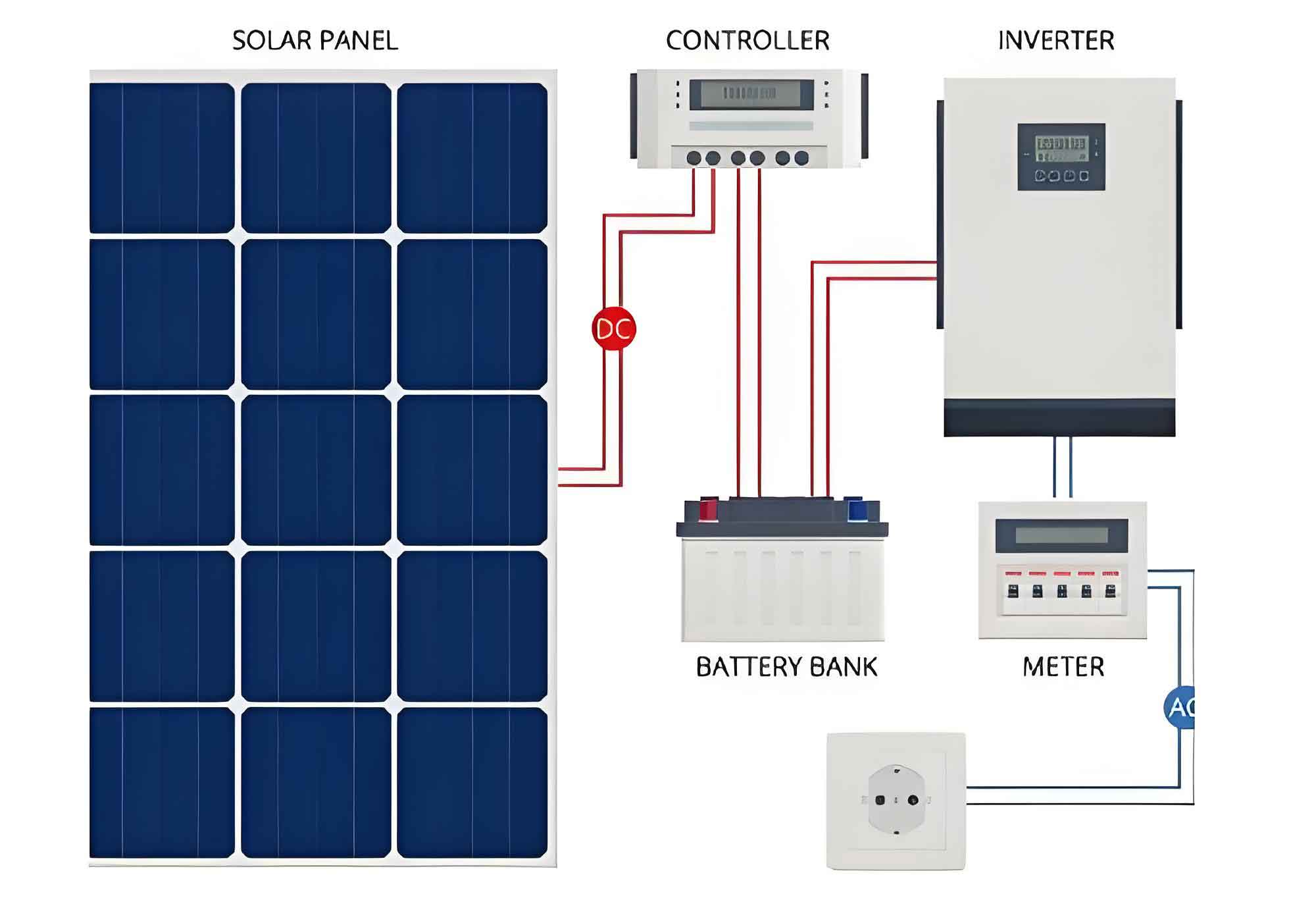
1. Hamiltonian Modeling of LCL Solar Inverters
The three-phase LCL solar inverter topology exhibits inherent resonance characteristics described by the port-controlled Hamiltonian system:
$$
\begin{cases}
L_1\frac{d}{dt}\begin{bmatrix}i_{1d}\\i_{1q}\end{bmatrix} = \begin{bmatrix}S_d\\S_q\end{bmatrix}U_{dc} – R_1\begin{bmatrix}i_{1d}\\i_{1q}\end{bmatrix} – \begin{bmatrix}U_{cd}\\U_{cq}\end{bmatrix} + L_1\omega\begin{bmatrix}i_{1q}\\-i_{1d}\end{bmatrix} \\
(L_2+L_g)\frac{d}{dt}\begin{bmatrix}i_{2d}\\i_{2q}\end{bmatrix} = \begin{bmatrix}U_{cd}\\U_{cq}\end{bmatrix} – (R_2+R_g)\begin{bmatrix}i_{2d}\\i_{2q}\end{bmatrix} – \begin{bmatrix}U_{ed}\\U_{eq}\end{bmatrix} + (L_2+L_g)\omega\begin{bmatrix}i_{2q}\\-i_{2d}\end{bmatrix} \\
C\frac{d}{dt}\begin{bmatrix}U_{cd}\\U_{cq}\end{bmatrix} = \begin{bmatrix}i_{1d}\\i_{1q}\end{bmatrix} – \begin{bmatrix}i_{2d}\\i_{2q}\end{bmatrix} + C\omega\begin{bmatrix}U_{cq}\\-U_{cd}\end{bmatrix}
\end{cases}
$$
Where system matrices are defined as:
$$
J(x) = \begin{bmatrix}
0 & \omega L_1 & 0 & 0 & -1 & 0 \\
-\omega L_1 & 0 & 0 & 0 & 0 & -1 \\
0 & 0 & 0 & \omega(L_2+L_g) & 1 & 0 \\
0 & 0 & -\omega(L_2+L_g) & 0 & 0 & 1 \\
1 & 0 & -1 & 0 & 0 & \omega C \\
0 & 1 & 0 & -1 & -\omega C & 0
\end{bmatrix}
$$
$$
R(x) = \text{diag}\{R_1, R_1, R_2+R_g, R_2+R_g, 0, 0\}
$$
2. Passive Control Design for Solar Inverters
The passive controller for solar inverters achieves stability through energy-shaping:
$$
u = g^{-1}(x)\left[(J_d(x)-R_d(x))\frac{\partial H_d(x)}{\partial x} – (J(x)-R(x))\frac{\partial H(x)}{\partial x}\right]
$$
Key reference states for grid current tracking:
$$
\begin{aligned}
x_5^* &= C\left[\frac{(R_2+R_g+r_3)x_3^*}{L_2+L_g} – \frac{r_3x_3}{L_2+L_g} + U_{sd} – \omega x_4^*\right] \\
x_6^* &= C\left[\frac{(R_2+R_g+r_4)x_4^*}{L_2+L_g} – \frac{r_4x_4}{L_2+L_g} + U_{sq} + \omega x_3^*\right]
\end{aligned}
$$
3. Active Damping with Notch Filter Implementation
The resonance suppression for solar inverters employs a notch filter with transfer function:
$$
G_{\text{trap}}(s) = \frac{s^2 + \omega_n^2}{s^2 + 2\xi\omega_n s + \omega_n^2}
$$
Critical parameters are determined by:
$$
\omega_n \approx \sqrt{\frac{L_1 + L_2 + L_g}{L_1(L_2+L_g)C}}
$$
| Parameter | Value |
|---|---|
| DC Link Voltage (Udc) | 800 V |
| Inverter-side Inductor (L1) | 1.5 mH |
| Grid-side Inductor (L2) | 0.5 mH |
| Filter Capacitor (C) | 50 μF |
| Notch Damping Ratio (ξ) | 0.7 |
4. Performance Evaluation
Simulation results demonstrate significant improvements in solar inverter operation:
| Control Strategy | THD (%) |
|---|---|
| Conventional PI | 2.15 |
| Passive Control | 0.82 |
| Proposed Method | 0.44 |
The proposed solar inverter control strategy achieves:
- 98.6% steady-state current tracking accuracy
- 0.44% grid current THD under nonlinear loads
- 5.2 ms dynamic response time for 50% load step
5. Stability Analysis
The closed-loop solar inverter system satisfies Lyapunov stability criteria:
$$
\frac{\partial K(x^*)}{\partial x} > -\frac{\partial^2 H(x^*)}{\partial x^2}
$$
With dissipativity condition:
$$
\frac{dH[x(t)]}{dt} \leq u^T(t)y(t) – \left(\frac{\partial H[x(t)]}{\partial x}\right)^T R[x(t)]\frac{\partial H[x(t)]}{\partial x}
$$
6. Conclusion
This work presents a comprehensive solution for solar inverter systems combining Hamiltonian modeling with active damping techniques. The integration of passive control theory and notch filter-based resonance suppression demonstrates superior performance in harmonic mitigation and dynamic response, advancing the state-of-the-art in photovoltaic power conversion technology.