
The accurate estimation of the State of Charge (SOC) for lithium-ion battery packs remains a critical challenge in the development of reliable Battery Management Systems (BMS). SOC is a fundamental internal state that directly impacts the performance, safety, and longevity of the battery system, forming the basis for other estimations like State of Health (SOH) and State of Power (SOP). However, achieving precise SOC estimation at the pack level is significantly more complex than for single cells. This complexity arises from factors such as inherent cell-to-cell inconsistencies, the influence of external conditions like temperature, and the presence of balancing circuits which introduce additional dynamic variables into the system. Traditional methods that apply single-cell estimation algorithms to each cell in a pack suffer from prohibitive computational burdens, making them unsuitable for real-time, on-board applications. This article presents an innovative, computationally efficient, and accurate framework for SOC estimation in lithium-ion battery packs, designed to overcome these hurdles.
The proposed methodology is built upon a “leader-follower” architecture combined with a hybrid data-model-driven approach. It strategically reduces computational load while maintaining high estimation accuracy across varying temperatures and operational profiles. The core innovation lies in the fusion of a Back Propagation Neural Network (BPNN) with an Extended Kalman Filter (EKF) and a Gradient Descent (GD) optimizer for the “leader” cell, complemented by a Random Forest (RF)-based correction strategy for the “follower” cells. This structure effectively balances the need for precision with the constraints of practical BMS implementation.
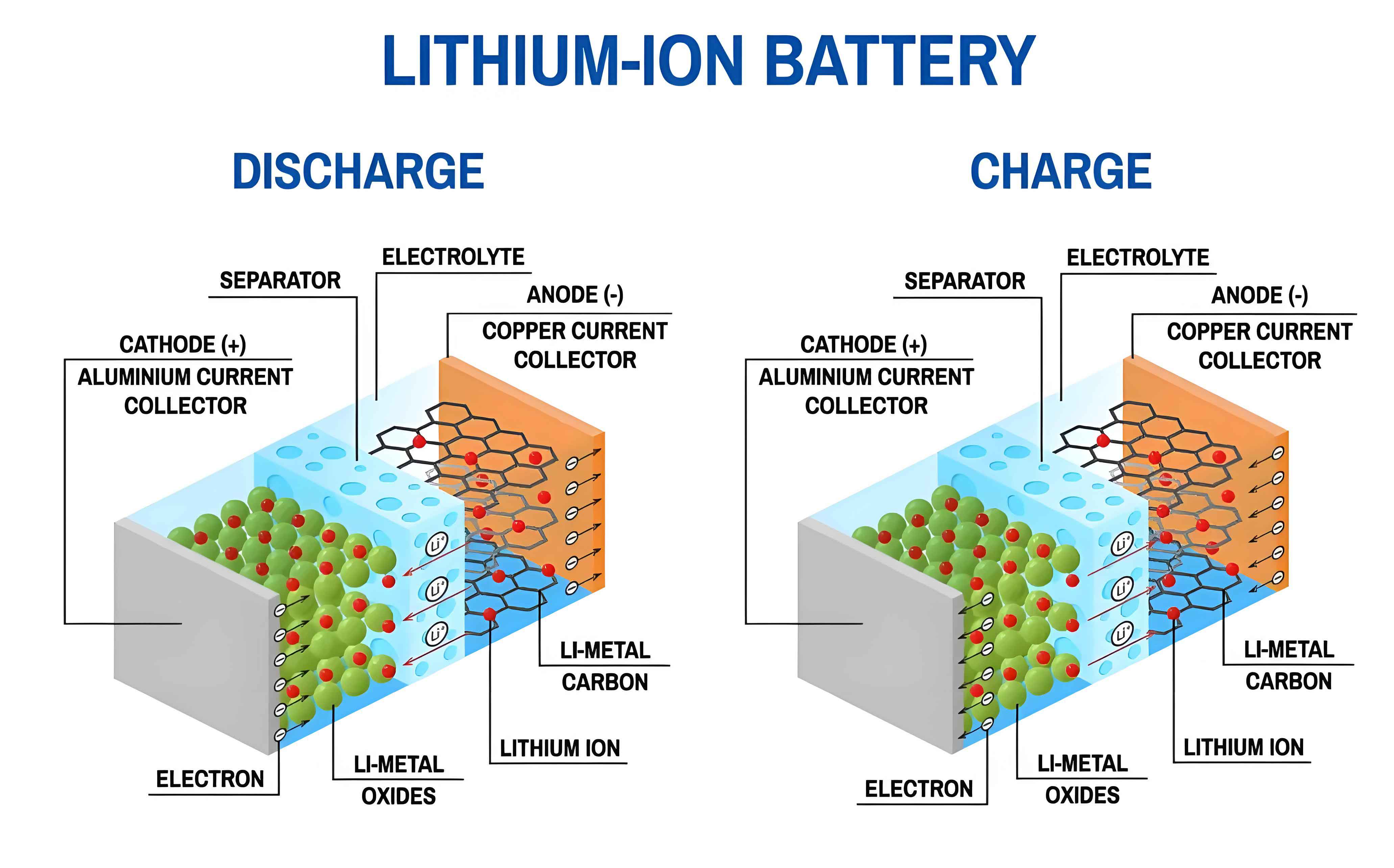
1. The “Leader-Follower” Estimation Framework for Lithium-Ion Battery Packs
Addressing the pack-level SOC estimation problem begins with a fundamental structural decision. The proposed framework designates one cell within the lithium-ion battery pack as the “leader” cell. The SOC of this cell is estimated using a high-fidelity, albeit more computationally intensive, algorithm. The remaining cells are classified as “follower” cells, whose SOC values are derived from the leader’s estimate via a lightweight correction mechanism. This approach circumvents the need to run complex algorithms for every single lithium-ion battery in the pack.
The SOC calculation for any individual cell within a managed pack must account for the currents flowing through both the main load and any active or passive balancing circuitry. The discrete-time SOC equation is formulated as:
$$
SOC_i(k) = SOC_i(0) + \frac{1}{C_i} \left[ \eta \int_{0}^{T_k} I_{pack}(t) \, dt + \int_{0}^{\tau_k^i} I_{bal}^i(t) \, dt \right]
$$
where \( SOC_i(k) \) is the SOC of the i-th lithium-ion battery at time index \( k \), \( SOC_i(0) \) is the initial SOC, \( C_i \) is the actual capacity, \( I_{pack} \) is the pack current (positive for discharge), \( I_{bal}^i \) is the balancing current for cell \( i \) (positive when the cell is being discharged by the balancer), \( T_k \) is the total duration of pack operation, and \( \tau_k^i \) is the cumulative duration during which the balancer was active for cell \( i \). The coulombic efficiency \( \eta \) is typically considered 1 for discharge and a constant near 1 for charge. The presence of the balancing current term is crucial for accurate SOC tracking in a real BMS environment.
2. High-Fidelity “Leader” Cell SOC Estimation: The BPNN-EKF-GD Algorithm
The accuracy of the entire pack’s SOC estimate hinges on the precise estimation of the leader cell’s SOC. We propose a hybrid algorithm (BPNN-EKF-GD) that leverages the strengths of neural networks for nonlinear mapping and Kalman filtering for optimal state observation.
2.1 Neural Network-Based Voltage Prediction
A Back Propagation Neural Network (BPNN) with multiple hidden layers is employed to predict the terminal voltage of the leader lithium-ion battery. The BPNN learns the complex, nonlinear relationship between operating conditions and cell voltage. The input vector at time \( k \) is designed to capture dynamic history and present state:
$$
\mathbf{Input}_k = [I_{k-H}, …, I_{k-1}, U_{k-H}, …, U_{k-1}, I_k, Is\_BAL_k, Temp_k, \widehat{SOC}_k]
$$
where \( H \) defines the historical window length, \( I \) and \( U \) are current and voltage, \( Is\_BAL_k \) is a binary indicator for balancing activity, \( Temp_k \) is temperature, and \( \widehat{SOC}_k \) is the prior SOC estimate. The network’s forward propagation through \( L \) hidden layers is given by:
$$
\begin{aligned}
\mathbf{OutP}^1_k &= f(\mathbf{W}^1 \cdot \mathbf{Input}_k – \mathbf{\beta}^1) \\
\mathbf{OutP}^l_k &= f(\mathbf{W}^l \cdot \mathbf{OutP}^{l-1}_k – \mathbf{\beta}^l), \quad \text{for } l = 2, …, L \\
\widehat{U}_k &= f(\mathbf{W}^{L+1} \cdot \mathbf{OutP}^L_k – \mathbf{\beta}^{L+1})
\end{aligned}
$$
Here, \( \mathbf{W}^l \) and \( \mathbf{\beta}^l \) are the weight matrices and bias vectors for layer \( l \), and \( f(\cdot) \) is the activation function (e.g., Sigmoid). The output \( \widehat{U}_k \) is the predicted terminal voltage.
2.2 Extended Kalman Filter for SOC Update
The difference between the measured voltage \( U_k \) and the BPNN-predicted voltage \( \widehat{U}_k \) is used to correct the prior SOC estimate via an EKF. The EKF treats the BPNN as a nonlinear measurement function \( h(\widehat{SOC}_k, \mathbf{Input}_k’) \), where \( \mathbf{Input}_k’ \) excludes \( \widehat{SOC}_k \). The standard EKF update steps are followed:
$$
\begin{aligned}
\text{Kalman Gain: } & \mathbf{L}_k = \mathbf{P}_k^- \mathbf{C}_k^T (\mathbf{C}_k \mathbf{P}_k^- \mathbf{C}_k^T + \mathbf{V}_k)^{-1} \\
\text{SOC Update: } & \widehat{SOC}_k^+ = \widehat{SOC}_k^- + \mathbf{L}_k (U_k – \widehat{U}_k) \\
\text{Covariance Update: } & \mathbf{P}_k^+ = (\mathbf{I} – \mathbf{L}_k \mathbf{C}_k) \mathbf{P}_k^-
\end{aligned}
$$
where \( \mathbf{C}_k = \frac{\partial \widehat{U}_k}{\partial \widehat{SOC}_k} \) is the linearized output matrix derived from the BPNN’s gradient, \( \mathbf{P}_k \) is the error covariance matrix, \( \mathbf{V}_k \) is the measurement noise covariance, and \( \mathbf{I} \) is the identity matrix. The superscripts \( – \) and \( + \) denote a priori and a posteriori estimates, respectively.
2.3 Gradient Descent for Online Network Refinement
To enhance adaptability and convergence speed, a Gradient Descent (GD) step is applied specifically to the weights connecting the last hidden layer to the output layer (\( \mathbf{W}^{L+1} \)). This online refinement helps the BPNN quickly adjust to the unique characteristics of the leader lithium-ion battery and changing conditions. The update rule is:
$$
\mathbf{W}^{L+1}_k = \mathbf{W}^{L+1}_{k-1} + \alpha \cdot \mathbf{L}_k \cdot (U_k – \widehat{U}_k)
$$
where \( \alpha \) is a tuning coefficient and \( \mathbf{L}_k \) is repurposed from the EKF as an adaptive learning rate. This synergistic use of the Kalman gain accelerates the minimization of the voltage prediction error.
3. Efficient “Follower” Cell SOC Estimation: RF-Based Correction Strategy
Estimating SOC for every follower lithium-ion battery using the full BPNN-EKF-GD algorithm would be redundant and computationally expensive. Instead, a correction strategy based on the voltage discrepancy between the follower and the leader cell is employed. The core assumption is that cells with very similar terminal voltages are at a very similar SOC when under the same load current. The strategy is defined as:
$$
SOC_{follower}(k) =
\begin{cases}
SOC_{leader}(k) + \Delta SOC_k & \text{if } |\Delta U_k| > \delta(SOC_{leader}(k)) \\
SOC_{leader}(k) & \text{otherwise}
\end{cases}
$$
where \( \Delta U_k = U_{follower}(k) – U_{leader}(k) \) and \( \delta(\cdot) \) is a SOC-dependent voltage difference threshold. The key component is the prediction of the SOC correction term \( \Delta SOC_k \).
3.1 Random Forest Model for SOC Correction
A Random Forest (RF) regressor is trained to predict \( \Delta SOC_k \) based on operational features. The RF model is chosen for its robustness, ability to handle nonlinearities, and relatively low computational cost during inference. The input features typically include:
- Historical and present pack current.
- Historical voltage differences \( \Delta U \).
- Temperature.
- Present SOC of the leader lithium-ion battery.
The RF model, comprising an ensemble of decision trees, is trained offline using data from diverse drive cycles and temperatures. During operation, it provides a rapid prediction for \( \Delta SOC_k \) only when the voltage threshold is crossed, ensuring computational efficiency.
4. Experimental Validation and Performance Analysis
The proposed BPNN-EKF-GD-RF framework was validated using a custom battery test bench. A module comprising six 18650 ternary lithium-ion battery cells in series, equipped with a passive balancing BMS, was subjected to various dynamic profiles at different temperatures.
4.1 Algorithm Performance Metrics
The estimation accuracy was evaluated using Root-Mean-Square Error (RMSE) and Maximum Absolute Error (MAE):
$$
RMSE = \sqrt{\frac{1}{N} \sum_{k=1}^{N} \left( SOC_k^{true} – \widehat{SOC}_k \right)^2 }
$$
$$
MAE = \max_{k} | SOC_k^{true} – \widehat{SOC}_k |
$$
4.2 Comparative Analysis of Estimation Schemes
Three schemes were compared to highlight the advantages of the proposed method:
- Plan 1 (Proposed): BPNN-EKF-GD for leader + RF correction for followers.
- Plan 2 (Baseline): All cells share the leader’s SOC (no correction).
- Plan 3 (High-Cost Benchmark): Full BPNN-EKF-GD algorithm run independently for every lithium-ion battery in the pack.
| Scheme | Target Cell | RMSE (%) | MAE (%) | Total Computation Time (s) |
|---|---|---|---|---|
| Plan 1 (Proposed) | Follower #1 | 1.22 | 2.91 | 285.1 |
| Follower #2 | 0.83 | 2.27 | ||
| Follower #3 | 0.80 | 2.20 | ||
| Follower #4 | 0.90 | 2.48 | ||
| Follower #5 | 1.05 | 2.70 | ||
| Plan 2 (Baseline) | Follower #1 | 2.35 | 4.64 | 189.3 |
| Follower #2 | 0.84 | 2.27 | ||
| Follower #3 | 0.81 | 2.20 | ||
| Follower #4 | 0.92 | 2.48 | ||
| Follower #5 | 1.13 | 2.74 | ||
| Plan 3 (Benchmark) | Follower #1 | 0.83 | 1.99 | 1077.6 |
| Follower #2 | 0.82 | 2.18 | ||
| Follower #3 | 0.91 | 2.41 | ||
| Follower #4 | 0.88 | 2.41 | ||
| Follower #5 | 0.83 | 2.03 |
The results clearly demonstrate the effectiveness of the proposed Plan 1. It significantly improves the estimation accuracy for inconsistent followers (e.g., Follower #1) compared to the naive sharing in Plan 2, while requiring only a fraction (~26%) of the computation time of the high-accuracy but costly Plan 3. This establishes an excellent trade-off between precision and computational load.
4.3 Performance Under Low-Temperature Stress
The framework was further tested under a Battery Simulation Driving Condition (BSDC) profile at 5°C to evaluate robustness in challenging environments. The leader lithium-ion battery SOC was estimated with an RMSE of 0.87% and MAE of 2.71%. The performance for follower cells is summarized below:
| Scheme | Target Cell | RMSE (%) | MAE (%) | Total Computation Time (s) |
|---|---|---|---|---|
| Plan 1 (Proposed) | Follower #1 | 1.56 | 3.87 | 80.7 |
| Follower #2 | 0.94 | 2.85 | ||
| Follower #3 | 0.97 | 3.02 | ||
| Follower #4 | 0.91 | 2.76 | ||
| Follower #5 | 0.95 | 3.00 | ||
| Note: Plan 2 & 3 results show a similar trend as Table 1, with Plan 1 offering the best balance. | ||||
Despite the increased model stress at low temperature, the proposed framework maintained all follower cell SOC estimates within 4% maximum absolute error, with RMSE generally below 1.6%. This confirms the algorithm’s strong generalization capability and suitability for real-world automotive environments where temperature varies widely.
5. Conclusion and Future Perspectives
This article has presented a novel, hybrid BPNN-EKF-GD-RF framework for accurate and computationally efficient State-of-Charge estimation in lithium-ion battery packs. The “leader-follower” architecture strategically allocates computational resources, applying a high-precision neural-network-enhanced filter to a single leader cell and a fast, data-driven corrector to the followers. Key achievements include:
- High Accuracy: The method maintains SOC estimation errors for all cells in a lithium-ion battery pack within 3.2% under temperature variations and within 2.5% at room temperature, effectively managing cell inconsistency.
- Computational Efficiency: By eliminating the need to run complex algorithms for every cell, the framework reduces the online computation time by approximately 65-75% compared to a full independent estimation scheme, making it highly suitable for embedded BMS implementation.
- Robustness: The integration of Gradient Descent for online BPNN refinement and the use of a Random Forest for context-aware correction provide strong adaptability to different cell characteristics and operating conditions.
The proposed solution effectively bridges the gap between estimation accuracy and practical computational constraints, offering a viable path forward for advanced BMS in electric vehicles and energy storage systems. Future work will focus on the real-vehicle validation of this algorithm, its extension over the full lifecycle of the lithium-ion battery pack to account for aging, and its integration into a co-estimation scheme for joint SOC and SOH determination.