
The global transition towards sustainable energy systems is fundamentally dependent on reliable energy storage solutions. Among these, li ion battery technology stands out due to its high energy density and proven application history, playing a pivotal role in integrating intermittent renewable sources like solar and wind into the power grid. The performance and longevity of these li ion battery units directly impact the economic and operational stability of clean energy infrastructure. Consequently, accurately forecasting the Remaining Useful Life (RUL) of a li ion battery is not merely a technical exercise but a critical requirement for predictive maintenance, system safety, and optimal asset management. Traditional RUL prediction methods often face challenges in handling the non-linear capacity fade and the phenomenon of capacity recovery (“regeneration”) observed in li ion battery aging data. This paper presents a novel data-driven fusion approach that combines insightful feature engineering from electrochemical signals with a dynamically enhanced neural network to address these challenges effectively.
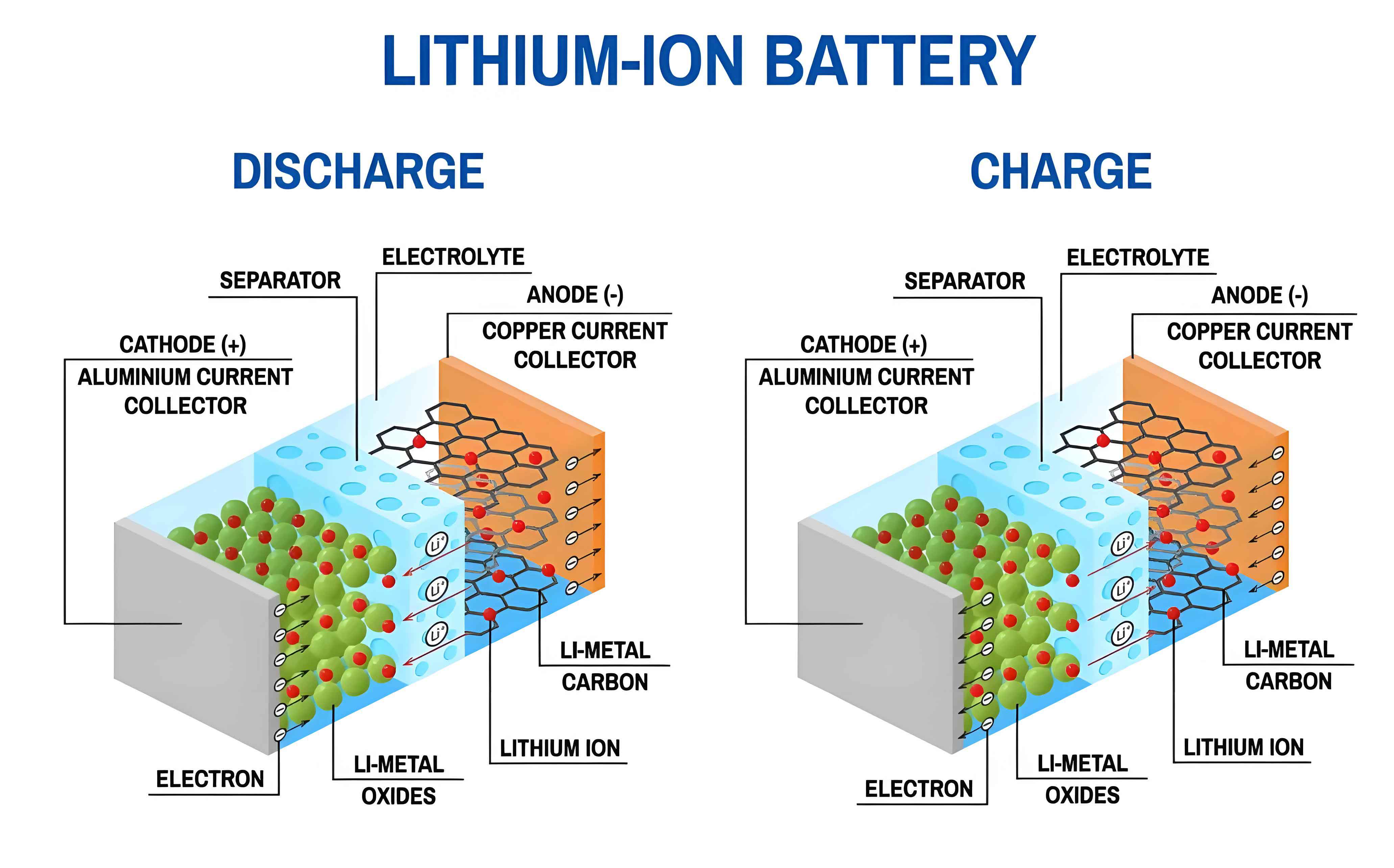
The aging process of a li ion battery is a complex interplay of internal electrochemical degradation and external operational stressors. My approach begins with a thorough analysis of the battery’s operational data to extract health indicators that reflect this internal state. Instead of relying solely on capacity measurements, I employ Differential Voltage (DV) analysis. The DV curve, derived from operational voltage data during charge and discharge, is a powerful tool that succinctly represents phase transitions within the electrode materials. The fundamental calculation for the differential voltage with respect to capacity is given by:
$$ \frac{dV}{dQ} = \frac{dV}{I \cdot dT} = \frac{1}{I} \cdot \frac{dV}{dT} $$
where \( V \) is the terminal voltage, \( Q \) is the capacity, \( I \) is the constant current, and \( T \) is time. From a physics-based perspective, this measured \( dV/dQ \) relates to the intrinsic thermodynamic properties of the electrodes:
$$ \frac{dV_{cell}(Q)}{dQ} = \frac{dV_{p}(Q)}{dQ} – \frac{dV_{n}(Q)}{dQ} = \frac{1}{m_{p}} \cdot \frac{dV_{p}(q_{p})}{dq_{p}} – \frac{1}{m_{n}} \cdot \frac{dV_{n}(q_{n})}{dq_{n}} $$
Here, \( V_{cell} \) is the cell voltage, while \( V_{p} \) and \( V_{n} \) represent the potentials of the positive and negative electrodes, respectively. The parameters \( m \) and \( q \) denote the active mass and specific capacity of each electrode. This equation shows how shifts in the DV curve directly correlate with loss of active material or changes in electrode stoichiometry—key markers of li ion battery health degradation. I systematically extract four distinct features from the DV curves to serve as Health Indicators (HIs) for RUL modeling: the inflection point value from the charging DV curve, its corresponding time index, the peak value from the discharging DV curve, and its corresponding voltage. The strong correlation between these features and the actual capacity fade of a li ion battery is quantified using Pearson correlation analysis, as summarized below:
| Health Indicator (Feature) | Pearson Correlation Coefficient with Capacity |
|---|---|
| Charging DV Inflection Point Value | 0.908 |
| Charging DV Inflection Time Index | 0.746 |
| Discharging DV Peak Value | 0.938 |
| Discharging DV Peak Voltage | 0.885 |
To model the temporal evolution of these features and predict future capacity, I require a network capable of capturing time-series dependencies and non-linear dynamics. The Elman Recurrent Neural Network (RNN) is an ideal candidate for this li ion battery RUL prediction task. Its unique architecture includes a context layer that receives feedback from the hidden layer, granting it inherent memory of previous states. This makes it exceptionally suited to model the sequential degradation of a li ion battery, including temporary capacity regeneration phenomena. The mathematical formulation of the Elman network is as follows:
The output of the hidden layer at cycle \( k \) is:
$$ x_k = f(w^1 x_{c(k-1)} + w^2 u_k + b_1) $$
The network’s final output (predicted capacity) is:
$$ y_k = g(w^3 x_k + b_2) $$
The context layer’s state is updated as:
$$ x_{c k} = x_{k-1} $$
In these equations, \( u_k \) is the input vector (our four HIs), \( w^1, w^2, w^3 \) are weight matrices, \( b_1, b_2 \) are bias vectors, and \( f(\cdot) \) and \( g(\cdot) \) are activation functions, for which I use the sigmoid function: \( \sigma(x) = \frac{1}{1 + e^{-x}} \).
However, the performance of a standard Elman network is highly sensitive to the initial randomization of its weights and biases. To overcome this limitation and significantly enhance prediction accuracy and robustness for li ion battery RUL, I integrate a metaheuristic optimization algorithm. I select the Cuckoo Search (CS) algorithm, inspired by the brood parasitism of some cuckoo species, due to its efficient balance between global exploration and local exploitation via Lévy flights. The basic position update in CS is governed by:
$$ x_i^{t+1} = x_i^t + \alpha \otimes L\acute{e}vy(\beta) $$
where \( \alpha \) controls the step size and \( L\acute{e}vy(\beta) \) represents a random walk drawn from a Lévy distribution.
I propose three strategic improvements to the vanilla CS algorithm, creating an Improved Cuckoo Search (ICS) optimizer specifically tailored for this li ion battery prediction model:
- Chaotic Initialization: I replace random population initialization with a chaotic sequence generated by \( x_i = 4x_{i-1}^3 – 3x_{i-1} \) to ensure a more uniform and diverse spread of initial solutions across the search space.
- Enhanced Local Search with Diffusion: After a new solution \( x_i^0 \) is generated via Lévy flight, I create two neighboring solutions \( x_i^1 \) and \( x_i^2 \) around it using diffusion operators: \( x_i^1 = (1-v)x_i^0 + r v x_i^0 \) and \( x_i^2 = (1+v)x_i^0 – r v x_i^0 \), where \( v \) and \( r \) are random numbers. The best among these three is selected, refining local search capability.
- Adaptive Discovery Probability: I replace the fixed probability \( P_a \) of abandoning poor nests with a dynamically decreasing function: \( P_a = P_{a_{min}} + (P_{a_{max}} – P_{a_{min}}) \times \left( \frac{12N^2}{n_{iter}^2 + 3N^2} – 3 \right) \). This allows for more exploration in early iterations and greater exploitation later, improving convergence.
The superiority of the ICS algorithm over standard CS is validated using benchmark optimization functions, as shown in the comparison of final best values:
| Test Function | CS Algorithm Best Value | ICS Algorithm Best Value |
|---|---|---|
| Sphere (f1) | 14.35 | 1.9 × 10⁻¹¹ |
| Schwefel (f2) | 2.03 × 10⁵ | 2.07 × 10⁻¹⁷ |
| Griewank (f3) | 323.03 | 8.11 × 10⁻¹³ |
| Quartic (f4) | 5.05 × 10⁴ | 5.32 × 10⁻⁵ |
The complete framework, which I term the ICS-Elman model, is thus established. The ICS algorithm optimizes the initial weights and thresholds of the Elman network by minimizing the prediction error on the training data. This hybrid model is specifically designed to learn the complex mapping from the differential voltage-based health indicators to the capacity trajectory of a li ion battery. The performance of the final RUL prediction is evaluated using three standard metrics:
Root Mean Square Error (RMSE): $$ E_{RMSE} = \sqrt{ \frac{1}{K} \sum_{k=1}^{K} (Y_k – \hat{Y}_k)^2 } $$
Mean Absolute Error (MAE): $$ E_{MAE} = \frac{1}{K} \sum_{k=1}^{K} |Y_k – \hat{Y}_k| $$
Absolute Error for RUL (AE): $$ E_{AE} = |RUL_{true} – RUL_{predicted}| $$
I validate the proposed ICS-Elman method using two distinct datasets. The first is the publicly available NASA li ion battery dataset, comprising cells cycled under controlled conditions. The second is a proprietary dataset collected from our own test platform, featuring different cell models and cycling regimes to demonstrate generalizability. In the first set of experiments, I perform “short-term” RUL prediction, where the model is trained on data from the early life of a cell and tasked with predicting its entire remaining cycle life until a failure threshold (typically 80% of initial capacity). The results for four NASA cells demonstrate the clear advantage of our method:
| Cell ID | Prediction Model | RMSE (%) | MAE (%) | RUL AE (Cycles) |
|---|---|---|---|---|
| B5 | Elman | 3.131 | 2.477 | 2 |
| CS-Elman | 1.423 | 1.271 | 2 | |
| ICS-Elman | 0.514 | 0.431 | 1 | |
| B7 | Elman | 4.243 | 4.474 | 12 |
| CS-Elman | 3.375 | 2.648 | 0 | |
| ICS-Elman | 0.760 | 0.617 | 2 |
A more challenging and practical scenario is “full-life cycle” prediction, where a model trained on the complete aging data of one li ion battery is used to predict the RUL of a different, unseen cell. This tests the model’s ability to generalize underlying degradation patterns. The ICS-Elman model maintains strong performance in this cross-cell prediction task, significantly outperforming the baseline models as shown in the following summary for one pairing:
| Training Cell | Test Cell | Prediction Model | RMSE (%) | MAE (%) |
|---|---|---|---|---|
| B5 | B7 | Elman | 7.889 | 7.402 |
| CS-Elman | 5.598 | 5.027 | ||
| ICS-Elman | 2.549 | 1.739 |
Finally, the robustness and applicability of the method are confirmed using our in-house li ion battery dataset (cells labeled Z1-Z4). The results consistently show that the ICS-Elman model achieves the lowest prediction error across all cells, with RMSE values reduced by up to 71.95% compared to the CS-Elman model. This proves the effectiveness of the proposed enhancements not just on standard benchmarks, but on real-world li ion battery aging data with varied operational profiles.
In conclusion, this work successfully develops and validates a novel fusion methodology for predicting the Remaining Useful Life of li ion battery systems. The core contributions are threefold. First, it leverages differential voltage analysis to extract physically meaningful health indicators that bridge external measurements with internal electrochemical states of the li ion battery. Second, it employs an Elman recurrent neural network to effectively capture the temporal dynamics and non-linear capacity fade characteristics, including regeneration effects. Third, and most crucially, it introduces an Improved Cuckoo Search algorithm that optimizes the network parameters, significantly boosting prediction accuracy and robustness. Extensive experimental results on both public and proprietary datasets demonstrate that this ICS-Elman model provides superior RUL forecasts compared to standard neural network and optimized baseline approaches, offering a reliable tool for the health management of li ion battery energy storage systems critical to our sustainable energy future.