
Wind power generation is characterized by inherent intermittency, randomness, and volatility, posing significant challenges to grid stability. To facilitate the secure grid integration of such renewable energy, energy storage systems (ESS) are commonly employed to improve power quality and system robustness. Given the substantial volume of curtailed wind energy and its seasonal variations, there is an urgent need to develop large-capacity, long-duration energy storage solutions to absorb surplus renewable generation on a massive scale.
In recent years, the installed capacity of lithium-ion battery energy storage systems has seen consistent growth, distinguished by their advantages in response speed, energy density, and charge-discharge efficiency. Concurrently, hydrogen energy storage has emerged as a promising technology, offering significant benefits in energy density, long-term storage capability, and environmental cleanliness. Among electrolysis technologies for hydrogen production, the Solid Oxide Electrolysis Cell (SOEC) stands out for its high efficiency and substantial hydrogen yield, making it suitable for coupling with renewable energy sources. However, existing research has not thoroughly explored capacity optimization methods for hybrid systems combining SOEC and lithium-ion battery storage to simultaneously achieve grid compliance for wind farm output and minimize the initial investment cost of the hybrid energy storage system (HESS).
To address the challenge of mitigating wind power fluctuations while achieving the dual objective of grid code compliance and minimized HESS capital cost, this work proposes a novel hybrid energy storage system comprising SOEC and lithium-ion battery technologies. We begin by establishing dynamic models for both the SOEC stack and the lithium-ion battery energy storage unit, analyzing their respective transient response characteristics. A Feedforward Model Predictive Control (FMPC) strategy is proposed for the SOEC system to enhance its resilience against power disturbances. Subsequently, leveraging decomposition techniques including Successive Variational Mode Decomposition (SVMD) and Variational Mode Decomposition (VMD), and integrated with the Whale Optimization Algorithm (WOA), a comprehensive capacity optimization and allocation methodology for the SOEC-lithium-ion battery HESS is developed. Finally, the effectiveness of the proposed methodology is validated through simulation experiments based on actual output power data from a 30 MW rated capacity wind farm.
Modeling, Transient Characteristics, and Control of Storage Components
1.1 SOEC Stack and Lithium-Ion Battery Storage Unit Modeling
The SOEC typically operates within a temperature range of 600–1000 °C. The electrochemical reactions during the electrolysis process occur at the hydrogen and oxygen electrodes, represented by the following equations:
Hydrogen electrode: $$ \text{H}_2\text{O} + 2\text{e}^- \rightarrow \text{H}_2 + \text{O}^{2-} $$
Oxygen electrode: $$ \text{O}^{2-} \rightarrow \frac{1}{2}\text{O}_2 + 2\text{e}^- $$
Overall reaction: $$ \text{H}_2\text{O} \rightarrow \text{H}_2 + \frac{1}{2}\text{O}_2 $$
Based on these principles, a single-cell SOEC model is developed, which is then scaled through series and parallel connections to form a 20 kW SOEC stack module.
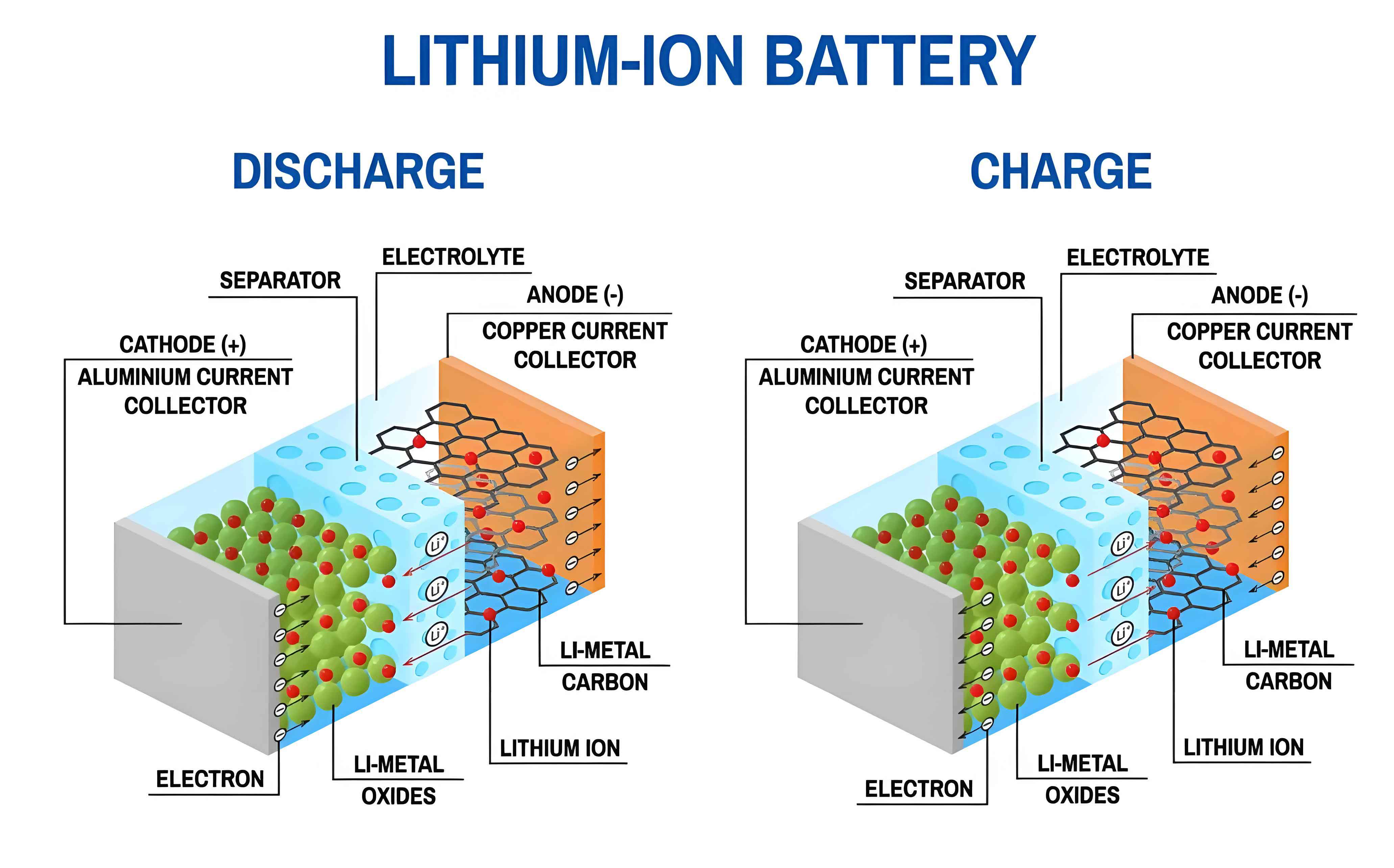
For the lithium-ion battery, a generic equivalent circuit model is employed, consisting of a controlled voltage source in series with a constant internal resistance. The battery voltage during discharge (\(V_d\)) and charge (\(V_c\)) cycles is calculated using the following improved mathematical model:
$$ V_d = E_0 – R i – K \frac{Q}{Q – i t} i^* – K \frac{Q}{Q – i t} i t + A \exp(-B \cdot i t) $$
$$ V_c = E_0 – R i – K \frac{Q}{0.1Q + i t} i^* – K \frac{Q}{Q – i t} i t + A \exp(-B \cdot i t) $$
where \(E_0\) is the battery constant voltage, \(R\) is the internal resistance, \(i\) is the battery current, \(i^*\) is the filtered current, \(K\) is the polarization constant, \(Q\) is the battery capacity, \(i t\) is the extracted capacity, and \(A\) and \(B\) are exponential zone coefficients. A single lithium-ion battery cell with a nominal voltage of 3.70 V and capacity of 2.50 Ah is configured into arrays to form a 250 kW / 500 kWh lithium-ion battery energy storage unit (ESU). The charge and discharge efficiencies for the lithium-ion battery unit are both set at 97.5%. Multiple such ESUs can be paralleled to form a storage array meeting the system’s capacity requirements.
1.2 Analysis of Transient Response Characteristics
The transient response of the 20 kW SOEC module is analyzed. To ensure safe and stable operation, the power command ramp rate is limited to no more than 15% of the rated power per minute, i.e., ≤ 3 kW/min, corresponding to a reference signal frequency \(f_e\) lower than 1/120 Hz. The lithium-ion battery ESU demonstrates a rapid response; when subjected to a step power command at rated power, its response time is less than 2 seconds, as shown in its charge-discharge transient profile.
1.3 Control Strategies for Individual Storage Systems
Addressing the nonlinearity and time-delay characteristics of the SOEC system, a Feedforward Model Predictive Control (FMPC) strategy is proposed. This method combines a feedforward regulator with a model predictive controller based on a Smith predictor structure. The feedforward action utilizes input or disturbance signals to act directly on the control input, granting the system superior response speed and accuracy compared to standard MPC.
For the lithium-ion battery storage array, a State-of-Charge (SOC) coordination controller is implemented to prevent over-charging and over-discharging, ensuring operation within a healthy SOC range, typically defined as [0.2, 0.8]. The reference power command for the lithium-ion battery array (\(P^*_{bat,ref}\)) is modified based on its instantaneous SOC (\(L_{SOC}\)) as follows:
For \(P_{bat,ref} \geq 0\) (Discharge Command):
$$ P^*_{bat,ref} = \begin{cases}
0, & L_{SOC} \geq 0.8 \\
P_{bat,ref}, & L_{SOC} < 0.8
\end{cases} $$
For \(P_{bat,ref} < 0\) (Charge Command):
$$ P^*_{bat,ref} = \begin{cases}
0, & L_{SOC} \leq 0.2 \\
P_{bat,ref}, & L_{SOC} > 0.2
\end{cases} $$
Wind Power Output Decomposition Methodology
2.1 Variational Mode Decomposition (VMD)
VMD is an adaptive, non-recursive signal processing method for time-frequency analysis. It aims to decompose a real-valued input signal \(f(t)\) into a discrete number of band-limited Intrinsic Mode Functions (IMFs) \(u_m(t)\), each compacted around a center pulsation \(\omega_m\). The variational problem is formulated as:
$$ \min_{\{u_m\},\{\omega_m\}} \left\{ \sum_{m=1}^M \left\| \partial_t \left[ \left( \delta(t) + \frac{j}{\pi t} \right) * u_m(t) \right] e^{-j\omega_m t} \right\|_2^2 \right\} $$
$$ \text{s.t.} \sum_{m=1}^M u_m(t) = f(t) $$
where \(M\) is the number of IMFs. The problem is solved by introducing a quadratic penalty term \(\alpha\) and Lagrangian multipliers \(\lambda\), constructing the augmented Lagrangian \(L\), and employing the Alternating Direction Method of Multipliers (ADMM).
2.2 Successive Variational Mode Decomposition (SVMD)
SVMD is a related decomposition method that extracts modes successively from the signal, unlike standard VMD which requires pre-defining the number of modes \(K\). This successive approach can improve convergence rates and computational efficiency. In SVMD, the input signal \(f(t)\) is decomposed into the \(L\)-th mode \(u_L(t)\) and a residual \(f_r(t)\), with minimization criteria ensuring the new mode is distinct from previously extracted ones.
Capacity Optimization and Allocation Method for Hybrid Energy Storage System
3.1 Whale Optimization Algorithm (WOA)
The WOA is a meta-heuristic optimization algorithm inspired by the bubble-net hunting behavior of humpback whales. It is known for its simple structure, few parameters, and strong search capability. The algorithm simulates hunting behavior through three phases: encircling prey, bubble-net attacking (exploitation), and searching for prey (exploration).
Encircling Prey: Whales update their position towards the best current solution (\(X_{best}\)).
$$ X_f(t_a+1) = X_{best}(t_a) – A_w \cdot D_1 $$
$$ D_1 = | C_w \cdot X_{best}(t_a) – X_f(t_a) | $$
$$ A_w = 2a \cdot r – a, \quad C_w = 2 \cdot r, \quad a = 2 – \frac{2t_a}{T} $$
where \(t_a\) is current iteration, \(T\) is max iterations, \(r\) is a random vector in [0,1].
Bubble-net Attacking: This employs either a shrinking encircling mechanism (when \(|A_w| < 1\)) or a spiral updating position, chosen with 50% probability.
$$ X_f(t_a+1) = D_2 \cdot e^{bl} \cdot \cos(2\pi l) + X_{best}(t_a) $$
$$ D_2 = | X_{best}(t_a) – X_f(t_a) | $$
where \(b\) is a constant, \(l\) is a random number in [-1,1].
Search for Prey: When \(|A_w| > 1\), whales explore by updating position relative to a randomly chosen whale (\(X_{rand}\)).
$$ X_f(t_a+1) = X_{rand}(t_a) – A_w \cdot D_3 $$
$$ D_3 = | C \cdot X_{rand}(t_a) – X_f(t_a) | $$
3.2 Proposed HESS Capacity Configuration Methodology
Grid codes, such as GB/T 19963-2021, specify limits for wind farm power fluctuations. For a 30 MW wind farm, the maximum permissible power change is 3 MW in 1 minute and 10 MW in 10 minutes under normal operation. The grid-connected power (\(P_{grid}\)) is the sum of the original wind power (\(P_w\)), the lithium-ion battery array power (\(P_{bat}\)), and the SOEC system power (\(P_{soec}\)): \(P_{grid} = P_w + P_{bat} + P_{soec}\). The primary goal is to ensure \(P_{grid}\) complies with these fluctuation limits.
The proposed capacity configuration flowchart outlines the method. To effectively smooth wind power while optimizing system size, the initial power command for the SOEC system is set as a fraction of the wind power: \(P^*_{soec} = P_w \times k\), where \(k\) is the SOEC consumption ratio coefficient. The remaining wind power after SOEC allocation is \(P^*_w = P_w – P_{soec,ref}\), where \(P_{soec,ref}\) is the feasible SOEC power command after SVMD processing to respect its ramp rate constraints.
The signal \(P^*_w\) is then decomposed using VMD into \(n\) IMFs. By evaluating the cumulative sum of IMFs from low to high frequency, the point \(j\) is determined where the reconstructed low-frequency component meets the grid fluctuation standard. The high-frequency components (from IMF(j+1) to IMF(n)) are assigned as the reference power command for the lithium-ion battery array: \(P_{bat,ref} = \sum_{i=j+1}^{n} IMF_2(i)\). Consequently, the final grid power becomes: \(P_{grid} = P_w – P_{soec,ref} – P_{bat,ref}\).
The rated power for each storage component is determined as the ceiling of the maximum absolute value of its reference power signal. For the lithium-ion battery array, the required energy capacity \(E_{rated,f}\) is calculated based on the cumulative energy requirement \(E_f[n]\) from the power profile, considering charge/discharge efficiencies (\(\eta_c, \eta_d\)) and the healthy SOC operating window:
$$ E_f[n] = \sum_{n=1}^{N} \frac{P_{x_ref}[n] \cdot \Delta t}{\eta_d} \quad \text{(for } P_{x_ref}[n] \geq 0 \text{)} $$
$$ E_f[n] = \sum_{n=1}^{N} P_{x_ref}[n] \cdot \eta_c \cdot \Delta t \quad \text{(for } P_{x_ref}[n] < 0 \text{)} $$
$$ E_{rated,f} = \max \left( \frac{\max\{E_f[n]\}}{L_{SOC,max} – L_{SOC,ref}}, \frac{-\min\{E_f[n]\}}{L_{SOC,ref} – L_{SOC,min}} \right) $$
The key parameters \(k\) (SOEC ratio) and \(j\) (VMD decomposition cut-off index) significantly impact both grid compliance and the final HESS capacity/cost. Therefore, the Whale Optimization Algorithm (WOA) is employed to optimize this parameter pair. The objective is to minimize the total initial investment cost of the HESS while strictly satisfying the grid fluctuation constraints. The final capacities are then rounded to integer multiples of the base 20 kW SOEC module and the 250 kW / 500 kWh lithium-ion battery ESU.
Simulation Case Study and Validation
A case study is conducted using 24-hour actual output power data from a 30 MW wind farm, selecting a day with high variability. The initial HESS configuration, before optimization, is determined with parameters \(k=3.5\) and \(j=4\), resulting in a system comprising 37 SOEC modules (0.74 MW) and 17 lithium-ion battery ESUs (4.25 MW / 8.5 MWh), with an estimated initial investment cost.
Applying the WOA to optimize parameters \(k\) and \(j\), the algorithm converges to an optimal set: \(k=2.5\) and \(j=3\). This optimized configuration requires 26 SOEC modules (0.52 MW) and 13 lithium-ion battery ESUs (3.25 MW / 6.5 MWh).
| Configuration Parameter | Initial (k=3.5, j=4) | Optimized by WOA (k=2.5, j=3) | Change |
|---|---|---|---|
| SOEC Capacity | 0.74 MW (37 modules) | 0.52 MW (26 modules) | ↓ 29.7% |
| Lithium-Ion Battery Power Capacity | 4.25 MW | 3.25 MW | ↓ 23.5% |
| Lithium-Ion Battery Energy Capacity | 8.5 MWh | 6.5 MWh | ↓ 23.5% |
| Total HESS Initial Investment Cost | Base Cost (1631 units) | 1183 units | ↓ 27.5% |
For the optimized case, the SOEC reference signal \(P^*_{soec}\) is processed via SVMD. The first IMF component, with frequency content below 1/120 Hz, is selected as the feasible command \(P_{soec,ref}\). The remaining wind power \(P^*_w\) is decomposed via VMD into 8 IMFs. The cumulative sum of IMFs 1 and 2 is found to satisfy the 3 MW/min grid fluctuation limit. Therefore, the sum of IMFs 3 to 8 is assigned as the power command for the lithium-ion battery storage array.
The simulation results demonstrate that the combined output power of the wind farm and the optimized HESS successfully complies with the grid code fluctuation limits. The SOEC system operates within its safe ramp rate constraints, achieving electrolysis efficiency consistently above the 0.8 threshold and a specific energy consumption below 3.8 kWh per normalized unit of hydrogen throughout the operational period. The lithium-ion battery storage array’s SOC is effectively managed by the coordination controller, varying within the healthy range of [0.2697, 0.6421], thus preventing harmful over-charge or over-discharge cycles and promoting long-term lithium-ion battery health.
Conclusion
This paper presents a comprehensive methodology for the optimal capacity configuration of a hybrid energy storage system integrating Solid Oxide Electrolysis Cell (SOEC) and lithium-ion battery technologies for wind power fluctuation mitigation. Key contributions include: 1) The development of dynamic models for a 20 kW SOEC module and a 250 kW/500 kWh lithium-ion battery energy storage unit, with an analysis of their transient response characteristics and the proposal of a Feedforward Model Predictive Control (FMPC) strategy for the SOEC to improve disturbance rejection. 2) A novel capacity optimization framework that leverages SVMD and VMD for power allocation and employs the Whale Optimization Algorithm (WOA) to co-optimize key parameters, simultaneously achieving grid code compliance and minimizing the total initial investment cost of the HESS. 3) Validation through a detailed simulation case study using real wind farm data, which confirmed the method’s effectiveness. The optimized HESS configuration reduced the SOEC capacity requirement by 29.7% and the total system cost by 27.5% compared to an initial non-optimal design, while ensuring the SOEC operated at high efficiency and the lithium-ion battery array remained within a healthy state of charge. This work provides a viable and economically advantageous solution for leveraging hydrogen and lithium-ion battery storage in tandem to facilitate the high-penetration integration of volatile renewable energy sources like wind power.