
The integration of renewable energy sources, such as photovoltaic and wind power, into the electrical grid is increasingly reliant on the performance of grid connected inverters. The quality of power injected into the grid is directly influenced by the inverter’s design, with the output filter playing a pivotal role. Traditional filter topologies present inherent trade-offs between performance and complexity. This article presents a detailed, first-person perspective on the analysis, design, and validation of an advanced hybrid damping control strategy for an inverter employing an LCL-LC filter, addressing its unique stability challenges.
Conventional grid connected inverters typically employ L-type or LCL-type output filters. While simple, the L-filter offers inadequate attenuation of switching-frequency harmonics. The LCL filter provides superior high-frequency attenuation but introduces a pronounced resonant peak that can destabilize the system. An evolution, the LLCL filter, incorporates a series inductor-capacitor branch tuned to the switching frequency, creating a notch filter characteristic. However, its high-frequency roll-off rate is less steep than that of an LCL filter. The LCL-LC filter topology emerges as a superior alternative, combining the strong high-frequency attenuation of the LCL structure with a parallel LC branch tuned to the switching frequency. This configuration effectively shunts switching-frequency harmonics while maintaining excellent attenuation at higher frequencies. The defining characteristic and primary challenge of the LCL-LC filter is the presence of two resonant peaks in its frequency response, which necessitates a robust damping strategy to ensure stable operation of the grid connected inverter.
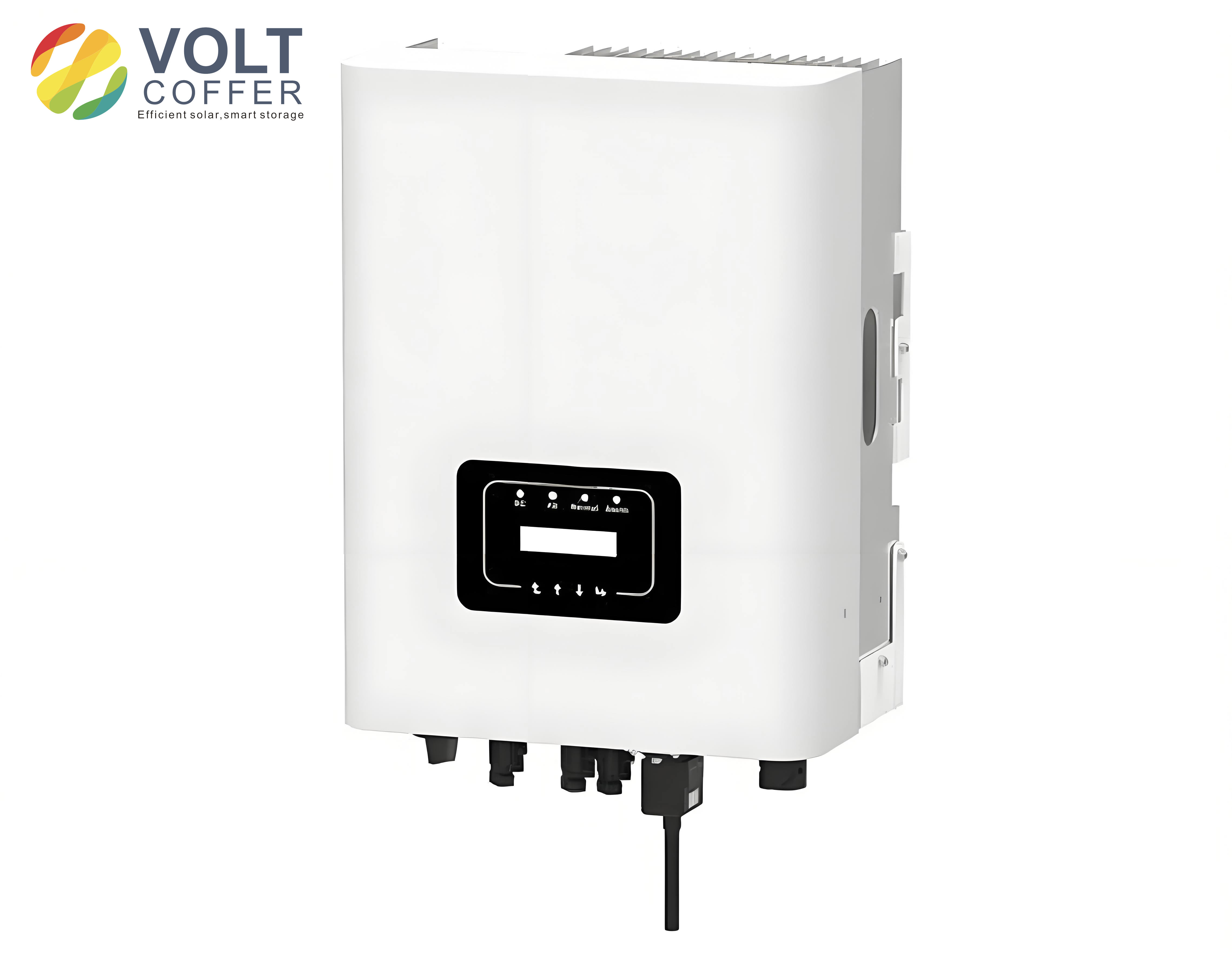
Damping methods for such filters generally fall into two categories: passive and active. Passive damping involves inserting physical resistors into the filter circuit. This method is simple, delay-free, and effective at suppressing resonance but incurs continuous power loss, reduces system efficiency, and can excessively dampen the fundamental component if poorly designed. Active damping techniques modify the control algorithm to virtually emulate a damping resistor, eliminating steady-state losses. However, they are susceptible to computational and PWM delays, which can limit their effectiveness, particularly for higher-frequency resonances. In the context of the LCL-LC grid connected inverter, relying solely on active damping often proves insufficient to adequately suppress the second resonant peak. Therefore, a synergistic approach is warranted.
The core contribution discussed here is a Hybrid Damping Strategy that intelligently combines active and passive damping. The strategy is designed to suppress both resonant peaks effectively: active damping is tailored to control the lower-frequency resonance, while a minimally sized passive damper is introduced specifically to mitigate the higher-frequency resonance. Furthermore, to counteract the phase lag introduced by digital control delays inherent in the active damping loop, an advanced phase-lead compensator is incorporated. The current control is accomplished using a Quasi-Proportional-Resonant (QPR) controller, whose parameters are systematically designed based on steady-state error, phase margin, and gain margin requirements. The entire system’s stability is rigorously verified using the Routh-Hurwitz criterion, providing clear constraints for the damping parameters.
Mathematical Modeling and Comparative Analysis of Filter Topologies
The single-phase equivalent circuit of an LCL-LC grid connected inverter forms the basis for analysis. The filter comprises an inverter-side inductor \(L_1\), a grid-side inductor \(L_2\), a main filter capacitor \(C_d\), and a parallel branch with a series inductor \(L_f\) and capacitor \(C_f\) tuned near the switching frequency. The transfer function from the inverter bridge voltage \(U_{inv}(s)\) to the grid current \(I_g(s)\) is derived as follows, where \(R_d\) represents a potential passive damping resistor in series with \(C_f\):
$$
G_{plant}(s) = \frac{I_g(s)}{U_{inv}(s)} = \frac{R_d C_f L_f s^3 + L_f C_f s^2 + R_d C_f s + 1}{A s^5 + B s^4 + C s^3 + D s^2 + E s}
$$
where the coefficients are:
$$A = L_1 L_2 L_f C_d C_f$$
$$B = R_d C_d C_f (L_1 L_2 + L_1 L_f + L_2 L_f)$$
$$C = (L_1+L_2)L_f C_f + (C_d+C_f)L_1 L_2$$
$$D = R_d C_d (L_1+L_2) + R_d C_f L_2$$
$$E = L_1 + L_2$$
The performance of LCL, LLCL, and LCL-LC filters can be compared through their frequency response and harmonic attenuation capability. The following table summarizes a set of typical parameters used for such a comparison, with a switching frequency \(f_{sw}\) of 12.5 kHz.
| Parameter | LCL Filter | LLCL Filter | LCL-LC Filter |
|---|---|---|---|
| \(L_1\) (mH) | 0.15 | 0.15 | 0.15 |
| \(L_2\) (mH) | 0.08 | 0.08 | 0.08 |
| \(C_d\) (μF) | 30 | 30 | 20 |
| \(L_f\) (μH) | – | 3.5 | 11.5 |
| \(C_f\) (μF) | – | 10 | 2 |
Simulating these topologies reveals the distinct advantage of the LCL-LC filter. The parallel \(L_f C_f\) branch creates a low-impedance path at the switching frequency, dramatically reducing the corresponding harmonic content in the grid current. Furthermore, its asymptotic high-frequency attenuation remains -60 dB/decade, similar to the LCL filter and superior to the LLCL filter. This is quantified in the harmonic analysis below:
| Harmonic Component | LCL Filter | LLCL Filter | LCL-LC Filter |
|---|---|---|---|
| Switching Frequency Harmonic | 0.31% | 0.29% | 0.004% |
| 2× Switching Frequency Harmonic | 0.24% | 0.28% | 0.19% |
| Total Harmonic Distortion (THD) | 1.83% | 1.57% | 1.39% |
Design of the Hybrid Damping Strategy with Phase-Lead Compensation
The proposed control architecture for the LCL-LC grid connected inverter integrates several key elements. The core is the QPR current controller \(G_c(s)\), which tracks the fundamental grid current reference with zero steady-state error. Its transfer function is:
$$
G_c(s) = K_p + \frac{2K_i \omega_c s}{s^2 + 2\omega_c s + \omega_0^2}
$$
where \(K_p\) is the proportional gain, \(K_i\) is the resonant gain, \(\omega_0\) is the fundamental angular frequency, and \(\omega_c\) is the cutoff angular frequency defining the bandwidth of the resonant integrator.
The active damping is implemented by feeding back the capacitor current \(I_c(s)\) through a virtual resistor \(R_v\). However, the digital control loop introduces a total delay of approximately 1.5 sampling periods, modeled as \(G_d(s) = e^{-1.5T_s s}\). This delay can severely compromise the phase response of the active damping loop, potentially leading to instability. To compensate for this, a phase-lead compensator \(G_{lead}(s)\) is cascaded with the feedback path. A first-order lead compensator has the form:
$$
G_{lead}(s) = A \frac{1+\tau s}{1+\alpha \tau s}, \quad (\alpha < 1)
$$
where \(A\) provides gain, and the parameters \(\tau\) and \(\alpha\) are tuned to provide sufficient phase boost around the first resonant frequency of the LCL-LC filter, ensuring the active damping remains effective despite the delay.
The passive damping component is simply the resistor \(R_d\) placed in series with the resonant branch capacitor \(C_f\). Its value is chosen to be small enough to minimize power loss but sufficient to dampen the second, higher-frequency resonant peak without significantly degrading the high-frequency attenuation characteristic of the filter.
The complete system’s open-loop transfer function \(T_{ol}(s)\) is complex but can be conceptually understood as:
$$
T_{ol}(s) = \underbrace{G_c(s) G_d(s)}_{Controller} \cdot \underbrace{\frac{G_{plant}(s)}{1 + (R_v \cdot G_{lead}(s) \cdot G_d(s) \cdot H_c(s))}}_{Plant with Active Damping}
$$
where \(H_c(s)\) is the sensor transfer function for the capacitor current.
Systematic Parameter Selection for Stability and Performance
The selection of controller gains \(K_p, K_i\) and the active damping coefficient \(R_v\) is guided by stability margins and steady-state performance. The analysis typically simplifies the plant model around the desired crossover frequency \(\omega_c\) (where \(|T_{ol}(j\omega_c)| = 1\)) by neglecting the filter capacitor \(C_d\). The simplified loop gain becomes:
$$
T_{ol,simple}(s) \approx G_c(s) G_d(s) \frac{1}{(L_1+L_2)s}
$$
1. Proportional Gain \(K_p\) from Crossover Frequency:
At the crossover frequency \(\omega_c\), the magnitude of the loop gain should be unity. Assuming the QPR controller’s magnitude is dominated by \(K_p\) at \(\omega_c\) and the delay has a magnitude of approximately 1, we can approximate:
$$ |T_{ol}(j\omega_c)| \approx \left| K_p \cdot \frac{1}{j\omega_c (L_1+L_2)} \right| = 1 $$
This yields a primary constraint for \(K_p\):
$$ K_p \approx \omega_c (L_1 + L_2) $$
2. Active Damping \(R_v\) from Phase Margin (PM) and Gain Margin (GM):
The phase margin is defined as \(PM = 180^\circ + \angle T_{ol}(j\omega_c)\). The active damping term significantly affects the phase at the first resonant frequency \(\omega_{r1}\). A detailed analysis of the full plant model with the capacitor \(C_d\) considered at the resonant frequency leads to a constraint for \(R_v\) to achieve a desired PM. Similarly, the gain margin \(GM = -20 \log_{10} |T_{ol}(j\omega_{r2})|\) at the second resonant frequency \(\omega_{r2}\) provides another bound. Combining these, a valid range for \(R_v\) is established. For good dynamic performance, typical targets are \(PM \in [30^\circ, 60^\circ]\) and \(GM > 6\) dB.
3. Resonant Gain \(K_i\) from Steady-State Error:
The QPR controller ensures near-zero error at the fundamental frequency \(\omega_0\). The gain \(K_i\) is set high enough to achieve the required attenuation of reference tracking error but is also limited by the system’s sensitivity to frequency variations. Its value is often tuned after \(K_p\) and \(R_v\) are set, observing the transient response.
4. Passive Damping \(R_d\) from High-Frequency Peak Suppression:
The value of \(R_d\) is chosen primarily to suppress the magnitude of the second resonant peak below 0 dB to ensure stability. It represents a trade-off: a larger \(R_d\) provides more damping but increases losses and can slightly reduce the high-frequency harmonic attenuation. A small value (e.g., 1-5 Ω) is usually sufficient, as its sole purpose is to augment the damping at the frequency where active damping is less effective due to delays.
Stability Verification via Routh-Hurwitz Criterion
After selecting preliminary parameters \((K_p, K_i, R_v, R_d)\), the closed-loop characteristic polynomial of the system must be examined to guarantee stability. The denominator of the closed-loop transfer function \(1 + T_{ol}(s) = 0\) yields a high-order polynomial:
$$
a_0 s^5 + a_1 s^4 + a_2 s^3 + a_3 s^2 + a_4 s + a_5 = 0
$$
The coefficients \(a_0, a_1, …, a_5\) are functions of all system parameters (filter components, controller gains, damping coefficients). The Routh-Hurwitz stability criterion provides a necessary and sufficient condition for stability: all coefficients must be positive, and all elements in the first column of the Routh array must be positive. Constructing the Routh array is systematic:
| \(s^5\) | \(a_0\) | \(a_2\) | \(a_4\) |
|---|---|---|---|
| \(s^4\) | \(a_1\) | \(a_3\) | \(a_5\) |
| \(s^3\) | \(b_1 = \frac{a_1 a_2 – a_0 a_3}{a_1}\) | \(b_2 = \frac{a_1 a_4 – a_0 a_5}{a_1}\) | 0 |
| \(s^2\) | \(c_1 = \frac{b_1 a_3 – a_1 b_2}{b_1}\) | \(a_5\) | 0 |
| \(s^1\) | \(d_1 = \frac{c_1 b_2 – b_1 a_5}{c_1}\) | 0 | 0 |
| \(s^0\) | \(a_5\) | 0 | 0 |
The stability condition is: \(a_0>0, a_1>0, b_1>0, c_1>0, d_1>0, a_5>0\). This analytical test provides a clear and rigorous method to validate that the chosen hybrid damping parameters do not lead to an unstable grid connected inverter system.
Simulation and Experimental Validation
The proposed strategy was validated through simulation in a dedicated power electronics environment and subsequently on a laboratory-scale prototype. The system parameters for the experimental 3 kW, 380V/50Hz grid connected inverter were as follows: DC link voltage \(U_{dc} = 750V\), switching frequency \(f_{sw} = 12.5\) kHz, sampling frequency \(f_s = 25\) kHz. Filter components: \(L_1 = 0.4\) mH, \(L_2 = 0.4\) mH, \(C_d = 2 \mu F\), \(L_f = 49 \mu H\), \(C_f = 2 \mu F\). The passive damping resistor was \(R_d = 1 \Omega\). The controller parameters, designed using the aforementioned principles, were set to \(K_p = 0.5\), \(K_i = 20\), and the active damping gain \(R_v = 0.3\).
Steady-State Performance: The key metric is Total Harmonic Distortion (THD). The hybrid strategy was compared against pure passive damping (using only \(R_d\)) and pure active damping (using only \(R_v\)). The grid current THD was measured under the same operating conditions.
| Damping Strategy | Grid Current THD | Fundamental Peak (50 Hz) |
|---|---|---|
| Pure Passive Damping (\(R_d=1\Omega\)) | 2.20% | 21.47 A |
| Pure Active Damping (\(R_v=0.3\)) | 2.02% | 21.45 A |
| Proposed Hybrid Damping | 1.74% | 20.91 A |
The results clearly demonstrate the superiority of the hybrid approach. It achieves the lowest THD, confirming its enhanced harmonic suppression capability for the grid connected inverter. The incorporation of the phase-lead compensator was crucial; without it, the system exhibited sustained oscillation when grid impedance was present, highlighting the importance of compensating for digital delay in the active damping loop.
Dynamic Performance: The system’s response to transients was tested. This included step changes in the grid voltage (a 20% voltage sag and recovery) and step changes in the current reference command (from 15A to 21A and back down to 10A). In all cases, the grid connected inverter employing the hybrid damping strategy demonstrated a fast and stable dynamic response. The grid current quickly settled to its new reference value without significant overshoot or oscillation during the voltage sag, and tracked the commanded current steps accurately and rapidly. These tests validate that the systematic design of the QPR controller parameters, in conjunction with the robust hybrid damping, yields a system with excellent stability margins and dynamic performance.
Conclusion
This comprehensive analysis has detailed the design and implementation of a hybrid damping strategy for an LCL-LC grid connected inverter. The LCL-LC filter topology offers distinct advantages in switching-frequency harmonic attenuation but presents a dual-resonance challenge. By synergistically combining active and passive damping, the proposed strategy effectively suppresses both resonant peaks. The active damping, augmented with a phase-lead compensator to counteract digital delay, controls the primary resonance without losses. A small, strategically placed passive resistor robustly damps the secondary high-frequency resonance. The QPR current controller parameters and damping coefficients were selected based on clear performance criteria—steady-state error, phase margin, and gain margin—and the overall stability was formally verified using the Routh-Hurwitz criterion. This methodical approach moves beyond empirical tuning. Both simulation and experimental results on a prototype inverter confirm that the strategy significantly improves grid current quality (lower THD) while maintaining excellent dynamic response and robust stability, making it a highly effective solution for advanced renewable energy grid connected inverter systems.