
Accurate estimation of the State of Health (SOH) for lithium-ion batteries represents a critical challenge within Battery Management Systems (BMS). This paper introduces a novel data-driven estimation method based on a Convolutional Neural Network-Convolutional Block Attention Module-Bidirectional Long Short-Term Memory (CNN-CBAM-BiLSTM) fusion model. The method begins by extracting highly correlated health indicators from charging data, including Constant Voltage (CV) charging time, charged capacity during CV phase, accumulated temperature, and the chi-square statistic of the charging current. Subsequently, a CNN-CBAM-BiLSTM fusion model is constructed for SOH estimation. The integrated CBAM mechanism adaptively assigns weights to critical features, optimizing the model’s representational capacity and task performance. A Mean Squared Error (MSE) loss function is incorporated to minimize estimation deviations during training. Experimental validation is conducted using cycling aging data from lithium-ion cells tested under different rates. The proposed method achieves superior performance metrics, with Mean Absolute Error (MAE) of 0.0038 and 0.0230, Root Mean Square Error (RMSE) of 0.0055 and 0.0269, and Coefficient of Determination (R²) of 0.9415 and 0.9715 for the two cells, respectively. Comparative studies demonstrate that the proposed approach outperforms other conventional models.
1. Introduction
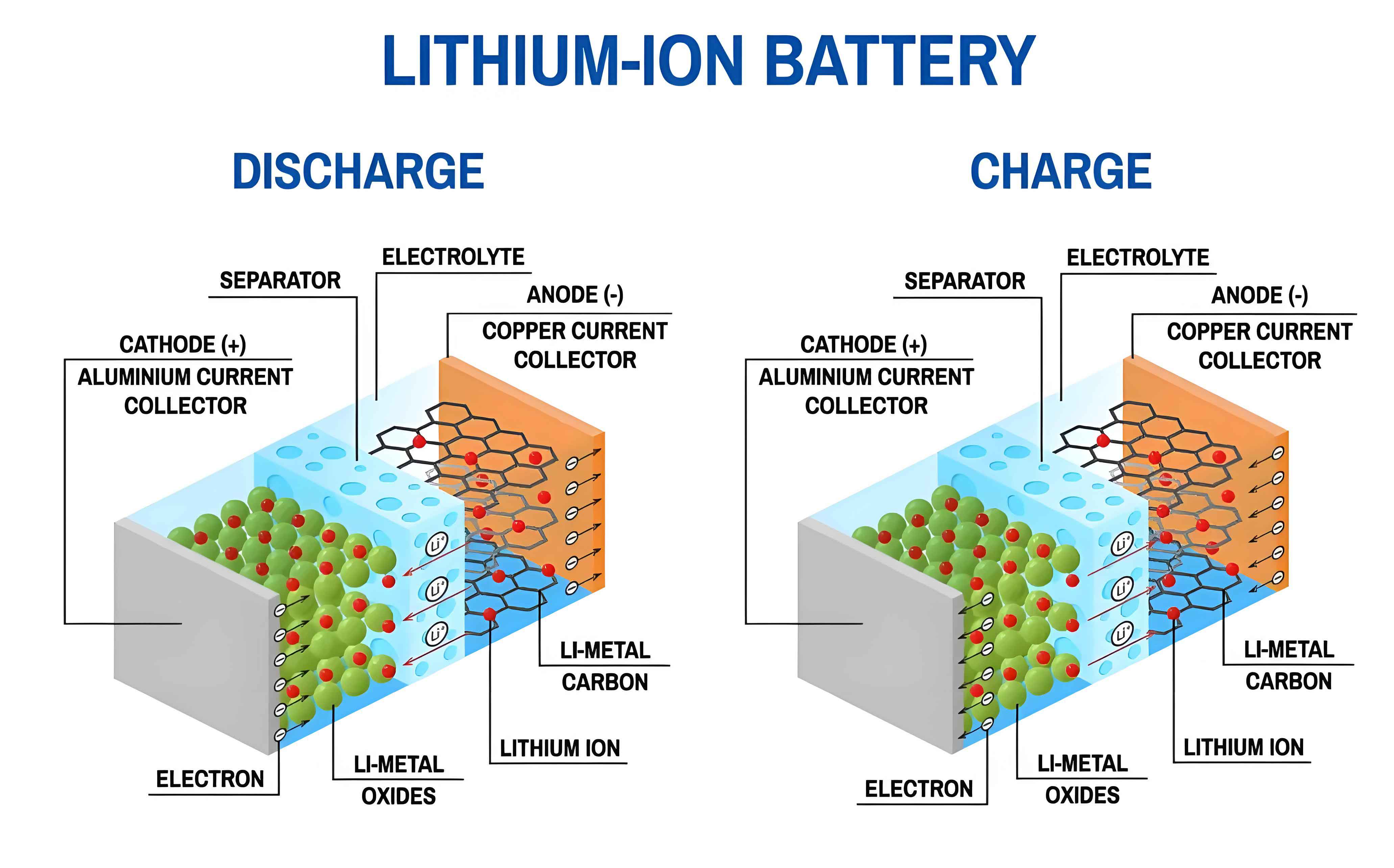
The lithium-ion battery, renowned for its high energy density, long cycle life, and low self-discharge rate, has become the cornerstone of energy storage for modern applications such as electric vehicles, renewable energy integration, and portable electronics. Precise and reliable management of lithium-ion batteries is paramount for ensuring safety, longevity, and performance. Among various state estimation tasks, determining the State of Health (SOH) of a lithium-ion battery is one of the most crucial and challenging. SOH quantifies the degree of battery degradation or aging relative to its initial pristine condition, directly impacting usable capacity, power capability, and remaining useful life.
Existing methods for lithium-ion battery SOH estimation can be broadly categorized into model-based and data-driven approaches. Model-based methods, such as electrochemical models and equivalent circuit models, attempt to capture the internal physico-chemical processes of the lithium-ion battery. While potentially offering deep insight, these models often suffer from complexity, require numerous difficult-to-measure parameters, and may lack robustness against cell-to-cell variations and diverse operating conditions.
Data-driven methods, in contrast, bypass explicit physical modeling and instead learn the mapping between measurable operational data and the target SOH. These methods typically involve two key steps: feature extraction and model construction. Common features extracted from charge/discharge curves include voltage plateau durations, incremental capacity (IC) peaks, and constant current charging time. However, many features are sensitive to noise, operating conditions like temperature, and may not fully capture the complex, nonlinear aging dynamics of lithium-ion batteries. Furthermore, the integration of temperature-related features, which significantly influence degradation, is often limited.
For model construction, techniques like Gaussian Process Regression (GPR), Support Vector Machines (SVM), and various Recurrent Neural Network (RNN) variants, including Long Short-Term Memory (LSTM) and Gated Recurrent Units (GRU), are widely employed. While effective, standard models may struggle with the intricate spatial-temporal patterns in battery data. Convolutional Neural Networks (CNNs) excel at extracting local spatial features from structured data, whereas Bidirectional LSTM (BiLSTM) networks are powerful for capturing long-range temporal dependencies in sequential data by processing information from both past and future contexts. Combining CNN and BiLSTM can leverage their complementary strengths. Moreover, integrating an attention mechanism, such as the Convolutional Block Attention Module (CBAM), can enhance model focus on the most informative features and time steps without substantially increasing computational cost.
This paper proposes a novel fusion model, CNN-CBAM-BiLSTM, for precise lithium-ion battery SOH estimation. The contributions are summarized as follows: (1) A multi-feature set is extracted, explicitly incorporating a temperature accumulation feature to account for thermal effects on lithium-ion battery aging. (2) A deep learning architecture is developed that synergistically combines CNN for spatial feature extraction, CBAM for adaptive feature refinement, and BiLSTM for bidirectional temporal dependency learning. (3) The model is rigorously validated on experimental lithium-ion battery cycling data under different charging rates, demonstrating superior accuracy and robustness compared to several benchmark models.
2. SOH Definition and Feature Extraction
2.1 Definition of State of Health
The State of Health (SOH) of a lithium-ion battery is commonly defined as the ratio of its current maximum available capacity (${C_r}$) to its nominal or initial capacity (${C_0}$), expressed as a percentage:
$$SOH = \frac{C_r}{C_0} \times 100\%$$
where ${C_r}$ denotes the actual discharge capacity at a specific cycle, and ${C_0}$ is the rated capacity of the fresh lithium-ion battery. SOH decays from 100% to lower values as the lithium-ion battery undergoes aging through repeated charge-discharge cycles.
2.2 Health Feature Extraction and Selection
Effective feature extraction is vital for data-driven SOH estimation. This work focuses on the Constant Voltage (CV) charging phase due to its strong correlation with internal resistance and capacity degradation in lithium-ion batteries. Six candidate features are initially calculated from the CV phase data: CV charging time (CT), CV charging capacity (CI), mean current (${\bar{I}}$), current variance (${S^2}$), chi-square statistic of current (${\chi^2}$), and accumulated temperature (TI).
Let ${t_b}$ and ${t_e}$ be the start and end times of the CV phase, respectively. ${I(t)}$ and ${T(t)}$ represent the measured current and temperature at time ${t}$. The features are computed as follows:
CV Charging Time: $$CT = t_e – t_b$$
CV Charging Capacity: $$CI = \int_{t_b}^{t_e} I(t) dt$$
Accumulated Temperature: $$TI = \int_{t_b}^{t_e} T(t) dt$$
Current Chi-square Statistic: $$\chi^2 = \sum \frac{(A – Z)^2}{Z}$$ where ${A}$ is the actual current sample and ${Z}$ is an expected or reference value, here used to quantify deviation from a normal pattern.
The Pearson correlation coefficient (${r}$) is employed to evaluate the linear relationship between each candidate feature and the reference SOH value (calculated from capacity measurements). The coefficient for variables ${X}$ and ${Y}$ is given by:
$$r = \frac{\sum (X_i – \bar{X})(Y_i – \bar{Y})}{\sqrt{\sum (X_i – \bar{X})^2 \sum (Y_i – \bar{Y})^2}}$$
Analysis of a test lithium-ion battery dataset reveals the correlation coefficients shown in Table 1.
| Feature | Symbol | Correlation (r) |
|---|---|---|
| CV Charging Time | CT | 0.9688 |
| CV Charging Capacity | CI | 0.9687 |
| Current Chi-square | $\chi^2$ | 0.9706 |
| Mean Current | $\bar{I}$ | 0.8970 |
| Current Variance | $S^2$ | 0.8236 |
| Temperature | T | 0.4192 |
Table 1: Pearson correlation coefficients between extracted features and SOH for a lithium-ion battery.
While instantaneous temperature shows a moderate correlation, the thermal history, represented by accumulated temperature (TI), is crucial as it directly influences degradation mechanisms like Solid Electrolyte Interphase (SEI) growth within the lithium-ion battery. Therefore, based on high correlation and physical significance, four features are selected for the model: CT, CI, $\chi^2$, and TI.
3. The Proposed CNN-CBAM-BiLSTM Estimation Model
The proposed framework integrates CNN, CBAM, and BiLSTM to effectively learn both spatial and temporal representations from the multi-feature input sequence for lithium-ion battery SOH estimation.
3.1 Convolutional Neural Network (CNN)
The CNN module is employed first to extract local spatial patterns and hierarchical features from the input feature vector sequence. A one-dimensional convolutional layer applies filters (kernels) to the input. The operation for the ${m}$-th feature map is:
$$S_n^m = X_m * W_n^m = \sum \sum x_n^m \omega_n^m$$
where ${*}$ is the convolution operator, ${X_m}$ is the input, ${W_n^m}$ is the convolutional kernel, and ${S_n^m}$ is the output feature map. This is followed by a pooling layer (e.g., max-pooling) for down-sampling:
$$M(i, j) = \max_{u=0}^{f-1} \max_{v=0}^{f-1} A(i \cdot s + u, j \cdot s + v)$$
where ${M(i,j)}$ is the pooled output, ${A}$ is the input feature region, ${f}$ is the pool size, and ${s}$ is the stride. This process reduces dimensionality and enhances translational invariance for the subsequent stages of lithium-ion battery health modeling.
3.2 Bidirectional Long Short-Term Memory (BiLSTM)
To capture complex temporal dependencies in the lithium-ion battery aging sequence, a BiLSTM network is utilized. A standard LSTM unit addresses the vanishing gradient problem through gating mechanisms (forget gate, input gate, output gate) and a cell state. The BiLSTM consists of two independent LSTM layers processing the sequence in forward and reverse directions. The final hidden state at each time step is a concatenation of the forward and backward passes, allowing the model to leverage contextual information from both past and future states within the sequence. This bidirectional context is particularly beneficial for understanding the progressive yet sometimes non-monotonic degradation trends of a lithium-ion battery.
3.3 Convolutional Block Attention Module (CBAM)
The CBAM attention module is integrated after the CNN layers to refine the extracted features dynamically. CBAM sequentially applies channel attention and spatial attention. The channel attention module generates a 1D channel attention map by exploiting inter-channel relationships, highlighting “what” is meaningful. The spatial attention module generates a 2D spatial attention map by utilizing inter-spatial relationships, focusing on “where” the informative regions are. Given an intermediate feature map ${F}$, CBAM performs:
$$F’ = M_c(F) \otimes F$$
$$F” = M_s(F’) \otimes F’$$
where ${M_c}$ and ${M_s}$ are the channel and spatial attention maps, respectively, and ${\otimes}$ denotes element-wise multiplication. This allows the model to emphasize critical features and suppress less useful ones, enhancing the representational power specifically for the task of lithium-ion battery SOH estimation.
3.4 Loss Function
During training, the model parameters are optimized by minimizing a loss function. The Mean Squared Error (MSE) loss is used to quantify the discrepancy between the estimated SOH values and the ground truth:
$$J(f(x), y) = \frac{1}{2} \sum_{j=1}^{Z} (f(x_j) – y_j)^2$$
where ${y_j}$ is the true SOH value, ${f(x_j)}$ is the model’s estimate for the ${j}$-th sample, and ${Z}$ is the batch size. Minimizing this loss drives the model’s predictions closer to the actual degradation trajectory of the lithium-ion battery.
3.5 Overall Architecture of CNN-CBAM-BiLSTM
The architecture of the proposed lithium-ion battery SOH estimation model is as follows:
- Input Layer: Receives the sequential multi-feature data (CT, CI, $\chi^2$, TI) for each cycle.
- CNN Layers: Multiple 1D convolutional and pooling layers extract local spatial features from the input sequence.
- CBAM Module: Applied to the CNN output features to adaptively recalibrate channel-wise and spatial-wise importance.
- BiLSTM Layers: Processes the CBAM-refined feature sequence bidirectionally to learn long-term temporal patterns in lithium-ion battery aging.
- Fully Connected (FC) Layer: Integrates the high-level features from the BiLSTM output.
- Output Layer with Loss: A regression layer produces the final SOH estimate. The MSE loss between the estimate and the true capacity-based SOH is computed to guide the training process.
This fusion enables the model to capture intricate spatial-temporal degradation signatures, handle potential capacity regeneration phenomena, and deliver accurate, robust SOH estimates for lithium-ion batteries.
4. Experimental Validation and Results
4.1 Experimental Setup and Data Description
The experiment utilized a battery testing platform comprising a Neware BTS-4000 cycler, a data server, and thermal sensors. Two Lishen 18650 cylindrical lithium-ion batteries (nominal capacity 2500 mAh) were subjected to different cycling regimes.
- Lithium-ion Battery 1: Charged at a low rate of 0.1C (250 mA) using a CC-CV protocol (CC to 4.2V, CV until current falls to 48 mA), and discharged at 1C (2500 mA) to 3.0V. This test ran for 679 cycles.
- Lithium-ion Battery 2: Charged at a high rate of 1C (2500 mA) using the same CC-CV protocol, and discharged at 0.5C (1250 mA). This test ran for 233 cycles.
The discharge capacity from each cycle was used to calculate the ground truth SOH according to Eq. (1). The extracted features (CT, CI, TI, $\chi^2$) were normalized. For each lithium-ion battery dataset, the first half of the cycles was used for training the model, and the second half was reserved for testing.
4.2 Performance Evaluation Metrics
The estimation performance is evaluated using three standard metrics:
Mean Absolute Error (MAE): $$MAE = \frac{1}{n} \sum_{i=1}^{n} |y_i – \hat{y}_i|$$
Root Mean Square Error (RMSE): $$RMSE = \sqrt{\frac{1}{n} \sum_{i=1}^{n} (y_i – \hat{y}_i)^2}$$
Coefficient of Determination (R²): $$R^2 = 1 – \frac{\sum (y_i – \hat{y}_i)^2}{\sum (y_i – \bar{y})^2}$$
where ${y_i}$ is the true SOH, ${\hat{y}_i}$ is the estimated SOH, ${\bar{y}}$ is the mean of true SOH, and ${n}$ is the number of test samples. Lower MAE and RMSE, and an R² closer to 1, indicate better performance.
4.3 SOH Estimation Results and Analysis
The proposed CNN-CBAM-BiLSTM model is compared against several benchmark data-driven models: GRU, CNN, RNN, and a baseline CNN-BiLSTM (without CBAM). The estimation results for both lithium-ion batteries are presented below.
The results for Lithium-ion Battery 1 (low-rate charging) show that all models generally follow the capacity fade trend. However, the CNN-CBAM-BiLSTM model exhibits the closest fit to the true SOH curve, especially during a noticeable “capacity regeneration” hump around cycles 400-550, which is likely influenced by temperature variations. The proposed model successfully tracks this phenomenon due to its incorporated temperature feature (TI) and enhanced feature weighting via CBAM. The error curve for the proposed model remains tightly bounded near zero.
For Lithium-ion Battery 2 (high-rate charging), which experiences more rapid degradation, the proposed model again demonstrates superior tracking accuracy and stability compared to other models, whose estimates show larger deviations, particularly in later cycles.
The quantitative performance metrics are summarized in Tables 2 and 3.
| Model | MAE | RMSE | R² |
|---|---|---|---|
| GRU | 0.0159 | 0.0192 | 0.2946 |
| CNN | 0.0094 | 0.0119 | 0.7281 |
| RNN | 0.0058 | 0.0088 | 0.8498 |
| CNN-BiLSTM | 0.0059 | 0.0077 | 0.8858 |
| CNN-CBAM-BiLSTM | 0.0038 | 0.0055 | 0.9415 |
Table 2: SOH estimation performance for Lithium-ion Battery 1.
| Model | MAE | RMSE | R² |
|---|---|---|---|
| GRU | 0.0425 | 0.0459 | 0.9168 |
| CNN | 0.0378 | 0.0399 | 0.9371 |
| RNN | 0.0543 | 0.0691 | 0.8115 |
| CNN-BiLSTM | 0.0382 | 0.0403 | 0.9357 |
| CNN-CBAM-BiLSTM | 0.0230 | 0.0269 | 0.9715 |
Table 3: SOH estimation performance for Lithium-ion Battery 2.
The proposed CNN-CBAM-BiLSTM model achieves the lowest MAE and RMSE, and the highest R² values for both lithium-ion batteries. This confirms its effectiveness and generalization capability across different charging regimes. The improvement over the CNN-BiLSTM baseline highlights the positive contribution of the CBAM attention mechanism in focusing on the most salient features for lithium-ion battery health assessment.
A supplementary experiment was conducted by removing the temperature accumulation (TI) feature. The results showed a significant performance drop, particularly for Lithium-ion Battery 1 (R² became negative), underscoring the importance of incorporating thermal history for accurate SOH estimation, especially when capacity regeneration occurs.
5. Conclusion
This paper presented a novel data-driven fusion model, CNN-CBAM-BiLSTM, for accurate State of Health estimation of lithium-ion batteries. The method extracts a robust set of health features, including an accumulated temperature metric, from the constant voltage charging phase. The core model architecture synergistically combines the spatial feature extraction capability of CNN, the adaptive feature refinement of the CBAM attention mechanism, and the bidirectional temporal dependency learning of BiLSTM. This integration allows the model to effectively capture the complex, nonlinear aging dynamics of lithium-ion batteries.
Experimental validation on lithium-ion battery cycling data under different charging rates demonstrated that the proposed model significantly outperforms several conventional and advanced deep learning benchmarks. It achieved high accuracy (R² up to 0.9715) and low error (MAE as low as 0.0038), proving its robustness and precision. The inclusion of the temperature feature and the CBAM module was shown to be crucial for handling real-world phenomena like capacity regeneration and varying degradation rates.
Future work will focus on validating the proposed framework with larger and more diverse lithium-ion battery datasets, including different chemistries and real-world driving/operation profiles. Furthermore, exploring the model’s potential for concurrent estimation of other states, such as State of Charge (SOC) and Remaining Useful Life (RUL), within a unified framework is a promising direction.