
With the widespread application of lithium-ion batteries in electronic devices, new energy vehicles, and energy storage systems, the efficient and accurate assessment of their State of Health (SOH) has become paramount for ensuring operational reliability and safety. This study proposes a novel SOH characterization method for lithium-ion batteries based on ultrasonic attenuation features, aiming to provide a non-invasive, rapid, and potentially cost-effective solution. By analyzing the correlation between internal physical characteristic changes during battery aging and corresponding variations in ultrasonic signals, this research establishes a foundational framework linking SOH to measurable acoustic properties.
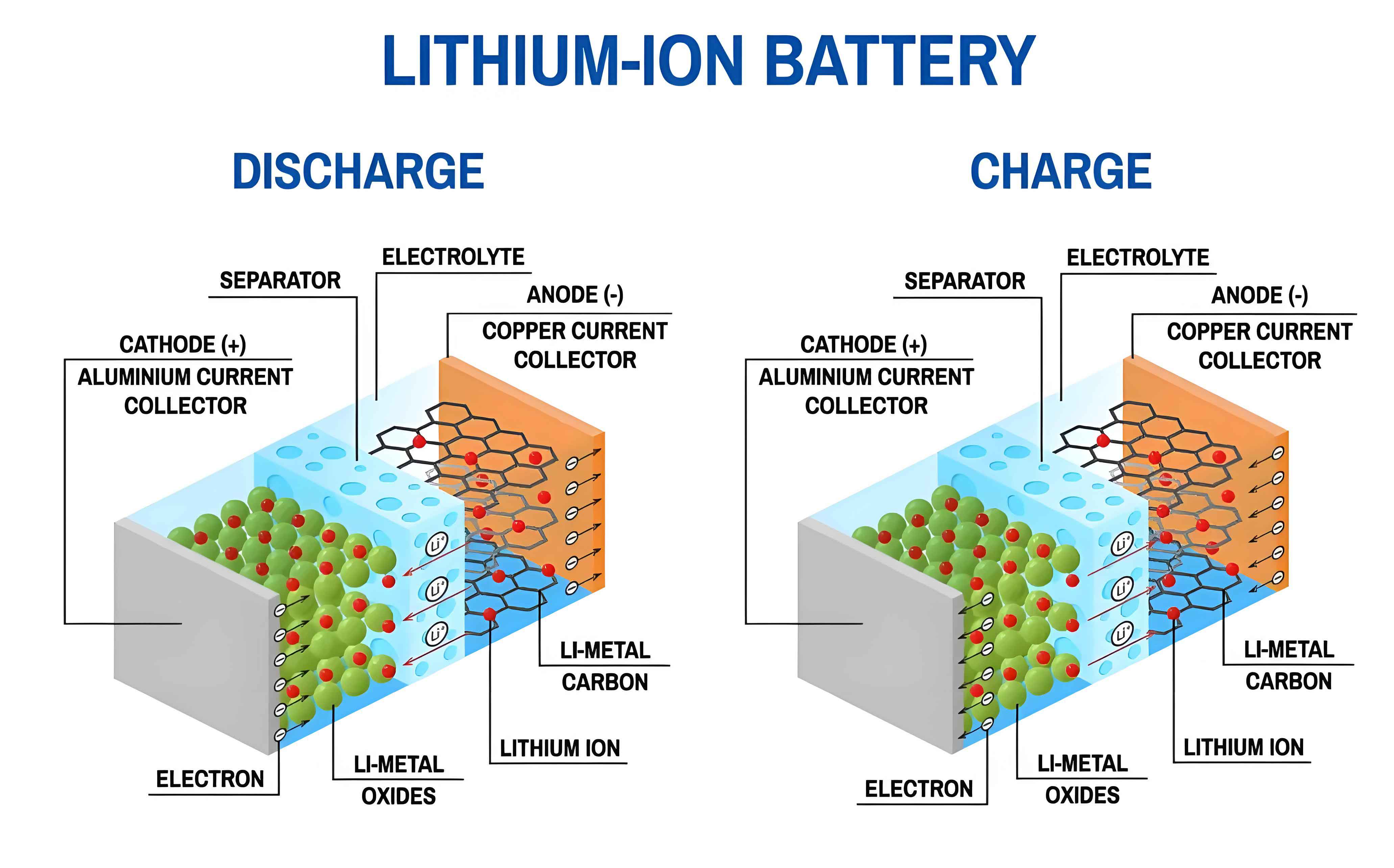
1. Aging Mechanisms and Ultrasonic Interactions
The degradation of a lithium-ion battery, manifested as capacity fade and power loss, is intrinsically linked to physical and chemical changes within its internal components. Key aging mechanisms include the continuous growth of the Solid Electrolyte Interphase (SEI) layer on the anode, loss of active lithium and electrode materials, electrolyte decomposition, and structural disordering in the cathode. These processes alter fundamental material properties such as density ($\rho$), Young’s modulus (E), and the thickness (l) of various layers (electrodes, SEI layer).
Ultrasonic waves propagating through a medium are sensitive to these exact physical properties. Changes in acoustic impedance $Z = \sqrt{\rho E}$ affect the transmission and reflection coefficients at material interfaces, while variations in layer thickness and the emergence of micro-cracks or porous structures influence the acoustic attenuation coefficient ($\alpha$). Therefore, the aging state of a lithium-ion battery can be indirectly probed by monitoring specific features of ultrasonic signals, such as time-of-flight (TOF) and signal amplitude (SA).
2. Theoretical Model: Linking SOH to Ultrasonic Amplitude
This study focuses on the signal amplitude of the primary back-wall echo, which demonstrates a strong and interpretable correlation with the state of the lithium-ion battery. A simplified model of a pouch lithium-ion battery cell treats it as a multi-layered structure. The amplitude $A_i$ of the ultrasonic wave after traversing a single unit cell (e.g., from one outer casing through electrodes and back) can be described by:
$$ A_i = A_0 \times t \times e^{-\sum_{i=1}^{n} \alpha_i l_i} $$
where $A_0$ is the initial amplitude, $t$ is the aggregate pressure transmission coefficient for all layer interfaces, and $\alpha_i$ and $l_i$ are the attenuation coefficient and thickness of the i-th layer, respectively.
As the lithium-ion battery ages from its initial state (SOH=100%) to a degraded state (SOH=S%), the change in the measured amplitude $A_S$ for the entire cell is attributed to two primary factors derived from the physical changes:
- Change in Aggregate Transmission Coefficient ($t_S$): Caused by changes in the acoustic impedance of electrode materials due to alterations in $\rho$ and E.
- Change in Effective Attenuation ($e(\alpha l)_S$): Caused by increased propagation path length (e.g., SEI growth) and changes in the attenuation coefficient of materials (e.g., due to porosity loss or micro-cracking).
Thus, the amplitude at a given SOH can be related to the amplitude at 100% SOH by:
$$ A_S = A_{100} \times t_S \times e(\alpha l)_S $$
Based on analysis of aging trends and their impact on the parameters $t_S$ and $e(\alpha l)_S$, an empirical characterization model is constructed. It is proposed that the relationship between the measured ultrasonic amplitude $A_S$ and the SOH of the lithium-ion battery can be effectively described by a combined function:
$$ A_S = (k_1 S + k_2) \times e^{(k_3 S^2 + k_4 S + k_5)} $$
where $S$ is the SOH value (e.g., $S=90$ for 90% SOH), and $k_1$ through $k_5$ are constants to be determined experimentally for a specific type of lithium-ion battery. This model captures the potential non-linear coupling between transmission and attenuation effects over the battery’s lifespan.
3. Experimental Validation and Analysis
To validate the proposed model, experiments were conducted on commercially available pouch-type lithium-ion batteries. Battery samples with different SOH levels (100%, 95%, 90%, 85%, 80%, 70%) were prepared using controlled charge-discharge cycling. Ultrasonic testing was performed using a 2.5 MHz transducer in pulse-echo mode at a stable temperature of 25°C. The State of Charge (SOC) was controlled during tests to isolate the SOH effect, with data at 60% SOC used for initial model fitting.
The experimental results confirmed that the ultrasonic signal amplitude decreases monotonically with reducing SOH for the tested lithium-ion battery. The data was fitted to the model $A_S = (k_1 S + k_2) \times e^{(k_3 S^2 + k_4 S + k_5)}$ using a nonlinear least-squares method. One of the optimal fits for the cobalt-oxide lithium-ion battery yielded parameters with a high coefficient of determination ($R^2 > 0.999$) and a low Mean Absolute Error (MAE) for SOH estimation.
| Fit Group | $k_1$ | $k_2$ | $k_3$ | $k_4$ | $k_5$ | $R^2$ | MAE |
|---|---|---|---|---|---|---|---|
| #3 | 17.5601 | -10.7589 | 8.4737 | -17.3366 | 11.3580 | 0.9997 | 0.83% |
This close fit between the theoretical model and experimental data preliminarily verifies the feasibility of using the ultrasonic attenuation-based model for SOH characterization of this specific lithium-ion battery type.
4. Compensation for State of Charge (SOC) and Broader Applicability
The ultrasonic signal in a lithium-ion battery is also significantly influenced by its instantaneous State of Charge (SOC), primarily due to lithium-ion intercalation/deintercalation causing electrode expansion/contraction and altering acoustic impedance. For practical SOH estimation, the coupling effect of SOC must be decoupled.
A comprehensive model is proposed where the predicted amplitude $A_{pred}$ is a product of independent functions for SOC and SOH effects, scaled by a constant $k$:
$$ A_{pred} = k \cdot f(SOC) \cdot g(SOH) $$
The function $f(SOC)$ is characterized using a fresh battery (SOH=100%), and $g(SOH)$ is the model previously derived at a reference SOC (e.g., 60%). Using this approach, SOH can be inverted from a measured amplitude $A_{meas}$ and a known SOC:
$$ g(SOH) = \frac{A_{meas}}{k \cdot f(SOC)} $$
The value of $g(SOH)$ is then computed, and the corresponding SOH is found by solving the model equation $g(SOH) = (k_1 S + k_2) \times e^{(k_3 S^2 + k_4 S + k_5)}$, for instance, using Newton’s iteration method. Applied to the cobalt-oxide lithium-ion battery data across an SOC range of 20%-80% and SOH range of 70%-90%, this method achieved an MAE of 1.52%.
To explore the potential generality of the approach, the methodology was also applied to a Lithium Iron Phosphate (LFP) lithium-ion battery. Following the same procedure, a similar characterization model was fitted for the LFP lithium-ion battery. A preliminary check on a limited dataset showed promising results with an MAE of 0.73%, indicating the potential applicability of the ultrasonic attenuation feature concept across different lithium-ion battery chemistries, though more extensive validation is required.
5. Comparison with Conventional SOH Estimation Methods
The ultrasonic-based method offers distinct advantages and faces different challenges compared to traditional techniques for lithium-ion battery SOH assessment. The key comparison is summarized below:
| Method Type | Key Principle | Advantages | Disadvantages | Efficiency |
|---|---|---|---|---|
| Ultrasonic Testing | Analyzes changes in acoustic properties (velocity, attenuation) related to internal structure. | Non-invasive, rapid, safe, provides internal physical insights. | Requires model mapping acoustic features to SOH; sensitive to coupling. | High (seconds) |
| Direct Measurement (e.g., Capacity Test) | Measures actual capacity or internal resistance via full/partial cycles. | Direct, accurate, widely accepted. | Time-consuming, interrupts operation, can accelerate aging. | Very Low (hours) |
| Model-Based Estimation | Uses electrochemical or equivalent circuit models with operational data. | Can be used online, has physical meaning. | Model complexity, requires parameter identification, sensitive to assumptions. | Medium-High |
| Data-Driven Methods | Employs ML/AI algorithms to learn SOH patterns from historical data. | No physical model needed, handles complex patterns. | Requires large, high-quality datasets; poor interpretability; generalization concerns. | Training: Low; Inference: High |
For the lithium-ion battery management, the ultrasonic method presents a compelling alternative for rapid, in-situ health screening, especially useful in quality control, onboard monitoring, and second-life assessment scenarios where traditional methods are impractical.
6. Conclusion and Future Perspectives
This study explored a characterization method for lithium-ion battery State of Health based on ultrasonic attenuation features. By establishing a link between the physical degradation mechanisms of the lithium-ion battery and the resulting changes in ultrasonic signal amplitude, a practical empirical model was developed and preliminarily validated. The method demonstrates the potential for rapid, non-destructive SOH estimation.
The key findings are:
- A theoretical framework connecting lithium-ion battery aging (via changes in density, modulus, thickness) to ultrasonic attenuation features was established.
- An SOH characterization model $A_S = (k_1 S + k_2) \times e^{(k_3 S^2 + k_4 S + k_5)}$ was proposed and showed excellent fit with experimental data from a cobalt-oxide lithium-ion battery.
- A comprehensive model incorporating SOC compensation was implemented, enabling SOH estimation across a range of SOC levels with good accuracy for the tested lithium-ion battery.
- Preliminary analysis on an LFP lithium-ion battery suggested the broader applicability of the core concept.
Future work should focus on extensive validation across diverse lithium-ion battery types, formats, and aging conditions to establish the robustness and generality of the model. Furthermore, research into the specific correlations between ultrasonic parameters (e.g., frequency-dependent attenuation, scattering profiles) and discrete aging mechanisms (like precise SEI growth or crack density) will enhance the model’s physical foundation and diagnostic specificity. Integrating this ultrasonic approach with other sensing modalities could lead to a more comprehensive and reliable battery management system for the next generation of lithium-ion battery applications.