
I have been following the global solid electrolyte cell race for years, and the latest annual summit in Chicago made one thing very clear to me: the conversation has shifted. In the past, researchers and executives spent most of their time debating whether a solid electrolyte cell could ever work outside a laboratory. Now the debate is about manufacturing lines, automotive qualification, and real vehicle integration. I see a global industry moving from scientific curiosity to industrial execution. The solid electrolyte cell is no longer only a promise; it is becoming a program with schedules, budgets, and supply-chain contracts.
From my perspective, the current landscape is defined by several parallel technology routes. Sulfide, oxide, halide, polymer, and composite electrolytes are all being explored. Each route has distinct advantages and stubborn limitations. China is using a semi-solid approach to build commercial momentum while steadily advancing toward a fully solid electrolyte cell. Japan and South Korea are attempting to leapfrog through aggressive development of all-solid-state technology. The United States, especially through venture-backed innovators, is exploring disruptive materials and manufacturing concepts. Europe is contributing advanced equipment and process know-how. I believe this multi-polar competition will accelerate innovation, but it will also create fragmentation in standards, supply chains, and investment priorities.
The Shift from Laboratory to Factory
I have observed that the most important change in the solid electrolyte cell industry is the new focus on industrialization. The global automotive solid electrolyte cell standard that took effect in July 2026 has given the industry a common reference point. Battery makers and automotive original equipment manufacturers are now building pilot lines, validating cell performance under automotive conditions, and preparing for vehicle installation. The question is no longer “Can a solid electrolyte cell work?” The question is “Can a solid electrolyte cell be manufactured at scale, with acceptable yield, cost, and reliability?”
In my analysis, this shift has three consequences. First, materials research must now be closely coupled with process engineering. A material that performs beautifully in a coin cell may fail completely in a large-format pouch cell. Second, equipment suppliers are becoming strategic partners rather than mere vendors. Third, supply chains for lithium, sulfur, halides, and specialized polymers must be built almost from scratch. I see these three forces shaping every major solid electrolyte cell roadmap.
Technology Routes for the Solid Electrolyte Cell
When I compare the leading solid electrolyte cell chemistries, I use several quantitative metrics: ionic conductivity, electrochemical stability window, mechanical modulus, thermal stability, and compatibility with high-voltage cathodes and lithium metal anodes. The Arrhenius equation remains a basic tool for understanding how temperature affects ionic transport:
$$ \sigma(T) = \sigma_0 \exp\left(-\frac{E_a}{k_B T}\right) $$
Here, \(\sigma(T)\) is the ionic conductivity at temperature \(T\), \(\sigma_0\) is a pre-exponential factor, \(E_a\) is the activation energy, and \(k_B\) is the Boltzmann constant. A low activation energy is essential for a solid electrolyte cell that must operate over a wide temperature range. I also use the Nernst-Einstein relation to link conductivity with diffusivity:
$$ \sigma = \frac{n q^2 D}{k_B T} $$
In this equation, \(n\) is the carrier concentration, \(q\) is the charge of the mobile species, and \(D\) is the diffusion coefficient. For a solid electrolyte cell, high ionic conductivity alone is not enough; the electrolyte must also block electrons, resist dendrite formation, and remain chemically stable against both electrodes.
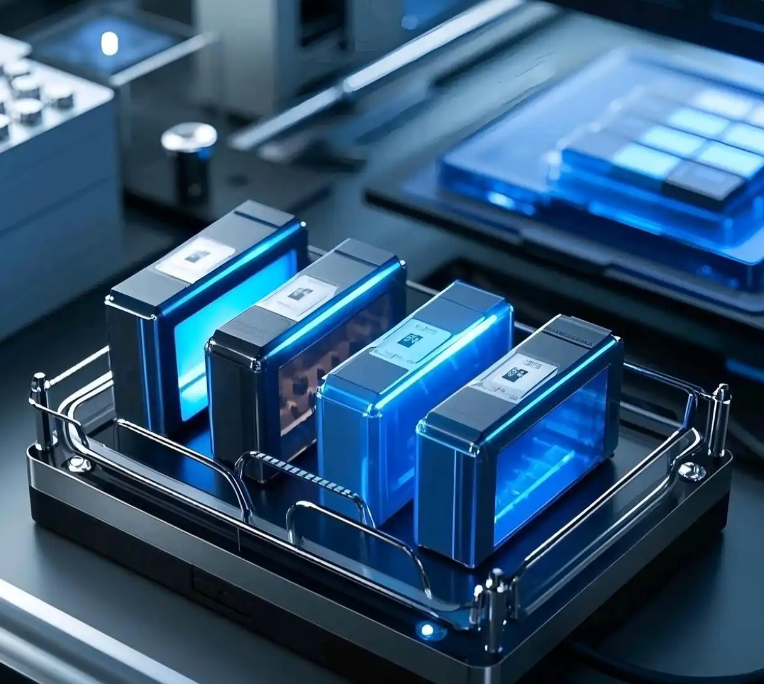
I have summarized the main solid electrolyte cell chemistries in the table below. The table reflects my own reading of the literature, conference presentations, and industrial announcements.
| Electrolyte Family | Typical Ionic Conductivity | Key Advantage | Primary Challenge | My Assessment of Maturity |
|---|---|---|---|---|
| Sulfide | \(10^{-3}\) to \(10^{-2}\) S/cm | Very high ionic conductivity; good mechanical deformability | Poor thermal stability; air sensitivity; hydrogen sulfide release | Leading candidate for all-solid-state, but manufacturing environment is demanding |
| Oxide | \(10^{-5}\) to \(10^{-3}\) S/cm | Excellent chemical and thermal stability | High interfacial resistance; brittle; requires high-temperature sintering | Promising for semi-solid and composite designs, but full solid electrolyte cell is difficult |
| Halide | Up to \(10^{-2}\) S/cm for amorphous halides | High voltage stability; good mechanical properties; compatibility with high-voltage cathodes | Anode interface instability; scalable synthesis and processing | Rapidly emerging; I see halides as a serious contender for high-energy solid electrolyte cell designs |
| Polymer | \(10^{-6}\) to \(10^{-4}\) S/cm at room temperature | Flexible; easy to process; low interface resistance | Low room-temperature conductivity; limited oxidative stability | Best suited for hybrid or semi-solid approaches, not yet for high-power all-solid-state |
| Composite | Wide range depending on filler and matrix | Can combine conductivity, flexibility, and stability | Complex interfaces; reproducibility; cost | I believe composites will dominate early commercial solid electrolyte cell products |
From my perspective, the halide route deserves special attention. Recent studies cited at the summit suggest that amorphous halide and oxyhalide solid electrolytes can achieve ionic conductivities above 10 mS/cm. That is a remarkable number. If such performance can be maintained in a practical solid electrolyte cell, halides could solve some of the high-voltage cathode compatibility problems that plague sulfides and oxides. However, I remain cautious about anode interfaces. A solid electrolyte cell with a halide electrolyte and a lithium metal anode still faces severe reduction stability challenges.
Electrolyte Materials in Greater Depth
I have spent considerable time comparing sulfide, oxide, and halide solid electrolytes. Each family tells a different story about the trade-offs in a solid electrolyte cell.
Sulfide solid electrolytes offer the highest ionic conductivity among inorganic candidates. They are soft and can be densified at relatively low temperatures, which is attractive for roll-to-roll processing. But they react with moisture to produce hydrogen sulfide, and their thermal stability is limited. For a solid electrolyte cell intended for automotive use, safety under abuse conditions is non-negotiable. I therefore see sulfide development focusing on protective coatings, dry-room manufacturing, and cell-level safety engineering.
Oxide solid electrolytes are much more stable in air and at high temperature. They do not release toxic gases. But they are brittle and require high-temperature sintering to achieve good contact with electrodes. The interface between an oxide electrolyte and a cathode or anode often has high resistance. I have used the following simple relation to estimate interfacial resistance:
$$ R_{int} = \frac{\rho_{int}}{A} $$
where \(\rho_{int}\) is the specific interfacial resistivity and \(A\) is the contact area. Increasing contact area and reducing interfacial reactions are two of the most important tasks for any oxide-based solid electrolyte cell. I have seen progress in co-sintering, buffer layers, and nanostructured interfaces, but large-format cells remain difficult.
Halide solid electrolytes are the newest frontier in my view. They can be stable against high-voltage cathodes, and their mechanical properties are often better than oxides. Some halides are ductile enough to accommodate volume changes during cycling. But they can react with lithium metal, and their synthesis often involves expensive or moisture-sensitive precursors. I believe halide solid electrolyte cell development will proceed fastest in applications where high voltage and moderate temperature operation are more important than ultimate low cost.
Polymer electrolytes are not new, but I see them being repositioned. Rather than competing directly with inorganic electrolytes for all-solid-state cells, polymers are increasingly used in semi-solid or hybrid designs. They can infiltrate electrodes, reduce interfacial resistance, and enable flexible form factors. However, their room-temperature ionic conductivity is still too low for many automotive requirements. I have summarized the key transport and stability equations for polymer and composite solid electrolyte cell systems below.
$$ D = D_0 \exp\left(-\frac{E_D}{RT}\right) $$
$$ t_+ = \frac{\sigma_+}{\sigma_+ + \sigma_-} $$
In these equations, \(D\) is the diffusion coefficient, \(E_D\) is the diffusion activation energy, \(R\) is the gas constant, and \(t_+\) is the transference number. A high cation transference number is desirable for a solid electrolyte cell because it reduces concentration polarization and supports uniform lithium deposition.
Anode Materials and Silicon-Based Negative Electrodes
I have also focused on anode development because the anode is often the limiting component in a solid electrolyte cell. Silicon-based negative electrodes are widely regarded as a core direction for next-generation high-energy batteries. Silicon has a theoretical specific capacity of about 4200 mAh/g, which is more than ten times that of conventional graphite. But silicon undergoes enormous volume expansion during lithiation. The volume expansion can reach 300% to 400%, which degrades cycle life.
The theoretical capacity of an electrode material can be estimated using Faraday’s law:
$$ Q = \frac{n F}{M} $$
where \(Q\) is the specific capacity, \(n\) is the number of electrons transferred per formula unit, \(F\) is the Faraday constant, and \(M\) is the molar mass. For silicon, the high value of \(n\) and low molar mass explain its exceptional capacity. However, mechanical instability is the price. I use the following expression to describe the volumetric strain:
$$ \varepsilon_V = \frac{\Delta V}{V_0} = \frac{V_{Li_xSi} – V_{Si}}{V_{Si}} $$
For silicon, \(\varepsilon_V\) can exceed 3.0, meaning the material expands to more than three times its original volume. In a solid electrolyte cell, this expansion can fracture the electrolyte, delaminate interfaces, and destroy electronic contacts. I therefore see three main strategies: nanostructuring, composite electrodes with carbon or polymer binders, and pre-lithiation or buffering layers.
| Anode Material | Theoretical Capacity | Volume Change | Main Advantage | Main Challenge for Solid Electrolyte Cell |
|---|---|---|---|---|
| Graphite | 372 mAh/g | About 10% | Mature, stable, low cost | Low capacity limits energy density |
| Silicon | 4200 mAh/g | 300% to 400% | Extremely high capacity | Mechanical fracture, unstable interface, poor cycle life |
| Silicon-Carbon Composite | 500 to 2000 mAh/g | 30% to 150% | Balances capacity and stability | Process complexity, cost, uniformity |
| Lithium Metal | 3860 mAh/g | Hostless, infinite volume change | Ultimate anode for high energy | Dendrites, interfacial reactions, safety |
I believe silicon-based anodes will appear first in semi-solid and hybrid solid electrolyte cell designs, where a small amount of liquid electrolyte can accommodate volume changes. For a true all-solid-state solid electrolyte cell, lithium metal remains the ultimate goal, but dendrite suppression and interface stability are still unresolved at scale.
Cathode and Interface Engineering
I have noticed that cathode development for the solid electrolyte cell is often overshadowed by electrolyte and anode news, but it is equally critical. High-voltage cathodes such as nickel-rich layered oxides, lithium-rich materials, and spinel materials can increase energy density. However, they react with many solid electrolytes. Halide electrolytes are attractive because they can pair with high-voltage cathodes, but the cathode-electrolyte interface still requires careful engineering.
I use the following expression to estimate the energy density of a solid electrolyte cell:
$$ \rho_E = \frac{Q_{cell} V_{avg}}{m_{cell}} $$
where \(\rho_E\) is the specific energy density, \(Q_{cell}\) is the cell capacity, \(V_{avg}\) is the average discharge voltage, and \(m_{cell}\) is the cell mass. To maximize \(\rho_E\), I need high-capacity electrodes, high voltage, and low inactive mass. A solid electrolyte cell can reduce inactive mass by eliminating separators and excess liquid electrolyte, but it also introduces dense ceramic or composite layers that add mass.
Interface engineering is where I see the most creative work. Coatings such as lithium niobate, lithium phosphate, and polymer interlayers can stabilize the cathode-electrolyte interface. For a solid electrolyte cell, the interface must conduct ions, block electrons, and remain mechanically compliant. I have summarized the desired interface properties in the table below.
| Interface | Desired Property | Common Failure Mode | Engineering Approach |
|---|---|---|---|
| Cathode / Solid Electrolyte | High ionic conductance, low electronic conductance, chemical stability | Element interdiffusion, oxygen loss, high resistance | Buffer layers, coatings, low-temperature processing |
| Anode / Solid Electrolyte | Dendrite resistance, stable contact, low reduction reactivity | Lithium dendrites, void formation, interfacial decomposition | Interlayers, alloy anodes, pressure control |
| Electrolyte / Electrolyte | Good contact, matched thermal expansion | Cracks, delamination, grain boundary resistance | Composite electrolytes, sintering aids, multilayer designs |
Manufacturing and Equipment: Warm Isostatic Pressing and Beyond
I have become convinced that manufacturing equipment will determine the pace of solid electrolyte cell commercialization. One process that received significant attention is warm isostatic pressing. This technique applies uniform pressure at elevated temperature to densify complex, multilayer battery components. For a solid electrolyte cell, uniform densification is essential because voids and poor contacts create high resistance and local hotspots.
I use relative density as a simple metric:
$$ \rho_{rel} = \frac{\rho}{\rho_{theo}} \times 100\% $$
where \(\rho\) is the measured density and \(\rho_{theo}\) is the theoretical density. A solid electrolyte cell typically needs relative densities above 95% to achieve good ionic conductivity and mechanical integrity. Warm isostatic pressing can help reach that target, but cycle time, equipment cost, and scalability are still concerns. I have also seen interest in roll-to-roll processing, dry electrode coating, and advanced sintering.
| Process Step | Purpose | Key Challenge for Solid Electrolyte Cell | My View on Readiness |
|---|---|---|---|
| Dry mixing | Prepare homogeneous electrode and electrolyte powders | Dust control, agglomeration, uniform distribution | Ready for pilot lines, but scale-up needs work |
| Dry electrode coating | Form electrode films without solvent | Binder selection, thickness control, adhesion | Promising for cost reduction |
| Warm isostatic pressing | Densify multilayer stacks uniformly | Throughput, tooling cost, thermal management | Critical enabler for high-performance solid electrolyte cell |
| Sintering | Consolidate oxide or composite electrolytes | High temperature, interfacial reactions, energy cost | Needs lower-temperature routes |
| Stacking and packaging | Assemble cells and modules | Pressure management, hermetic sealing, thermal expansion | Early stage for large-format solid electrolyte cell |
| Formation and aging | Activate and stabilize the cell | Uniform pressure, interface evolution, safety | Knowledge gap for all-solid-state |
I see equipment alliances forming between battery makers and process specialists. These partnerships aim to solve technical barriers and accelerate global solid electrolyte cell industrialization. In my view, the companies that master scalable densification and interface formation will have a decisive advantage.
Global Race Strategies
I have mapped the global solid electrolyte cell competition into several regional strategies. China is leveraging its complete lithium battery supply chain to commercialize semi-solid cells first, then iterate toward all-solid-state. Japan and South Korea are focusing on all-solid-state solid electrolyte cell technology, hoping to achieve a technology leap. The United States is using its venture ecosystem to explore radical materials and manufacturing concepts. Europe is contributing high-end equipment, automation, and automotive integration expertise.
| Region | Primary Strategy | Representative Technology Focus | Strengths | Challenges |
|---|---|---|---|---|
| China | Semi-solid first, then all-solid-state | Oxide-polymer composites, sulfide pilot lines, silicon anodes | Complete supply chain, large-scale manufacturing, cost control | Need breakthroughs in all-solid-state interfaces and high-yield processes |
| Japan | All-solid-state leapfrog | Sulfide electrolytes, lithium metal anodes, automotive integration | Deep materials research, automotive engineering, patents | High cost, limited supply chain for sulfide materials, slow scale-up |
| South Korea | All-solid-state mass production | Sulfide and oxide electrolytes, large-format cells | Battery manufacturing expertise, strong corporate investment | Material bottlenecks, equipment dependence, cost reduction |
| United States | Innovation-driven venture model | Solid electrolyte cell startups, lithium metal, ceramic separators | Risk capital, advanced characterization, software-driven R&D | Limited domestic manufacturing base, scaling challenges |
| Europe | Equipment and process leadership | Isostatic pressing, automation, battery recycling | Precision engineering, automotive partnerships | Smaller battery cell production base, reliance on Asian materials |
From my first-person perspective, China is clearly the leader in solid electrolyte cell mass production, using semi-solid batteries as an orderly transition to all-solid-state technology. I have seen this strategy described as pragmatic and fast-iterating. Japan and South Korea are pursuing a different path: they want to solve the hardest technical problems first, then scale. The American model is more fragmented but highly innovative. I believe each region will produce valuable intellectual property, but global standards and supply-chain coordination will be essential.
Commercialization Timelines and Milestones
I have compiled the following timeline based on public announcements and my own industry tracking. I use these milestones to compare the pace of solid electrolyte cell development across regions.
| Time Frame | Milestone | Region or Actor | My Interpretation |
|---|---|---|---|
| 2026 | Global automotive solid electrolyte cell standard takes effect | International standards bodies | Provides common test and safety framework |
| 2026 | Pilot line prototype testing for automotive all-solid-state cells | Japan | Validates basic cell design and process flow |
| 2027 | Planned start of all-solid-state solid electrolyte cell mass production | South Korea | First serious large-scale attempt |
| 2027 | Small-batch vehicle validation in flagship models | Japan | Tests real-world performance and durability |
| 2028 | Target launch of electric vehicles with self-developed all-solid-state cells | Japan | Marks the beginning of commercial deployment |
| 2030 and beyond | Expected broader cost reduction and scale-up | Global | Solid electrolyte cell becomes competitive in more segments |
I believe the 2027 to 2030 window will be decisive. Pilot lines will reveal whether the solid electrolyte cell can meet automotive requirements for cycle life, fast charging, cold-weather performance, and safety. Cost will remain the biggest hurdle. I use a simple learning-curve model to project future cost:
$$ C_n = C_1 n^{-\alpha} $$
where \(C_n\) is the unit cost after \(n\) cumulative units, \(C_1\) is the first-unit cost, and \(\alpha\) is the learning rate. For a solid electrolyte cell, \(\alpha\) is uncertain because many process steps are new. If \(\alpha\) is small, costs will remain high for a long time. If \(\alpha\) is large, rapid scaling could make the solid electrolyte cell competitive sooner than many expect.
Cost, Supply Chain, and Scalability Challenges
I have repeatedly emphasized that the solid electrolyte cell is not only a materials problem. It is a cost and supply-chain problem. The cell cost can be decomposed as follows:
$$ C_{cell} = C_{material} + C_{process} + C_{yield} + C_{capital} $$
Here, \(C_{material}\) is the cost of active and inactive materials, \(C_{process}\) is the manufacturing cost, \(C_{yield}\) is the cost penalty from defects and scrap, and \(C_{capital}\) is the amortized equipment cost. For a solid electrolyte cell, \(C_{process}\) and \(C_{yield}\) are often higher than for conventional lithium-ion cells because of high-pressure densification, dry-room requirements, and low throughput.
Yield is especially important. I use the following definition:
$$ Y = \frac{N_{good}}{N_{total}} $$
where \(Y\) is yield, \(N_{good}\) is the number of acceptable cells, and \(N_{total}\) is the total number produced. A low yield can destroy the economics of a solid electrolyte cell line. I have seen pilot lines with yields far below what is needed for mass production. Improving yield requires better process control, inline inspection, and robust materials.
| Supply Chain Element | Primary Risk | Impact on Solid Electrolyte Cell | Mitigation |
|---|---|---|---|
| Lithium | Price volatility, geographic concentration | Affects anode and electrolyte cost | Diversified sourcing, recycling, sodium alternatives |
| Sulfur | Byproduct supply, purity requirements | Critical for sulfide solid electrolyte cell | Purification investment, closed-loop manufacturing |
| Halides | Moisture sensitivity, expensive precursors | Limits halide solid electrolyte cell scale-up | New synthesis routes, dry handling |
| Rare earths and transition metals | Geopolitical risk, price spikes | Affects cathodes and interface coatings | Material substitution, recycling, thrifting |
| Specialty equipment | Long lead times, limited suppliers | Bottleneck for pilot and mass production | Strategic partnerships, in-house development |
I believe supply-chain maturity will lag behind technical breakthroughs. Even if a solid electrolyte cell design is proven in the laboratory, it may take years to build the raw material, component, and equipment ecosystem needed for terawatt-hour scale. This is why I see semi-solid and hybrid designs as important bridge technologies. They allow companies to learn about solid electrolyte cell manufacturing while generating revenue and refining supply chains.
Performance Metrics and Modeling
I evaluate solid electrolyte cell performance using a set of core metrics. These metrics are interrelated, and improving one often degrades another. For example, increasing electrode thickness raises energy density but reduces power density and can worsen mechanical stress. I use the following equations to frame the trade-offs.
Energy density:
$$ E_d = \frac{Q_{cell} V_{avg}}{m_{cell}} $$
Power density:
$$ P_d = \frac{V_{avg}^2}{4 R_{int} m_{cell}} $$
Round-trip efficiency:
$$ \eta_{RT} = \frac{E_{discharge}}{E_{charge}} \times 100\% $$
Coulombic efficiency:
$$ \eta_C = \frac{Q_{discharge}}{Q_{charge}} \times 100\% $$
Cycle life is often modeled with a power-law or exponential decay:
$$ Q(n) = Q_0 \left(1 – \beta n^{\gamma}\right) $$
where \(Q(n)\) is the capacity after \(n\) cycles, \(Q_0\) is the initial capacity, and \(\beta\) and \(\gamma\) are degradation parameters. For a solid electrolyte cell, \(\gamma\) can be large if mechanical degradation accelerates. I have summarized typical performance targets and current status in the table below.
| Metric | Conventional Lithium-Ion | Semi-Solid Cell | All-Solid-State Solid Electrolyte Cell | My Target for Automotive |
|---|---|---|---|---|
| Specific energy | 250 to 300 Wh/kg | 300 to 400 Wh/kg | 400 to 500 Wh/kg | Above 400 Wh/kg |
| Energy density | 600 to 750 Wh/L | 700 to 900 Wh/L | 900 to 1200 Wh/L | Above 900 Wh/L |
| Cycle life | 1000 to 2000 cycles | 500 to 1500 cycles | 500 to 1000 cycles | Above 1000 cycles |
| Fast charge | 2 to 4 C | 1 to 3 C | 0.5 to 2 C | Above 2 C |
| Operating temperature | -20 to 60 °C | -20 to 60 °C | -10 to 80 °C | -30 to 60 °C |
| Safety | Good with management | Improved | Potentially excellent | No thermal runaway |
I have also modeled the influence of interfacial resistance on power density. As the equation above shows, \(P_d\) is inversely proportional to \(R_{int}\). Reducing interfacial resistance is therefore one of the highest-leverage improvements for a solid electrolyte cell. This is why interface engineering, pressure control, and composite electrolytes receive so much attention.
Safety, Reliability, and Standards
I consider safety to be both a challenge and an opportunity for the solid electrolyte cell. The replacement of flammable liquid electrolytes with solid materials can reduce fire risk. But solid electrolytes introduce new failure modes: crack propagation, dendrite penetration, and interfacial decomposition. The critical current density for dendrite formation can be approximated by:
$$ J_{crit} \propto \frac{\sigma_{el} E_{crit}}{d} $$
where \(\sigma_{el}\) is the electrolyte conductivity, \(E_{crit}\) is a critical electric field, and \(d\) is a characteristic length. Improving \(\sigma_{el}\) and increasing mechanical strength can raise \(J_{crit}\), but the relationship is not simple. I have seen many promising solid electrolyte cell materials fail because of dendrites at high current densities.
| Safety Test | Purpose | Relevance to Solid Electrolyte Cell | My Assessment |
|---|---|---|---|
| Overcharge | Evaluate tolerance to excessive voltage | High-voltage cathodes and electrolyte stability | Critical for automotive qualification |
| Overdischarge | Evaluate tolerance to deep discharge | Anode dissolution, interface damage | Often overlooked but important |
| External short | Evaluate response to short circuit | High current density, thermal hotspots | Solid electrolyte can help, but contact resistance matters |
| Thermal ramp | Evaluate thermal stability | Sulfide oxidation, polymer decomposition | Material-dependent |
| Mechanical abuse | Evaluate crash and penetration tolerance | Brittle ceramic electrolytes, composite delamination | Requires new cell and pack designs |
| Cycle life at high temperature | Evaluate long-term durability | Interfacial reactions, creep, pressure loss | Major challenge for all-solid-state |
I believe the new global automotive standard will help harmonize safety testing and accelerate market acceptance. Without common standards, each region could develop different requirements, slowing the solid electrolyte cell industry. I see standards as a foundation for investment, not a bureaucratic burden.
My Perspective on the Next Phase
As I look ahead, I see several forces shaping the solid electrolyte cell industry. First, semi-solid cells will continue to gain market share while all-solid-state technology matures. Second, silicon-based anodes will improve energy density in both semi-solid and solid-state designs. Third, halide electrolytes may emerge as a serious alternative to sulfides and oxides, especially for high-voltage solid electrolyte cell architectures. Fourth, equipment and process innovation will determine which companies can scale first. Fifth, supply-chain development will require coordinated investment across mining, refining, synthesis, and recycling.
I also want to emphasize that the solid electrolyte cell is not a single product. It is a family of technologies with different trade-offs. A solid electrolyte cell for a premium electric vehicle may prioritize energy density and fast charging. A solid electrolyte cell for grid storage may prioritize cost and cycle life. A solid electrolyte cell for consumer electronics may prioritize thinness and safety. I therefore expect multiple winners rather than a single dominant chemistry.
From my first-person perspective, the global race is entering its most consequential phase. The laboratory breakthroughs of the past decade are being translated into pilot lines, automotive validation programs, and early commercial products. The challenges are immense: material bottlenecks, manufacturing cost, low yield, supply-chain gaps, and unresolved interface science. Yet the momentum is undeniable. I have never seen so much capital, talent, and political attention focused on the solid electrolyte cell.
I will continue to track the following indicators: pilot-line yield, cell-level energy density, cycle life at realistic pressures, fast-charge performance, and cost per kilowatt-hour. I will also watch for standardization progress and supply-chain announcements. These are the metrics that will separate real progress from hype. The solid electrolyte cell is no longer a distant dream. It is a fast-moving industrial race, and I believe the next five years will define the winners.
In my assessment, the global solid electrolyte cell competition will be won not by the best material alone, but by the best system: the best combination of electrolyte, anode, cathode, interface, process, equipment, and supply chain. I see China leading in manufacturing scale, Japan and South Korea leading in all-solid-state materials, the United States leading in innovation, and Europe leading in precision equipment. The most successful players will be those who can integrate across borders and disciplines. The solid electrolyte cell is a global challenge, and it will require a global response.