
In the continuous advancement of petroleum drilling technology, the demand for stable and efficient power supply has become increasingly stringent. Traditional generator-based power supply methods often fail to achieve ideal performance when facing sudden load changes and poor energy management. In the field of microgrids, battery energy storage technology can improve power quality, enhance system stability, and serve as an emergency power source during faults. Large-capacity battery energy storage systems can also perform peak shaving and valley filling in the grid. Existing studies have shown that under voltage sag conditions, an energy storage system can rapidly provide reactive power support to help maintain grid voltage stability. Moreover, integrating an energy storage system into the grid reduces the power support required from the upstream grid. Combining diesel generators with an energy storage system not only enables efficient operation of diesel engines but also reduces energy waste and prevents power system collapse caused by prolonged overcurrent during heavy loading, thereby improving power supply quality. Typically, in microgrids, energy storage compensation is needed to enhance system stability, and appropriate control methods and energy management strategies are required to balance supply and demand. When system power is abundant, a portion of electrical energy can be stored in the energy storage unit; when system power is insufficient, the stored energy is released to meet load demands.
Our team introduces a novel system that effectively integrates a battery energy storage system (BESS), an electric control system for drilling rigs, generator sets or the power grid, and on-site loads through an energy management system (EMS). In terms of system configuration, we elaborate on the connection methods and functions of each component, including the power connections, communication connections, and core functions of the BESS. This system can reduce fuel consumption, improve power quality, monitor system operation status in real time, and achieve effective energy dispatch and management, thereby enhancing the reliability and efficiency of power supply.
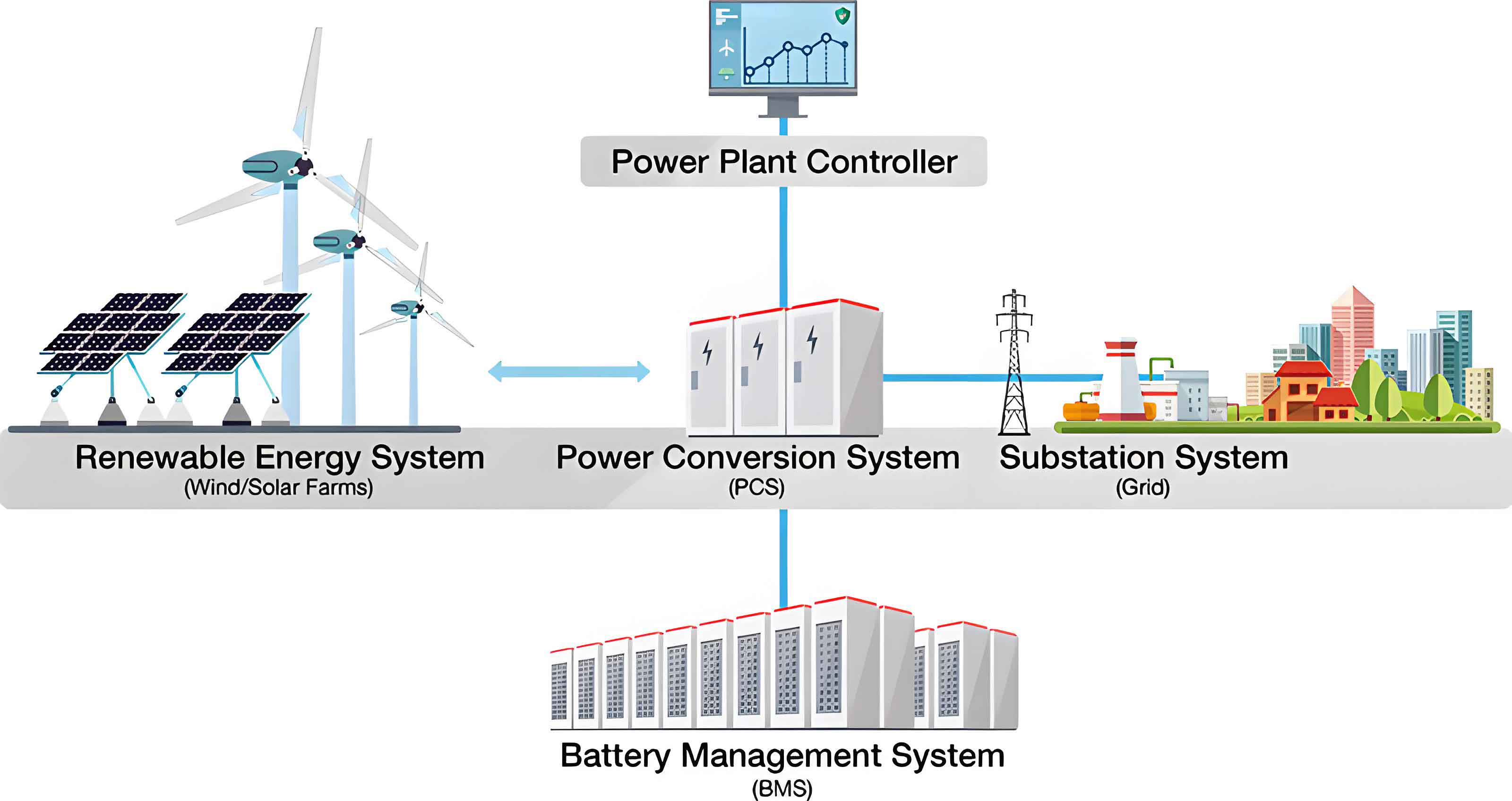
System Configuration
Through the energy management system (EMS), we combine the battery energy storage system, the drilling rig electric control system, generator sets or the grid, and on-site loads effectively. The EMS monitors system operation status in real time and achieves rational energy dispatch management. The system architecture is described in detail below. The BESS, together with the drilling rig’s electric control system, forms a microgrid that can operate in grid-connected or islanded modes. The generator sets and the BESS share the load through an AC bus, while the drilling rig’s variable frequency drives are connected via a DC bus. This hybrid topology allows flexible energy flow.
Battery Energy Storage System Design
Power Connections
We have identified three main power connection methods between the BESS and the drilling rig electric control system: DC access, AC access, and simultaneous AC/DC access. Each has its own advantages and disadvantages.
1. DC Access Method
In this method, the BESS is directly connected to the DC bus of the drilling rig electric control system. It directly compensates power and recovers energy on the DC bus.
- Advantages: It can directly recover the energy that would otherwise be dissipated by braking resistors when the DC bus voltage is too high. The energy utilization efficiency of the BESS is high.
- Disadvantages: It cannot respond to power surges from MCC loads. DC switches rated above 1500 V and 1000 A are not yet widely used, posing safety risks. It cannot directly participate in frequency and voltage regulation of the generator sets.
2. AC Access Method
In this method, the BESS is directly connected to the 600 V AC bus of the drilling rig electric control system, enabling power regulation on the AC bus.
- Advantages: It directly participates in generator frequency and voltage regulation, quickly compensating active and reactive power. It rapidly responds to power surges from both MCC loads and variable frequency loads.
- Disadvantages: It cannot recover the energy that should be dissipated by braking resistors when the DC bus voltage is too high.
3. Simultaneous AC/DC Access Method
We strongly recommend this connection method, which combines the benefits of both previous approaches. It provides frequency and voltage regulation for generators, fast compensation of active and reactive power, and also recovers braking energy from the DC bus. In this topology, the BESS includes both an AC-side power conversion system (PCS) and a DC-side DC/DC converter. The AC connection is made via an isolation transformer, which offers the following benefits:
- Electrical isolation and protection: The isolation transformer electrically separates the BESS from the electric control system, preventing current surges due to faults or short circuits from damaging either system. This enhances overall safety and stability.
- Voltage matching and conversion: The isolation transformer steps up or down the output voltage of the PCS to match the voltage level of the electric control system, ensuring smooth energy transfer. The transformer must be designed to accommodate different battery types and system voltages.
- Filtering and interference rejection: The isolation transformer filters out harmonics and interference signals from the grid, ensuring stable operation of both the BESS and the electric control system.
Communication Connections
The communication interface between the BESS and the drilling rig electric control system should use RJ45 (Ethernet) ports, with protocols such as Profinet, EtherCAT, or Modbus TCP. We recommend placing the BESS and the electric control system on different network segments to improve security. The communication must enable data exchange, allowing operators to control and monitor the BESS from the driller’s cabin touchscreen. Inside the BESS, the PCS, DC/DC converter, Battery Management System (BMS), and power meters all communicate with a dedicated BESS PLC.
Core Functions
The application of a battery energy storage system on a petroleum drilling rig aims to meet specific load requirements and improve operational efficiency. The core functions are categorized into three groups:
1. Stabilization and Optimization of the Microgrid
- Inertia support and primary frequency regulation: The PCS provides inertia response and primary frequency regulation, enhancing resistance to frequency and load power disturbances, thereby reducing fuel injection due to frequency fluctuations.
- Drilling load prediction: Using statistical analysis of historical data, a hybrid model predicts future loads. This allows pre-planning of generator output to avoid overloading or underloading.
- Generator load rate optimization: Interaction with the electric control system enables automatic start/stop, speed regulation, and protection of generators. Real-time monitoring dynamically adjusts output power and load matching, increasing the load rate of online units and reducing their operating time.
- Power factor optimization: By injecting appropriate reactive power, the system compensates the reactive power demand of loads, improving the power factor. It quickly responds to voltage fluctuations to maintain stability.
2. Energy Management and Economic Efficiency
- Peak-valley arbitrage: The system automatically charges during low-price periods and discharges during high-price periods based on grid time-of-use tariffs, maximizing economic benefits.
- Optimization effect statistics and display: The system statistically displays improvements in load rate, fuel savings, and peak-valley charging/discharging revenue before and after BESS operation.
- Potential energy recovery: During tripping operations, the BESS recovers gravitational or kinetic potential energy. This reduces energy waste, lowers drilling costs, and improves extraction efficiency. Several studies have proposed energy storage recovery schemes for AC/DC drilling rigs.
3. Safety Assurance and Emergency Response
- Seamless grid-connected/islanded switching and black start: The BESS continuously monitors the drilling load and microgrid status. When the voltage at the point of common coupling drops, it quickly achieves seamless switching between grid-connected and islanded modes, supporting critical loads (e.g., drawworks, disc brakes, auxiliary motors). The BESS also provides black start capability to power the drilling site after a complete grid blackout or generator failure, supplying emergency operations and living quarters.
- System self-safety management: The BESS includes battery management, thermal management, fire protection management, and data management to ensure safe and stable operation.
System Integration Design
We integrate the battery clusters, PCS, EMS, potential energy recovery system, temperature control system (HVAC), fire suppression system, and video monitoring system into a single skid-mounted enclosure.
System Grounding and Protection
To ensure independence and safety, both the BESS and the electric control system should have separate grounding systems to prevent ground current interference. Lightning protection devices such as surge arresters are essential to reduce the impact of direct and induced lightning. Additionally, grounding monitoring devices are installed to:
- Ensure personnel safety: Monitor grounding status to quickly act in case of electrical faults, reducing electric shock risk.
- Ensure equipment safe and stable operation: The grounding system provides leakage protection, overvoltage protection, and overcurrent protection under abnormal conditions.
- Prevent fault propagation: In the event of an electrical fault, the grounding device quickly disconnects the circuit, protecting other equipment and preventing fault escalation.
Field Application Results
In 2024, we conducted an industrial trial on a 5000 m drilling rig. The rig was equipped with six CDVS-550B diesel generator sets, each rated at 550 kW. The BESS was integrated using the simultaneous AC/DC access method. The following results were obtained.
Improved Power Quality
After BESS activation, the power quality of the generators improved significantly. The AC voltage fluctuation dropped from 7.2% to 0.67%, and the frequency fluctuation dropped from 7.26% to 1.32%.
| Parameter | Before BESS | After BESS |
|---|---|---|
| Base Voltage (V) | 600 | 600 |
| Voltage Upper Limit (V) | 608 | 599 |
| Voltage Lower Limit (V) | 565 | 595 |
| Voltage Fluctuation (%) | 7.20 | 0.67 |
| Parameter | Before BESS | After BESS |
|---|---|---|
| Base Frequency (Hz) | 50 | 50 |
| Frequency Upper Limit (Hz) | 51.08 | 50.40 |
| Frequency Lower Limit (Hz) | 47.45 | 49.74 |
| Frequency Fluctuation (%) | 7.26 | 1.32 |
Potential Energy Recovery
The BESS successfully recovered and stored potential energy during tripping operations. Due to power limitations of the recovery device, full recovery was not achieved. The measured recovery data are shown below.
| Operation | Energy per Stand (kWh) | Number of Stands | Hook/Top Drive Mass (t) | Well Depth (m) | Total Recovered Energy (kWh) |
|---|---|---|---|---|---|
| Tripping in | 0.77 | 82 | 20 | 2930 | 63.4 |
| Tripping out | 0.47 | 82 | 20 | 2930 | 38.6 |
Power Fluctuation Smoothing
Generators in drilling operations often face sudden load changes, causing large diesel engine power fluctuations. The BESS provides additional power during load increases, smoothing the generator output. The following table compares generator power fluctuation before and after BESS activation.
| Parameter | Before BESS | After BESS |
|---|---|---|
| Number of Online Generators | 3 | 2 |
| Total Load (kW) | 336–646 | 400–629 |
| Generator Power (kW) | 336–646 | 300–429 |
| PCS Power (kW) | 0 | -100 to 200 |
| Generator Power Fluctuation Range (kW) | 310 | 129 |
| Generator Power Fluctuation Rate (%) | 63 | 35 |
| Fluctuation Reduction | 45% | |
Reduction of Online Generators
During drilling and tripping operations, the number of online generators reduced from three to two after BESS activation. The BESS effectively replaced one standby diesel generator, reducing fuel consumption and noise.
| Parameter | Before BESS | After BESS |
|---|---|---|
| Total Load (kW) | 570–866 | 400–806 |
| Total Diesel Generator Power (kW) | 570–866 | 280–506 |
| Single Generator Power (kW) | 190–288 | 140–250 |
| PCS Power (kW) | 0 | -120 to 300 |
| Number of Generators | 3 | 2 |
| Parameter | Before BESS | After BESS |
|---|---|---|
| Total Load (kW) | 320–886 | 330–869 |
| PCS Power (kW) | 0 | 0 to 270 |
| Total Diesel Generator Power (kW) | 320–886 | 330–599 |
| Single Generator Power (kW) | 107–295 | 165–300 |
| Number of Generators | 3 | 2 |
Mathematical Modeling of Energy Storage System Performance
To quantify the benefits, we define key performance indices. Let \(P_{\text{gen}}(t)\) be the generator output power, \(P_{\text{load}}(t)\) the total load, and \(P_{\text{BESS}}(t)\) the BESS power (positive when discharging). The power balance equation is:
$$P_{\text{gen}}(t) = P_{\text{load}}(t) – P_{\text{BESS}}(t)$$
The fluctuation reduction factor \(\eta\) is defined as:
$$\eta = \left(1 – \frac{\sigma_{\text{after}}}{\sigma_{\text{before}}}\right) \times 100\%$$
where \(\sigma\) is the standard deviation of generator power. In our field test, the standard deviation decreased by 45%.
The potential energy recovery efficiency \(\epsilon\) is given by:
$$\epsilon = \frac{E_{\text{recovered}}}{E_{\text{available}}} \times 100\%$$
where \(E_{\text{available}}\) is the theoretical maximum recoverable energy during a tripping operation. In the trial, the average recovery per stand was 0.77 kWh for tripping in and 0.47 kWh for tripping out.
The economic benefit from peak-valley arbitrage can be expressed as:
$$B = \sum_{i} \left( C_{\text{discharge},i} \cdot E_{\text{discharge},i} – C_{\text{charge},i} \cdot E_{\text{charge},i} \right)$$
where \(C\) is the electricity price per kWh and \(E\) is the energy exchanged. Future implementations will incorporate real-time price signals to maximize this benefit.
Conclusion
By effectively combining the battery energy storage system, the drilling rig electric control system, generator sets or the grid, and on-site loads through an energy management system, we have significantly improved the reliability and efficiency of power supply for petroleum drilling operations. The system not only stabilizes and optimizes the microgrid, realizes energy management and economic benefits, but also ensures safety and emergency response. Field application results demonstrate that the BESS substantially improves generator power quality, successfully recovers potential energy during tripping operations, smooths power fluctuations, and reduces the number of online generators. These achievements highlight the transformative potential of integrating a battery energy storage system into modern drilling rigs, paving the way for more sustainable and cost-effective drilling operations.