
We present a comprehensive review of battery energy storage systems (BESS) for active grid support applications. As renewable energy penetration increases dramatically, power systems face significant challenges related to frequency and voltage stability due to the reduced inertia and lack of active support capabilities from inverter-based resources. The energy storage system, particularly BESS, has emerged as a critical enabling technology to address these challenges through its fast response, flexible control, and bidirectional power capability. We systematically analyze the technical characteristics and functional roles of BESS in modern power systems, covering frequency regulation, peak shaving, voltage regulation, inertia support, and damping compensation. By emulating key parameters of synchronous generators, we explore how BESS can provide comprehensive active grid support. We also identify current research gaps and propose solutions for multi-energy storage coordination, dynamic collaborative control, and economic optimization.
1. Introduction
The modern power system is undergoing a profound transformation driven by the global commitment to carbon neutrality and the large-scale integration of renewable energy sources. Wind and solar power generation, characterized by inherent volatility and randomness, pose serious challenges to grid stability. Unlike conventional synchronous generators, renewable energy units typically connect to the grid through power electronic interfaces, lacking the inherent inertial response and active grid support capabilities that are essential for maintaining system stability. This situation creates an urgent need for innovative solutions to ensure reliable power system operation under high renewable penetration scenarios.
The energy storage system, especially BESS, has demonstrated remarkable potential in addressing these challenges. With its fast response time, flexible controllability, and high precision, BESS can effectively smooth renewable energy fluctuations, provide frequency and voltage regulation, and enhance system inertia and damping characteristics. The energy storage system has become an indispensable component of modern power systems, offering services that range from milliseconds-level fast response to hours-level energy shifting.
We observe that extensive research has been conducted on energy storage system applications in power systems. Various studies have explored the modeling, control strategies, and economic viability of BESS for grid support. However, a systematic review that comprehensively covers the multiple dimensions of BESS active grid support — from frequency and voltage regulation to inertia and damping compensation — is still needed. This paper aims to fill this gap by providing a holistic overview of BESS applications for active grid support, analyzing the underlying mechanisms, control strategies, and emerging challenges.
2. Grid-Scale BESS: Concept and Feasibility Analysis
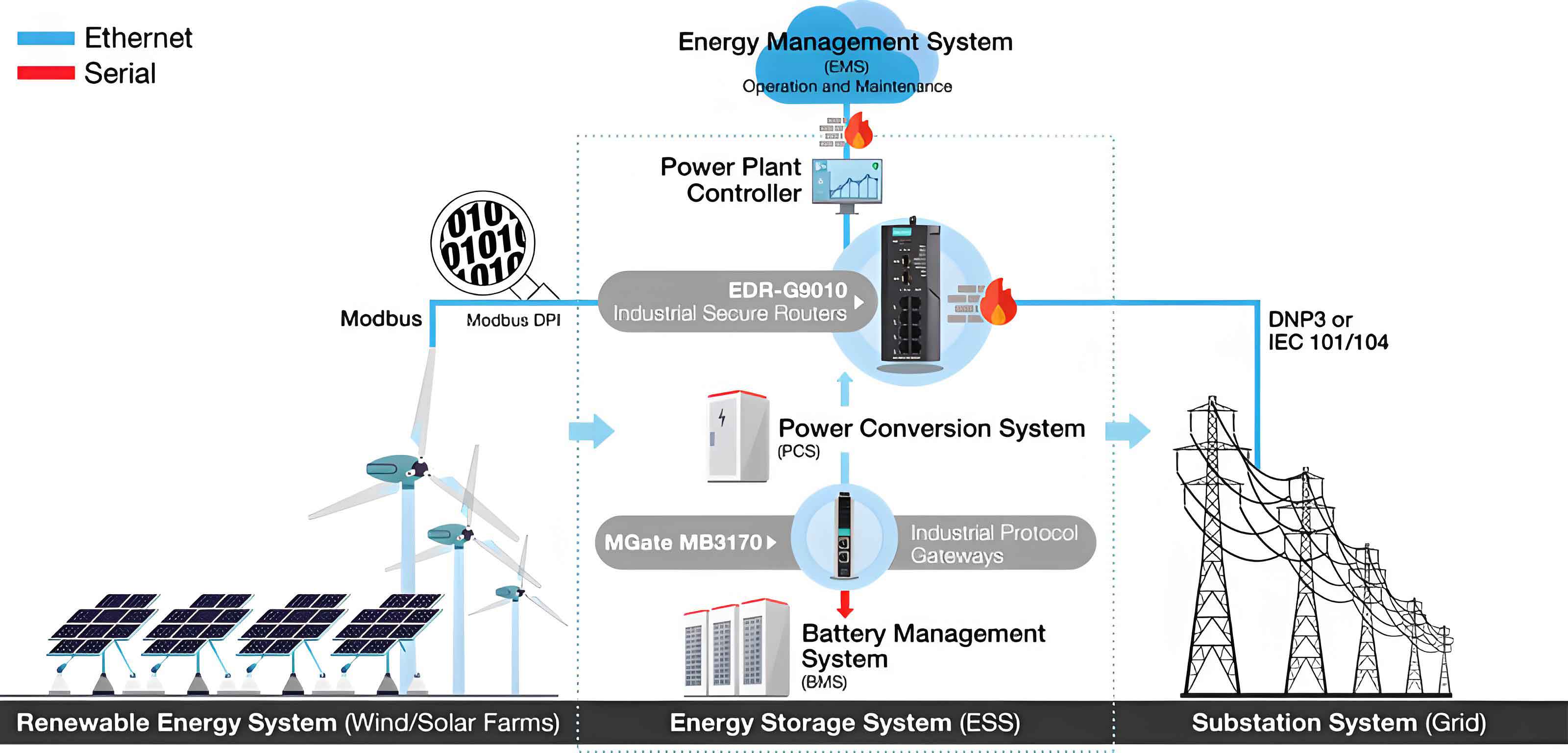
The grid-scale BESS is an electrochemical device that can charge from the grid or power plants, store electrical energy, and discharge when needed to provide electricity or ancillary services. A typical BESS consists of three primary components: the temperature control module, the battery module, and the converter module. The temperature control module regulates the operating temperature of the battery cells by circulating conditioned air, ensuring optimal performance and safety. The battery module comprises multiple battery cells arranged in series and parallel configurations, forming the core energy storage medium. The converter module interfaces the DC-side battery system with the AC-side power system, enabling bidirectional power flow and grid synchronization.
Several battery technologies have been deployed for grid-scale applications, including lithium-ion, lead-acid, sodium-sulfur, and flow batteries. Each technology exhibits distinct technical characteristics that determine its suitability for specific grid support applications. We summarize the key technical parameters of different battery types in the following table.
Table 1: Technical Parameters of Different Energy Storage Battery Types
| Battery Type | Power Rating | Response Time | Duration | Efficiency (%) | Cycle Life | Share (%) |
|---|---|---|---|---|---|---|
| Lithium-ion | 1–10 MW | 1–10 min (primary), 30 min–4 h (secondary), 4–8 h (peak) | 90–98 | 90–98 | 1000–10000 | 97.09 |
| Lead-acid | 0–20 MW | 1–5 min (primary), 10 min–1 h (secondary), 1–3 h (peak) | 63–80 | 63–80 | 500–1000 | 1.64 |
| Sodium-sulfur | 1 kW–10 MW | 1–15 min (primary), 1–6 h (secondary), 4–12 h (peak) | 75–90 | 75–90 | 4500 | 0.01 |
| Flow battery | 1–10 MW | 1–5 min (primary), 5 min–2 h (secondary), 4–24 h (peak) | 65–85 | 65–85 | 12000 | 0.69 |
The economic feasibility of BESS for grid support has been extensively studied. Multiple revenue streams can be captured, including energy arbitrage, frequency regulation payments, capacity markets, and ancillary service provision. Studies have shown that the energy storage system can achieve positive net present value when properly sized and operated in suitable market environments. The economic viability depends critically on factors such as battery degradation costs, market price signals, and the efficiency of the energy storage system.
From a technical perspective, the energy storage system offers superior performance characteristics compared to conventional generation for grid support applications. In frequency regulation, for example, a large-scale BESS can respond within milliseconds, whereas conventional thermal units require tens of seconds to minutes to adjust their output. This fast response capability makes the energy storage system particularly valuable for maintaining grid stability in systems with high renewable penetration.
3. BESS for Active Power Support
3.1 Frequency Regulation
The energy storage system plays a critical role in power system frequency regulation by providing fast and accurate power injection or absorption in response to frequency deviations. We divide frequency regulation into primary and secondary responses based on the time scale and control objectives.
Primary frequency regulation involves the rapid adjustment of active power output to arrest frequency deviations following a disturbance. The energy storage system responds to frequency deviations that exceed a specified deadband, injecting or absorbing power to stabilize the frequency. The control law for primary frequency regulation can be expressed as:
$$
\Delta P_{BESS} = K_{droop} \cdot (f_{ref} – f_{meas}) = K_{droop} \cdot \Delta f
$$
where $$K_{droop}$$ is the droop coefficient, $$f_{ref}$$ is the reference frequency, and $$f_{meas}$$ is the measured system frequency.
Secondary frequency regulation, also known as automatic generation control (AGC), aims to restore the frequency to its nominal value and maintain inter-area power exchange schedules. The energy storage system can participate in secondary regulation by responding to AGC signals, providing fast and precise power adjustments. The dynamic coupling between the energy storage system output and frequency deviation can be represented as:
$$
\frac{\Delta P_{BESS}(s)}{\Delta f(s)} = A_{BESS}(s) = \frac{K_{BESS}}{1 + sT_{BESS}}
$$
where $$K_{BESS}$$ is the gain of the energy storage system and $$T_{BESS}$$ is the time constant.
We have developed various control strategies for BESS participation in frequency regulation. Adaptive droop control adjusts the droop coefficient based on the state of charge (SOC) and frequency deviation magnitude, improving the energy storage system performance under varying conditions. Virtual inertia control emulates the inertial response of synchronous generators by making the energy storage system power output proportional to the rate of change of frequency (ROCOF):
$$
\Delta P_{inertia} = M_{virtual} \cdot \frac{d\Delta f}{dt}
$$
where $$M_{virtual}$$ is the virtual inertia constant. Combined strategies that integrate droop control and virtual inertia control have been shown to provide superior frequency support performance.
We present a systematic comparison of different control strategies for BESS frequency regulation in the following table.
Table 2: Comparison of Control Strategies for BESS Frequency Regulation
| Control Strategy | Response Type | Advantages | Disadvantages | Typical Application |
|---|---|---|---|---|
| Droop control | Proportional | Simple, proven technology | Steady-state error, limited dynamic response | Primary frequency regulation |
| Virtual inertia control | Derivative | Fast initial response, inertial emulation | Noise sensitivity, requires accurate ROCOF measurement | Inertia support |
| Combined droop-inertia | Proportional-derivative | Comprehensive response, improved transient performance | Parameter tuning complexity | Integrated frequency control |
| Model predictive control | Predictive-optimal | Handles constraints, optimal performance | Computational complexity, model dependency | Multi-service coordination |
| Reinforcement learning | Adaptive-optimal | Adapts to system changes, model-free | Training requirements, convergence guarantee | Real-time adaptive control |
The energy storage system capacity configuration for frequency regulation is a critical design problem. We approach this problem by analyzing system frequency response characteristics, establishing mathematical models that include frequency deviation and ROCOF constraints, and formulating optimization problems that minimize cost while ensuring adequate frequency support. The general optimization framework can be expressed as:
$$
\min_{P_{BESS}, E_{BESS}} C_{total} = C_{CAPEX} + C_{OPEX}
$$
subject to:
$$
\Delta f_{max} \leq \Delta f_{limit}, \quad ROCOF_{max} \leq ROCOF_{limit}, \quad SOC_{min} \leq SOC \leq SOC_{max}
$$
We have found that different optimization algorithms are suitable for different frequency regulation scenarios. Mixed-integer linear programming (MILP) is effective for short-term planning, two-stage stochastic programming with L-shape methods handles complex scenarios with uncertain wind and solar output, robust optimization addresses extreme risk prevention, and reinforcement learning enables real-time adaptive control.
For multi-type energy storage systems participating in frequency regulation, we decompose the system frequency variation into different time scales using Fourier decomposition or wavelet transform. Fast-responding energy storage systems such as flywheels handle second-level fluctuations, battery energy storage systems handle minute-level variations, and longer-duration storage such as molten salt thermal storage addresses hour-level imbalances. This coordinated approach optimizes the utilization of various energy storage system technologies based on their respective strengths.
3.2 Peak Shaving
The energy storage system provides valuable peak shaving services by charging during periods of low demand and discharging during peak demand periods, effectively reducing the peak-to-valley difference and improving the utilization efficiency of generation and transmission assets. This application, also known as energy arbitrage when driven by price differentials, represents one of the primary revenue streams for grid-connected BESS.
We categorize peak shaving research into two main streams: control strategy development and capacity optimization. Control strategies include independent BESS operation and coordinated operation with other generation units such as nuclear, thermal, or renewable plants. The objective function for peak shaving optimization typically includes minimizing operational costs, maximizing renewable energy utilization, and improving system reliability.
The fundamental peak shaving optimization problem for BESS can be formulated as:
$$
\max_{P_{BESS}(t)} \sum_{t=1}^{T} [R_{arbitrage}(t) + R_{ancillary}(t) – C_{deg}(t)]
$$
where $$R_{arbitrage}(t)$$ is the revenue from energy arbitrage at time $$t$$, $$R_{ancillary}(t)$$ is the revenue from ancillary services, and $$C_{deg}(t)$$ is the battery degradation cost.
The constraints include:
$$
\begin{align}
SOC(t+1) &= SOC(t) + \eta_{ch}P_{ch}(t)\Delta t – \frac{1}{\eta_{dis}}P_{dis}(t)\Delta t \\
0 &\leq P_{ch}(t) \leq P_{ch,max} \\
0 &\leq P_{dis}(t) \leq P_{dis,max} \\
SOC_{min} &\leq SOC(t) \leq SOC_{max}
\end{align}
$$
We have studied various approaches to peak shaving with BESS. Cluster switching power allocation strategies address SOC imbalance at the cluster level, improving operational efficiency and extending battery life. Coordination strategies with thermal power units leverage the complementary characteristics of fast-responding BESS and bulk-capacity thermal units to achieve comprehensive peak regulation.
The impact of different electricity pricing mechanisms — time-of-use (TOU) pricing versus real-time pricing (RTP) — on arbitrage revenue is significant. TOU pricing provides stable, predictable price differentials that simplify scheduling, while RTP offers potentially higher returns but requires accurate price forecasting and introduces revenue uncertainty. We find that incorporating battery degradation costs, charging/discharging efficiency, and cycle life into the arbitrage optimization framework significantly affects the optimal operating strategy and profitability assessment.
4. BESS for Reactive Power Support and Voltage Regulation
The energy storage system can provide reactive power support for voltage regulation without affecting its SOC, as reactive power injection or absorption only utilizes the converter capacity. This characteristic makes BESS an attractive asset for voltage support in both steady-state and transient conditions.
For steady-state voltage regulation, BESS can be controlled to maintain voltage within acceptable limits by injecting or absorbing reactive power. The voltage control characteristic can be expressed as:
$$
Q_{BESS} = K_{V} \cdot (V_{ref} – V_{meas})
$$
where $$K_{V}$$ is the voltage droop coefficient, $$V_{ref}$$ is the reference voltage, and $$V_{meas}$$ is the measured voltage.
We have developed various control schemes for BESS voltage regulation. Distributed control strategies that coordinate multiple BESS units have been shown to effectively manage voltage profiles in distribution networks with high PV penetration. Agent-based control schemes using online convex optimization enable adaptive voltage tracking without requiring detailed system models. Communication-based frameworks that coordinate front-end and back-end interactions enable stepwise voltage regulation in distribution systems.
For transient voltage stability, the energy storage system provides fast reactive power support during disturbances, helping to maintain voltage stability and prevent voltage collapse. The control design for transient voltage support often employs interconnection and damping assignment passivity-based control (IDA-PBC) to enhance voltage stability in multi-machine power systems. The optimal placement and sizing of BESS for voltage stability enhancement involve determining the location and capacity that maximize stability margins while minimizing costs.
We summarize the key voltage regulation services that the energy storage system can provide in the following table.
Table 3: Voltage Regulation Services Provided by BESS
| Service Type | Time Scale | Control Approach | Key Metrics |
|---|---|---|---|
| Steady-state voltage regulation | Minutes to hours | Droop control, distributed coordination | Voltage deviation, reactive power margin |
| Transient voltage support | Milliseconds to seconds | Passivity-based control, optimal placement | Transient voltage recovery, critical clearing time |
| Voltage fluctuation mitigation | Seconds to minutes | Adaptive control, model predictive control | Voltage variation rate, flicker severity |
The coordination of BESS with conventional voltage regulation devices — such as on-load tap changers (OLTCs) and capacitor banks — presents both opportunities and challenges. While BESS can provide faster and more continuous voltage regulation, the coordination of multiple voltage regulation resources with different response times and characteristics requires sophisticated control algorithms. We believe that future research should focus on developing dynamic coordination mechanisms and multi-time-scale decoupling strategies for integrated voltage regulation.
5. BESS for Inertia Support
As synchronous generators are progressively replaced by inverter-based renewable energy sources, the effective inertia of power systems decreases significantly. This reduction in system inertia makes the grid more vulnerable to frequency disturbances, as the initial rate of change of frequency following a disturbance increases inversely with system inertia. The energy storage system can provide virtual inertia through advanced control techniques, emulating the inertial response of conventional synchronous machines.
The inertia constant $$H$$ of a synchronous generator is defined as:
$$
H = \frac{E}{S_g} = \frac{J\omega^2}{2S_g}
$$
where $$E$$ is the kinetic energy stored in the rotating mass, $$J$$ is the moment of inertia, $$\omega$$ is the rated angular velocity, and $$S_g$$ is the rated apparent power. For a power system with $$N$$ synchronous generators, the equivalent system inertia constant is:
$$
H_{system} = \sum_{i=1}^{N} H_i
$$
When an energy storage system provides virtual inertia, it emulates this inertial response by making its power output proportional to the ROCOF:
$$
P_{virtual} = H_{virtual} \cdot \frac{d\Delta f}{dt} \cdot S_{BESS}
$$
where $$H_{virtual}$$ is the virtual inertia constant and $$S_{BESS}$$ is the rated capacity of the BESS.
We have investigated various approaches for BESS inertia support. One approach uses a negative resistor-based equivalent circuit model to characterize the lithium-ion battery energy storage system for grid inertia support, capturing the dynamic behavior of the battery in providing fast power injection during frequency disturbances. Another approach combines supercapacitors with BESS, introducing the concept of virtual capacitance to enhance system inertia. The complementary characteristics of supercapacitors and batteries — high power density versus high energy density — enable comprehensive inertia support across different time scales.
The capacity sizing of BESS for inertia support is an important design consideration. The required power and energy capacity depend on the system characteristics, the magnitude of expected disturbances, and the desired frequency response performance. We formulate the sizing problem as:
$$
E_{BESS} \geq \frac{1}{2} H_{required} S_{system} (f_{min}^2 – f_0^2)
$$
where $$H_{required}$$ is the required virtual inertia contribution, $$S_{system}$$ is the system base power, $$f_{min}$$ is the minimum frequency allowed during disturbances, and $$f_0$$ is the nominal frequency.
Comparative studies of different energy storage system technologies for inertia support show that BESS offers an excellent combination of response speed, energy capacity, and cost-effectiveness for inertia emulation. We believe that future research should focus on optimizing the allocation of virtual inertia among multiple BESS units and coordinating inertia support with other grid services to maximize the overall system benefit.
6. BESS for Damping Support
Power system oscillations, particularly low-frequency electromechanical oscillations, threaten the stability and security of interconnected power systems. The energy storage system can provide effective damping support by modulating its active power output to counteract power oscillations. We demonstrate this capability through the rotor swing equation of a synchronous generator with BESS participation.
Consider a single-machine infinite-bus system. The rotor swing equation is:
$$
M\frac{d\omega}{dt} = P_m – P_e – D\omega
$$
where $$M$$ is the inertia coefficient, $$P_m$$ is the mechanical power, $$P_e$$ is the electrical power, and $$D$$ is the natural damping coefficient.
When a BESS is connected and controlled to provide damping support, its power output $$P_{BESS}$$ is modulated in proportion to the frequency deviation:
$$
P_{BESS} = k \cdot \Delta \omega
$$
where $$k$$ is a positive constant related to the BESS capacity and control gain. The modified swing equation becomes:
$$
M\frac{d\omega}{dt} = P_m – P_e – D\omega – k\omega = P_m – P_e – (D + k)\omega
$$
Thus, the effective damping coefficient is increased from $$D$$ to $$D + k$$, demonstrating that the energy storage system can enhance system damping.
We have explored various control strategies for BESS damping support. Power system stabilizers (PSS) combined with power oscillation dampers (POD) using BESS provide a composite control structure that effectively improves system stability under high renewable penetration. The controller design typically involves selecting appropriate input signals (such as local frequency, power flow, or remote measurements) and tuning control parameters to achieve the desired damping performance.
We summarize the damping support capabilities of different energy storage system configurations in the following table.
Table 4: Damping Support Capabilities of Different ESS Configurations
| Configuration | Control Method | Damping Improvement | Implementation Complexity |
|---|---|---|---|
| Standalone BESS | Power oscillation damping (POD) | Moderate | Low |
| BESS with PSS | Composite PSS+POD | High | Moderate |
| Multi-BESS coordination | Wide-area damping control | Very high | High |
| Hybrid ESS (BESS+supercapacitor) | Coordinated damping control | High | Moderate |
The optimal placement and sizing of BESS for damping support is a spatial optimization problem that considers the controllability and observability of oscillation modes. We have developed systematic methodologies that combine modal analysis, sensitivity analysis, and optimization techniques to determine the optimal BESS locations and capacities for damping enhancement.
7. Challenges and Solutions for BESS Grid Support
Despite the significant potential and demonstrated benefits of BESS for active grid support, several challenges must be addressed to enable widespread deployment and effective operation. We identify and discuss these challenges along with potential solutions.
7.1 Coordination of Multi-Type Energy Storage Systems
Single-type BESS may have insufficient capacity or inappropriate response characteristics to meet all grid support requirements. Multi-type energy storage systems that combine different technologies — such as batteries, flywheels, supercapacitors, and hydrogen storage — can provide comprehensive support across different time scales. However, the coordination of these diverse energy storage system technologies presents significant challenges.
We propose using advanced optimization algorithms, including reinforcement learning and distributionally robust optimization, to allocate regulation tasks among different energy storage system resources. The objective function should consider the economic and reliability trade-offs, while constraints include power output limits, energy capacity limits, and response time requirements. Pareto frontier analysis can be employed to quantify the economic-reliability trade-offs and guide investment decisions.
7.2 Multi-Service Coordination of BESS
A single BESS installation may need to provide multiple services simultaneously — for example, frequency regulation and voltage regulation. The provision of frequency regulation requires active power capability, while voltage regulation requires reactive power capability. Since both services share the same converter capacity, conflicts can arise when active and reactive power demands exceed the converter rating.
We propose using model predictive control or reinforcement learning to design integrated control strategies that coordinate active and reactive power outputs. The control framework should prioritize services based on system conditions and service value, dynamically adjusting the power allocation to ensure that critical services are maintained while maximizing overall benefits. Real-time prediction of grid conditions using machine learning can further enhance the coordination effectiveness.
7.3 Thermal Management and Fire Safety
The thermal management and fire safety of BESS are critical for safe and reliable operation. Thermal runaway in lithium-ion batteries can occur due to internal short circuits, leading to electrolyte decomposition, separator melting, and fire. The key thermal management objectives are to maintain temperature uniformity within 5°C across the battery pack, keep the maximum temperature below 45°C during normal operation (60°C under extreme conditions), and ensure an early warning time of at least 30 seconds.
We have developed various thermal management approaches, including liquid cooling systems and phase change materials for temperature uniformity control. For fire safety, the chain reaction characteristics of lithium battery fires make conventional fire suppression methods inadequate. We recommend multi-stage early warning mechanisms and composite fire suppression schemes — such as the combination of fine water mist for cooling and aerosol for suppressing re-ignition — to improve firefighting effectiveness.
7.4 Economic Viability and Policy Challenges
The economic viability of BESS projects is affected by policy adjustments and subsidy phase-outs. In China, the 2023 electricity pricing policy for new energy storage eliminated capacity subsidies, reducing the profitability of peak-valley arbitrage. Similar policy changes in other countries have created uncertainty for energy storage system investments.
We believe that moving from policy-driven development to technology-market dual-driven development is a natural progression for the energy storage system industry. Technological innovations — such as solid-state batteries, optimized flame-retardant electrolytes, and improved manufacturing processes — will reduce costs and improve performance. Market innovations — such as cross-provincial price arbitrage, aggregation of distributed energy storage systems, and participation in multiple ancillary service markets — will create new revenue streams and improve project economics.
7.5 State of Charge Balancing
SOC imbalance among battery cells or modules degrades the performance, efficiency, and lifetime of the energy storage system. SOC imbalance can result from temperature gradients, current distribution non-uniformity, manufacturing variations, and differential aging. We have developed various balancing approaches, including passive balancing using shunt resistors, active balancing using power electronics converters that transfer energy between cells, and intelligent battery management system (BMS) algorithms that optimize charging and discharging schedules to maintain SOC uniformity.
We summarize the key challenges and proposed solutions in the following table.
Table 5: Challenges and Solutions for BESS Grid Support
| Challenge Category | Specific Challenge | Proposed Solution | Implementation Approach |
|---|---|---|---|
| Technical coordination | Multi-type ESS coordination | Reinforcement learning, distributionally robust optimization | Hierarchical control, multi-agent systems |
| Multi-service conflicts | Simultaneous P and Q support | Model predictive control, integrated control strategies | Real-time optimization, priority-based allocation |
| Safety and reliability | Thermal runaway, fire risk | Advanced thermal management, multi-stage fire suppression | Liquid cooling, phase change materials, composite fire suppression |
| Economic sustainability | Policy uncertainty, subsidy phase-out | Technology innovation, market diversification | Solid-state batteries, cross-market arbitrage, aggregation |
| Operational optimization | SOC imbalance, degradation management | Intelligent BMS, active cell balancing | Active balancing circuits, adaptive charging algorithms |
8. Conclusion
We have presented a comprehensive review of battery energy storage systems for active grid support applications. The energy storage system, particularly BESS, has emerged as a critical enabling technology for modern power systems with high renewable energy penetration. We have systematically analyzed the technical characteristics and functional roles of BESS in providing frequency regulation, peak shaving, voltage regulation, inertia support, and damping compensation.
Our review demonstrates that the energy storage system can effectively emulate the key parameters of synchronous generators — active power, reactive power, inertia, and damping — to provide comprehensive grid support. Through advanced control strategies such as virtual synchronous generator control, adaptive droop control, and model predictive control, BESS can achieve performance that matches or exceeds that of conventional generation for grid support applications.
We have identified several critical challenges that must be addressed for the widespread deployment of BESS for grid support, including the coordination of multi-type energy storage systems, multi-service conflicts, thermal management and safety, economic viability under policy uncertainty, and SOC balancing. For each challenge, we have proposed potential solutions and research directions.
Looking forward, we believe that future research should focus on: (1) developing integrated frameworks for simultaneous consideration of primary and secondary frequency regulation in BESS capacity planning and control; (2) designing dynamic coordination mechanisms for multiple voltage regulation resources with different time scales; (3) optimizing the allocation of virtual inertia among distributed BESS units; (4) developing adaptive damping control strategies that can handle varying system conditions; and (5) creating market mechanisms that properly value the multiple services provided by the energy storage system.
The energy storage system will undoubtedly play an increasingly important role in the transition to a sustainable, reliable, and resilient power system. We hope that this review provides a useful reference for researchers, engineers, and policymakers working in this exciting and rapidly evolving field.