
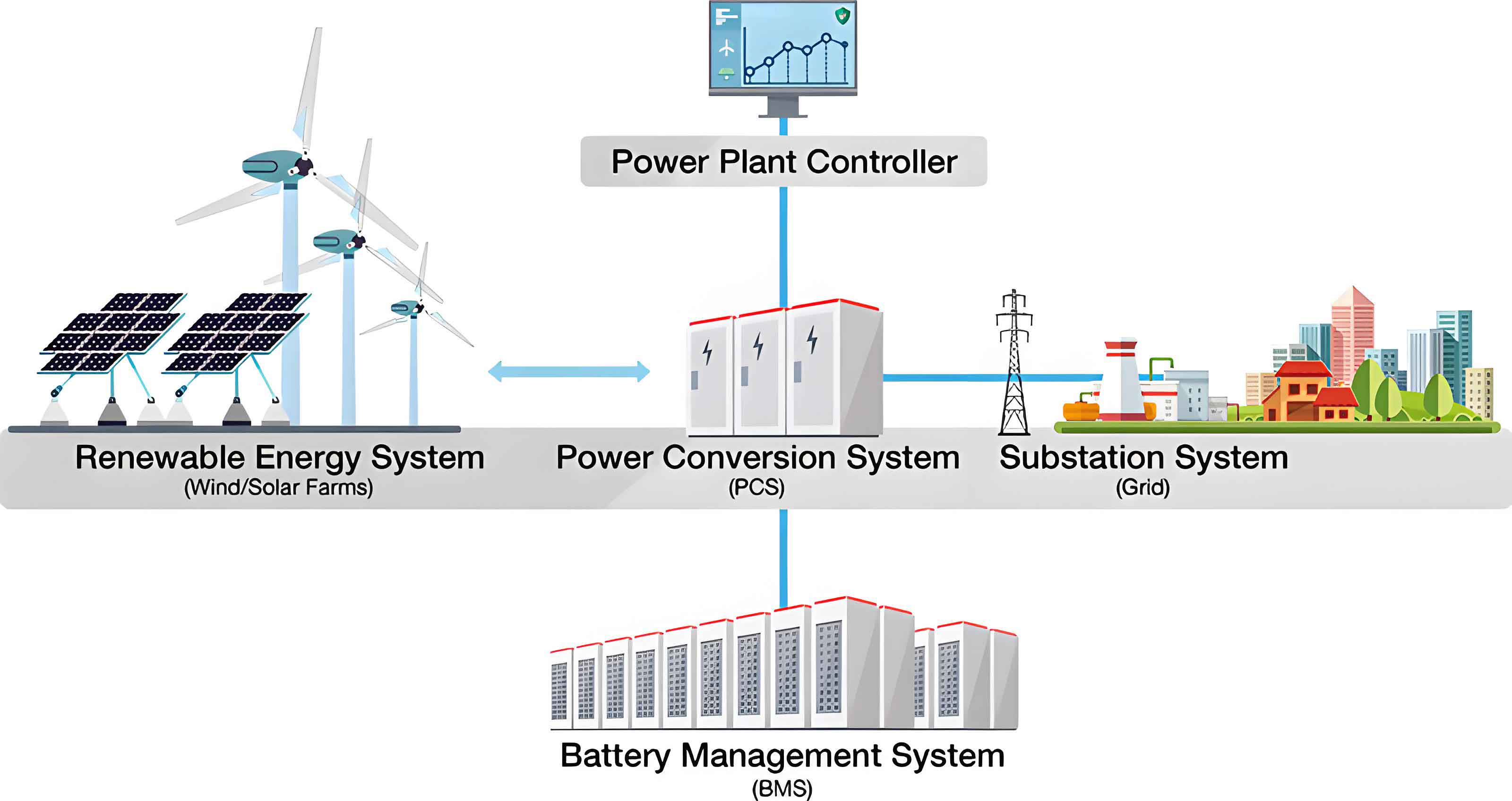
In the rapidly evolving landscape of energy storage, the lithium-ion battery energy storage system (BESS) has emerged as a dominant technology due to its flexibility, fast response, and decreasing costs. According to the “2025 China New Energy Storage Industry Development White Paper – Opportunities and Challenges”, lithium-ion batteries accounted for 89% of energy storage tenders in 2024, establishing their leading position. At the heart of every modern BESS lies the Energy Management System (EMS), which acts as the “intelligent brain” to coordinate energy dispatch, state estimation, and power conversion. This paper presents my research on the key technologies of a lithium-ion battery energy storage EMS, focusing on intelligent energy scheduling, precise state-of-charge (SOC) estimation, and seamless grid-connected/off-grid switching. The system is developed on the domestic KingSCADA4.0 platform, integrating model predictive control (MPC), extended Kalman filtering (EKF), and multi-source data processing techniques. The results demonstrate significant improvements in reliability, scalability, SOC estimation accuracy, and scheduling response speed compared to conventional solutions. This study provides a practical pathway for upgrading lithium-ion battery energy storage EMS technology and offers insights for microgrids, renewable energy integration, and multi-energy system coordination.
1. System Requirements and Challenges
Based on the current architecture of lithium-ion battery energy storage systems, the cloud platform and virtual power plant face dual bottlenecks in achieving strong control functions. On one hand, data interface protocol heterogeneity leads to complex cross-system integration, making it difficult for cloud commands to efficiently penetrate to the device layer. On the other hand, there is a lack of deep integration of core control logic, hindering the implementation of key functions such as intelligent energy scheduling and optimization strategies, precise SOC control, and automatic grid-connected/off-grid switching with power assurance. Therefore, it is essential to build a configurable EMS as the central hub for intelligent management of energy storage devices. The system requirements are decomposed as shown in Table 1.
| System Module | Sub-module | Detailed Function |
|---|---|---|
| Energy Storage EMS Platform | User Rights Configuration | Ordinary User |
| System Deployment Topology | ||
| Battery System Monitoring | Data Monitoring | |
| Alarm Setting | ||
| Parameter Setting | ||
| Variable Current System Monitoring | ||
| Converter System Monitoring | Data Monitoring | |
| Parameter Setting | ||
| Auxiliary System Monitoring | Real-time Data and Alarms | |
| Intelligent Energy Scheduling & Optimization Strategy | Optimization Objective and Constraint Modeling | |
| Operation and Maintenance Engineer | ||
| System Administrator | ||
| Precise SOC Control | Battery Equivalent Model Construction | |
| Adaptive Estimation Algorithm | ||
| Grid/Off-Grid Automatic Switching & Power Assurance | State Monitoring and Switching Criteria | |
| Smooth Switching Control Strategy | ||
| Expert Diagnosis | Alarm Log | |
| Real-time/Historical Alarm | ||
| Log Traceability | ||
| Operation and Maintenance Debugging | System Configuration | Data Forwarding |
1.1 Key Technical Difficulties
Based on the current status of the energy storage industry, the development difficulties of this system are as follows:
- Data fusion and control adaptation: Multi-vendor devices use Modbus, CAN, and proprietary protocols. The data and command formats are inconsistent, leading to difficulties in cross-device coordinated control, affecting the accuracy of energy scheduling and the generality of SOC estimation.
- Insufficient data sharing and strategy linkage: The MQTT communication topics and data specifications between the EMS and cloud platforms/virtual power plants are not unified. Cloud-side commands are inefficiently executed, and status feedback is delayed, breaking the strategy closed loop and increasing integration workload.
- Limited core function implementation: Protocol barriers cause incomplete collection of battery state data, resulting in large SOC estimation errors. The synchronization delay of grid/off-grid switching is high, and there is a lack of universal logic to adapt to multi-brand PCS, leading to inadequate power assurance response.
- Operation and maintenance issues: System configuration is scattered and relies on manual deployment. Manufacturers cannot autonomously maintain parameters. The edge side lacks a cache-async-resume mechanism, leading to loss of critical data, affecting strategy iteration and early warning model training.
2. Solution Research
2.1 System Software Architecture
To meet the development needs of the energy storage industry, I built a lithium-ion battery energy storage EMS platform. As the “smart brain” of the storage system, this platform achieves data aggregation, processing, storage, and sharing under complex protocols, providing data support for intelligent storage system construction. It adopts a modular framework, providing a unified energy management template, achieving business function isolation and weakly coupled expansion, avoiding redundant construction. The overall business architecture is shown in Figure 1 (referenced conceptually). The platform layers include: presentation layer (large screen, browser, C/S client, mobile), cloud platform layer (scenario display, digital twin, monitoring and early warning, remote dispatch, operation analysis, etc.), station-level EMS layer (power wiring diagram, battery/converter/auxiliary monitoring, logic control, protocol parsing, etc.), and device layer (BMS, PCS, auxiliary equipment).
2.2 Deployment Architecture
The station-level EMS is deployed based on KingSCADA4.0. Its built-in IOserver acquisition module supports distributed deployment. It connects to device data via LAN, ModbusRTU, or CAN bus, and features offline caching with resume capability to ensure historical data integrity. It also supports unified operation and maintenance from a central group, enabling data sharing. Through custom interfaces, it easily interacts with the energy storage operation and maintenance cloud platform for data exchange and command dispatch. The deployment architecture is summarized in Table 2.
| Component | Description |
|---|---|
| Station-level EMS Server | KingSCADA4.0 runtime, Linux IOserver, distributed deployment |
| Data Acquisition | ModbusRTU, Modbus TCP, CAN bus, 5000+ protocol drivers |
| Offline Cache | IOserver buffer with resume on reconnect; data synced by timestamp |
| Cloud Interface | MQTT protocol for northbound data sharing with cloud platform |
| Central O&M | Remote update of edge EMS projects, unified monitoring, data aggregation |
2.3 Key Technologies
(1) Multi-source Data Aggregation
KingSCADA4.0 solves the multi-source data collection challenge with: (a) Heterogeneous device access – supports over 5000 driver protocols with key adaptations for ModbusRTU, ModbusTCP, and CAN bus; (b) Unified deployment and O&M – provides central O&M interface for remote updates and monitoring of all edge systems; (c) Data integrity – IOserver offline caching ensures no data loss, supporting big data analysis.
(2) Core Function Subsystem Development
I rapidly developed the EMS core subsystems using KingSCADA4.0: intelligent energy scheduling, precise SOC control, grid/off-grid switching control, and remote O&M subsystems. These modules interact through a unified data bus using a distributed computing architecture to guarantee real-time performance. Critical control command response time is ≤50 ms.
(3) Data Sharing and Cloud-Edge Collaboration
KingSCADA4.0 integrates the MQTT protocol. By configuring topics and data structures (with exception handling), it opens data sharing channels with northbound cloud platforms and virtual power plants. No code compilation is required to adapt to different targets. Data granularity covers variable and device dimensions, improving integration efficiency and accuracy.
(4) Full Localization (Xinchuang) Integration
KingSCADA4.0 supports domestic operating systems (NeoKylin, UOS) and CPUs (FeiTeng, Loongson, Zhaoxin, Haiguang, ShenWei). It also completes driver compatibility with mainstream domestic PLCs (Nanda Aotuo, Huichuan, Hollysys).
2.4 System Implementation
(1) User Rights Configuration: Three roles: Ordinary user (view only), O&M engineer (view most pages, operate limited pages), System administrator (full access).
(2) System Deployment Topology: Displays the topology of the energy storage system, showing key device data (BMS, PCS, auxiliary loads, grid meters, etc.) in a concentrated manner.
(3) Battery System Monitoring: Shows BMS real-time data and alarms (green=normal, red=alarm). Alarm thresholds are configurable (minor/moderate/severe). Parameters such as SOC-related configs are online adjustable.
(4) Converter (PCS) System Monitoring: Shows real-time data and alarms for PCS.
(5) Auxiliary System: Monitors fire protection, liquid cooling, temperature/humidity sensors, with alarm status indicators.
(6) Intelligent Energy Scheduling and Optimization Strategy
Optimization Objective and Constraint Modeling:
The lifetime revenue maximization objective function is:
$$
\max J = \int_{0}^{T} \left( C_{grid} P_{sell} – C_{buy} P_{buy} – \lambda_{deg} P_{bat}^2 \right) dt
$$
where \(C_{grid}\) is the feed-in tariff, \(P_{sell}\) is the power sold to grid, \(C_{buy}\) is the purchase cost, \(P_{buy}\) is the power bought from grid, \(\lambda_{deg}\) is the battery aging coefficient, and \(P_{bat}\) is the battery charge/discharge power.
Constraints include: battery power limits, SOC safety range (e.g., 10%–90%), grid interaction power limits.
Dynamic Optimization Algorithm:
I employ model predictive control (MPC) combined with rolling horizon optimization:
- Short-term load forecasting: LSTM neural network predicts 24-hour load curve with error ≤5%.
- Rolling optimization: Every 15 minutes, the optimization window is updated; interior point method solves the optimal charge/discharge plan.
- Real-time correction: Control variables are adjusted based on actual load deviation to ensure robustness.
(7) Precise SOC Control
Battery Equivalent Model:
I use a second-order RC equivalent circuit model:
$$
U_{ocv} = f(SOC)
$$
$$
U_{bat} = U_{ocv} – I_{bat} R_0 – U_{R1} – U_{R2}
$$
where \(U_{ocv}\) is open-circuit voltage, \(R_0\) is ohmic internal resistance. Model parameters are identified via HPPC tests, establishing a SOC-OCV mapping database.
Adaptive Estimation Algorithm:
I propose an Extended Kalman Filter (EKF) based SOC estimation method.
State equation:
$$
SOC_k = SOC_{k-1} – \frac{\eta I_{bat} \Delta t}{Q_{nom}} + w_k
$$
Observation equation:
$$
U_{bat,k} = f(SOC_k, I_{bat,k}) + v_k
$$
Adaptive correction: Battery aging factors are introduced to update capacity parameters in real time, keeping estimation error within 2%.
(8) Grid/Off-Grid Automatic Switching and Power Assurance
State Monitoring and Switching Criteria:
A grid state assessment index system includes voltage deviation, frequency fluctuation, and harmonic distortion. Three-level thresholds:
- Normal: voltage deviation ≤±5%, frequency deviation ≤±0.2 Hz
- Warning: voltage deviation 5%–10%, frequency deviation 0.2–0.5 Hz
- Switch: voltage deviation >±10%, frequency deviation >±0.5 Hz or continuous interruption >200 ms
Smooth Switching Control Strategy:
I adopt Virtual Synchronous Generator (VSG) based seamless switching technology.
- Grid to off-grid: Detects grid anomaly 50 ms in advance; pre-synchronization control keeps storage output voltage aligned with grid; voltage fluctuation during transition ≤3%.
- Off-grid to grid: Uses droop control for smooth active/reactive power transition; inrush current ≤1.2 times rated current.
- Black start: Supports gradual load insertion without grid support; startup time ≤30 s.
(9) Expert Diagnosis: Enumerates IO acquisition variables, retrieves historical data by time period, displays as line chart, bar chart, scatter plot, or table. Ensures historical data integrity for equipment early warning and trend prediction.
(10) Alarm Log: Real-time alarms (monitor equipment faults), historical alarms (filterable queries), operation logs (automatically saved steps).
(11) O&M Debugging: Single-step debugging for controllable devices (liquid cooling units, PCS, BCU) to verify correct response.
(12) System Configuration: Sets parameters for grid, logic thresholds, shutdown protection conditions, energy storage mode operation logic, etc.
3. Application Value of the System
The developed EMS system demonstrates significant application value:
- Rapid protocol adaptation: KingSCADA4.0’s fast protocol adaptation capability enables seamless data protocol switching between different PCS and BMS devices, providing real-time multi-source data support. Driver debugging time is reduced by more than 60% on average, ensuring core algorithms run on complete device data and improving multi-cabinet coordinated scheduling response speed.
- Cloud-edge collaboration closed loop: The configurable MQTT northbound data interaction mechanism enables flexible data and topic configuration, supporting efficient cloud-edge linkage. The cloud optimizes charge/discharge plans based on real-time SOC data from storage cabinets, and the edge quickly receives commands with latency ≤100 ms, improving energy utilization efficiency.
- Core control reliability enhancement: Real-time collection of BMS key parameters, combined with second-order RC model and EKF algorithm, achieves SOC estimation with error ≤2%, avoiding overcharge/overdischarge, extending battery life by approximately 15%. Provides reliable switching criteria for grid/off-grid transition with voltage fluctuation ≤3%, improving power stability by 40%.
- Domestic (Xinchuang) support for core algorithms: Leveraging the cross-platform Xinchuang capability of the QT framework, the system runs on domestic OS (NeoKylin) and CPU (FeiTeng) platforms, ensuring autonomous control of scheduling logic and meeting infrastructure security requirements.
- Global energy efficiency improvement: Cloud-edge bidirectional data flow enables global optimization: the cloud optimizes charge/discharge strategy, and the edge feeds back device status, supporting fast grid/off-grid switching (≤50 ms). Peak-valley arbitrage revenue increases by 12.3%, while ensuring continuous power supply during grid anomalies.
4. Conclusion
The lithium-ion battery energy storage EMS system is the core of intelligent energy storage, whose technical maturity determines device operation efficiency and safety, supporting enterprise competitiveness. The system developed on KingSCADA4.0 not only realizes basic functions like multi-source data acquisition, storage, real-time monitoring, and alarming, but also achieves dynamic energy scheduling via model predictive control algorithm, precise SOC control (error ≤2%) via extended Kalman filter algorithm, and seamless grid/off-grid switching (fluctuation ≤3%) via pre-synchronization control technology. This forms a closed-loop “perception-decision-execution” control chain. Verified in practical cases, the system responds to cloud platform/virtual power plant regulation demands, optimizes charge/discharge strategies through cloud-edge collaboration, improves energy efficiency, and reduces battery degradation. The configurable development and standardized interface design facilitate rapid deployment, realizing full-process intelligent management of energy storage, providing an economically reliable EMS solution reference for the industry.