
In response to the structural contradiction between the surge in charging load for electric vehicles under the “dual carbon” targets and the insufficient local consumption of renewable energy, I have constructed a full-chain system architecture of “photovoltaic generation, energy storage system, and charging piles” for parking lots. My research systematically reviews three feasible business models: full investment, energy management contracting (EMC), and the integrated photovoltaic-storage-charging model. I have established a dynamic economic model that couples the Levelized Cost of Energy (LCOE) with Net Present Value (NPV), embedding time-of-use electricity pricing, carbon trading, and vehicle-to-grid (V2G) revenue mechanisms into a single discounting framework. Through Monte Carlo simulation, I conducted an uncertainty analysis of electricity prices, carbon prices, battery degradation, and policy degression. Based on the results from the evaluation model, I propose targeted recommendations for the integrated application of photovoltaic generation and an energy storage system in parking lot construction.
Since the implementation of the “dual carbon” goals, the annual growth rate of new energy vehicles in China has averaged 58%, and the evening peak charging load in commercial districts of first-tier cities has reached 8% to 12% of regional electricity consumption. Due to differences in regional resource endowments, the average proportion of renewable energy used in public charging facilities in China is still about 15%, leaving significant room for improvement. The National Development and Reform Commission has listed “photovoltaic-storage-charging integration” in the “Green and Low-Carbon Advanced Technology Demonstration Project Implementation Plan,” aiming to build 100 demonstration projects before 2025. However, the academic community currently lacks a quantitative and comparative study on the economics and business models of photovoltaic-storage-charging systems for China’s five major climate zones. The International Energy Agency (IEA) reports that in 2022, the global installed capacity of “photovoltaic + energy storage system” charging stations exceeded 15 GW, becoming a main driver of market growth. In terms of policy support, Germany implemented a “photovoltaic + energy storage system + charging” tripartite subsidy plan, increasing its share in public charging infrastructure to 18%. California in the United States strengthened development through legislation, mandating that from 2023, all new commercial buildings must be equipped with photovoltaic-storage-charging facilities for no less than 20% of total parking spaces. After China listed photovoltaic-storage-charging integration as a key development area in the “14th Five-Year Plan” for energy development, a “1+N” policy system has been formed. The first batch of 15 pilot cities, including Beijing and Shanghai, has cumulatively built 83 demonstration projects, with the Qianhai Free Trade Zone in Shenzhen leading the industry in scale.
Current research mainly focuses on two dimensions. In system configuration optimization, a laboratory-developed dynamic capacity ratio algorithm improves overall system efficiency by 12% through real-time prediction of charging and discharging demands. In the field of economic assessment, tracking data from 152 global projects shows that as equipment costs decline and the price difference arbitrage model matures, the average payback period for photovoltaic-storage-charging projects has shortened from 9-11 years in 2018 to 5-7 years. However, breakthroughs are still needed in emerging areas such as grid interaction and the integration of carbon trading mechanisms.
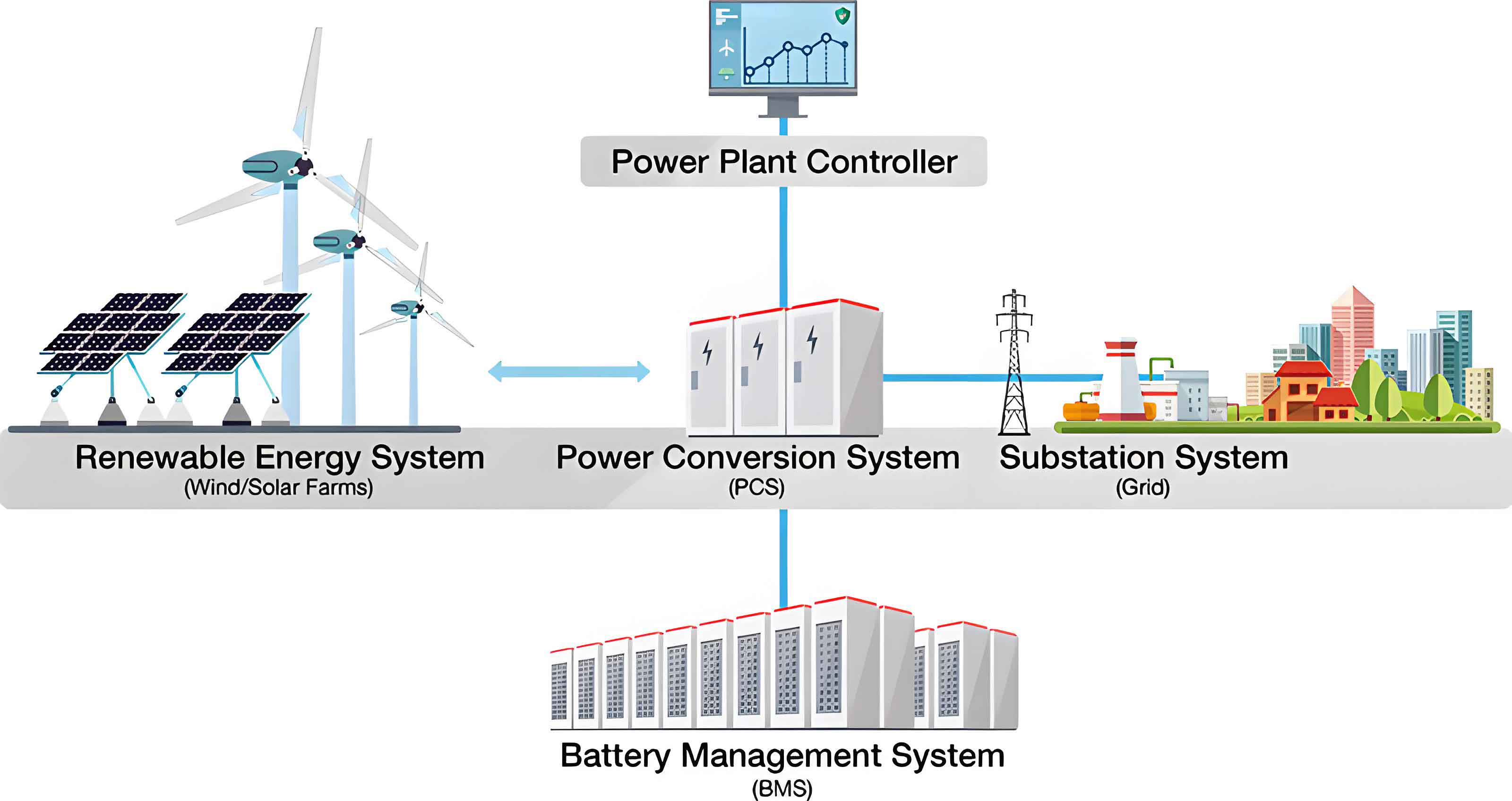
Therefore, based on a systematic review and a techno-economic analysis framework, I conducted a multi-dimensional cross-study on the photovoltaic and energy storage system for parking lots. I selected typical project cases for a full life-cycle assessment and constructed a dynamic optimization model to quantify system performance. On this basis, I built a “technology-economy-policy” coupling model to identify the most profitable and low-risk construction models for the integrated photovoltaic-storage-charging parking lot.
System Composition and Technical Principles
Overall System Architecture Design
The photovoltaic and energy storage system for a parking lot is built on a three-tier energy architecture: “generation, storage, and application,” achieving efficient utilization of clean energy through intelligent management.
Generation Layer: I use high-efficiency PERC bifacial photovoltaic modules, which provide a 5% to 15% boost in power generation through bifacial characteristics. The module conversion efficiency is no less than 21.5%, and anti-PID and anti-crack technologies are employed to ensure long-term stability. The installation tilt angle is optimized based on the local latitude combined with shadow analysis, and an intelligent tracking bracket system is configured to maximize solar energy utilization.
Energy Storage Layer: I typically adopt high-safety lithium iron phosphate battery packs with a modular design for easy future expansion. This energy storage system has a cycle life of over 6,000 times at 80% depth of discharge (DOD), equipped with an advanced liquid cooling temperature control system to maintain the optimal operating temperature range. It supports 0.5C fast charging and discharging, integrates multiple safety mechanisms like overcharge/over-discharge protection and short-circuit protection, and controls the state of charge (SOC) estimation accuracy within 3%.
Application Layer: I deploy 60-150 kW intelligent allocated charging piles using dynamic power distribution technology. The charging piles have V2G bidirectional charging and discharging functionality, are compatible with both CCS and CHAdeMO standards, and integrate smart identification and scheduled charging functions. An emergency power interface is also configured to provide backup power support in case of a grid failure.
The system control core is the Energy Management System (EMS) platform, which uses a distributed edge computing architecture. The platform functions include photovoltaic output forecasting based on meteorological data and historical generation curves, load demand response combined with electricity price signals and user habits, and battery health assessment based on SOH algorithms. The control layer achieves millisecond-level power scheduling through a 5G communication network, with a system response time typically not exceeding 50 ms. The platform provides comprehensive functions such as remote monitoring, energy efficiency analysis, and fault diagnosis to ensure safe and stable system operation.
| Component | Technical Parameter | Testing Standard Description |
|---|---|---|
| Photovoltaic Module | Peak power: 550 Wp | IEC 61215 international standard |
| Energy Storage Battery | Energy density: 160 Wh/kg (25°C) | GB/T 36276 national standard |
| Charging Pile | Output DC voltage: 200-750 VDC adjustable | NB/T 33008 industry certification |
| Inverter | Max conversion efficiency ≥98% (rated load) | GB/T 37408 energy efficiency level 1 |
System Operating Mode Analysis
The system has three typical operating modes, which can be intelligently switched based on different weather conditions, electricity demand, and energy supply status for optimal energy allocation.
1. Photovoltaic Direct Supply Mode: On sunny days, photovoltaic output prioritizes meeting charging demand, with excess electricity stored in the energy storage system. This mode utilizes renewable energy and reduces grid dependency. Typical application scenarios include industrial park charging stations and highway service areas.
2. Storage-Discharge Complementary Mode: During peak electricity consumption periods in the morning and evening, the system uses a coordinated power supply strategy from the energy storage system and photovoltaic generation. The built-in EMS monitors load demand in real-time and, in conjunction with the time-of-use pricing mechanism, prioritizes the release of stored energy from the energy storage system during peak price periods. This mode is suitable for commercial complexes with significant peak-valley electricity price differences.
3. Grid Supplement Mode: During consecutive cloudy or rainy days or when photovoltaic output is severely insufficient, the system seamlessly switches to grid power supply to ensure power continuity. This mode is typically the last resort, with annual activation time not exceeding 15% of the year, and is suitable for facilities with extremely high requirements for power supply stability, such as medical facilities and data centers.
Construction and Business Models and Development Recommendations
Typical Construction Models
Based on the system architecture and working modes, from the perspective of the investment return cycle, there are three main typical business models.
Full Investment Model: Suitable for investors with ample funds seeking long-term, stable returns. The investment recovery period T (i.e., operation period) is calculated using the formula:
$$ T = \frac{\ln \left(1 + \frac{\gamma \times I}{C}\right)}{\ln (1 + \gamma)} $$
Where: \( I \) is the initial investment (in million yuan), \( C \) is the annual net cash flow (in million yuan), and \( \gamma \) is the discount rate.
Energy Management Contracting (EMC) Model: Suitable for energy service companies focusing on short-term benefits and risk mitigation.
Integrated Photovoltaic-Storage-Charging Model: Aligns with the progressive development characteristics of the new energy field.
| Model | Investment Return Cycle | Typical Application Scenarios | Primary Risk Factors | Capital Contributor | Revenue Distribution Method | Technical Threshold |
|---|---|---|---|---|---|---|
| Full Investment | 7.2 years (Long) | Urban transport hubs, large public facilities | Policy adjustments, subsidy changes | Investor bears full cost | Investor enjoys all revenue | Low |
| EMC | 5.4 years (Short) | Commercial complexes, industrial parks | Client credit risk, electricity bill settlement risk | Energy service company invests | Shares energy-saving benefits with client | Medium |
| Photovoltaic-Storage-Charging | 6.1 years (Medium) | New residential communities, charging stations | Equipment maintenance requirements, system safety risks | Project developer or operator invests | Achieves comprehensive revenue through energy self-sufficiency | High |
Economic Evaluation Model
To economically evaluate the three business models, I established a dynamic economic model coupling the Levelized Cost of Energy (LCOE) and Net Present Value (NPV). This model embeds time-of-use electricity pricing, carbon trading, and Vehicle-to-Grid (V2G) revenue mechanisms within the same discounting framework.
The LCOE formula is:
$$ LCOE = \frac{\sum_{t=0}^{T} \frac{C_{inv,t} + C_{om,t} + C_{rep,t}}{(1+\gamma)^t}}{\sum_{t=0}^{T} \frac{E_{pv,t}}{(1+\gamma)^t}} $$
Where: \( C_{inv,t} \), \( C_{om,t} \), and \( C_{rep,t} \) are the initial investment amortization, operation and maintenance expenditure, and equipment replacement cost in year \( t \); \( E_{pv,t} \) is the effective photovoltaic power generation in year \( t \); \( \gamma \) is the discount rate; and \( T \) is the operating period.
The NPV formula is:
$$ NPV = \sum_{t=0}^{T} \frac{R_{cha,t}(P_{cha,t}) + R_{v2g,t}(P_{v2g,t}) + R_{co2,t}(P_{co2,t}) – C_{om,t} – C_{deg,t}}{(1+\gamma)^t} – C_{inv,0} $$
Where: \( R_{cha,t}(P_{cha,t}) \), \( R_{v2g,t}(P_{v2g,t}) \), and \( R_{co2,t}(P_{co2,t}) \) are the price signal functions for charging service fees, V2G discharge revenue, and carbon trading revenue; \( P_{cha,t} \), \( P_{v2g,t} \), and \( P_{co2,t} \) are the time-of-use electricity price, discharge agreement price, and carbon market average price in year \( t \); \( C_{deg,t} \) is the capacity value loss due to battery degradation in year \( t \); and \( C_{inv,0} \) is the one-time initial investment.
Using this coupled model, I built a comparison matrix for the three business models. Based on the mean parameters from photovoltaic construction revenue data in major Chinese cities, I conducted 5,000 random samplings using Monte Carlo simulation for electricity prices, carbon prices, battery degradation, and policy degression. This allowed me to output the NPV probability distribution and Risk-Adjusted Internal Rate of Return (RA-IRR) for each model, providing a quantitative basis for investment decisions. Additionally, to identify key risk factors, I used Value at Risk (VaR) to measure the maximum potential loss under extreme adverse scenarios. This is defined as the left-tail quantile of the project’s NPV distribution at a given confidence level (95%). A 5% VaR indicates that there is a 5% probability that the project’s loss will exceed this value; a larger absolute value signifies higher tail risk.
| Model | RA-IRR (95% Confidence) | 5% VaR (in million yuan) | LCOE Mean (yuan/kWh) |
|---|---|---|---|
| EMC | 12.0% | -95 | 0.38 |
| Photovoltaic-Storage-Charging | 7.7% | -142 | 0.52 |
| Full Investment | 4.1% | -198 | 0.65 |
The simulation results reveal significant performance differences across the three models. The EMC model demonstrates the best ability to resist tail risks due to its low initial investment and flexible revenue-sharing mechanism. In contrast, the full investment model, while theoretically offering high returns, is most sensitive to policy subsidy withdrawal and electricity price declines. The integrated photovoltaic-storage-charging model, with its high technical coupling, faces major uncertainties primarily from the complexity of its operation and maintenance. This dynamic economic model is effective in quickly identifying the key risk factors for each business model, providing investors with a quantitative basis for optimizing capital structure and formulating hedging strategies.
Development Recommendations
Based on the current development needs of the new energy industry, I propose four targeted development recommendations to improve the industry support mechanism and stimulate market vitality.
1. Incorporate photovoltaic carports into green building evaluation standards. I recommend revising the current green building evaluation system to explicitly recognize the energy-saving and carbon-reduction contributions of photovoltaic carports, encouraging their application in public buildings, commercial parks, and other scenarios, and granting corresponding scoring weights or policy incentives.
2. Implement a capacity electricity price subsidy for the energy storage system (≥0.3 yuan/kWh). To address the high operational costs of the energy storage system, I suggest introducing a special subsidy policy to provide electricity price support based on the actual discharge volume for qualifying storage projects, thereby improving the investment return rate and promoting large-scale development of energy storage systems.
3. Formulate technical specifications for DC microgrid integration. To promote the efficient consumption of new energy, I recommend accelerating the development of grid-connection standards for DC microgrids and public grids, clarifying voltage levels, safety protection, and dispatch control requirements, lowering the technical application threshold, and ensuring stable system operation.
4. Establish a carbon trading mechanism for photovoltaic-storage-charging projects. I suggest incorporating integrated photovoltaic-storage-charging projects into the carbon market trading system. This would involve quantifying their green electricity substitution and carbon emission reduction benefits, allowing enterprises to obtain additional income through carbon quota trading, thereby stimulating market investment vitality.
Conclusion
I have proposed a design model for the “photovoltaic + parking lot + charging pile” system and analyzed its construction models, economic benefits, investment risks, and related policy recommendations. The results provide a reference for the flexible application of photovoltaic systems in China. Future research will focus on the charging model and profit distribution mechanisms for the “photovoltaic + parking lot + charging pile” system and propose strategies for the system’s construction under varying policies and natural climate conditions.