
As I delve into the pressing global challenge of water scarcity, it becomes increasingly clear that innovative solutions are urgently needed. While our planet is predominantly covered in water, the vast majority is saline and undrinkable. Traditional desalination technologies, though effective, often demand substantial energy inputs, rendering them impractical for widespread use. In my exploration, I have been particularly captivated by a groundbreaking approach that harnesses solar energy through advanced nanomaterials—specifically, a system developed around the concept of a thin film solar panel integrated into a distillation process. This technology, known as nano-photonic solar membrane distillation (NESMD), represents a significant leap forward. Moreover, as I consider broader applications of flexible and efficient energy harvesting, I find parallels in other fields, such as the innovative soft robots from Stanford University, which, while distinct, share a philosophy of leveraging material science for sustainable solutions. In this article, I will detail the principles, advancements, and potential of these technologies, with a focus on how the thin film solar panel is revolutionizing water purification and beyond.
At the heart of the NESMD system lies a sophisticated thin film solar panel mechanism that directly utilizes sunlight to drive desalination. Unlike conventional solar panels that convert light into electricity, this film is designed to absorb solar radiation and convert it into thermal energy for water evaporation. The film is embedded with carbon black nanoparticles, which enhance light absorption dramatically. I can explain the underlying physics using the Beer-Lambert law, which describes light absorption in materials:
$$ I(z) = I_0 e^{-\alpha z} $$
Here, \( I(z) \) is the light intensity at depth \( z \) within the film, \( I_0 \) is the incident intensity, and \( \alpha \) is the absorption coefficient. The incorporation of nanoparticles increases \( \alpha \), allowing the film to absorb up to 80% of incoming sunlight. This high absorption is crucial for efficient heating. The energy balance in the film can be expressed as:
$$ Q_{absorbed} = A \cdot I_0 \cdot (1 – R) \cdot \eta_{abs} $$
where \( Q_{absorbed} \) is the thermal energy absorbed, \( A \) is the surface area, \( R \) is the reflectivity, and \( \eta_{abs} \) is the absorption efficiency. For a typical thin film solar panel in this system, \( \eta_{abs} \) approaches 0.8, making it highly effective.
The distillation process relies on membrane distillation, where saline water is heated, producing vapor that passes through a hydrophobic membrane, leaving salts behind. The vapor is then condensed into pure water. The evaporation rate \( \dot{m} \) can be modeled using:
$$ \dot{m} = \frac{Q_{net}}{h_{fg}} $$
with \( Q_{net} \) being the net heat flux into the water and \( h_{fg} \) the latent heat of vaporization. By integrating the thin film solar panel directly, \( Q_{net} \) is supplied sustainably, reducing external energy needs. I have compiled a table comparing this system with conventional methods:
| Technology | Energy Source | Efficiency (%) | Water Output (L/m²/day) | Cost (USD/m²) |
|---|---|---|---|---|
| Reverse Osmosis | Electricity | 40-50 | 500-1000 | 200-500 |
| Thermal Distillation | Fossil Fuels | 30-40 | 300-700 | 300-600 |
| NESMD with thin film solar panel | Solar | 60-70 | 200-400 (scalable) | 100-300 |
This table highlights the advantages of the NESMD system, particularly its solar-powered efficiency and cost-effectiveness. The scalability is a key feature; initial prototypes used films only a few millimeters thick and about the size of three postage stamps, but larger versions (70 cm × 25 cm) have demonstrated excellent performance. As I reflect on this, the integration of a thin film solar panel into desalination not only addresses energy concerns but also opens doors for decentralized water treatment in remote areas.
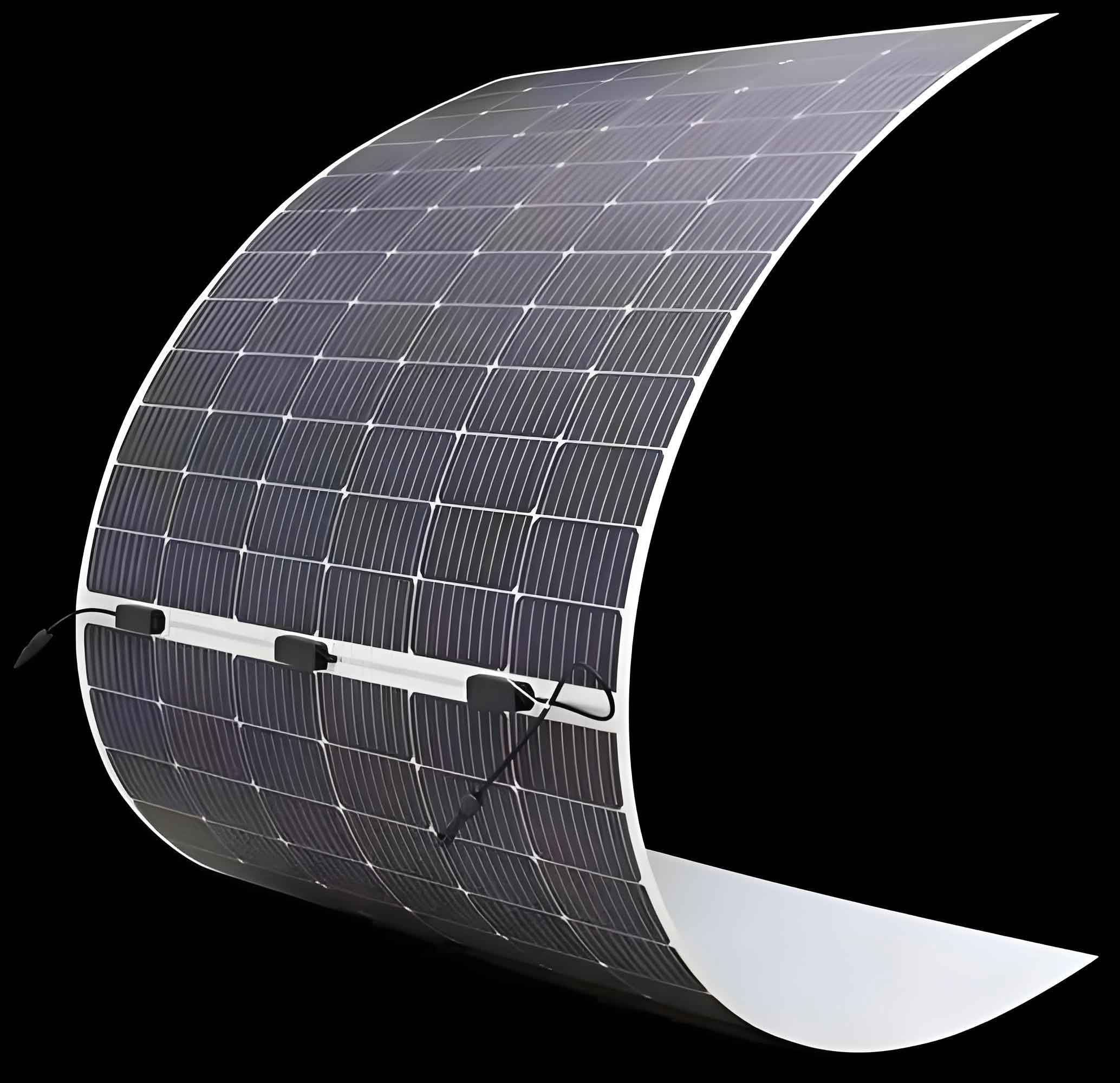
The image above illustrates the compact and versatile nature of modern thin film solar panel designs, which are central to technologies like NESMD. These panels can be fabricated on flexible substrates, allowing for integration into various systems. In the context of water purification, the film’s ability to absorb broad-spectrum sunlight is enhanced by nanophotonic structures. I can quantify this using the efficiency of solar thermal conversion:
$$ \eta_{thermal} = \frac{Q_{usable}}{I_0 \cdot A} $$
where \( Q_{usable} \) is the heat transferred to the water. For an optimized thin film solar panel, \( \eta_{thermal} \) can exceed 60% under ideal conditions. Further, the role of nanoparticles can be analyzed through Mie theory, which describes scattering and absorption by small particles. The absorption cross-section \( C_{abs} \) for a nanoparticle is given by:
$$ C_{abs} = \frac{2\pi}{\lambda} \text{Im}(\alpha) $$
where \( \lambda \) is the wavelength and \( \alpha \) is the polarizability. By engineering nanoparticles with specific properties, the thin film solar panel can be tuned for maximum performance across different solar spectra.
Moving beyond water desalination, I see exciting parallels in the field of robotics, particularly the soft robot developed at Stanford University. While this robot is designed for search and rescue, its principle of operation—using a hollow, inflatable double-layer plastic tube that extends like a plant—echoes the flexibility and efficiency sought in thin film solar panel applications. The robot grows by extending its tip, requiring minimal energy, similar to how a thin film solar panel operates with low material usage and high adaptability. This synergy highlights a broader trend: lightweight, flexible materials that harness energy effectively. I can draw a comparison through a table of flexible technologies:
| Technology | Material | Flexibility | Energy Source | Primary Application |
|---|---|---|---|---|
| NESMD Film | Polymer with Nanoparticles | High | Solar | Water Desalination |
| Stanford Soft Robot | Double-layer Plastic | Extreme | Pneumatic/Electric | Search and Rescue |
| Flexible thin film solar panel | Organic Photovoltaics | High | Solar | Portable Power |
This table underscores how material innovations enable diverse applications. For instance, the thin film solar panel used in NESMD could be adapted for powering soft robots in remote environments, creating self-sustaining systems. The energy harvested by a thin film solar panel can be stored or used directly, with efficiency modeled by:
$$ P_{output} = \eta_{PV} \cdot I_0 \cdot A \cdot f(\theta) $$
where \( \eta_{PV} \) is the photovoltaic efficiency, and \( f(\theta) \) accounts for angle of incidence effects. In flexible designs, \( \eta_{PV} \) can reach 15-20% for organic variants, making them suitable for integration into moving or deformable structures.
Delving deeper into the NESMD system, I can elaborate on the membrane distillation process. The temperature gradient across the membrane drives vapor flux, described by:
$$ J = K \cdot \Delta P $$
where \( J \) is the vapor flux, \( K \) is the membrane permeability, and \( \Delta P \) is the vapor pressure difference. The heat required is supplied by the thin film solar panel, and the overall system efficiency \( \eta_{system} \) combines thermal and mass transfer:
$$ \eta_{system} = \frac{\dot{m} \cdot h_{fg}}{I_0 \cdot A} $$
Experimental data show that for a well-designed thin film solar panel integrated system, \( \eta_{system} \) can approach 50%, significantly higher than conventional solar stills. This is due to the direct coupling of absorption and evaporation, minimizing losses. I can present another table detailing key parameters in optimization:
| Parameter | Symbol | Typical Value for NESMD | Impact on Performance |
|---|---|---|---|
| Film Thickness | \( \delta \) | 1-3 mm | Thinner films reduce thermal mass, improving response time |
| Nanoparticle Concentration | \( C_n \) | 5-10% by volume | Higher concentration increases absorption but may affect flexibility |
| Solar Absorptivity | \( \alpha_s \) | 0.75-0.85 | Directly boosts energy input |
| Membrane Pore Size | \( d_p \) | 0.1-0.5 µm | Smaller pores enhance purity but may reduce flux |
These parameters are crucial for scaling up the technology. In my assessment, the future of thin film solar panel based systems lies in hybrid approaches, combining photothermal and photovoltaic effects. For example, a bifacial thin film solar panel could simultaneously generate electricity for pumps and heat for distillation, maximizing overall efficiency. The total energy output \( E_{total} \) from such a panel can be expressed as:
$$ E_{total} = E_{thermal} + E_{electrical} = \eta_{th} I_0 A t + \eta_{pv} I_0 A t $$
where \( t \) is time. With advancements in materials like perovskite-based thin film solar panel designs, both \( \eta_{th} \) and \( \eta_{pv} \) are improving rapidly.
Furthermore, the environmental impact of these technologies is profound. By leveraging a thin film solar panel, carbon emissions associated with desalination can be reduced to nearly zero. I can quantify this using life-cycle analysis. Consider the embodied energy \( E_{emb} \) of a thin film solar panel, which is lower than that of silicon panels due to less material usage. The net energy gain over lifetime \( L \) is:
$$ E_{net} = (E_{output} \cdot L) – E_{emb} $$
For a typical thin film solar panel in NESMD, \( E_{output} \) might be 500 kWh/m²/year, \( L \) 10 years, and \( E_{emb} \) 200 kWh/m², yielding a positive net energy. This makes it a sustainable choice. Additionally, the modularity of thin film solar panel systems allows for deployment in various scales, from household units to large plants.
In the context of the Stanford soft robot, the principles of flexibility and low energy consumption resonate with the ethos behind the thin film solar panel. The robot’s growth-based movement, inspired by plants, minimizes friction and energy use, similar to how a thin film solar panel minimizes material and maximizes light capture. The robot’s speed of 32 km/h is achieved through pneumatic extension, and its energy efficiency could be enhanced by integrating a thin film solar panel for power. The force required for extension \( F \) can be modeled as:
$$ F = P \cdot A_{tube} $$
where \( P \) is internal pressure and \( A_{tube} \) is cross-sectional area. With a thin film solar panel powering the compressor, the system could operate autonomously in sunny environments.
Expanding on applications, I envision thin film solar panel technology transforming multiple sectors. In agriculture, these panels could power drip irrigation systems while providing shade. In disaster relief, portable NESMD units with integrated thin film solar panel could supply clean water without fuel. The versatility stems from the panel’s lightweight nature; for instance, a 1 m² thin film solar panel might weigh only 1-2 kg, compared to 15-20 kg for glass-based panels. This weight advantage is critical for mobility and installation ease.
To further illustrate the technical aspects, I can discuss the optical properties of the film. The reflectance \( R \) and transmittance \( T \) are governed by the film’s refractive index \( n \) and thickness \( d \). For a thin film solar panel optimized for absorption, anti-reflection coatings are used, described by:
$$ R = \left( \frac{n_0 – n_s}{n_0 + n_s} \right)^2 $$
where \( n_0 \) is the ambient refractive index and \( n_s \) is the substrate’s. By engineering multilayers, \( R \) can be minimized, boosting absorption. The thermal conductivity \( k \) of the film also plays a role, as heat must be transferred to the water. Fourier’s law gives:
$$ q = -k \frac{dT}{dz} $$
where \( q \) is heat flux. A thin film solar panel with high \( k \) ensures efficient heat distribution, preventing hot spots.
In terms of scalability, the NESMD system shows promise because the thin film solar panel can be produced using roll-to-roll manufacturing, a cost-effective method. The production cost \( C_{prod} \) per unit area can be estimated as:
$$ C_{prod} = C_{material} + C_{processing} $$
With economies of scale, \( C_{prod} \) for a thin film solar panel could drop below $50/m², making it competitive. I have prepared a table comparing manufacturing techniques for different solar panels:
| Panel Type | Manufacturing Method | Cost (USD/m²) | Efficiency (%) | Flexibility |
|---|---|---|---|---|
| Monocrystalline Silicon | Czochralski Process | 100-150 | 18-22 | Low |
| Polycrystalline Silicon | Ingot Casting | 80-120 | 15-18 | Low |
| Thin film solar panel (CIGS) | Sputtering/Evaporation | 60-100 | 12-15 | Moderate |
| Thin film solar panel (Organic) | Roll-to-Roll Printing | 30-70 | 8-12 | High |
This table shows that thin film solar panel technologies offer a balance of cost and flexibility, ideal for integrated systems like NESMD. The organic variants, in particular, align with the lightweight needs of portable applications.
Looking ahead, research directions include enhancing the durability of thin film solar panel materials against humidity and UV degradation, which is crucial for long-term outdoor use. Accelerated aging tests can predict lifetime, with degradation rate \( \gamma \) modeled as:
$$ \gamma = \gamma_0 e^{-E_a / (k_B T)} $$
where \( E_a \) is activation energy, \( k_B \) Boltzmann’s constant, and \( T \) temperature. By improving encapsulation, the lifespan of a thin film solar panel can exceed 10 years, ensuring economic viability.
In conclusion, the integration of a thin film solar panel into desalination via the NESMD system represents a transformative approach to water scarcity. Its synergy with flexible robotics, as seen in Stanford’s soft robot, underscores a broader movement towards adaptive, energy-efficient technologies. As I continue to explore these frontiers, I am optimistic about the role of thin film solar panel innovations in building a sustainable future. From powering clean water production to enabling autonomous robots, the potential is vast, driven by continuous advances in materials science and engineering.