
In my research, I explore the construction of an innovation support system for the solar photovoltaic industry, focusing on regional development strategies. As energy and environmental issues become increasingly urgent for sustainable development, the solar photovoltaic industry, as a key component of new energy sectors, has gained global attention. This industry leverages the solar system to convert sunlight into electricity, offering a renewable and eco-friendly solution. In this article, I analyze the current state, threats, and recommendations for strengthening the innovation support system, with an emphasis on the role of the solar system in driving technological advancements. I will use tables and formulas to summarize key points, ensuring that the concept of the solar system is frequently highlighted to underscore its importance in this context.
The innovation support system for an industry, as I define it, comprises four essential elements: technology enterprises, innovation platforms, service agencies, and policy frameworks. These components interact to foster technological breakthroughs and industrial growth. For the solar photovoltaic industry, this system is critical because the efficiency and scalability of solar systems depend on continuous innovation. Below, I present a table summarizing these elements in relation to the solar system.
| Element | Description | Role in Solar System Development |
|---|---|---|
| Technology Enterprises | Includes tech-based SMEs, high-tech firms, and innovative companies that drive R&D and production. | They design and manufacture components for solar systems, such as photovoltaic cells and inverters, enhancing system performance. |
| Innovation Platforms | Comprises key laboratories, engineering research centers, and technology centers hosted by universities, research institutes, or enterprises. | These platforms conduct research on solar system technologies, improving energy conversion rates and durability. |
| Service Agencies | Encompasses organizations for R&D, technology transfer, testing, incubation, intellectual property, consulting, and financial services. | They support the deployment and maintenance of solar systems, ensuring reliability and market integration. |
| Policy Frameworks | Involves government policies on taxation, finance, talent, intellectual property, and standards that regulate and incentivize innovation. | Policies promote the adoption of solar systems by providing subsidies and setting technical standards. |
From my investigation, the solar photovoltaic industry in a specific region has shown promising growth, with significant contributions from local enterprises and platforms. The capacity for photovoltaic cells and modules has reached substantial levels, accounting for a notable share of the national market. The integration of solar systems into power grids has advanced, with installed capacity for photovoltaic power generation systems increasing steadily. Key enterprises have made breakthroughs in core technologies, such as photovoltaic inverters and thin-film solar cells, positioning the region as a leader in solar system innovation. To illustrate the economic impact, I propose a formula for the levelized cost of electricity (LCOE) for a solar system, which is crucial for evaluating its feasibility:
$$ LCOE = \frac{\sum_{t=1}^{n} \frac{I_t + M_t}{(1+r)^t}}{\sum_{t=1}^{n} \frac{E_t}{(1+r)^t}} $$
where \( I_t \) represents initial investment costs, \( M_t \) is maintenance costs, \( E_t \) is energy output, \( r \) is the discount rate, and \( n \) is the system lifetime. This formula helps assess the competitiveness of solar systems against traditional energy sources.
However, the development of the innovation support system faces several threats. Based on my analysis, I identify five major factors that hinder progress. First, top-level design is inadequate, leading to uncoordinated planning and a lack of comprehensive standards for solar system deployment. Second, publicity efforts are insufficient, resulting in low awareness about the benefits of solar systems and available policies. Third, preferential policies are difficult to implement, with delays in subsidy disbursement and quota allocations for solar projects. Fourth, financing challenges persist, as solar system investments require large upfront capital but face limited access to funds. Fifth, there is a shortage of professional talent, affecting the R&D, installation, and maintenance of solar systems. I summarize these threats in the table below, linking each to the solar system context.
| Threat Factor | Impact on Solar System Innovation | Examples |
|---|---|---|
| Top-Level Design Gaps | Leads to fragmented development and inconsistent standards for solar system integration. | Absence of regional solar system planning aligned with grid infrastructure. |
| Insufficient Publicity | Reduces public and corporate engagement in adopting solar systems. | Low uptake of rooftop solar systems due to misinformation. |
| Policy Implementation Issues | Delays incentives for solar system deployment, slowing market growth. | Subsidies for solar system installations not being timely paid. |
| Financing Difficulties | Limits capital for solar system projects, especially for SMEs. | High interest rates for loans to build large-scale solar systems. |
| Talent Shortages | Hampers innovation in solar system technologies and operations. | Lack of engineers specialized in solar system design and grid integration. |
To address these threats, I propose several recommendations. First, accelerate top-level design by formulating a regional development plan for the solar photovoltaic industry, with a focus on harmonizing solar system deployments with energy grids. This should include establishing technical standards for solar system components and installations, which can be elevated to national levels. Second, enhance publicity campaigns to educate stakeholders about the economic and environmental benefits of solar systems. For instance, disseminating success stories of solar system applications can boost confidence. Third, streamline policy implementation by simplifying subsidy procedures and ensuring timely fund allocation for solar system projects. Governments should consider shifting from front-end to back-end subsidies to reduce financial risks. Fourth, diversify financing channels by creating dedicated funds for solar system investments and encouraging public-private partnerships. A formula for the net present value (NPV) of a solar system investment can guide decision-making:
$$ NPV = \sum_{t=0}^{n} \frac{CF_t}{(1+r)^t} $$
where \( CF_t \) represents cash flows from the solar system, including revenue from energy sales and subsidies, \( r \) is the discount rate, and \( n \) is the project duration. Positive NPV indicates viability, attracting more investors to solar systems.
Fifth, accelerate talent cultivation through collaborations between universities, research institutes, and enterprises to develop curricula and training programs focused on solar system technologies. This will ensure a skilled workforce for designing, installing, and maintaining solar systems. Sixth, strengthen technological innovation capabilities by supporting R&D platforms and industry alliances dedicated to advancing solar system efficiency. For example, investing in labs that study photovoltaic materials can lead to breakthroughs in solar system performance. The efficiency of a solar system is often measured by the photovoltaic conversion rate, given by:
$$ \eta = \frac{P_{out}}{P_{in}} \times 100\% $$
where \( \eta \) is the efficiency, \( P_{out} \) is the electrical power output from the solar system, and \( P_{in} \) is the solar irradiance input. Improving \( \eta \) is a key goal for innovation, as it directly impacts the cost-effectiveness of solar systems.
In my view, the solar system is not just a technological entity but an ecosystem that requires coordinated support. For instance, the integration of distributed solar systems into urban areas can transform energy landscapes. To visualize the potential of solar systems, consider the following image that illustrates a scalable solar system installation, highlighting its components and applications. This representation underscores how solar systems can be deployed in diverse settings, from residential rooftops to large-scale farms.
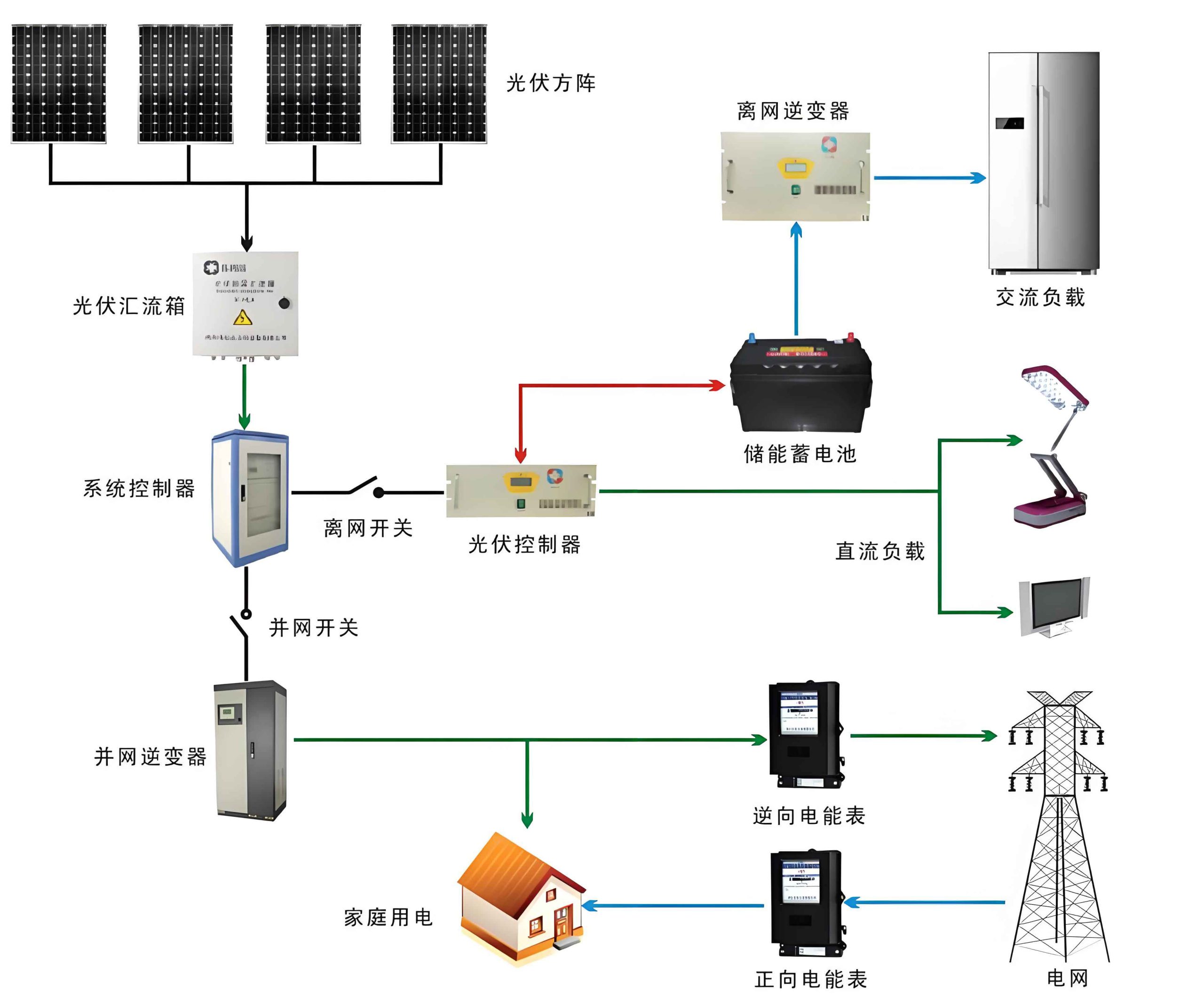
Furthermore, the growth of the solar photovoltaic industry relies on continuous innovation in solar system design. I have observed that regions with robust innovation support systems tend to excel in solar system exports and technology licensing. For example, advancements in thin-film solar cells have made solar systems more flexible and applicable in building-integrated photovoltaics (BIPV). The economic benefits of solar systems can be modeled using a production function that incorporates innovation inputs:
$$ Y = A \cdot K^\alpha \cdot L^\beta \cdot S^\gamma $$
where \( Y \) is the output of solar system products, \( A \) is total factor productivity driven by innovation, \( K \) is capital investment, \( L \) is labor, \( S \) is the stock of solar system knowledge, and \( \alpha, \beta, \gamma \) are elasticities. This formula emphasizes how knowledge accumulation in solar systems boosts industrial output.
In conclusion, building a strong innovation support system for the solar photovoltaic industry is essential for sustainable development. From my perspective, the solar system serves as the core of this industry, and its success depends on addressing threats through strategic recommendations. By focusing on planning, publicity, policies, financing, talent, and innovation, regions can enhance their competitiveness in the global solar system market. I recommend further research into cost-reduction techniques for solar systems and international comparisons of support frameworks. Ultimately, the widespread adoption of solar systems will contribute to energy security and environmental protection, aligning with global trends toward renewable energy. As I reflect on this study, I believe that continuous emphasis on the solar system in policy and practice will drive the transition to a low-carbon economy.