
The increasing prevalence of haze and the accelerated depletion of the ozone layer have positioned PM2.5 and ultraviolet (UV) radiation as significant modern environmental pollutants. Their imperceptible nature—PM2.5 due to its fine particulate size and UV due to its non-visible wavelength spectrum—poses a direct yet invisible threat to human health. Prolonged exposure is linked to respiratory, cardiovascular diseases, and skin cancers. Consequently, the development of reliable, real-time remote monitoring solutions is paramount for public health awareness and safety. Traditional monitoring stations are often fixed, costly, and reliant on grid power, limiting deployment flexibility. This design addresses these challenges by proposing a distributed, wireless sensor network (WSN) for outdoor environments, uniquely characterized by its autonomous solar system for power, integrating ZigBee and GSM communication technologies, and enabling both local data logging and remote user interaction via SMS commands.
The core innovation lies in creating a sustainable and intelligent monitoring infrastructure. The entire apparatus is powered by an independent photovoltaic solar system, eliminating dependency on external electrical grids and facilitating installation in remote or expansive outdoor areas. The system architecture synergizes short-range, low-power ZigBee networks for dense, localized data collection from multiple points with the expansive, ubiquitous coverage of GSM networks for long-distance user communication. This fusion allows for detailed spatial environmental analysis and on-demand access to information from anywhere with cellular service. The design philosophy emphasizes modularity, energy efficiency, and user-centric control, providing a robust technical framework for modern environmental telemetry.
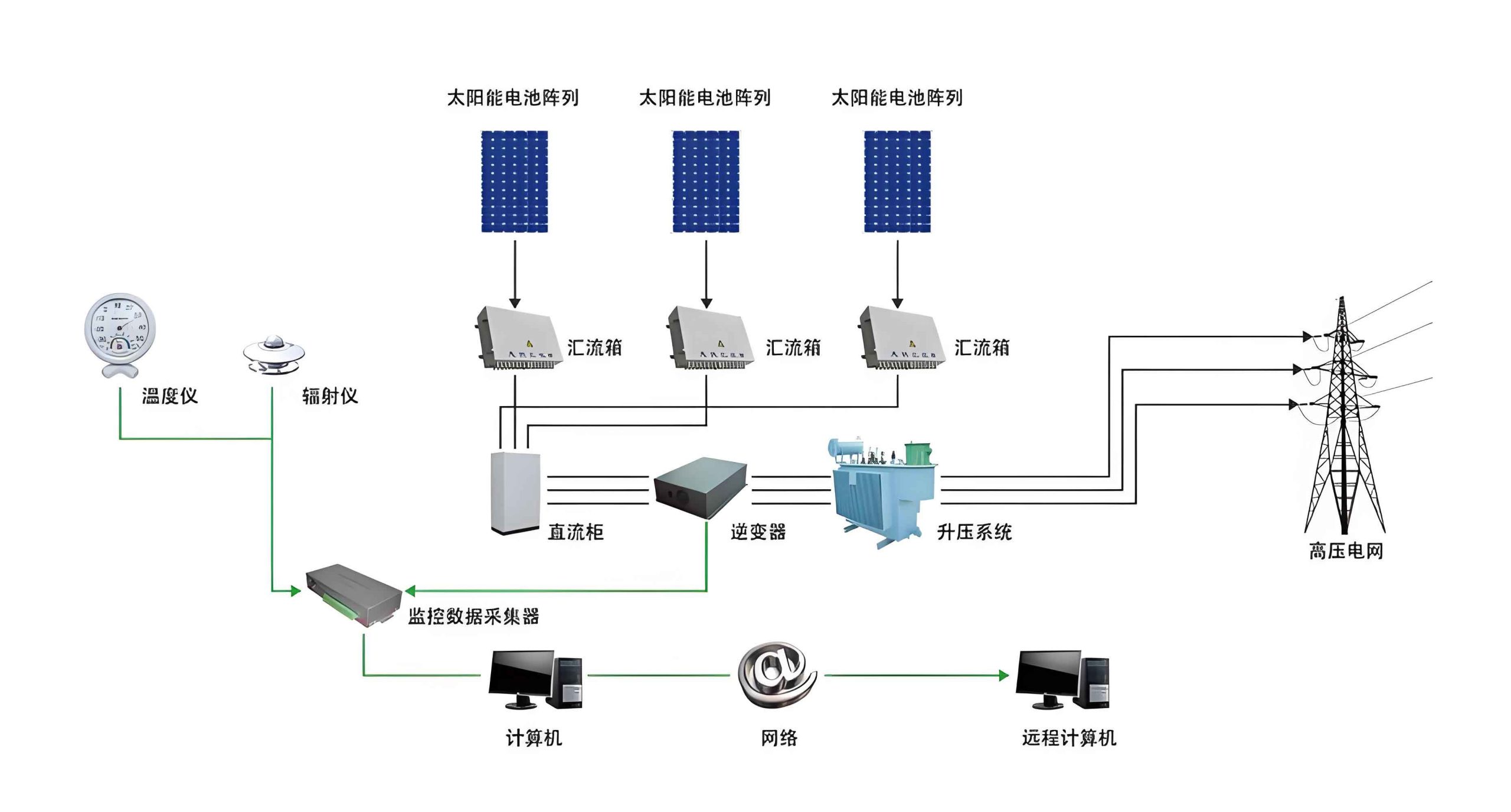
1. Overall System Architecture and Design Principles
The proposed system is a three-tiered structure comprising End-Device Nodes, a ZigBee-GSM Gateway, and a Central Data Server (Upper Computer). The topology of the ZigBee network is a star configuration, chosen for its simplicity, reliability in moderate-scale deployments, and direct management of end-devices by the coordinator. This structure is ideal for monitoring specific zones within an outdoor area, such as a public square or park.
End-Device Nodes (Sensor Nodes): These are the distributed data acquisition units. Each node is equipped with sensors for PM2.5 concentration and UV index, a microcontroller with a ZigBee radio, and a dedicated power management unit sourced from its own solar system. Their primary functions are to collect sensor data, process it, and wirelessly transmit it to the gateway coordinator upon command. Crucially, they can enter a deep sleep state, with only the communication circuitry minimally active to listen for wake-up commands, conserving energy from the solar system.
ZigBee-GSM Gateway: This is the system’s hub and bridge. It consists of a ZigBee network coordinator and a GSM module (SIM900A). The coordinator establishes and manages the ZigBee network, aggregates data from all end-devices, and forwards it to the central server via a serial (USB) connection. Simultaneously, it processes incoming SMS commands from user mobile phones via the GSM module. Based on the command, it can either broadcast control signals to the sensor nodes or query the latest data and send it back as an SMS reply.
Central Data Server: Typically a PC running a custom application developed in a platform like LabVIEW, this tier is responsible for data visualization, historical storage, and analysis. It provides a graphical user interface (GUI) to display real-time and historical trends from all deployed nodes.
The data flow and command flow are bidirectional. The user initiates interaction by sending an SMS (e.g., “START NODE1”, “QUERY ALL”) to the gateway’s SIM number. The gateway interprets this and issues corresponding ZigBee commands. Sensor nodes activate, collect data, and send it back via ZigBee to the gateway, which then relays it to the server and/or the user’s phone. This design ensures the system remains dormant until requested, maximizing the efficiency of the onboard solar system energy reserves.
2. Hardware Design and Component Specification
The hardware implementation focuses on robustness for outdoor operation, precision in sensing, and ultra-low power consumption facilitated by the renewable solar system.
2.1 End-Device Node Design
Each end-device node is an integrated unit with four key subsystems: the Sensing Unit, the Main Controller & Transceiver, the Power Management & Switching Unit, and the Photovoltaic Solar System.
2.1.1 Sensing Unit
PM2.5 Sensor Module: The Sharp GP2Y1014AU0F optical dust sensor is employed. It operates on the principle of light scattering. An internal infrared LED illuminates particles, and a phototransistor detects the scattered light intensity, which is proportional to dust concentration. The sensor requires a specific drive signal: a 0.32ms wide pulse every 10ms. The output is an analog voltage (Vout) that needs to be sampled shortly after the LED is turned off. The relationship between output voltage and mass concentration is non-linear but can be characterized. A simplified model for the region of interest can be expressed as a linear approximation after calibration:
$$ C_{pm2.5} \approx k \cdot (V_{out} – V_{clean}) $$
where \( C_{pm2.5} \) is the estimated concentration (µg/m³), \( V_{out} \) is the measured analog voltage, \( V_{clean} \) is the output voltage in clean air, and \( k \) is a calibration constant derived from empirical data.
UV Index Sensor Module: The Genicom GUVA-S12GD photodiode is used. It is sensitive specifically to the UV-A and UV-B spectrum (240-370 nm). The photodiode generates a minute photocurrent (\(I_{ph}\)) linearly proportional to the UV irradiance. A transimpedance amplifier (TIA) circuit converts this current to a measurable voltage. The UV Index (UVI), as defined by the World Health Organization, is a unitless scale directly proportional to erythemal irradiance. The sensor’s output voltage (\(V_{uv}\)) is linearly related to the UVI after proper circuit design and calibration:
$$ UVI = m \cdot V_{uv} + b $$
Coefficients \(m\) and \(b\) are determined through calibration against a reference meter under various sunlight conditions. The following table summarizes key sensor parameters:
| Sensor | Parameter | Value / Range | Notes |
|---|---|---|---|
| GP2Y1014AU0F (PM2.5) | Detection Particle Size | > 0.8 µm | Effective for PM2.5 |
| Supply Voltage | 5V ± 0.5V | – | |
| Output Type | Analog Voltage | Amplified and shaped | |
| Current Consumption | Typ. 20mA (during LED pulse) | Pulsed operation reduces avg. current | |
| GUVA-S12GD (UV) | Spectral Response | 240nm – 370nm | – |
| Photo-sensitivity | ~0.11 A/W @ 365nm | – | |
| Output | Photocurrent (nA to µA scale) | Requires TIA circuit | |
| Linearity | Excellent vs. UVI | Core advantage |
2.1.2 Main Controller and Transceiver
The Texas Instruments CC2530F256 system-on-chip (SoC) serves as the brain of the node. It integrates an enhanced 8051 microcontroller, a 2.4 GHz IEEE 802.15.4/ZigBee compliant RF transceiver, 12-bit ADC, timers, and ample flash memory. Its key roles are:
- Sensor Driving & Data Acquisition: Generate the precise 10ms pulse for the PM2.5 sensor using a timer in compare mode. Trigger ADC sampling of both sensor outputs at defined intervals (e.g., every 2 seconds during active phase).
- Data Processing: Apply the calibration formulas (\(C_{pm2.5} \approx k \cdot (V_{out} – V_{clean})\) and \(UVI = m \cdot V_{uv} + b\)) to convert raw ADC values into meaningful physical quantities.
- Wireless Communication: Package the processed data along with a unique node ID and transmit it to the coordinator using the ZigBee protocol stack (Z-Stack). Listen for and execute incoming commands (ON/OFF/QUERY) from the coordinator.
- Power Management Control: Control a relay or a solid-state switch to completely disconnect power to the sensing unit when the node is in standby mode, a critical feature for conserving the solar system‘s energy.
2.1.3 Power Management and the Solar System
This is the cornerstone of the node’s autonomy. Each node features a dedicated, modular solar system.
- Energy Harvesting: A 25W monocrystalline solar panel converts sunlight into electrical energy.
- Energy Storage: A 12V, 11Ah lithium iron phosphate (LiFePO4) battery stores the harvested energy. This chemistry offers good cycle life, safety, and performance across a wide temperature range.
- Power Conditioning: A two-stage voltage regulation circuit provides stable voltages for different sub-circuits.
- Stage 1 (12V to 5V): A switching regulator (e.g., based on LM2596) efficiently steps down the battery voltage to 5V. This 5V rail primarily powers the sensor modules and the relay coil.
- Stage 2 (5V to 3.3V): A low-dropout (LDO) linear regulator (e.g., MCP1700) provides a clean 3.3V supply for the CC2530 and its associated circuitry.
- Intelligent Switching: A relay circuit, controlled by a GPIO pin of the CC2530, sits between the 5V regulator and the sensors. When the node receives a “SLEEP” or “OFF” command, the CC2530 de-energizes the relay, cutting off all power to the PM2.5 and UV sensor circuits, reducing the idle power draw to almost zero for these components. Only the CC2530’s low-power listening mode remains active, sustained by the efficient 3.3V LDO. This drastic reduction in quiescent current is essential for ensuring the solar system can maintain operation through periods of low sunlight.
The energy balance for the node can be modeled as:
$$ E_{harvested}(t) \geq E_{active} \cdot t_{active} + E_{sleep} \cdot t_{sleep} + E_{loss} $$
where \(E_{harvested}(t)\) is the time-dependent energy from the solar system, \(E_{active}\) and \(E_{sleep}\) are power consumptions in active and sleep modes, and \(t_{active}\), \(t_{sleep}\) are the respective durations. The design ensures this inequality holds under typical weather conditions.
2.2 ZigBee-GSM Gateway Design
The gateway hardware is more complex, as it interfaces between three different networks: ZigBee, USB (for the PC), and GSM. It also requires a more substantial solar system due to the higher power demands of the GSM module.
- ZigBee Coordinator: Another CC2530 module, configured as the network coordinator (PAN coordinator). It uses one serial port (UART0) for communication with a USB-to-serial chip (e.g., CP2102 or PL2303) to connect to the PC. It uses a second serial port (UART1) to communicate with the GSM module at TTL logic levels.
- GSM Module: The SIM900A module provides GPRS/GSM connectivity. It is controlled via AT commands sent from the CC2530 coordinator over UART1. It handles the reception of SMS commands and the transmission of SMS replies containing sensor data.
- Gateway Power System: The gateway’s solar system is scaled up, typically using a larger panel (e.g., 50W) and a larger battery (e.g., 20Ah) to accommodate the peak currents (up to 2A) required by the SIM900A during transmission bursts. The voltage regulation architecture is similar but must be rated for higher current.
3. Software Design and System Logic
The software is structured in layers, following the Z-Stack protocol stack for ZigBee operations and incorporating modular firmware for sensor handling and GSM interaction.
3.1 Gateway Software Operation
The gateway firmware, running on the coordinator’s CC2530, is event-driven. Its main flowchart involves initialization, network formation, and a main loop polling serial ports and processing events.
- Initialization & Network Formation: On startup, the coordinator initializes the hardware, the ZigBee stack, and the GSM module (sending AT commands like AT+CMGF=1 for text SMS mode). It then scans for a clear channel and establishes a ZigBee personal area network (PAN), assigning itself a network address (typically 0x0000).
- Command Processing from GSM: The firmware periodically checks UART1 for new data from the SIM900A. When an SMS arrives, the SIM900A forwards it via a UART interrupt or polled read. The coordinator parses the SMS text.
- If the command is “START” or “QUERY NODE_X”, it sets a global flag `system_active = 1` and broadcasts a ZigBee “WAKE_UP” message to all end-devices or a unicast message to a specific node.
- If the command is “STOP”, it sets `system_active = 0` and broadcasts a “SLEEP” command.
- Data Aggregation & Routing: When end-devices send data packets, the ZigBee stack receives them and generates an application event. The application reads the packet, extracts node ID, PM2.5, and UVI values.
- The data is immediately formatted and sent to the PC via UART0 (USB).
- If the data was triggered by a “QUERY” SMS, the coordinator also formats a reply string (e.g., “N1_PM25=35_UVI=8″) and sends it to the SIM900A via UART1 using AT commands (AT+CMGS=”+1234567890”).
3.2 End-Device Node Software Operation
The end-device firmware is optimized for low duty-cycle operation.
- Startup and Association: After power-on, the device searches for and joins the coordinator’s network. Once joined, it primarily waits in a low-power mode, periodically waking its radio to listen for messages.
- Command Execution: Upon receiving a “WAKE_UP” command, the node:
- Powers on the sensor relay (setting GPIO high).
- Waits for sensor stabilization (~1s).
- Enters an active measurement loop: drives the PM2.5 LED, samples ADC channels, processes data using the defined formulas, packages the data, and transmits it to the coordinator.
- This loop repeats at a configurable interval (e.g., every 10 seconds) until a “SLEEP” command is received.
- Sleep Mode: On receiving “SLEEP”, the node:
- Powers off the sensor relay (GPIO low).
- Stops all periodic timers.
- Configures the CC2530 for its deepest sleep mode compatible with receiving wireless commands (e.g., PM2 or PM3 with wake-on-radio). This maximizes the benefit of the solar system by minimizing baseload consumption.
3.3 Data Server Application
The LabVIEW application on the PC performs several key functions:
- Communication: Manages the virtual COM port connection to the gateway.
- Parsing & Decoding: Interprets the incoming data strings, separating values by node ID.
- Real-time Display: Presents data numerically and graphically (gauges, charts, trends) for each node.
- Data Logging: Appends all received data with timestamps to files (e.g., .csv or .txt format) for long-term analysis.
- Alert Management: Can be configured to trigger visual or auditory alarms if sensor readings exceed predefined safety thresholds.
4. System Performance Analysis and Test Results
Extensive field testing was conducted over a prolonged period to validate system reliability, communication range, power autonomy, and measurement accuracy. The core performance metrics are summarized below.
4.1 Communication Reliability and Range
Tests were performed to establish the practical operating range of the ZigBee network in an outdoor, non-line-of-sight (NLOS) environment typical of a park with light foliage. The coordinator and end-devices were placed at varying distances, and packet success rate was measured over one-hour periods. The results clearly show the relationship between distance and packet loss, defining the effective deployment radius.
| Test Distance (m) | Packets Sent | Packets Received at Gateway | Packet Delivery Ratio (%) | Estimated Path Loss (dB) |
|---|---|---|---|---|
| 50 | 3600 | 3598 | 99.94 | ~70 |
| 100 | 3600 | 3580 | 99.44 | ~80 |
| 150 | 3600 | 3520 | 97.78 | ~90 |
| 200 | 3600 | 3420 | 95.00 | ~95 |
| 250 | 3600 | 3100 | 86.11 | ~102 |
| 300 | 3600 | 2520 | 70.00 | ~110 |
The path loss (PL) in dB can be estimated using a log-distance model:
$$ PL(d) = PL(d_0) + 10 \cdot n \cdot \log_{10}\left(\frac{d}{d_0}\right) + X_\sigma $$
where \(d_0\) is a reference distance (1m), \(n\) is the path loss exponent (higher for cluttered outdoors, ~3.5), and \(X_\sigma\) represents shadow fading. The sharp decline in PDR beyond 200m guides the planning of node density and gateway placement. For reliable operation (>95% PDR), a node spacing within 200m of the gateway is recommended.
4.2 Power System Performance and Autonomy
The efficacy of the independent solar system was evaluated by monitoring battery voltage over consecutive days, including cloudy periods. The power budget was calculated for a typical operational scenario.
Daily Energy Budget for an End-Device Node:
- Active Mode (2 hours per day): CC2530 Tx/Rx (~30mA avg) + Sensors powered (~25mA avg) = ~55mA @ 3.3V & 5V. Energy consumed: \(E_{active} \approx 55mA \cdot 3.7V_{avg} \cdot 2h = 407 mWh\).
- Sleep Mode (22 hours per day): CC2530 in PM2 mode (~1µA) + Quiescent current of LDO (~5µA) = ~6µA @ 3.3V. Energy consumed: \(E_{sleep} \approx 6\mu A \cdot 3.3V \cdot 22h = 0.44 mWh\).
- Total Daily Load: \(E_{load} \approx 407.44 mWh\).
Daily Energy Harvest (Estimate): A 25W panel in a moderately sunny location (4 peak sun hours equivalent) can generate: \(E_{harvest} \approx 25W \cdot 4h \cdot 0.70\) (system efficiency) \(= 70 Wh\).
This vast surplus (\(E_{harvest} \gg E_{load}\)) confirms the system’s sustainability. In practice, the battery state-of-charge remained above 80% throughout a 5-day cloudy period, proving the robustness of the designed solar system buffer.
4.3 Measurement Accuracy and Calibration
Sensor readings were compared against calibrated commercial instruments. For the UV sensor, a calibration curve was established. A sample of the calibration data and the resulting linear fit is shown below:
| Reference UVI Meter | Sensor Output Voltage (Vuv) | Calculated UVI (from fit) | Absolute Error |
|---|---|---|---|
| 2.0 | 0.85 | 1.98 | -0.02 |
| 5.0 | 1.52 | 5.05 | +0.05 |
| 8.0 | 2.18 | 8.02 | +0.02 |
| 11.0 | 2.85 | 10.96 | -0.04 |
The linear fit derived was: \( UVI = 3.57 \cdot V_{uv} – 1.05 \), with an R² value of 0.999, demonstrating excellent linearity. The PM2.5 sensor required a two-point calibration (clean air and a known dust source) to determine parameters for its specific response curve, achieving an accuracy within ±15% of the reference in the 0-100 µg/m³ range, which is acceptable for indicative environmental monitoring.
4.4 End-to-End System Latency
The time from user SMS command to received data SMS response was measured. The latency, typically between 10 to 15 seconds, is dominated by the GSM network’s SMS delivery time and the pre-programmed measurement/transmission cycle of the sensor nodes. This is perfectly adequate for environmental monitoring applications where real-time, sub-second response is not critical.
5. Discussion and Comparative Advantages
The implemented system demonstrates several key advantages over conventional or hypothetical alternatives:
| Feature | This System (Solar-Powered ZigBee-GSM) | Traditional Wired Station | Battery-Only WSN | GSM-Only Sensor Nodes |
|---|---|---|---|---|
| Deployment Flexibility | Very High. No need for power grid or communication cables. | Very Low. Requires fixed infrastructure. | High initially, but limited by battery life. | Moderate, but each node needs strong GSM signal. |
| Operational Cost | Very Low (no electricity bills). Minor SMS costs. | High (continuous grid power, land lease). | High (battery replacement labor & cost). | Moderate (SMS/GPRS data costs per node can add up). |
| Scalability | High. Easy to add more ZigBee nodes within range. | Low. Adding a station is expensive. | Moderate. Battery management complexity grows. | Low. Each node incurs separate subscription cost. |
| Energy Sustainability | Fully sustainable via the solar system. | Grid-dependent. | Not sustainable; requires periodic intervention. | Poor; GSM modules are power-hungry, quickly depleting batteries. |
| User Interaction | Direct & simple via SMS; also has a professional PC interface. | Typically requires accessing a dedicated website or SCADA. | Usually requires gateway and internet connection for remote access. | Direct via SMS, but no low-power local network for dense sensing. |
The synergy between the low-power, short-range ZigBee network for dense data collection and the high-power, long-range GSM for sporadic user interaction is optimal. It avoids the energy penalty of having every node connect directly to the cellular network, a design that would severely challenge any solar system at the node level. Furthermore, the intelligent switching of sensor power extends the operational lifetime during low-light conditions, a critical feature often overlooked in simple solar-powered designs.
6. Conclusion and Future Perspectives
This work has successfully designed, implemented, and validated a wireless outdoor environmental monitoring system centered around a sustainable, off-grid power solution. The integration of a photovoltaic solar system with energy-aware ZigBee sensor nodes and a GSM gateway creates a robust, flexible, and user-accessible platform for monitoring critical parameters like PM2.5 and ultraviolet radiation. The system proves that reliable, remote environmental telemetry can be achieved without reliance on fixed infrastructure, making it suitable for deployment in developing regions, remote sites, or for temporary monitoring campaigns.
The hardware design, particularly the dual-voltage regulation and relay-based sensor control, effectively manages the harvested solar energy. The software architecture, built upon a standard ZigBee stack with custom application layers, provides reliable device control, data routing, and seamless SMS-based user interaction. Field tests confirm stable operation, acceptable communication ranges, and sufficient measurement accuracy for its intended purpose.
Future enhancements could focus on several areas:
- Multi-Parameter Expansion: Integrating sensors for ozone (O₃), nitrogen dioxide (NO₂), noise levels, and meteorological data (temperature, humidity, wind speed) to provide a more comprehensive environmental picture.
- Advanced Energy Management: Implementing maximum power point tracking (MPPT) for the solar system to improve energy harvest efficiency, especially under partial shading or low-light conditions.
- Network Robustness: Evolving from a star to a mesh ZigBee topology (using router nodes) to extend coverage area and provide redundant communication paths, increasing system reliability for larger deployments.
- Data Connectivity: Upgrading the gateway’s GSM module to a 4G/LTE Cat-M1 or NB-IoT module for lower-power, higher-data-rate internet connectivity, enabling continuous cloud data logging and advanced web/mobile application interfaces alongside the basic SMS service.
- Predictive Analytics: Using the historical data collected by the system to train simple machine learning models for predicting local air quality trends based on time of day, weather, and traffic patterns.
In conclusion, this system provides a viable, cost-effective, and sustainable model for distributed environmental sensing. Its core principle of harnessing a dedicated solar system for autonomy, combined with hybrid wireless communication, forms a strong foundation for the next generation of smart environmental monitoring infrastructure.