
As the digital era accelerates with the rise of internet industries, AI technologies, and short-video platforms, data centers have become critical infrastructure for data storage, processing, and transmission. However, these facilities operate 24/7, leading to enormous energy consumption and environmental concerns. The urgent need for green data centers is underscored by global sustainability goals, and among renewable energy solutions, solar photovoltaic systems stand out as a transformative force. In this article, I explore the immense potential of solar systems in data center construction, analyzing their advantages, optimization strategies, and challenges, while emphasizing how they can drive energy efficiency and reduce carbon footprints. Through detailed discussions, tables, and formulas, I aim to provide a comprehensive guide for integrating solar systems into future data center projects.
The concept of a green data center revolves around minimizing energy use and leveraging renewable sources. Solar photovoltaic systems, which convert sunlight directly into electricity, offer a promising path forward. From my perspective, the adoption of solar systems is not just an environmental imperative but also an economic opportunity, as advancements in technology have made them more efficient and cost-effective. In the following sections, I will delve into why solar systems are uniquely suited for data centers, how they can be optimized, and what hurdles must be overcome to maximize their benefits.
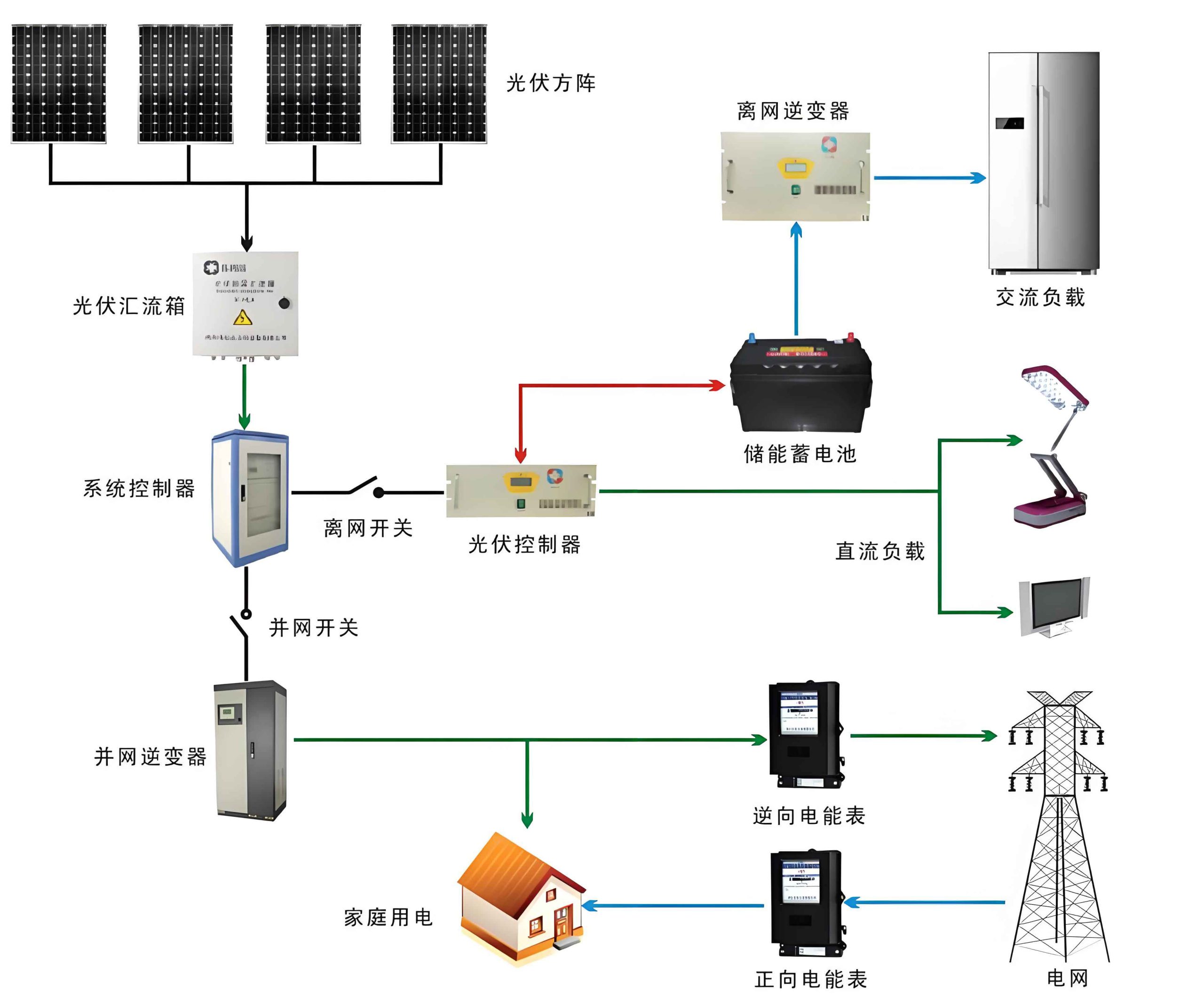
One of the key reasons solar systems are gaining traction in data centers is their inherent sustainability. Solar energy is abundant and renewable, with global irradiation levels varying by region but universally accessible. For instance, areas like the Qinghai-Tibet Plateau and northwestern China boast high solar resources, making them ideal for large-scale solar installations. By harnessing this energy, data centers can significantly cut their reliance on grid power, which often comes from fossil fuels. The basic principle of a solar system involves photovoltaic cells that generate direct current (DC) electricity when exposed to sunlight. This electricity can then be converted to alternating current (AC) for use in data center operations or stored in batteries for later use. The environmental benefits are clear: a well-designed solar system can reduce carbon emissions by displacing conventional energy sources, aligning with policies like China’s “Data Center Green and Low-Carbon Development Special Action Plan” that promote renewable energy adoption.
To quantify the impact of a solar system, consider the formula for power output: $$P = \eta \cdot A \cdot G$$ where \(P\) is the power generated in watts, \(\eta\) is the photovoltaic conversion efficiency, \(A\) is the surface area of the solar panels in square meters, and \(G\) is the solar irradiance in watts per square meter. Over time, the total energy produced can be expressed as: $$E = \int P \, dt$$ which highlights how factors like panel efficiency and sunlight exposure directly influence energy yield. Recent breakthroughs have pushed the efficiency of silicon-based solar cells beyond 27%, while perovskite-silicon tandem cells have achieved over 25% efficiency, demonstrating rapid technological progress. This efficiency gain means that modern solar systems can produce more electricity from the same area, a crucial advantage for data centers with limited rooftop or land space.
The flexibility and scalability of solar systems further enhance their appeal. Most solar installations are modular, consisting of individual panels that can be added or removed without disrupting the entire system. This modularity allows data centers to start with a small solar system and expand it as energy demands grow or budgets allow. For example, a data center might initially install panels on its roof and later extend to parking lots or adjacent land. This phased approach reduces upfront costs and enables continuous optimization. Moreover, the integration of a solar system with existing data center infrastructure, such as uninterruptible power supply (UPS) batteries, creates synergistic benefits. By linking solar generation to UPS storage, excess solar energy can be stored during peak production and used during grid outages or high-tariff periods, a practice known as peak shaving. This not only improves energy resilience but also lowers electricity bills, making the solar system a financially savvy investment.
In data center architecture, solar systems offer unique advantages through building-integrated photovoltaics (BIPV). Instead of treating solar panels as add-ons, BIPV incorporates them into building elements like façades, roofs, or windows, serving dual purposes as construction materials and power generators. This approach enhances aesthetic appeal while maximizing energy harvest. For instance, a data center in Hami, Xinjiang, utilized BIPV on its south-facing façade and roof, significantly reducing its energy draw from the grid. The annual energy production from such a solar system can be substantial, with estimates suggesting thousands of kilowatt-hours per year, directly offsetting operational costs. The table below summarizes key benefits of integrating a solar system into data centers:
| Benefit | Description | Impact on Data Center |
|---|---|---|
| Renewable Energy Source | Solar power reduces dependence on fossil fuels. | Lowers carbon emissions and aligns with green mandates. |
| High Efficiency | Modern panels achieve over 25% conversion efficiency. | More power per unit area, optimizing space use. |
| Modular Design | Systems can be scaled incrementally. | Reduces initial investment and allows future expansion. |
| Integration with UPS | Excess solar energy charges backup batteries. | Enhances reliability and enables peak shaving. |
| BIPV Applications | Panels serve as building materials. | Cuts construction costs and improves aesthetics. |
Looking ahead, optimizing solar systems in data centers requires a multi-faceted strategy. First, the integration of solar generation with energy storage and load management can create a microgrid that operates independently from the main grid. This involves smart control systems that monitor real-time energy production from the solar system and data center demand, adjusting distribution accordingly. For example, an algorithm might prioritize solar power for critical servers during the day and store surplus in batteries for nighttime use. The energy balance can be modeled as: $$\text{Net Load} = L_{\text{data center}} – P_{\text{solar}} – S_{\text{battery}}$$ where \(L_{\text{data center}}\) is the data center load, \(P_{\text{solar}}\) is the solar power output, and \(S_{\text{battery}}\) is the battery storage contribution. By minimizing net load, the solar system reduces peak demand charges and grid dependency.
Second, design optimization is crucial for maximizing solar yield. Using simulation tools like PVsyst or SunEye, engineers can analyze solar irradiance patterns and shade effects to determine the optimal tilt, orientation, and spacing of panels. For a data center in a temperate region, the ideal tilt angle might approximate the latitude to capture annual sunlight, whereas in arid zones, a steeper angle could minimize dust accumulation. The formula for optimal tilt (\(\theta\)) often relates to latitude (\(\phi\)): $$\theta = \phi \pm 15^\circ$$ depending on seasonal adjustments. Additionally, selecting high-efficiency panels, such as monocrystalline silicon or heterojunction types, boosts energy output per square meter. The table below compares common solar panel technologies for data center applications:
| Technology | Efficiency Range | Cost per Watt | Suitability for Data Centers |
|---|---|---|---|
| Monocrystalline Silicon | 20-27% | Moderate to High | Excellent for rooftops with space constraints. |
| Polycrystalline Silicon | 15-20% | Low to Moderate | Cost-effective for large ground-mounted systems. |
| Thin-Film (e.g., CdTe) | 10-15% | Low | Flexible for BIPV on curved surfaces. |
| Perovskite-Silicon Tandem | 25-30% | High (R&D phase) | Future potential for high-yield installations. |
Third, proactive maintenance ensures the long-term performance of a solar system. Dust, bird droppings, and weathering can reduce panel efficiency by up to 20%, so regular cleaning with automated robots or manual methods is essential. Thermal management is also critical, as solar panels lose efficiency at high temperatures. Incorporating passive cooling, such as airflow gaps, or active systems like water circulation, can maintain optimal operating conditions. The efficiency drop with temperature can be expressed as: $$\eta(T) = \eta_0 \cdot [1 – \beta (T – T_0)]$$ where \(\eta_0\) is the efficiency at standard test conditions (25°C), \(\beta\) is the temperature coefficient (typically -0.3% to -0.5% per °C), and \(T\) is the panel temperature. By keeping panels cool, the solar system maintains higher output, especially in hot climates common to many data center locations.
Despite these advantages, deploying a solar system in data centers faces several challenges. High initial capital expenditure is a major barrier, with costs encompassing panels, inverters, mounting structures, and installation labor. However, government incentives, such as tax credits or feed-in tariffs, can offset these expenses. From my experience, a thorough life-cycle cost analysis often reveals that a solar system pays for itself within 5-10 years through electricity savings. The net present value (NPV) of a solar investment can be calculated as: $$\text{NPV} = \sum_{t=1}^{n} \frac{C_t}{(1 + r)^t} – I_0$$ where \(C_t\) is the annual cash flow from energy savings, \(r\) is the discount rate, \(n\) is the system lifetime, and \(I_0\) is the initial investment. Positive NPV indicates economic viability, encouraging data center operators to adopt solar systems.
Technical complexity is another hurdle, as integrating a solar system with data center power infrastructure requires careful engineering. Issues like grid synchronization, voltage regulation, and fault protection must be addressed to ensure safety and reliability. Employing standardized designs and collaborating with experienced solar integrators can streamline this process. For instance, using hybrid inverters that manage both solar input and battery storage simplifies system architecture. Moreover, the intermittent nature of solar power—due to weather and diurnal cycles—poses reliability concerns. To mitigate this, data centers can combine solar systems with other renewables like wind or supplement with grid power, creating a hybrid energy mix. Energy storage systems, particularly lithium-ion batteries, play a pivotal role in smoothing output, with capacity sizing determined by: $$C_{\text{battery}} = \frac{E_{\text{surplus}}}{\text{DOD} \cdot \eta_{\text{battery}}}$$ where \(E_{\text{surplus}}\) is the excess solar energy to be stored, DOD is the depth of discharge (typically 80-90%), and \(\eta_{\text{battery}}\) is the battery efficiency (around 95%).
Environmental factors also impact solar system performance. Extreme temperatures, sandstorms, or heavy snow can degrade panels and reduce lifespan. Choosing durable materials, such as tempered glass with anti-reflective coatings, and designing robust mounting systems enhance resilience. In desert areas, regular cleaning schedules prevent sand accumulation, while in cold regions, heating elements or tilt adjustments shed snow. Furthermore, the spatial requirements of a solar system may conflict with other data center needs, but creative solutions like floating solar on water bodies or vertical installations on walls can overcome land limitations.
In conclusion, the integration of solar photovoltaic systems into data center construction represents a forward-thinking approach to sustainable infrastructure. From my analysis, the benefits of a solar system—ranging from renewable energy generation and cost savings to enhanced resilience—are compelling. As technology advances, efficiencies will continue to rise, making solar systems even more attractive for data centers worldwide. The optimization strategies discussed, including microgrid integration, design tweaks, and diligent maintenance, can unlock full potential, while addressing challenges through financial incentives and robust engineering ensures successful deployment.
The future of data centers lies in their ability to balance growth with environmental stewardship, and solar systems are poised to be a cornerstone of this transformation. By embracing innovation and collaboration, the industry can harness the sun’s power to create greener, more efficient data centers. I encourage stakeholders to explore solar solutions in their projects, leveraging the insights shared here to drive meaningful change. With continued research and adoption, solar photovoltaic systems will undoubtedly play a pivotal role in shaping the sustainable digital landscape of tomorrow.