
In the context of national “Carbon Peaking and Carbon Neutrality” strategies, the transition to renewable energy in public buildings has become a critical focus. As an energy-intensive sector, public institutions are key targets for low-carbon transformation, and solar photovoltaic systems have emerged as a vital technological solution. This article, from a first-person perspective, explores the design and application of a solar photovoltaic system in a public institution in Shanghai, emphasizing the integration of technical assessments, economic models, and practical outcomes. The aim is to provide a comprehensive reference for similar projects, highlighting how solar systems can be effectively deployed to promote green and low-carbon development.
The project involves a large public office complex with multiple buildings, covering an area of approximately 96,000 square meters. The structures feature varied roof types, including frame beam roofs and concrete roofs, offering a total available area of around 2,400 square meters for solar system installation. The highest roof point is 47 meters above ground. The electrical supply is derived from a municipal 10 kV grid, with two distribution rooms located in the basement. The diversity in roof structures necessitated a tailored approach to the solar system design, ensuring compatibility with existing infrastructure while maximizing energy generation potential.
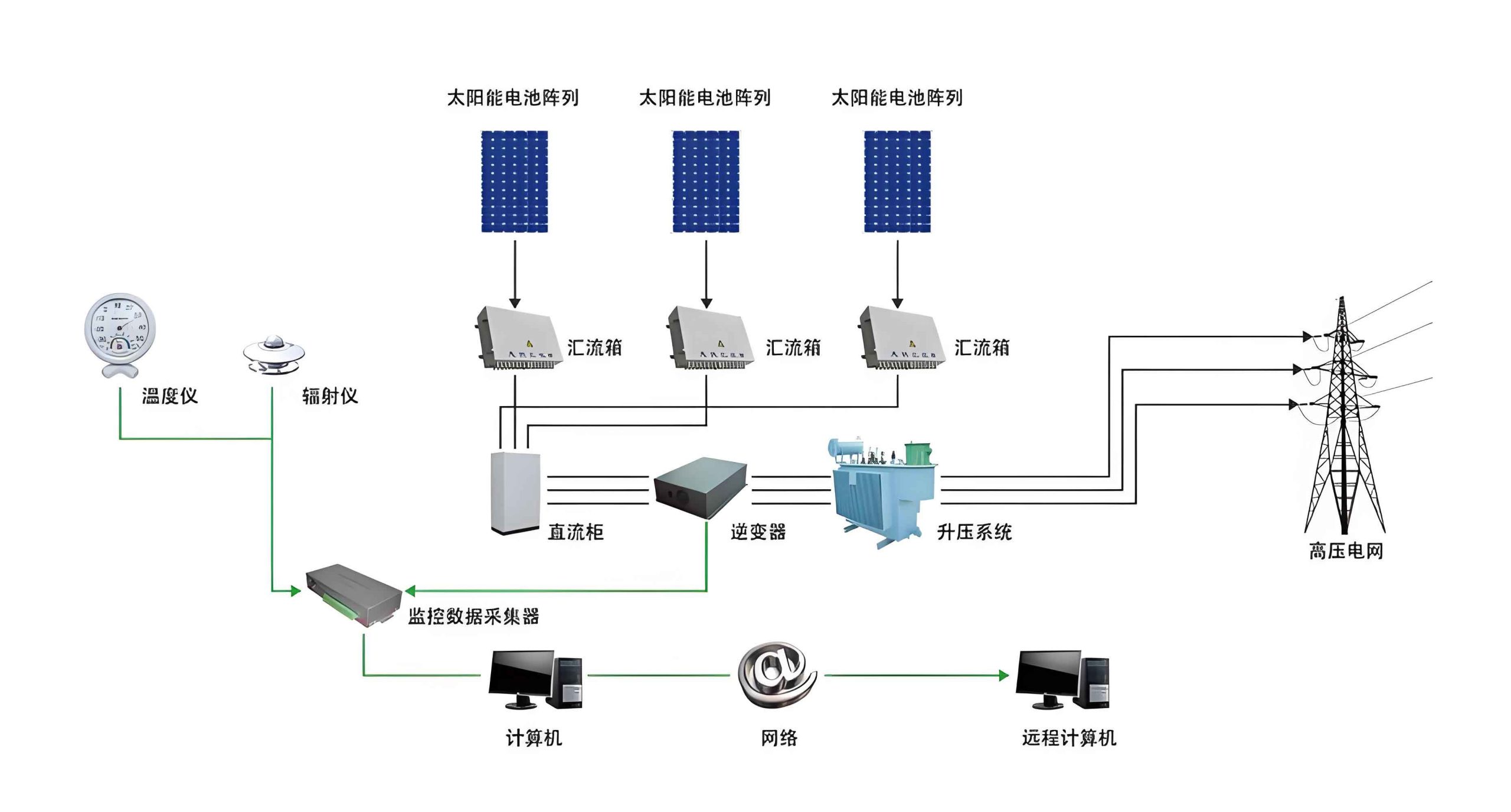
The design and construction of the solar system required a holistic evaluation of multiple factors to ensure feasibility, safety, and efficiency. Key considerations included solar irradiation conditions, structural load-bearing capacity, component configuration, grid integration, lightning protection, and monitoring systems. Each aspect was analyzed in detail to optimize the performance of the solar system.
Solar irradiation is a fundamental determinant of photovoltaic system output. In Shanghai, the annual solar radiation exhibits distinct temporal variations, with peak levels typically occurring in summer months. For this project, simulation software was used to model shading effects across the roof areas throughout the year. The analysis revealed that one building’s main roof experienced minimal shading due to its height, while auxiliary roofs faced partial shading, reducing the effective radiation rates. These radiation rates were crucial for predicting energy yield and informing the layout of the solar system components. The simulation results indicated an average annual radiation rate of 76% for one auxiliary roof and 90% for another building’s roof, which directly influenced the positioning of photovoltaic panels.
To quantify the solar energy potential, the following formula was applied to estimate the annual energy generation of the solar system:
$$E = P \times G \times \eta \times (1 – L)$$
Where:
- \(E\) is the annual energy output (kWh),
- \(P\) is the installed capacity of the solar system (kWp),
- \(G\) is the annual global horizontal irradiance (kWh/m²),
- \(\eta\) is the system efficiency factor, accounting for panel efficiency and other losses,
- \(L\) is the shading loss factor derived from simulation data.
For Shanghai, the average annual irradiance is approximately 1,240.4 kWh/m², as per meteorological data. Incorporating site-specific shading losses, the projected annual energy output for the solar system was calculated, forming the basis for economic and environmental assessments.
Structural integrity was a paramount concern, especially for retrofitting solar systems onto existing roofs. The project involved two primary roof types: frame beam roofs and concrete roofs. For frame beam roofs, custom steel supports were designed to anchor photovoltaic panels onto concrete beams, while concrete roofs utilized precast concrete blocks for mounting. A critical analysis focused on wind loads, which dominate the structural stress on photovoltaic arrays. The wind pressure and suction forces were computed based on panel dimensions, installation angles, roof height, and local wind pressure parameters. The formula for wind load calculation is:
$$F_w = C_f \times q \times A$$
Where:
- \(F_w\) is the wind force (kN),
- \(C_f\) is the force coefficient dependent on panel orientation and shape,
- \(q\) is the dynamic wind pressure (kN/m²), given by \(q = 0.5 \times \rho \times v^2\), with \(\rho\) as air density and \(v\) as wind velocity,
- \(A\) is the exposed area of the solar system components (m²).
Through finite element analysis, the maximum bending moments on structural beams were determined. The existing reinforcement was found to meet the calculated demands under both wind pressure and suction scenarios, confirming the feasibility of installing the solar system without compromising safety. This structural validation was essential for securing approvals and ensuring long-term reliability.
The configuration of the solar system components was optimized based on roof space and irradiation patterns. A total of 442 crystalline silicon photovoltaic panels, each rated at 545 Wp, were selected, resulting in a total installed capacity of 240.9 kWp. The system operates under a “self-consumption with grid feed-in” mode, connecting to the low-voltage grid at 400 V through inverters located near the rooftops. The inverter setup included units of 80 kW, 50 kW, and 30 kW, strategically placed to minimize cable losses. The electrical output from inverters is channeled via new cable trays to the basement, where it integrates with the existing distribution network. A summary of the key equipment is presented in the table below:
| Inverter Specification (kW) | Number of Units | Roof Location | Number of Panels | Installed Capacity (kWp) | String Configuration |
|---|---|---|---|---|---|
| 80 | 2 | Main Building Roof | 298 | 163.9 | 18×7 + 19×8 + 20×1 |
| 30 | 1 | Auxiliary Building Roof | 54 | 29.7 | 18×4 |
| 50 | 1 | Secondary Building Roof | 90 | 49.5 | 18×5 |
This configuration ensures that the solar system operates efficiently across different roof conditions, maximizing energy capture from available sunlight. The grid integration involves dedicated metering cabinets for accurate measurement of generated electricity, facilitating performance monitoring and financial settlements.
Lightning protection is crucial for solar systems installed on exposed rooftops. To mitigate risks, all metallic components, including photovoltaic panels, inverters, and cable trays, were bonded and connected to the existing lightning protection system. Additionally, surge protection devices were installed at critical points, such as inverters and distribution boxes, to guard against indirect lightning strikes. The grounding system was designed to be independent for inverters, enhancing overall safety. These measures ensure the solar system’s resilience against environmental hazards, minimizing downtime and maintenance costs.
A comprehensive monitoring system was developed for real-time oversight of the solar system. This platform collects data on energy production, environmental conditions, and equipment status, enabling proactive management. Key features include:
- Real-time display of power generation and system efficiency,
- Historical data analysis for performance trends,
- Alerts for faults or deviations from expected output,
- Integration with weather data to correlate generation with solar irradiance.
The monitoring system employs algorithms to calculate efficiency metrics, such as the performance ratio (PR), defined as:
$$PR = \frac{E_{actual}}{P \times G_{stc}} \times 100\%$$
Where \(E_{actual}\) is the actual energy output, \(P\) is the installed capacity, and \(G_{stc}\) is the irradiance under standard test conditions (1,000 W/m²). This allows for continuous optimization of the solar system, identifying areas for improvement and ensuring sustained high performance.
The energy yield of the solar system was evaluated both theoretically and empirically. Based on irradiation data and system efficiency factors, the projected annual generation was approximately 224,700 kWh over 25 years, with an initial year output of 247,100 kWh. However, actual operation exceeded expectations, with the first year yielding 271,400 kWh, a 9.8% increase over projections. This variance can be attributed to favorable weather conditions and conservative assumptions in the efficiency model. The monthly generation pattern aligns with Shanghai’s solar profile, peaking in summer and dipping in winter, as shown in the table below:
| Month | Actual Generation (kWh) | Percentage of Annual Average |
|---|---|---|
| January | 15,200 | 54% |
| February | 16,800 | 60% |
| March | 22,500 | 80% |
| April | 25,300 | 90% |
| May | 30,100 | 107% |
| June | 28,700 | 102% |
| July | 33,500 | 119% |
| August | 32,900 | 117% |
| September | 27,600 | 98% |
| October | 23,400 | 83% |
| November | 18,900 | 67% |
| December | 16,500 | 59% |
This data underscores the reliability of the solar system in varying seasons, contributing to stable energy savings. The cumulative effect over the system’s lifetime is significant, with an estimated reduction of 2,800 tons of carbon dioxide emissions, highlighting the environmental benefits of such solar installations.
The project was implemented under an Energy Performance Contracting (EPC) model, a market-based mechanism where a service provider finances, installs, and maintains the solar system, recovering costs through shared energy savings. This approach alleviated upfront capital constraints for the public institution, enabling rapid deployment without budgetary strain. The contract delineates responsibilities: the service company handles design, procurement, installation, and ongoing operation, while the institution pays a portion of the cost savings generated by the solar system. This model fosters collaboration, incentivizing efficiency and ensuring long-term performance. The financial arrangement can be expressed as:
$$S = E \times (C_g – C_s)$$
Where \(S\) is the annual savings, \(E\) is the energy generated by the solar system (kWh), \(C_g\) is the grid electricity cost (USD/kWh), and \(C_s\) is the service fee (USD/kWh). Over the contract period, both parties benefit, with the institution reducing energy expenses and the service provider earning a return on investment. This framework is particularly effective for public sectors seeking to adopt renewable energy solutions like solar systems.
The benefits of the solar system extend beyond energy generation. Economically, the project reduces electricity costs by leveraging self-consumption, with excess power fed back to the grid for additional revenue. Environmentally, it contributes to carbon reduction, supporting climate goals. Socially, it demonstrates leadership in sustainable practices, inspiring broader adoption. Moreover, the solar panels provide incidental shading, lowering roof temperatures and reducing cooling loads, which enhances indoor comfort. These multifaceted advantages underscore the value of integrating solar systems into public infrastructure.
From a technical standpoint, the success of this solar system hinges on meticulous planning and adaptive design. The integration of advanced simulation tools for shading analysis, structural modeling for load assessment, and smart monitoring for performance tracking ensures optimal outcomes. The use of high-efficiency components and robust grid interfaces further enhances reliability. Importantly, the solar system is scalable; lessons learned can be applied to other public buildings, facilitating widespread replication. The table below summarizes key performance indicators for the solar system:
| Indicator | Value | Description |
|---|---|---|
| Installed Capacity | 240.9 kWp | Total power rating of photovoltaic panels |
| Annual Generation (Year 1) | 271,400 kWh | Actual electricity produced |
| Performance Ratio | 85% | Measure of system efficiency relative to ideal conditions |
| Carbon Reduction (Annual) | 113.4 tons | Estimated CO₂ savings based on grid emission factors |
| Payback Period | 6-8 years | Time to recover investment through savings |
These metrics validate the effectiveness of the solar system in meeting both energy and sustainability targets. The performance ratio, in particular, indicates a well-designed system with minimal losses, attributable to careful component selection and installation practices.
Looking ahead, the proliferation of solar systems in public institutions can be accelerated through policy support and technological innovation. Governments can incentivize adoption via subsidies, streamlined permitting, and mandates for renewable energy usage. Technologically, advancements in photovoltaic materials, such as perovskite cells, could boost efficiency, while energy storage solutions like batteries can address intermittency issues, making solar systems more resilient. The integration of artificial intelligence for predictive maintenance and optimization will further enhance operational efficiency. In this project, the monitoring system already lays groundwork for such innovations, allowing data-driven decisions to refine the solar system over time.
In conclusion, the deployment of a solar photovoltaic system in a Shanghai public institution exemplifies a holistic approach to green transformation. By addressing technical, economic, and managerial dimensions, the project achieves substantial energy savings and environmental benefits. The use of contract energy management mitigates financial barriers, enabling swift implementation. This case demonstrates that solar systems are not only viable but also advantageous for public sectors, aligning with global trends toward decarbonization. As solar technology evolves and costs decline, similar initiatives can proliferate, contributing significantly to national carbon neutrality goals. The insights gained from this experience—from structural assessments to performance monitoring—provide a valuable blueprint for future projects, underscoring the transformative potential of solar systems in building a sustainable energy future.
Ultimately, the success of this solar system hinges on continuous improvement and adaptation. Regular audits, software updates, and stakeholder engagement will ensure long-term viability. By sharing best practices and lessons learned, public institutions can collectively advance the adoption of solar systems, fostering a culture of innovation and responsibility. The journey toward a low-carbon society is complex, but with dedicated efforts and collaborative models like this, solar energy can play a pivotal role in powering our institutions efficiently and cleanly.