
From my perspective as an observer of global energy transitions, the history of industrialization is fundamentally a story of energy evolution. The first industrial revolution, spanning from 1760 to 1840, saw the British replace wood with coal, establishing a coal-based economy. The second industrial revolution, from 1870 to the early 20th century, witnessed Americans substituting coal with oil, ushering in the petroleum economy. Now, in the ongoing third industrial revolution, I believe that humanity, led by pioneering efforts worldwide, is poised to replace traditional fossil fuels with renewable energy, particularly through the widespread adoption of solar photovoltaic systems. This shift promises to establish a “photovoltaic economy,” where solar energy becomes the cornerstone of sustainable development. The solar system—encompassing photovoltaic panels, inverters, and storage solutions—is at the heart of this transformation, offering a clean, abundant, and decentralized power source.
When I reflect on the journey of photovoltaic technology, it is remarkable to see how far we have come. The utilization of solar energy for industrial purposes dates back to 1615, when the first solar-powered engine was invented, operating on the principle of heating air to perform work. However, the real breakthrough occurred in 1954 with the development of the practical silicon solar cell, which laid the foundation for large-scale photovoltaic applications. Since then, the solar system has evolved rapidly, from powering satellites in space to grid-connected operations. In the 21st century, advancements in materials science and engineering have propelled photovoltaic efficiency and affordability, making solar energy a viable alternative. To summarize this progression, I have compiled key milestones in the table below, highlighting the evolution of the solar system over time.
| Year | Event | Significance for Solar System |
|---|---|---|
| 1615 | First solar-powered engine | Early industrial use of solar thermal energy |
| 1954 | Practical silicon solar cell | Foundation for modern photovoltaic systems |
| 1958 | Solar cells in space | Demonstrated reliability in extreme environments |
| 1960 | Grid-connected solar station | Integration into electrical networks |
| 21st Century | Rapid efficiency gains | Cost reduction and mass adoption of solar systems |
The advantages of photovoltaic power are profound, and I often summarize them through the lens of a solar system’s inherent benefits. A solar system is not only infinite in supply but also universally accessible, operating without temporal or geographical bias. Its environmental friendliness and zero-fuel cost make it an ideal energy source. From a technical standpoint, the efficiency of a solar system can be expressed using the photoconversion efficiency formula, which is critical for evaluating performance. The efficiency $\eta$ is given by:
$$ \eta = \frac{P_{\text{out}}}{P_{\text{in}}} \times 100\% $$
where $P_{\text{out}}$ is the electrical power output and $P_{\text{in}}$ is the solar irradiance input. Modern crystalline silicon photovoltaic modules have achieved efficiencies around 21%, driven by innovations in cell design and materials. Additionally, the levelized cost of energy (LCOE) for a solar system has decreased significantly, making it competitive with fossil fuels. The LCOE can be approximated as:
$$ \text{LCOE} = \frac{\sum_{t=1}^{n} \frac{I_t + M_t}{(1+r)^t}}{\sum_{t=1}^{n} \frac{E_t}{(1+r)^t}} $$
where $I_t$ is investment cost, $M_t$ is maintenance cost, $E_t$ is energy output, $r$ is discount rate, and $n$ is system lifetime. With smart grid development and policy support, the integration of solar systems into power networks has become seamless. Moreover, advancements in battery storage, such as lithium-ion and flow batteries, have addressed intermittency issues, enhancing the reliability of solar systems. The table below contrasts the key attributes of solar systems with traditional fossil fuels, underscoring the superiority of photovoltaic technology.
| Aspect | Solar System | Fossil Fuels |
|---|---|---|
| Energy Source | Renewable (sunlight) | Non-renewable (coal, oil) |
| Environmental Impact | Zero emissions during operation | High carbon and pollutant emissions |
| Cost Trend | Decreasing LCOE | Volatile and rising |
| Scalability | Modular and decentralized | Centralized infrastructure |
| Energy Security | Enhanced by local generation | Subject to geopolitical risks |
In terms of applications, the versatility of the solar system is astounding. I have observed its deployment across diverse sectors, from rural electrification to urban infrastructure. Distributed generation stations, for instance, leverage rooftops and unused lands to create decentralized power hubs. In rural areas, solar systems installed on household roofs not only provide electricity but also offer insulation benefits, reducing cooling costs in summer. The thermal effect can be modeled using heat transfer equations, where the reduction in indoor temperature $\Delta T$ due to a photovoltaic roof is given by:
$$ \Delta T = T_{\text{outside}} – T_{\text{inside}} \approx 3 – 5^\circ \text{C} $$
for typical conditions. Similarly, industrial buildings utilize their vast roof areas to host solar systems, offsetting energy expenses and generating revenue through excess power sales. The flexibility of thin-film photovoltaic components allows retrofitting on existing structures without heavy structural reinforcements. In arid regions like deserts, solar systems have dual benefits: they generate power and reduce water evaporation, promoting ecological restoration. For example, photovoltaic panels over water bodies in “aquavoltaic” setups combine aquaculture with energy production, optimizing land use. The energy yield $E$ from such a solar system can be estimated as:
$$ E = A \cdot G \cdot \eta \cdot \text{PR} $$
where $A$ is area, $G$ is solar irradiance, $\eta$ is efficiency, and PR is performance ratio. To illustrate the broad applications, I have tabulated various use cases of solar systems below.
| Application | Description | Benefits |
|---|---|---|
| Rural Solar Programs | Photovoltaic systems on rural roofs | Poverty alleviation, energy access, insulation |
| Industrial Rooftops | Solar panels on factories and warehouses | Cost savings, revenue from excess power |
| Desert and Mountain Installations | Large-scale plants in arid regions | Land use optimization, ecological benefits |
| Aquavoltaic Systems | Floating photovoltaic on water bodies | Space efficiency, reduced evaporation |
| Mobile Energy Solutions | Portable solar chargers for devices | Convenience, off-grid power |
| Transportation Integration | Solar-powered bikes and vehicles | Emission reduction, extended range |
| Infrastructure Power | Solar traffic signals and road lighting | Reduced grid dependency, lower costs |
Mobile energy represents another frontier for solar systems. I have seen innovations like solar-powered paper-thin chargers that can bend and fold, providing electricity for outdoor enthusiasts. Shared bicycles equipped with miniature solar systems power their smart locks, eliminating the need for disposable batteries. The power output $P$ of such a solar system for a bike lock can be expressed as:
$$ P = V \cdot I $$
where $V$ is voltage and $I$ is current, typically around 5.5W for optimal operation. In transportation safety, solar systems energize remote traffic signals, leveraging their autonomy and low maintenance. The integration of solar systems into everyday objects—from backpacks to tents—showcases the pervasive potential of photovoltaic technology.
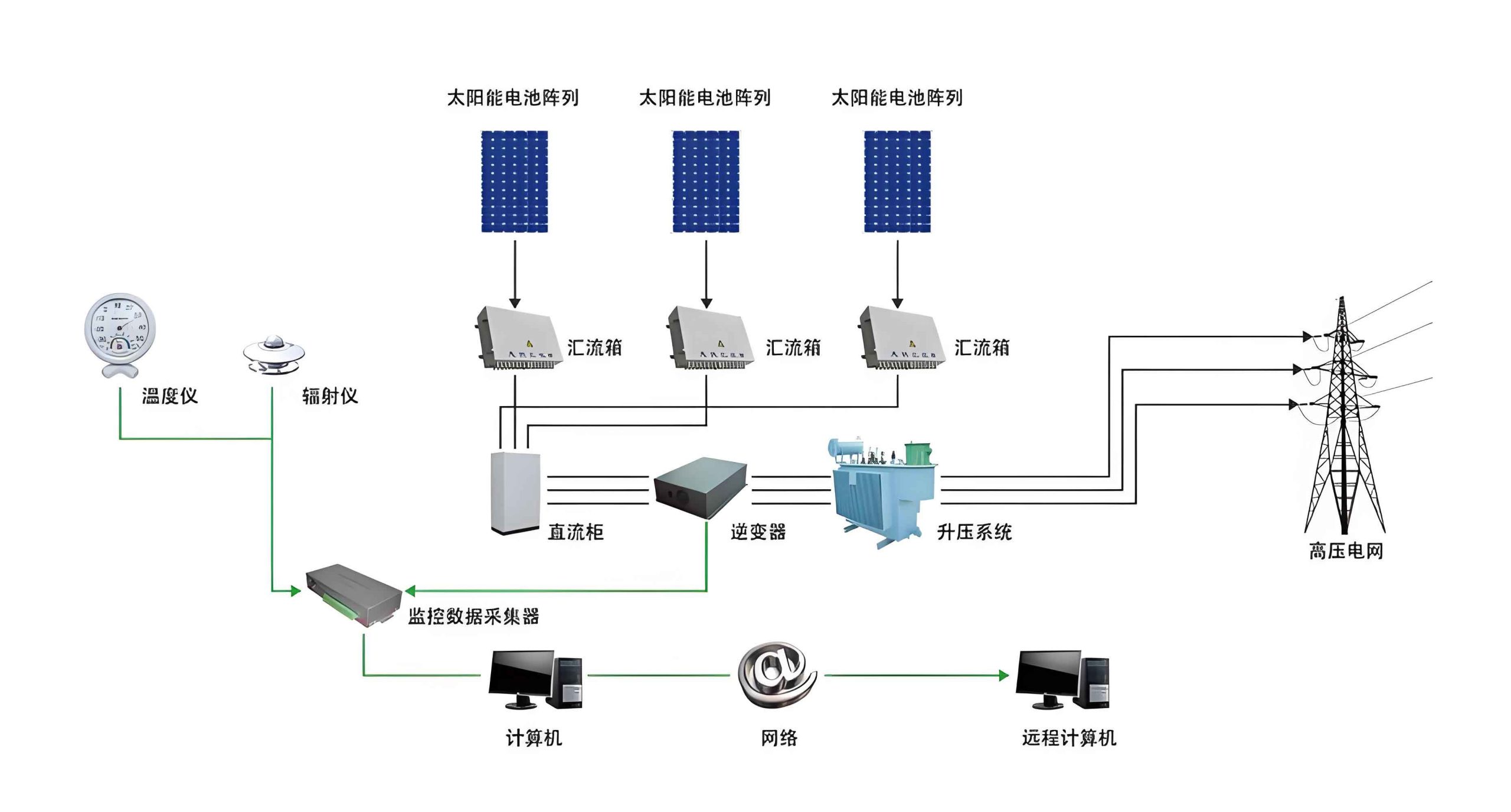
Looking ahead, I envision a future where solar systems become even more integrated into our lives. The convergence of photovoltaic generation with electric vehicle charging infrastructure is a natural synergy. Imagine a solar system powering charging stations, creating a closed-loop clean energy ecosystem. The energy balance for such a setup can be modeled as:
$$ E_{\text{EV}} = \sum_{i=1}^{n} E_{\text{solar}, i} – E_{\text{loss}} $$
where $E_{\text{EV}}$ is energy for EVs, $E_{\text{solar}, i}$ is output from solar panels, and $E_{\text{loss}}$ accounts for transmission losses. Solar-powered aircraft and cars with photovoltaic roofs are already in development, promising to extend travel ranges without emissions. In architecture, solar tiles—photovoltaic components designed as roofing materials—will redefine building-integrated solar systems. The aesthetic and functional blend could revolutionize urban energy landscapes. Perhaps most ambitiously, solar roads that generate electricity while supporting vehicular traffic are being tested. The potential energy harvest from a solar road surface can be calculated based on area and efficiency. For instance, with a highway area $A_{\text{road}}$ and average irradiance $G$, the annual energy yield $E_{\text{annual}}$ is:
$$ E_{\text{annual}} = A_{\text{road}} \cdot G \cdot \eta \cdot 365 \cdot \text{CF} $$
where CF is capacity factor. Such innovations highlight how the solar system can transform infrastructure into active power generators.
Moreover, I anticipate advancements in materials science that will enable solar systems to be woven into fabrics, creating energy-harvesting clothing. The efficiency of these flexible solar systems may follow thin-film physics, described by the diode equation for photovoltaic cells:
$$ I = I_{\text{ph}} – I_0 \left( e^{\frac{V}{nV_T}} – 1 \right) $$
where $I_{\text{ph}}$ is photocurrent, $I_0$ is saturation current, $n$ is ideality factor, and $V_T$ is thermal voltage. As research progresses, the solar system will become more efficient, durable, and cost-effective, driving mass adoption. The growth trajectory of photovoltaic installations—from millions to billions of watts—signals a paradigm shift. I am convinced that solar energy will not merely supplement traditional sources but eventually dominate the global energy mix. The solar system, with its scalability and sustainability, embodies the hope for a cleaner, equitable future. This transition is irreversible, propelled by technological strides and environmental imperatives. In conclusion, the era of solar energy is dawning, and embracing the solar system is key to unlocking a brighter tomorrow for all.