
In my analysis of modern energy solutions, I find that solar systems, particularly photovoltaic (PV) systems, have emerged as a cornerstone for renewable energy generation. However, the inherent intermittency of solar power—due to diurnal cycles and weather variations—poses significant challenges for meeting continuous load demands. As I explore this topic, I emphasize that energy storage systems (ESS) are crucial for mitigating these limitations, enabling reliable and stable power supply from solar systems. This article delves into the various ESS technologies integrated with solar systems, highlighting their principles, applications, and future prospects. Throughout, I will use tables and formulas to summarize key aspects, ensuring a comprehensive understanding. Let me begin by outlining the importance of ESS in solar systems.
The integration of energy storage with solar systems is not merely an enhancement but a necessity for achieving grid stability and energy independence. In my view, without storage, the fluctuating output of solar systems can lead to inefficiencies, such as curtailment during peak generation and shortages during low-light periods. Therefore, I advocate for a systematic approach to ESS adoption. The common ESS categories include electrochemical batteries, flywheels, and superconducting magnetic energy storage (SMES), each with unique advantages. I will analyze these in detail, but first, let me provide a foundational overview of ESS in the context of solar systems.
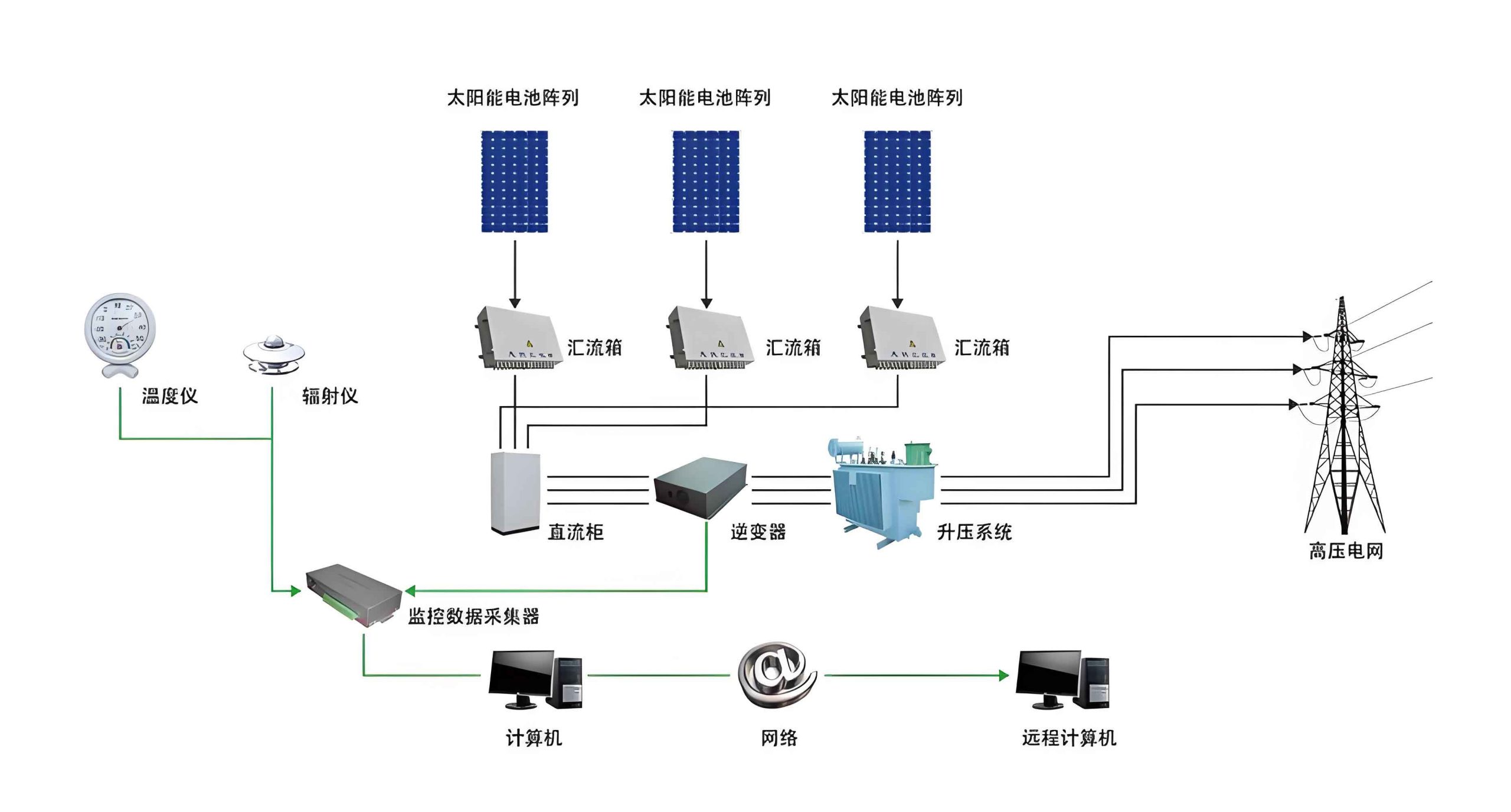
In my experience, the deployment of solar systems often requires complementary storage to maximize utilization. For instance, in off-grid solar systems, ESS ensures power availability during nights, while in grid-tied systems, it facilitates load leveling and peak shaving. I believe that understanding the working principles of ESS is essential for optimizing solar system performance. To this end, I present the following sections, where I discuss specific ESS technologies, their applications, and analytical insights. I will also incorporate mathematical models to quantify energy storage capabilities, such as the energy stored in a flywheel given by $$E = \frac{1}{2} I \omega^2$$, where $I$ is the moment of inertia and $\omega$ is the angular velocity. This formula illustrates the kinetic energy storage mechanism in flywheels, which is vital for high-power applications in solar systems.
Overview of Energy Storage Systems in Solar Systems
As I examine ESS for solar systems, I categorize them based on their energy conversion processes. The primary goal is to store excess energy generated by solar systems during peak sunlight hours and discharge it when needed. I have identified three prominent ESS types: battery storage, flywheel storage, and superconducting magnetic storage. Each plays a distinct role in enhancing the reliability of solar systems. Let me introduce them sequentially.
Battery Storage Systems
In my assessment, battery storage is the most prevalent ESS for solar systems, owing to its maturity and scalability. Batteries, as electrochemical devices, convert chemical energy into direct current (DC) electricity through redox reactions. This DC power can directly supply loads or be inverted for alternating current (AC) use in solar systems. Common battery chemistries include lead-acid, lithium-ion, and nickel-metal hydride. Among these, lead-acid batteries are widely used due to their cost-effectiveness, but lithium-ion batteries are gaining traction for their higher energy density and longer cycle life in solar systems.
To quantify battery performance in solar systems, I often use the following parameters: energy density (Wh/kg), power density (W/kg), efficiency (%), and cycle life. The stored energy in a battery can be expressed as $$E_b = C \times V$$, where $C$ is the capacity in ampere-hours (Ah) and $V$ is the voltage. For a solar system, the battery sizing depends on the daily energy demand and depth of discharge (DoD). I recommend a table to compare battery types:
| Battery Type | Energy Density (Wh/kg) | Cycle Life | Efficiency (%) | Typical Application in Solar Systems |
|---|---|---|---|---|
| Lead-Acid | 30-50 | 500-1000 | 70-85 | Off-grid residential solar systems |
| Lithium-Ion | 100-265 | 1000-3000 | 90-95 | Grid-scale solar farms |
| Nickel-Metal Hydride | 60-120 | 500-1000 | 70-80 | Hybrid solar systems |
From my perspective, the choice of battery for a solar system hinges on factors like cost, lifespan, and environmental conditions. For example, in remote solar systems, lead-acid batteries may be preferred for their robustness, whereas urban solar systems might opt for lithium-ion for space efficiency. I must stress that battery management systems (BMS) are critical for monitoring state of charge (SoC) and preventing over-discharge, thereby extending the lifespan of solar systems.
Flywheel Energy Storage Systems
I consider flywheel energy storage (FES) as an innovative ESS with high potential for solar systems. FES stores energy kinetically in a rotating mass, offering high power density and rapid response times. In a solar system, excess electricity drives a motor to accelerate the flywheel, converting electrical energy to mechanical energy. During discharge, the flywheel decelerates, driving a generator to produce electricity. The energy stored, as mentioned, is $$E_f = \frac{1}{2} I \omega^2$$. For a cylindrical flywheel, $I = \frac{1}{2} m r^2$, where $m$ is mass and $r$ is radius, so $$E_f = \frac{1}{4} m r^2 \omega^2$$.
In my analysis, FES excels in applications requiring frequent charge-discharge cycles, such as smoothing output fluctuations in solar systems. Its advantages include high efficiency (85-95%), long operational life (over 20 years), and minimal environmental impact. I have observed that dual-mode flywheels, which combine magnetic bearings and vacuum enclosures, reduce friction losses, making them ideal for integration with solar systems. The power output of a flywheel in a solar system can be modeled as $$P_f = \tau \omega$$, where $\tau$ is the torque. This allows for flexible design in voltage and current settings, enhancing compatibility with solar system inverters.
To illustrate, I provide a table comparing FES with other ESS for solar systems:
| ESS Type | Power Density (W/kg) | Response Time | Lifespan (years) | Suitability for Solar Systems |
|---|---|---|---|---|
| Flywheel | 500-2000 | Milliseconds | 20+ | High-power, short-duration storage |
| Battery | 50-300 | Seconds | 5-15 | Long-duration, energy-intensive storage |
| Supercapacitor | 1000-10000 | Milliseconds | 10+ | Peak shaving and regenerative braking |
From my viewpoint, FES is particularly valuable in solar systems for frequency regulation and voltage support, thanks to its fast response. In hybrid solar systems, combining FES with batteries can optimize both power and energy needs, ensuring stable operation.
Superconducting Magnetic Energy Storage Systems
In my exploration of advanced ESS, superconducting magnetic energy storage (SMES) stands out for its high efficiency and power capability. SMES stores energy in the magnetic field generated by direct current flowing through a superconducting coil. When cooled below its critical temperature, the coil exhibits zero electrical resistance, allowing persistent current flow without energy loss. The stored energy is given by $$E_s = \frac{1}{2} L I^2$$, where $L$ is the inductance and $I$ is the current. For solar systems, SMES can provide megawatt-level power bursts within milliseconds, making it suitable for mitigating transient disturbances.
I have found that SMES systems can maintain stored energy for years if kept at cryogenic temperatures, typically using liquid helium or nitrogen. This longevity is advantageous for solar systems requiring long-term backup. However, the high cost of superconducting materials and cooling infrastructure limits widespread adoption. In my opinion, SMES is best deployed in large-scale solar farms for grid stabilization. The power discharge rate can be expressed as $$P_s = V I$$, where $V$ is the voltage across the coil. Integrating SMES with solar systems involves power electronic interfaces to convert DC to AC, similar to other ESS.
To summarize SMES characteristics, I present this formula-based comparison: the energy density of SMES is relatively low (0.5-5 Wh/kg), but its power density exceeds 1000 W/kg. For a solar system, this means SMES is more suited for power quality applications than energy arbitrage. I believe that ongoing research in high-temperature superconductors could reduce costs, enabling broader use in solar systems.
Comprehensive Analysis of Energy Storage Systems in Solar Systems
As I delve deeper into ESS applications, I recognize that the global focus on energy storage for solar systems is intensifying. Countries are investing in large-scale battery storage plants to complement solar generation. For instance, in my review, China’s lead-acid battery production leads internationally, with significant installations like the wind-solar hybrid station in Hebei Province. This station uses ESS to track wind power output and enhance grid reliability, a model applicable to solar systems. In this section, I analyze flywheel and supercapacitor applications in detail, expanding to other ESS like compressed air and hydrogen storage for solar systems.
Flywheel Storage Applications in Solar Systems
From my perspective, flywheel technology is gaining traction in renewable energy integration, especially for solar systems. Many institutions are researching FES to pair with solar farms, aiming for grid frequency regulation and power quality improvement. In a solar system, flywheels can respond to rapid changes in solar irradiance, such as cloud cover, by injecting or absorbing power within milliseconds. I estimate that, compared to traditional hydro or thermal调频 resources, flywheels in solar systems can double调频效益 due to faster response.
Moreover, flywheel ESS in solar systems promotes energy savings. Once deployed, they allow conventional power plants to operate at optimal loads, reducing fuel consumption. For example, in a solar system with flywheel storage, peak shaving can defer grid upgrades, saving time and costs. The environmental benefits are also notable: flywheels produce no emissions and use composite materials like carbon fiber for rotors, aligning with the sustainability goals of solar systems. The rotor dynamics can be modeled using the equation of motion: $$J \frac{d\omega}{dt} = \tau_{in} – \tau_{out}$$, where $J$ is the moment of inertia, and $\tau_{in}$ and $\tau_{out}$ are input and output torques, respectively.
I have compiled a table on flywheel applications in solar systems:
| Application | Benefits for Solar Systems | Typical Power Rating | Case Study |
|---|---|---|---|
| Frequency Regulation | Fast response, improves grid stability | 1-20 MW | Solar farm in California using flywheels for调频 |
| Voltage Support | Enhances power quality during fluctuations | 100 kW-5 MW | Off-grid solar system with flywheel backup |
| Energy Arbitrage | Stores excess solar energy for peak demand | 500 kW-10 MW | Commercial solar installation with FES |
In my opinion, the integration of flywheels with solar systems requires careful sizing based on solar output profiles. Using historical data, I often apply the formula for required storage capacity: $$C_f = \int_{t_1}^{t_2} (P_{solar} – P_{load}) dt$$, where $P_{solar}$ is the solar power generation and $P_{load}$ is the load demand. Flywheels can cover short-term mismatches, making solar systems more reliable.
Supercapacitor Storage Applications in Solar Systems
I find that supercapacitors, or ultracapacitors, are emerging as a promising ESS for solar systems due to their high power density and long cycle life. Unlike batteries, supercapacitors store energy electrostatically in an electric double layer, enabling rapid charge and discharge. The energy stored is $$E_c = \frac{1}{2} C V^2$$, where $C$ is the capacitance and $V$ is the voltage. For solar systems, supercapacitors can buffer rapid power fluctuations, protecting inverters and improving efficiency.
In my analysis, supercapacitors serve multiple roles in solar systems. First, as traction power for electric vehicles (EVs) charged by solar systems, they provide high bursts for acceleration. Second, in electronic applications, such as satellite solar systems, supercapacitors combine with batteries to handle pulsed loads. Third, in power systems, supercapacitors can replace electrolytic capacitors in switchgear for solar substations, offering higher reliability and capacity. For instance, in a solar system, supercapacitors can supply分闸 energy for circuit breakers, ensuring safe operation during faults.
I emphasize that supercapacitors excel in hybrid configurations with batteries for solar systems. The combined system can be modeled as a parallel RC circuit, where the supercapacitor handles high-frequency components and the battery manages base loads. The total energy is $$E_{total} = E_b + E_c$$. To illustrate, here’s a table on supercapacitor uses in solar systems:
| Use Case | Advantages for Solar Systems | Technical Specifications | Example |
|---|---|---|---|
| PV Ramp Rate Control | Mitigates rapid changes in solar output | Capacitance: 100-5000 F | Utility-scale solar plant with supercapacitor bank |
| Microgrid Support | Enhances stability in islanded solar systems | Voltage: 2.5-3.0 V per cell | Off-grid community solar project |
| Backup Power | Provides instant power during solar outages | Energy density: 5-10 Wh/kg | Residential solar system with supercapacitor module |
From my viewpoint, the future of supercapacitors in solar systems lies in improving energy density through nanomaterials. Research on graphene-based supercapacitors could revolutionize storage, enabling compact ESS for distributed solar systems. I often calculate the required capacitance for a solar system using $$C = \frac{2E_c}{V^2}$$, based on the desired backup time.
Other Energy Storage Systems for Solar Systems
Beyond the aforementioned, I explore additional ESS options for solar systems, such as compressed air energy storage (CAES) and hydrogen storage. CAES involves compressing air using excess solar power and storing it in underground caverns. During discharge, the air is expanded through turbines to generate electricity. The energy stored can be approximated as $$E_a = \frac{p V}{\gamma – 1} \left[ \left( \frac{p_2}{p_1} \right)^{\frac{\gamma-1}{\gamma}} – 1 \right]$$, where $p$ is pressure, $V$ is volume, and $\gamma$ is the heat capacity ratio. For large-scale solar systems, CAES offers cost-effective long-duration storage.
Hydrogen storage, via electrolysis of water using solar power, produces hydrogen that can be stored and reconverted to electricity via fuel cells. The overall efficiency is around 30-40%, but it provides seasonal storage for solar systems. The energy content of hydrogen is about 33.3 kWh/kg, making it suitable for decarbonizing sectors beyond electricity. In my opinion, hybrid ESS combining hydrogen with batteries could optimize solar systems for 24/7 operation. I present a comparative table of these ESS for solar systems:
| ESS Type | Storage Duration | Efficiency (%) | Scale for Solar Systems | Key Formula |
|---|---|---|---|---|
| CAES | Hours to days | 60-70 | Grid-scale | $E_a$ as above |
| Hydrogen | Days to months | 30-50 | Large-scale | $E_h = m_h \times 33.3 \text{ kWh/kg}$ |
| Pumped Hydro | Hours to days | 70-85 | Utility-scale | $E_p = \rho g h V$ |
I believe that the choice of ESS for a solar system depends on factors like location, scale, and economic considerations. For instance, in arid regions, solar systems might pair with CAES, while coastal solar systems could use pumped hydro. My analysis underscores the need for tailored solutions to maximize the value of solar systems.
Conclusion and Future Perspectives
In my comprehensive analysis of energy storage systems in solar systems, I conclude that ESS are indispensable for overcoming the intermittency of solar power. Each ESS technology—batteries, flywheels, supercapacitors, SMES, CAES, and hydrogen—offers unique benefits, from high energy density to rapid response. I have demonstrated through formulas and tables that integrating ESS with solar systems enhances reliability, reduces costs, and promotes sustainability. For example, the efficiency of a solar system with storage can be modeled as $$\eta_{total} = \eta_{PV} \times \eta_{ESS} \times \eta_{inverter}$$, where $\eta_{PV}$ is the photovoltaic efficiency, $\eta_{ESS}$ is the storage efficiency, and $\eta_{inverter}$ is the conversion efficiency.
Looking ahead, I anticipate advancements in ESS technologies will further optimize solar systems. Innovations like solid-state batteries for higher safety, advanced flywheels with lower losses, and cost-effective superconductors could revolutionize storage. Moreover, smart grid integration using artificial intelligence can dynamically manage ESS in solar systems, predicting demand and generation patterns. I recommend that policymakers and investors support research and deployment of hybrid ESS for solar systems, as no single technology meets all needs.
Ultimately, the synergy between solar systems and energy storage will drive the transition to a renewable energy future. By leveraging diverse ESS, we can ensure that solar systems provide continuous, clean power, meeting societal demands while mitigating climate change. I encourage continued exploration and implementation of these systems to unlock the full potential of solar energy.