
From my extensive experience in the field of renewable energy, I have witnessed the transformative potential of solar photovoltaic (PV) lighting. As an integral part of a modern, decentralized solar system, PV lighting offers a sustainable and practical solution for illumination, particularly in areas where grid extension is challenging or economically unfeasible. The core principle involves converting sunlight directly into electricity to power efficient light sources after dusk, creating a self-contained solar system for lighting. This essay will delve into the application prospects, economic viability, component reliability, and practical maintenance insights of these systems, drawing from hands-on project implementation. The overarching goal is to provide a detailed, data-driven perspective on why and how solar system lighting is not just an alternative, but often the optimal choice for widespread illumination needs.
The fundamental appeal of a standalone solar system for lighting lies in its operational simplicity and energy independence. A typical configuration comprises four key components: the PV module, the charge controller, the storage battery, and the light source (typically LED). The sun’s energy, a free and abundant resource, is harnessed by the PV module, generating direct current (DC) electricity. This electricity is managed by an intelligent charge controller, which regulates the charging process to protect the battery from overcharge and, later, controls the discharge to power the light while preventing deep discharge damage. The battery stores the energy for use during nighttime or cloudy days. The efficiency of this entire solar system chain is paramount to its success and economic payoff.
Economic Viability Analysis of Solar PV Lighting
A common misconception is that the high initial cost of a solar system negates its benefits. A comprehensive Life Cycle Cost (LCC) analysis tells a different story. The LCC includes the initial investment, installation costs, ongoing operational expenses (primarily maintenance), and the cost of energy consumed over the system’s lifetime. For grid-connected conventional lighting, the energy cost is a continuous, often escalating, financial drain. For a solar system, the “fuel” cost is zero after installation.
Let’s consider a comparative analysis between a solar LED street light and a conventional grid-powered high-pressure sodium (HPS) lamp. We will model this for a project involving 40 street lights, each requiring 8 hours of operation per night.
| Cost Component | Solar LED Lighting System (40 units) | Conventional HPS Lighting System (40 units) |
|---|---|---|
| 1. Initial Equipment Cost | PV Panel, Battery, LED Luminaire, Controller, Pole | HPS Luminaire, Electrical Gear, Cable, Pole |
| Estimated Cost (USD) | $16,000 | $8,000 |
| 2. Installation & Civil Works | Simple foundation; no trenching or cabling. | Complex trenching, cable laying, connection to grid. |
| Estimated Cost (USD) | $800 | $8,000 |
| 3. Total Initial Investment (1+2) | $16,800 | $16,000 |
| 4. Annual Operating Cost | Routine inspection & minor maintenance. | Grid electricity consumption + maintenance. |
| Electricity Cost (Year 1, $0.12/kWh) | $0 | $1,400 |
| Maintenance Cost Estimate | $200 | $400 (lamp replacement, etc.) |
| Total Annual Op. Cost | $200 | $1,800 |
| 5. Project Lifetime | 20 years (PV), 10 years (Battery), 50,000h (LED) | 5 years (HPS lamp), 20 years (infrastructure) |
The table reveals a critical insight: while the equipment cost for the solar system is higher, the drastically lower installation cost (due to the absence of extensive civil works and grid connection) brings the total initial investment for both systems to a comparable level. The economic advantage of the solar system becomes overwhelmingly clear in the operational phase.
To quantify the long-term savings, we can calculate the Net Present Value (NPV) of costs over a 20-year period, discounting future operational expenses. The formula for NPV is:
$$ NPV = C_0 + \sum_{t=1}^{n} \frac{C_t}{(1 + r)^t} $$
Where \( C_0 \) is the initial investment, \( C_t \) is the net cash flow (negative for costs) at time \( t \), \( r \) is the discount rate, and \( n \) is the project lifetime. For the conventional system, \( C_t \) includes annual electricity and maintenance costs. For the solar system, \( C_t \) includes only maintenance and a battery replacement cost at year 10. Even with a conservative discount rate, the NPV for the solar system is significantly lower over two decades, proving its superior economic performance. The simple payback period, considering only the avoided electricity bills, can be as short as 5-7 years for a well-designed solar system, after which it generates pure savings.
Reliability and Key Component Analysis
The reliability of a PV lighting solar system hinges on the synergistic performance and durability of its four main components. Failure in any one can compromise the entire system’s functionality.
1. Photovoltaic Module: The cornerstone of any solar system. A PV cell is essentially a large-area PN junction diode. Its current-voltage (I-V) characteristic under illumination is given by the diode equation:
$$ I = I_L – I_0 \left[ \exp\left(\frac{q(V + IR_s)}{nkT}\right) – 1 \right] – \frac{V + IR_s}{R_{sh}} $$
Where \( I_L \) is the light-generated current, \( I_0 \) is the diode saturation current, \( R_s \) is series resistance, \( R_{sh} \) is shunt resistance, and \( n \) is the ideality factor. A key reliability aspect is its negative temperature coefficient for voltage (\( \approx -0.3\%/°C \)), which must be accounted for in system design to ensure proper battery charging under high-temperature conditions. Modern crystalline silicon modules are remarkably robust, with lifespans exceeding 25 years and warranties often guaranteeing 80% of nominal power output after 25 years.
2. Light Source: The advent of high-power Light Emitting Diodes (LEDs) has been the single greatest enabler for efficient solar system lighting. LEDs offer superior luminous efficacy (lm/W), long lifetime, and excellent durability compared to traditional sources like CFL or HPS. The efficacy directly impacts the size and cost of the PV-battery subsystem. The required PV power \( P_{pv} \) can be approximated as:
$$ P_{pv} = \frac{E_{load} / \eta_{bat}}{\text{PSH} \times \eta_{controller} \times \eta_{wiring}} $$
Where \( E_{load} \) is the daily load energy (Luminaire Wattage × Hours), \( \eta_{bat} \) is battery round-trip efficiency, PSH is Peak Sun Hours, and \( \eta_{controller}, \eta_{wiring} \) are other efficiencies. A higher LED efficacy reduces \( E_{load} \), allowing for a smaller, more affordable solar system.
| Light Source | Typical Efficacy (lm/W) | Approx. Lifetime (hours) | Suitability for Solar Systems |
|---|---|---|---|
| Incandescent | 10-15 | 1,000 | Very Poor (High energy demand) |
| Compact Fluorescent (CFL) | 50-70 | 8,000 | Fair (Contains mercury, ballast loss) |
| High-Pressure Sodium (HPS) | 80-120 | 20,000 | Moderate (High wattage, warm-up time) |
| Light Emitting Diode (LED) | 100-200+ | 50,000+ | Excellent (Low voltage DC, instant on, robust) |
3. Charge Controller: This is the “brain” of the solar system. Its primary functions are to prevent battery overcharge and over-discharge, both of which drastically shorten battery life. Advanced controllers use Maximum Power Point Tracking (MPPT) algorithms to extract up to 30% more power from the PV module compared to simpler Pulse Width Modulation (PWM) types. The MPPT algorithm continuously adjusts the electrical operating point of the modules. Reliability issues often stem from environmental stress (dust, moisture, insects causing short circuits) rather than electronic failure. Sealed, potted, and well-ventilated enclosures are crucial for controller longevity.
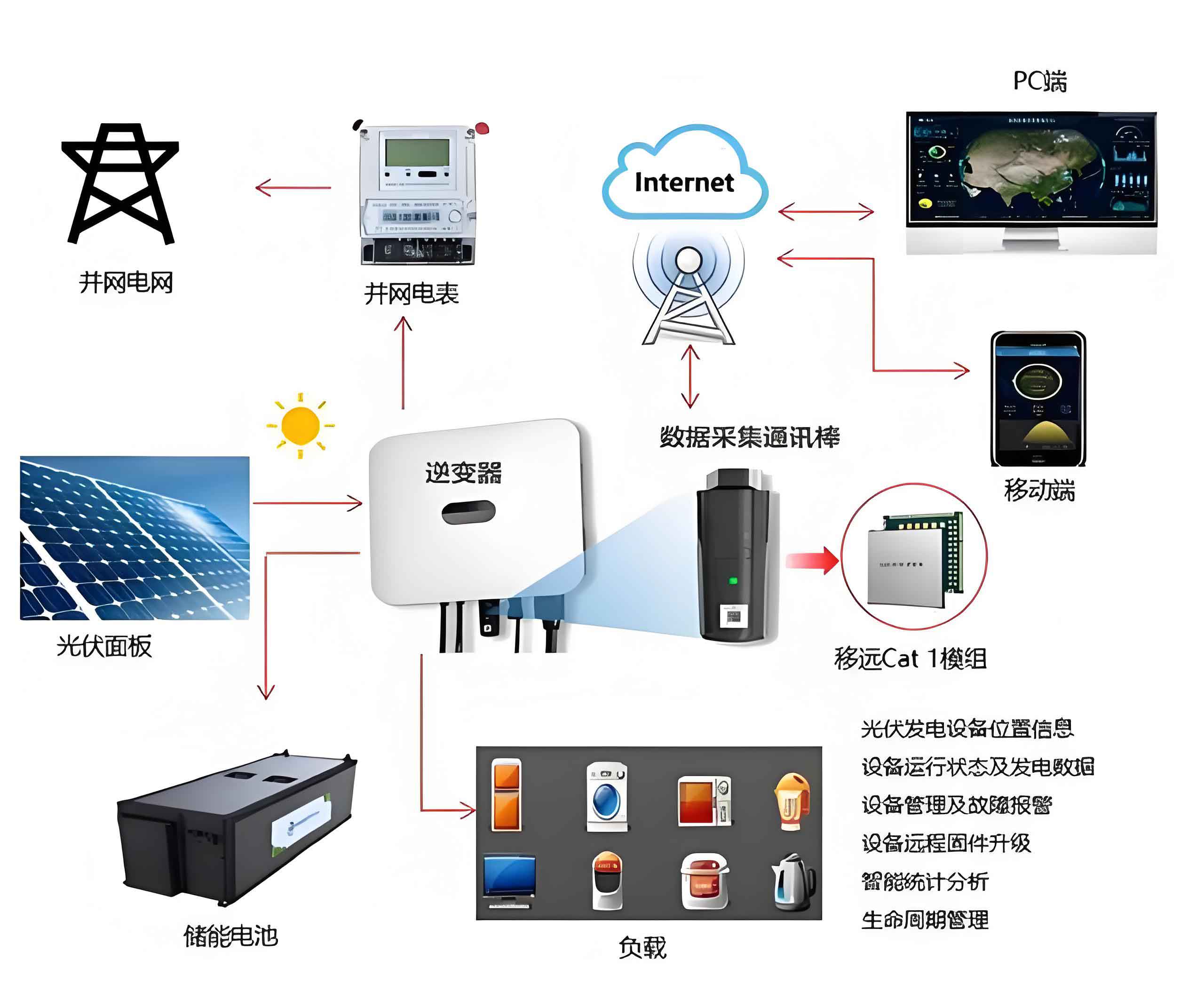
4. Battery: Often termed the “Achilles’ heel” of an off-grid solar system. It is the component with the shortest lifespan and the most stringent maintenance requirements. Deep-cycle Lead-Acid (Valve-Regulated Lead-Acid – VRLA) batteries are common. Their state of charge (SOC) is closely related to terminal voltage. A critical reliability parameter is the Depth of Discharge (DOD). Battery cycle life \( N \) is a strong function of DOD, often following a relationship like:
$$ N \approx k \times (DOD)^{-\alpha} $$
Where \( k \) and \( \alpha \) are constants specific to battery chemistry and construction. A shallower DOD (e.g., 30% vs. 80%) can extend cycle life by several times. The primary failure modes are sulfation (from chronic undercharging), corrosion, and water loss (for flooded types). In a well-managed solar system, the controller’s setpoints for charge and discharge are optimized to maximize battery life, making the controller-battery interface the most critical for overall solar system reliability.
Maintenance Realities and Field Experience
My practical involvement in deploying thousands of solar lighting systems, particularly in rural and semi-urban settings, has provided crucial lessons in maintenance. The promise of a “maintenance-free” solar system is a myth; it is more accurate to describe it as “low-maintenance” compared to grid-tied alternatives with recurring energy bills.
The most common issues encountered stem from component interplay and environmental factors:
- Battery Failure: This accounts for over 70% of field failures in the first 3-5 years. Causes include poor quality batteries, improper controller settings (leading to chronic undercharge or overcharge), and extreme ambient temperatures. Regular voltage checks are the first diagnostic step.
- Controller Malfunction: Dust and humidity ingress can cause leakage currents or shorts on the high-impedance sensing circuits of the controller’s microcontroller. This manifests as lights not turning on/off at the correct times or erratic behavior. Weatherproof enclosures and “conformal coating” on circuit boards are essential.
- PV Module Soiling: Dust, bird droppings, and snow significantly reduce energy harvest. In areas with low rainfall, periodic cleaning (2-4 times a year) is necessary to maintain designed performance. The power loss \( P_{loss} \) can be approximated as a linear function of soiling density for mild soiling.
- Physical Damage: Vandalism, vehicle impact, or extreme weather can damage panels, poles, or luminaires. Robust mechanical design and appropriate installation height are key mitigations.
A proactive, scheduled maintenance regimen is vital for a healthy solar system. This includes biannual visual inspections, terminal tightening, battery voltage/charge state verification, and module cleaning. Empowering local community members or technicians with basic troubleshooting training—such as using a multimeter to check battery voltage or PV open-circuit voltage—can drastically reduce system downtime and central maintenance costs. This decentralized maintenance model is often the most sustainable for large-scale rural solar system lighting projects.
Future Prospects and Concluding Synthesis
The trajectory for solar photovoltaic lighting is unequivocally toward broader adoption and deeper market penetration. Several convergent trends guarantee this:
- Cost Reduction: The continued, steep decline in PV module and LED prices directly improves the economics of the entire solar system, shortening payback periods.
- Technology Advancement: Improvements in battery technology (e.g., Lithium Iron Phosphate – LiFePO4 batteries offering longer life, higher DOD tolerance, and lighter weight), more efficient MPPT controllers, and smarter networked controls for fault monitoring and diagnostics.
- Policy and Environmental Drivers: Global commitments to carbon reduction and sustainable development goals make decentralized, renewable energy solutions like standalone solar lighting systems highly attractive for public infrastructure projects.
- Standardization: The development and enforcement of international performance and reliability standards for solar lighting systems will weed out inferior products, protect consumers, and accelerate market confidence.
In conclusion, a solar photovoltaic lighting solar system represents a mature, economically sound, and environmentally imperative technology. Its viability is no longer in question. The initial cost parity with conventional lighting, when full installation costs are considered, combined with near-zero operational energy costs, creates a compelling financial case. The reliability of the modern solar system is high, though it demands careful component selection, intelligent system design tailored to local climate and load, and a commitment to simple, proactive maintenance. As the technology continues its cost-performance improvement curve, solar PV lighting will transition from being a niche solution for remote areas to a mainstream choice for municipal, residential, and commercial lighting worldwide, fundamentally altering how we think about and power public and private illumination. The future of lighting is intelligent, efficient, and powered by the sun, making every light point a self-sufficient solar system.