
The global imperative for sustainable energy has catalyzed an unprecedented shift towards renewable sources. Among these, solar energy stands out due to its ubiquity, abundance, and minimal environmental footprint. The core technology harnessing this power is the photovoltaic (PV) solar system, which converts sunlight directly into electricity. However, the efficiency, reliability, and economic viability of a solar system are heavily dependent on the sophistication of the technologies employed throughout its lifecycle—from material production and module manufacturing to system operation and maintenance. This is where automation technology becomes a critical enabler. This analysis delves into the principles of photovoltaic solar systems and provides a detailed examination of the application and transformative impact of automation across this dynamic field, illustrated with technical data, formulas, and comparative insights.
The fundamental principle behind a photovoltaic solar system is the photoelectric effect. When photons from sunlight strike a semiconductor material (typically silicon in a solar cell), they can transfer enough energy to electrons to liberate them, creating electron-hole pairs. An internal electric field within the cell, established by a p-n junction, then separates these charges, driving them to the external circuit and generating a direct current (DC). The performance of a single cell is limited, so they are connected in series and parallel to form modules and arrays, scaling up to power a complete solar system. The key electrical parameters are defined by the current-voltage (I-V) characteristic curve, from which critical metrics are derived.
The maximum power point (MPP) is a crucial concept, representing the voltage and current at which the PV module delivers its peak power output. This point is not fixed and varies with irradiance (G) and cell temperature (T_c). The power output can be approximated by:
$$P_{mp} = V_{mp} \cdot I_{mp} = FF \cdot V_{oc} \cdot I_{sc}$$
where \(V_{oc}\) is the open-circuit voltage, \(I_{sc}\) is the short-circuit current, and \(FF\) is the fill factor, a measure of the “squareness” of the I-V curve. Automation in a modern solar system is vital for continuously tracking this MPP to maximize energy harvest.
Automation in the Photovoltaic Manufacturing Value Chain
The journey of a solar system begins with the production of high-purity materials and precise manufacturing. Automation is integral at every stage to ensure quality, increase throughput, and reduce costs.
1. Silicon Ingot Growth and Wafering
The predominant material is crystalline silicon. The process starts with the Siemens process or fluidized bed reactor (FBR) methods to produce high-purity polysilicon. Modern plants employ fully automated chemical vapor deposition (CVD) reactors where process parameters like temperature, gas flow rates (e.g., SiHCl_3, H_2), and pressure are precisely controlled by distributed control systems (DCS).
The subsequent step is crystallization, forming either single-crystal (mono-Si) ingots via the Czochralski (CZ) method or multi-crystalline (mc-Si) ingots via directional solidification. Automation ensures perfect control over the pull rate, rotation speed, and thermal gradient in the CZ furnace, which directly impacts the minority carrier lifetime and final cell efficiency.
Wafering is a critical and delicate process. Today, diamond-wire sawing has completely replaced slurry-based sawing. This process is highly automated. The relationship for material removal rate (MRR) and wafer thickness tolerance can be modeled, considering wire speed (v_w), ingot feed rate (v_f), wire tension, and abrasive grit properties.
$$MRR \propto v_w \cdot v_f \cdot d_{grit} \cdot N_{wires}$$
State-of-the-art wire saws feature automated loading/unloading, in-situ diameter measurement for feedback control, and automated slurry/wire management. The target is to produce wafers with thicknesses below 150 µm with a total thickness variation (TTV) of less than 20 µm, minimizing silicon kerf loss. The following table contrasts key parameters of traditional and automated wafering lines:
| Parameter | Traditional Slurry Sawing | Automated Diamond-Wire Sawing |
|---|---|---|
| Wafer Thickness | ~200 µm | 150-170 µm |
| Kerf Loss | ~180 µm | ~70 µm |
| Cutting Speed | 0.4-0.6 mm/min | 1.0-1.5 mm/min |
| TTV Control | Manual adjustment, ±30 µm | Automated feedback, ±15 µm |
| Silicon Utilization | Lower (~45%) | Higher (~55%) |
2. Solar Cell Production
Cell fabrication is a sequence of intricate steps where automation ensures process uniformity and high yield. Key automated processes include:
- Texturing & Cleaning: Automated wet benches perform anisotropic etching (for mono-Si) or isotropic etching (for mc-Si) to create a light-trapping surface. Concentration, temperature, and time are robotically controlled.
- Doping (Diffusion/Ion Implantation): To form the p-n junction. Tube diffusion furnaces with automated wafer boats and precise gas flow controllers manage the POCl_3 or BBr_3 diffusion process. Ion implanters offer superior dose control and are inherently automated.
- Plasma-Enhanced Chemical Vapor Deposition (PECVD): This is the standard for depositing anti-reflection (SiN_x:H) and passivation coatings. Modern PECVD tools feature automated cassette-to-cassette wafer handling, plasma process monitoring via optical emission spectroscopy (OES), and automated chamber cleaning. The film’s refractive index (n) and thickness (d) are critical and must satisfy the quarter-wavelength condition for minimal reflection at the target wavelength (λ):
$$n \cdot d = \frac{\lambda}{4}$$
- Screen Printing & Firing: Robots apply front and rear metallization pastes through patterned screens. High-precision vision systems ensure alignment. The subsequent co-firing process in a conveyor belt furnace has multiple temperature zones strictly controlled by programmable logic controllers (PLCs) to achieve optimal ohmic contact.
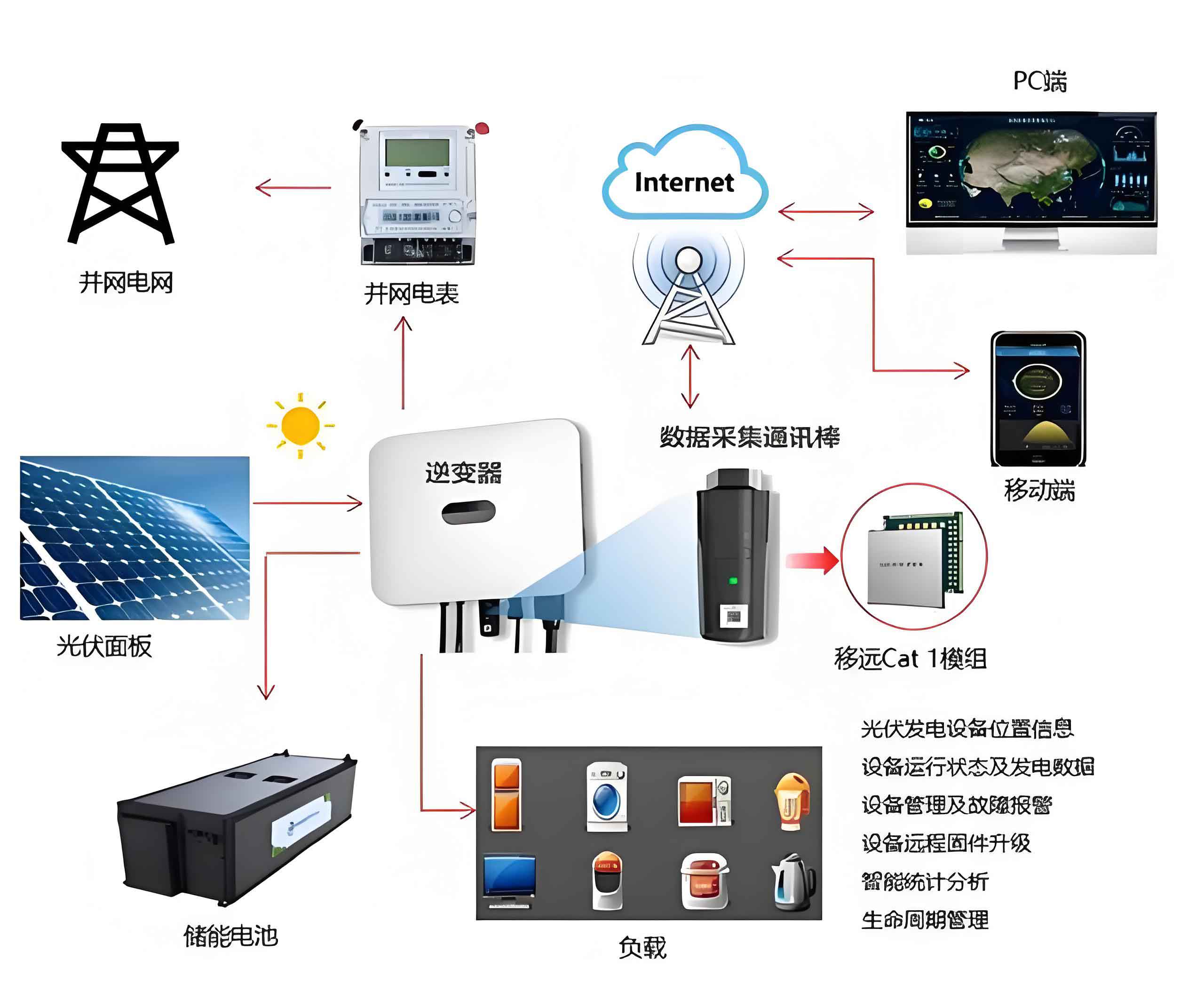
This image conceptually represents a modern, automated solar system manufacturing and integration flow, from raw silicon to grid-connected power generation.
3. Module Assembly
This stage involves stringing cells, layering, laminating, framing, and junction box installation. Automation is key for high throughput and quality.
- Stringing & Layup: Robotic arms with computer vision pick, place, and interconnect cells with high-speed tabber-stringer machines. Positioning accuracy is within ±0.2 mm.
- Lamination: The layered stack (glass, EVA, cells, EVA, backsheet) undergoes vacuum lamination. The lamination cycle—vacuum pull, heating, pressure application, and cooling—is fully automated via PLCs, following a precise time-temperature-pressure profile to ensure perfect encapsulation without voids.
- Testing: Every module undergoes automated flash testing under Standard Test Conditions (STC: 1000 W/m², 25°C, AM1.5 spectrum) to measure \(P_{mp}\), \(V_{oc}\), \(I_{sc}\), and \(FF\). Data is automatically logged and used for binning and quality assurance.
Automation in Photovoltaic System Operation and Control
Once deployed, the performance and health of a solar system rely heavily on automated power electronics and monitoring systems.
1. The Photovoltaic Inverter: The Automated Brain
The inverter is the core control unit of any grid-connected solar system. Its primary function is to convert DC from the PV array into grid-compliant AC. Modern inverters are highly automated devices with multiple embedded functions:
- Maximum Power Point Tracking (MPPT): Uses algorithms like Perturb and Observe (P&O) or Incremental Conductance (InCond) to dynamically find the MPP. The InCond algorithm works by comparing the instantaneous conductance (I/V) to the incremental conductance (dI/dV):
$$\frac{dI}{dV} = -\frac{I}{V} \quad \text{at MPP}$$
$$\frac{dI}{dV} > -\frac{I}{V} \quad \text{left of MPP}$$
$$\frac{dI}{dV} < -\frac{I}{V} \quad \text{right of MPP}$$
- Grid Management Functions: Includes automatic voltage and frequency regulation (AVR, AFR), power factor correction, low-voltage ride-through (LVRT), and anti-islanding protection. These are mandated by grid codes and executed autonomously.
- System Diagnostics: Continuous monitoring of DC and AC side parameters, insulation resistance, and component temperatures. Automated fault detection and classification (FDC) algorithms trigger alarms or safe shutdowns.
The efficiency of an inverter (\(\eta_{inv}\)) is paramount and is a function of its load. Modern string inverters achieve peak efficiencies (\(\eta_{peak}\)) over 99%.
$$\eta_{inv} = \frac{P_{AC, out}}{P_{DC, in}} = f(P_{DC, in})$$
2. Automated Monitoring and Analytics for Solar Systems
Large-scale solar plants comprise thousands of modules and dozens of inverters. A comprehensive Supervisory Control and Data Acquisition (SCADA) system is essential. This automated monitoring platform collects data from sensors (irradiance, temperature, wind speed) and inverters at intervals of seconds to minutes.
The data is used for:
- Performance Ratio (PR) Calculation: An automated, key performance indicator (KPI) measuring the quality of the solar system independent of location. It compares actual yield to theoretical yield.
$$PR(t) = \frac{Y_f}{Y_r} = \frac{\frac{E_{AC}(t)}{P_{0}}}{\frac{H_{t}(t)}{G_{STC}}}$$
where \(Y_f\) is the final yield, \(Y_r\) is the reference yield, \(E_{AC}\) is the AC energy output, \(P_0\) is the rated DC power, \(H_t\) is the plane-of-array irradiation, and \(G_{STC}\) is 1000 W/m².
- Predictive Maintenance: Machine learning algorithms analyze historical performance data to predict failures (e.g., inverter component degradation, string underperformance) before they occur, scheduling maintenance automatically.
- Fleet Management: For operators with multiple plants, automated dashboards provide a unified view, benchmarking the performance of different solar system assets.
3. Automation in Balance of System (BoS) Components
Beyond the inverter, other BoS elements are becoming smarter:
- Automatic Tracking Systems: Single-axis and dual-axis trackers use sun-position algorithms (e.g., based on the solar azimuth \(\alpha_s\) and elevation \(\gamma_s\) angles) and light sensors to orient the PV array optimally throughout the day, increasing energy yield by 15-35%.
- Robotic Cleaning Systems: Deployed in arid, dusty environments, these autonomous robots traverse the arrays on rails or using air-cushion technology, removing soiling that can cause significant efficiency losses. Their operation is often scheduled based on soiling rate models and weather forecasts.
Future Trajectories: The Path Towards Fully Autonomous Solar Systems
The integration of automation in the solar system ecosystem is an ongoing evolution. Key future trends include:
1. Hyper-Automation in Manufacturing
The vision is a “lights-out” fab for PV production. This involves the convergence of Internet of Things (IoT), Artificial Intelligence (AI), and advanced robotics.
- AI for Process Optimization: Machine learning models will analyze vast datasets from production equipment to predict and preemptively adjust process drifts, optimizing parameters like diffusion temperature or PECVD plasma power in real-time to maximize cell efficiency.
- Advanced Robotics and AGVs: Collaborative robots (cobots) will work alongside humans for complex assembly tasks, while Autonomous Guided Vehicles (AGVs) will manage all material transport between production islands, tracked by a Manufacturing Execution System (MES).
2. The Rise of Digital Twins
A digital twin is a virtual, dynamic replica of a physical solar system. It is fed with real-time operational data (from SCADA) and environmental forecasts. Engineers can use the twin to run simulations, test control strategies (e.g., curtailment schemes, storage dispatch), and predict energy output with high accuracy, all without interfering with the actual plant.
3. Grid Integration and Smart Inverters
As penetration of solar system generation increases, grid stability becomes a concern. Next-generation “smart” or “grid-forming” inverters will autonomously provide grid services traditionally offered by fossil-fuel plants: voltage support, frequency regulation, and synthetic inertia. They will use advanced, automated controls to respond to grid signals in milliseconds, acting as a stabilizing force.
4. Autonomous Operation and Maintenance (O&M)
The future O&M paradigm will be predominantly robotic and remote:
- Drone-Based Inspection: Autonomous drones equipped with infrared (IR) and electroluminescence (EL) cameras will perform routine inspections, automatically identifying hotspots (indicative of cell cracks or faulty connections) and soiling patterns.
- Automated Analysis and Work Orders: The inspection data will be automatically analyzed by AI, which will generate work orders for targeted repairs, dispatch robotic cleaners, or schedule component replacements, drastically reducing downtime and labor costs.
The following table summarizes the evolution of automation levels across the solar system value chain:
| Value Chain Stage | Current State (High Automation) | Future State (Hyper-Automation / Autonomy) |
|---|---|---|
| Material & Cell Production | Automated process lines, PLC/DCS control, robotic handling. | AI-driven process optimization, predictive maintenance of tools, fully integrated “lights-out” fabs. |
| Module Assembly | Robotic stringing, layup, and lamination; automated testing. | Adaptive robotics for heterojunction/perovskite tandem cells; AI-based visual QA. |
| System Operation | Advanced MPPT, SCADA monitoring, basic remote control. | Digital twins for simulation & control; autonomous grid-forming inverters. |
| System Maintenance | Scheduled manual inspections, some drone use. | Fully autonomous robotic inspection, cleaning, and repair; AI-powered predictive O&M. |
Conclusion
Automation is the indispensable backbone of the modern photovoltaic industry, driving its evolution from a niche technology to a mainstream energy source. From the precise control required to grow pure silicon crystals and fabricate high-efficiency cells to the intelligent algorithms that maximize power harvest and ensure seamless grid integration, automation permeates every facet of the solar system. It enhances manufacturing yield and quality, reduces levelized cost of energy (LCOE), improves operational reliability, and enables the management of vast, distributed fleets of PV assets. As the industry marches forward, the convergence of automation with artificial intelligence, robotics, and digitalization promises to usher in an era of fully autonomous, self-optimizing, and highly resilient solar systems. This continuous technological advancement will solidify solar energy’s pivotal role in achieving a sustainable and decarbonized global energy future.