
In this paper, we explore the integration of a solar photovoltaic intelligent system into inland river LNG cargo ships, aiming to enhance energy efficiency and reduce environmental impact. The solar system leverages solar energy to generate electricity, which is then combined with traditional diesel power through grid-connected control, enabling synergistic operation between photovoltaic and diesel sources. This approach not only mitigates pollution from ship emissions but also lowers operational costs, aligning with the global shift toward green shipping. The solar photovoltaic intelligent system is designed with modularity, where each module incorporates independent Maximum Power Point Tracking (MPPT) control, forming a standalone power supply unit. Control is based on a Digital Signal Processor (DSP) digital control system, facilitating intelligent management of energy flows. By analyzing the smart application of solar photovoltaic and diesel power, we outline the technical pathway for grid integration, including both grid-connected and off-grid control modes. The construction of this solar system results in a hybrid energy setup combining solar photovoltaic with LNG-diesel, automatically switching energy sources based on real-time ship conditions to achieve significant energy savings and consumption reduction.
The solar photovoltaic intelligent system architecture comprises several key subsystems: photovoltaic power generation management control, energy storage management control, propulsion management control, data transmission, DSP data management control, and an upper computer monitoring system. This solar system employs CAN fieldbus technology and DSP embedded technology for data acquisition, transmission, and energy management. The communication framework combines CAN and Ethernet, ensuring efficient signal collection from lower-level devices and real-time monitoring from the upper computer, which is crucial for maintaining the solar system’s stability. To ensure uninterrupted power supply, the system includes a central energy management controller and battery storage for sustainable energy provision, achieved through solar output and charge-discharge cycles. The solar system’s design prioritizes modularity to prevent single-point failures, enhancing reliability and flexibility in energy deployment. Below is a table summarizing the core components of the solar photovoltaic intelligent system:
| Subsystem | Function | Key Features |
|---|---|---|
| Photovoltaic Power Generation Management | Converts solar energy to electricity via solar panels | MPPT control, modular design |
| Energy Storage Management | Stores excess energy in batteries for later use | Lead-acid batteries, charge-discharge control |
| Propulsion Management | Integrates with ship’s propulsion system | DSP-based control, grid synchronization |
| Data Transmission | Facilitates communication between subsystems | CAN bus, Ethernet |
| DSP Data Management Control | Processes data for intelligent decision-making | Real-time monitoring, PWM signal generation |
| Upper Computer Monitoring | Provides user interface for system oversight | Graphical display, fault detection |
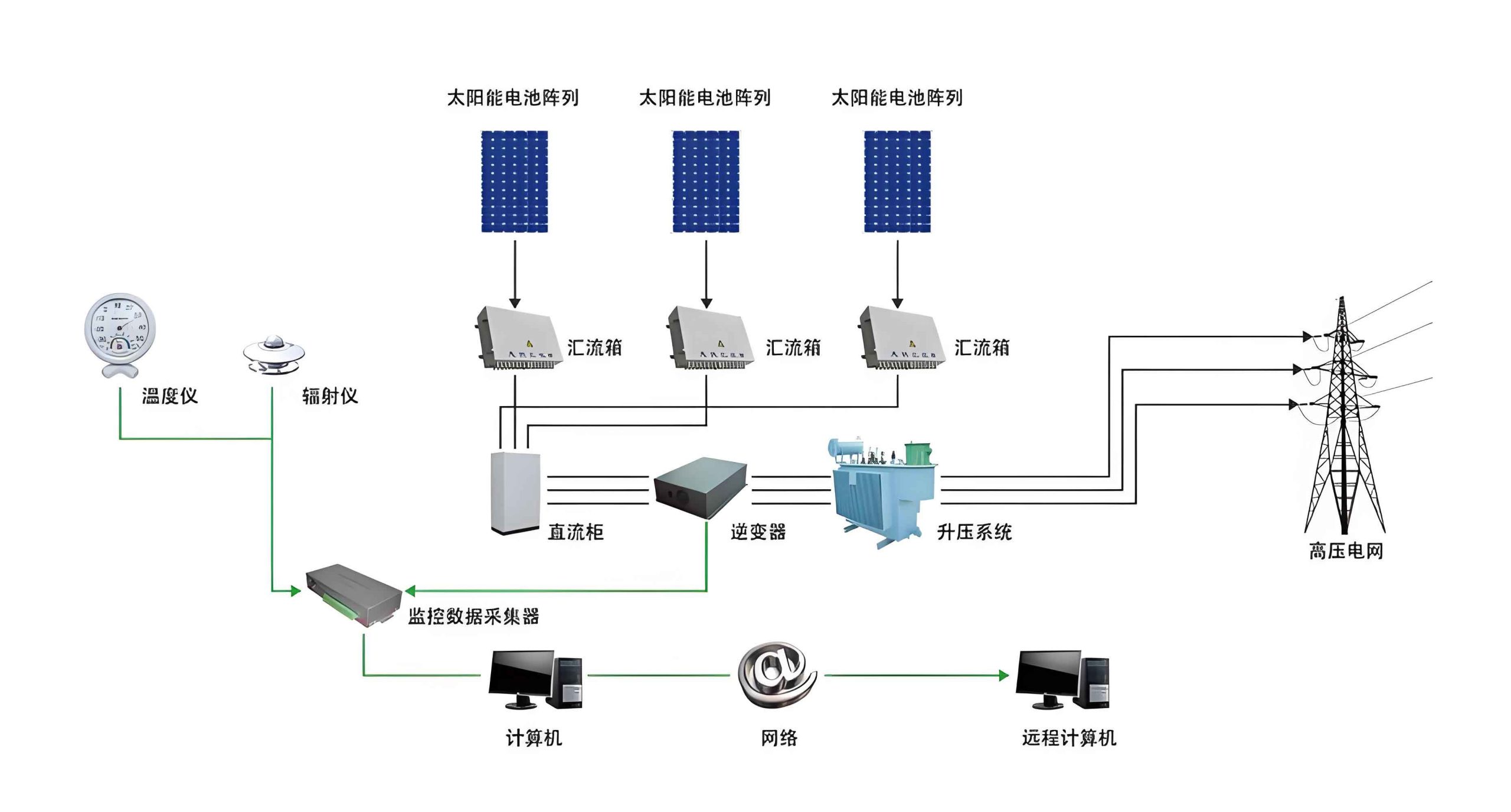
The solar system’s architecture is visualized in the image above, highlighting the integration of photovoltaic arrays, batteries, and control units. This solar photovoltaic intelligent system ensures robust performance by utilizing a matrix series-parallel connection and incremental power analysis model, allowing seamless switching between LNG, diesel, and solar energy. The solar system’s efficiency is further enhanced through advanced control strategies, such as MPPT, which optimizes power extraction from solar panels under varying conditions. The mathematical representation of MPPT control can be expressed using the perturb and observe method, where the power output is maximized by adjusting the voltage. For instance, the power from a solar panel is given by: $$ P = V \times I $$ where \( P \) is power, \( V \) is voltage, and \( I \) is current. The MPPT algorithm iteratively adjusts \( V \) to find the maximum power point, ensuring the solar system operates at peak efficiency.
In analyzing the intelligent application of solar photovoltaic and diesel power, the grid integration technical route is critical. The solar system connects to the ship’s grid via a photovoltaic inverter, enabling both grid-connected and off-grid modes. In grid-connected mode, the inverter synchronizes the solar output with the main grid, while in off-grid mode, it powers ship lighting independently. To prevent reverse power flow to diesel generators, anti-reverse current devices are installed, safeguarding the solar system from interference. The solar photovoltaic array configuration involves series connections of solar panels for current aggregation, followed by parallel connections to a DC lightning protection distribution cabinet, ultimately feeding into the inverter. Battery storage plays a pivotal role by charging during high solar irradiance and discharging during low light, ensuring a stable power supply. The technical route for this solar system can be summarized in the following steps: solar energy capture → DC conversion → MPPT control → battery storage → inverter AC output → grid synchronization. A key aspect of the solar system is its ability to manage energy flows intelligently, as described by the energy balance equation: $$ E_{\text{solar}} + E_{\text{battery}} + E_{\text{grid}} = E_{\text{load}} + E_{\text{loss}} $$ where \( E_{\text{solar}} \) is energy from solar panels, \( E_{\text{battery}} \) is battery energy, \( E_{\text{grid}} \) is grid energy, \( E_{\text{load}} \) is load demand, and \( E_{\text{loss}} \) represents system losses. This equation underpins the solar system’s energy management strategy, ensuring optimal resource utilization.
For photovoltaic grid-connected control, the solar system employs a DSP-based inverter that uses Pulse Width Modulation (PWM) to generate driving signals. This control method relies on direct current control, where grid current and voltage parameters are monitored to produce AC power matching the grid in frequency and phase. The PWM technique involves generating a series of pulses with varying widths but equal amplitude, effectively replicating a sinusoidal waveform. The control loop can be modeled using a transfer function: $$ G(s) = \frac{I_{\text{out}}(s)}{V_{\text{ref}}(s)} = \frac{K_p s + K_i}{s^2 + \omega_n s + \omega_n^2} $$ where \( I_{\text{out}} \) is the output current, \( V_{\text{ref}} \) is the reference voltage, \( K_p \) and \( K_i \) are proportional and integral gains, and \( \omega_n \) is the natural frequency. This enhances the solar system’s robustness against grid disturbances. Additionally, the solar system incorporates harmonic filters to mitigate waveform distortion, as harmonics can be expressed as Fourier series: $$ V(t) = \sum_{n=1}^{\infty} (a_n \cos(n\omega t) + b_n \sin(n\omega t)) $$ where \( V(t) \) is the voltage waveform, \( n \) is the harmonic order, and \( a_n \), \( b_n \) are coefficients. By suppressing these harmonics, the solar system maintains power quality and complies with grid standards.
In photovoltaic off-grid control, the solar system utilizes an off-grid inverter to convert DC power from batteries to AC for ship loads. This mode is essential when the ship is disconnected from the main grid, such as during port operations or emergencies. The off-grid inverter employs a dual-loop control strategy combining an inner current loop and an outer voltage loop, with PI control for the voltage loop and P control for the current loop. This approach improves dynamic performance and reduces load disturbances. However, for nonlinear loads causing periodic waveform distortion, repetitive control is integrated to correct errors. The combined control strategy can be represented as: $$ u(t) = K_p e(t) + K_i \int e(t) dt + \sum_{k=1}^{N} r(t-kT) $$ where \( u(t) \) is the control signal, \( e(t) \) is the error, \( K_p \) and \( K_i \) are control gains, and \( r(t-kT) \) is the repetitive correction term for period \( T \). This ensures the solar system delivers clean AC power even under varying load conditions. The table below compares grid-connected and off-grid control modes in the solar photovoltaic intelligent system:
| Control Mode | Primary Function | Key Technologies | Advantages |
|---|---|---|---|
| Grid-Connected | Synchronizes solar power with ship grid | PWM, direct current control, harmonic filtering | Enables energy exchange with grid, high efficiency |
| Off-Grid | Provides standalone power for ship loads | Dual-loop control, repetitive control, battery management | Ensures power availability during grid outages |
The construction of the solar photovoltaic intelligent system involves feasibility analysis, component selection, installation, and monitoring. Given space constraints on ships, the solar system must be carefully designed to maximize solar exposure while ensuring safety and compliance with maritime regulations. Solar panels are typically installed on the cabin roof, with adjustable brackets to optimize tilt angle for capturing maximum solar irradiance. Battery capacity is sized based on load demand and solar generation, often configured as three times the peak load to account for cloudy days. The installation process includes stability calculations to assess weight distribution and structural integrity. The solar system’s reliability is enhanced through redundancy in critical components, such as inverters and controllers. For instance, the inverter’s protection functions prevent electromagnetic interference with ship communication systems. The overall construction workflow can be outlined as: ship selection → solar potential assessment → component sizing → installation design → integration testing → operational monitoring. The solar system’s performance can be evaluated using metrics like energy yield, calculated as: $$ E_{\text{yield}} = \eta \times A \times G \times t $$ where \( \eta \) is photovoltaic efficiency, \( A \) is panel area, \( G \) is solar irradiance, and \( t \) is time. By optimizing these parameters, the solar system achieves high energy output, reducing reliance on diesel fuel.
In conclusion, the solar photovoltaic intelligent system for inland river LNG cargo ships represents a significant advancement in maritime energy management. This solar system integrates solar power with traditional diesel engines through intelligent grid control, enabling efficient energy use and emission reduction. The modular design of the solar system ensures fault tolerance and flexibility, while DSP-based control enhances precision in power conversion. By employing both grid-connected and off-grid modes, the solar system adapts to varying operational conditions, automatically switching between energy sources to meet load demands. The incorporation of MPPT, PWM control, and advanced battery management further optimizes the solar system’s performance. Through careful construction and monitoring, the solar system proves to be a viable solution for green shipping, contributing to sustainability goals. Future work may focus on scaling the solar system for larger vessels or integrating additional renewable sources, but the current framework provides a robust foundation for energy-efficient maritime transport. The solar photovoltaic intelligent system, as described, exemplifies how innovative technology can transform traditional industries, paving the way for cleaner and smarter shipping solutions.