
As I delve into the challenges of modern energy consumption, it becomes clear that the growing demand for resources necessitates innovative solutions. In the building sector, energy efficiency is paramount, and my focus lies on harnessing renewable technologies. The integration of a solar system with geothermal heat pumps presents a promising avenue. This article explores how such systems can drastically reduce能耗 and promote sustainability. I will detail the components, benefits, and smart management approaches, emphasizing the role of the solar system in this integration. Through formulas and tables, I aim to provide a comprehensive understanding.
The solar system, specifically photovoltaic technology, is central to this discussion. It converts sunlight into electricity, offering a clean and renewable energy source. The basic principle involves photovoltaic cells that generate direct current (DC) when exposed to light. The power output can be expressed mathematically. For instance, the electrical power \( P_{pv} \) produced by a solar system is given by:
$$ P_{pv} = \eta_{pv} \cdot A \cdot G $$
where \( \eta_{pv} \) is the photovoltaic conversion efficiency, \( A \) is the surface area of the panels, and \( G \) is the solar irradiance in W/m². This efficiency typically ranges from 15% to 22% for commercial panels, but it varies with temperature and光照 conditions. To illustrate, consider the following table comparing different solar system technologies:
| Solar System Type | Average Efficiency (%) | Typical Application |
|---|---|---|
| Monocrystalline Silicon | 18-22 | Residential rooftops |
| Polycrystalline Silicon | 15-18 | Large-scale farms |
| Thin-Film | 10-12 | Building-integrated systems |
The solar system’s intermittent nature requires energy storage, often using batteries. The state of charge (SOC) of a battery can be modeled as:
$$ SOC(t) = SOC_0 + \int_0^t \frac{I_{bat}(\tau)}{C_{bat}} d\tau $$
where \( SOC_0 \) is the initial charge, \( I_{bat} \) is the battery current, and \( C_{bat} \) is the battery capacity. This ensures stable power supply despite fluctuations in the solar system’s output.
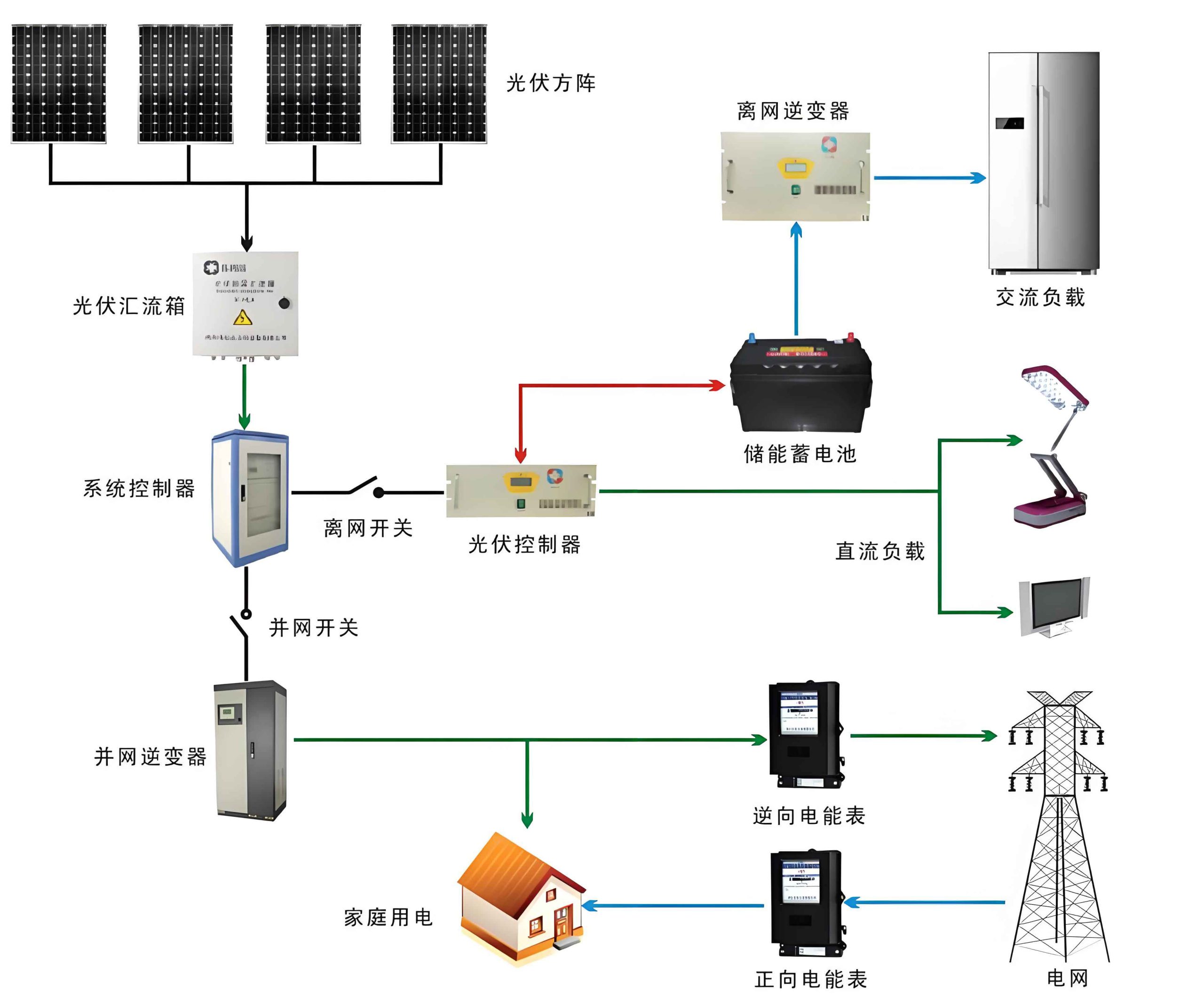
Moving to geothermal heat pumps, these systems leverage the earth’s stable temperature for heating and cooling. A heat pump’s performance is quantified by the coefficient of performance (COP), defined as:
$$ COP = \frac{Q}{W} $$
where \( Q \) is the heat delivered or removed, and \( W \) is the work input to the compressor. For ground-source heat pumps, COP values often range from 3 to 5, indicating high efficiency. The heat exchange process can be analyzed using the following formula for heat transfer rate \( \dot{Q} \):
$$ \dot{Q} = U \cdot A \cdot \Delta T $$
where \( U \) is the overall heat transfer coefficient, \( A \) is the area, and \( \Delta T \) is the temperature difference. Classifying heat pumps by冷凝 temperature, we have:
| Heat Pump Category | Condensation Temperature Range | Typical Use |
|---|---|---|
| Low-Temperature | < 50°C | Space heating |
| Medium-Temperature | 50-80°C | Domestic hot water |
| High-Temperature | > 100°C | Industrial processes |
Integrating the solar system with heat pumps leads to solar-assisted heat pump (SAHP) systems. There are two main types: indirect and direct expansion. In indirect SAHP, the solar system collects heat independently, supplying it to the heat pump via a heat exchanger. The energy balance can be written as:
$$ Q_{collector} = m \cdot c_p \cdot (T_{out} – T_{in}) $$
where \( m \) is the mass flow rate of the fluid, \( c_p \) is its specific heat, and \( T_{out} \) and \( T_{in} \) are outlet and inlet temperatures. In direct expansion SAHP, the solar system’s collectors act as the evaporator for the heat pump, enhancing efficiency. The combined performance coefficient \( COP_{SAHP} \) is given by:
$$ COP_{SAHP} = \frac{Q_{heating} + P_{electric}}{W_{compressor}} $$
where \( P_{electric} \) is the electrical power generated by the solar system. This synergy boosts overall efficiency.
The PV-SAHP system, which combines photovoltaic and thermal components, offers numerous advantages. First, the evaporation cooling effect lowers the temperature of PV panels, increasing光电 conversion efficiency. The enhanced efficiency \( \eta_{enhanced} \) can be approximated as:
$$ \eta_{enhanced} = \eta_{ref} \cdot (1 – \beta \cdot (T_{pv} – T_{ref})) $$
where \( \eta_{ref} \) is the reference efficiency at temperature \( T_{ref} \), \( \beta \) is the temperature coefficient, and \( T_{pv} \) is the panel temperature. Second, the solar system provides electricity directly to the heat pump’s compressor, reducing grid dependency. This autonomy is crucial for remote applications. Third, the integrated system improves thermal performance, especially under high solar radiation. The following table summarizes key benefits:
| Advantage | Impact | Quantitative Measure |
|---|---|---|
| Higher COP | Reduced energy consumption | COP increase by 20-30% |
| Dual energy output | Electricity and heat from one solar system | Up to 80% combined efficiency |
| Improved cold climate operation | Reliable heating in winter | Operational at -10°C or lower |
Moreover, the solar system can be designed to power auxiliary devices, further embedding its role in building operations.
To optimize these systems, I incorporate物联网 technology for smart building management.物联网 enables real-time monitoring and control of the solar system and heat pumps. The architecture consists of three layers: perception, network, and application. In the perception layer, sensors collect data from the solar system, such as irradiance, panel temperature, and power output. For example, the power output \( P_{pv} \) is continuously measured and transmitted. The network layer uses protocols like MQTT or CoAP to send data to cloud platforms. The application layer provides analytics for decision-making, such as adjusting heat pump settings based on solar system performance. A key formula for data aggregation is:
$$ D_{aggregated} = \sum_{i=1}^{n} w_i \cdot d_i $$
where \( d_i \) are data points from sensors, and \( w_i \) are weighting factors. This facilitates predictive maintenance and energy调度. For instance, RFID technology can manage access to solar system maintenance areas, ensuring security. The integration of物联网 with the solar system enhances overall system resilience. Consider the following table outlining物联网 applications:
| IoT Application | Function | Benefit for Solar System |
|---|---|---|
| Remote monitoring | Tracks performance metrics | Early fault detection |
| Automated control | Adjusts parameters based on weather | Maximizes energy harvest |
| Data analytics | Predicts energy generation | Optimizes storage use |
By leveraging物联网, the solar system becomes part of an intelligent network that adapts to changing conditions, thereby increasing the building’s energy efficiency.
In conclusion, the fusion of a solar system with geothermal heat pumps represents a significant leap toward sustainable buildings. The solar system provides renewable electricity and thermal energy, while heat pumps offer efficient temperature regulation. Through mathematical modeling and IoT integration, these systems can achieve remarkable energy savings. I have highlighted how the solar system’s efficiency can be enhanced and managed smartly. As we advance, further research into materials and control algorithms will unlock even greater potentials for the solar system in building applications. The journey toward energy-efficient buildings is paved with innovations like these, where the solar system plays a starring role.