
In addressing the challenges of rural sewage treatment, I have analyzed the feasibility of utilizing standalone solar systems for power supply. Rural wastewater is characterized by its scattered distribution, small volume, and low management levels, often coupled with financial constraints for construction and operation. Traditional grid electricity faces issues such as high costs for grid expansion and line installation, leading to many treatment stations being non-operational. Therefore, I explored renewable energy solutions, focusing on solar systems as a sustainable and long-term power source. This paper summarizes my research and the implementation of a demonstration project, detailing design parameters, operational management, and the integration of solar technology into rural wastewater treatment infrastructure.
The solar system for power generation offers numerous advantages. Solar energy is ubiquitous and can be harnessed locally, eliminating the need for long-distance transmission and reducing losses and infrastructure costs. It operates without fuel, resulting in low maintenance expenses. With no moving parts, it is durable and suitable for unmanned operation. In regions like Beijing, which receives abundant sunlight with an average annual solar radiation of 4,841.54 MJ/m² from 1983 to 2005, the solar system proves highly viable. I have investigated various configurations of photovoltaic power generation to optimize efficiency and reliability for rural applications.
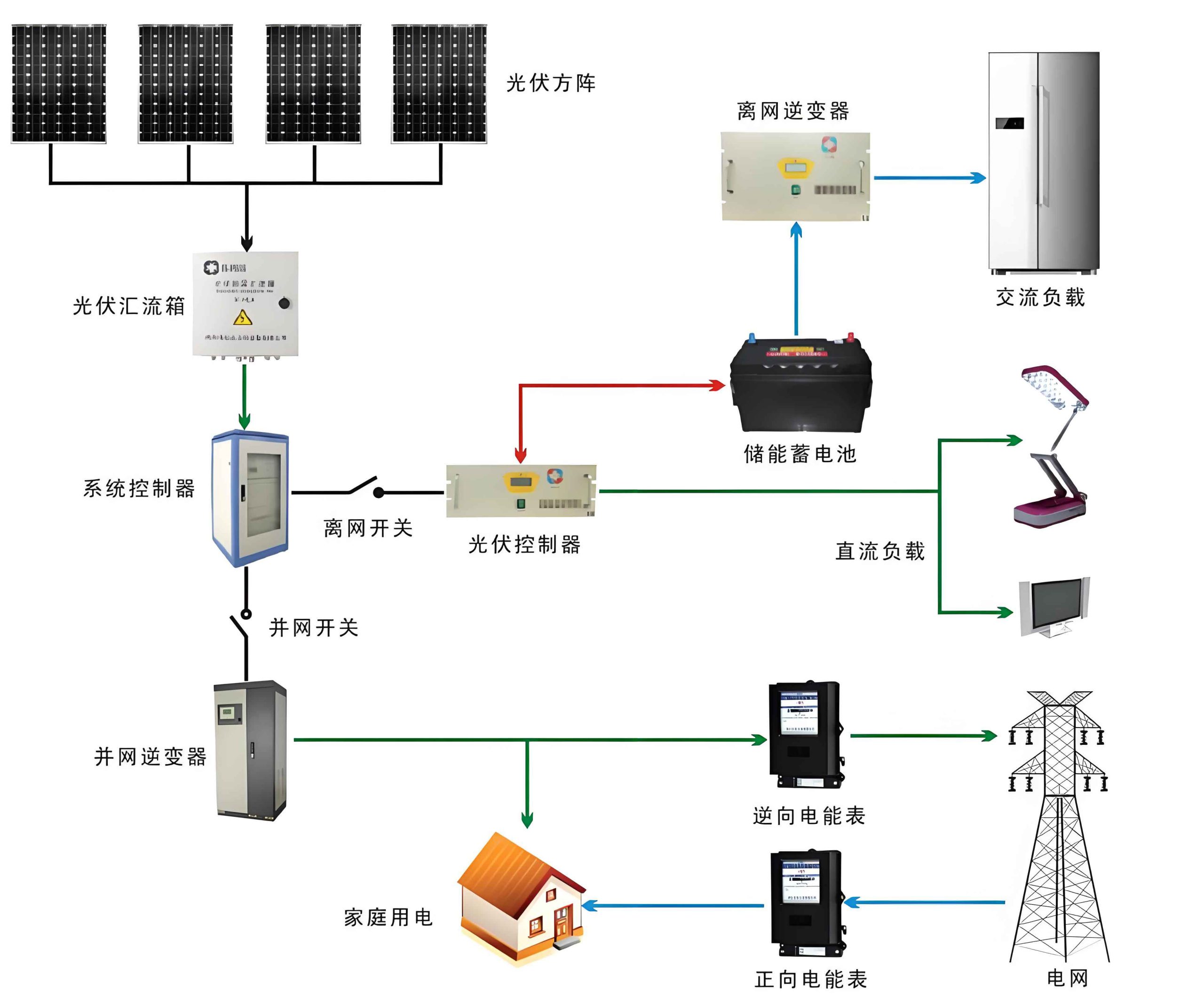
Globally, solar systems have seen rapid development, driven by energy security and environmental concerns. Photovoltaic water pumping systems, in particular, have gained traction in remote areas for irrigation and drinking water. In China, research on photovoltaic pumps dates back to the 1980s, with continuous improvements leading to widespread demonstration projects. For instance, a 2.5 kW solar photovoltaic pumping and lighting system installed in 1999 has operated effectively, providing over 60 m³/day of water output. These advancements highlight the potential of solar systems for decentralized applications like sewage treatment.
In my analysis, I categorized solar photovoltaic power supply modes based on system composition and load types. The primary modes include standalone photovoltaic systems without energy storage, standalone photovoltaic systems with energy storage, and hybrid wind-solar complementary systems. Each mode has distinct advantages and limitations, which I evaluated for suitability in rural settings.
First, the standalone solar system without energy storage directly powers equipment like pumps using solar panels. The energy is used immediately upon generation, simplifying the system and extending lifespan by avoiding batteries. However, it is highly weather-dependent. The power output can be modeled using the formula: $$ P_{pv} = \eta_{pv} \cdot A_{pv} \cdot G_t $$ where \( P_{pv} \) is the photovoltaic power output, \( \eta_{pv} \) is the efficiency of the solar panels, \( A_{pv} \) is the area of the panels, and \( G_t \) is the solar irradiance. This mode is ideal for applications where operation can align with daylight hours.
Second, the standalone solar system with energy storage incorporates batteries to store excess energy for use during non-sunny periods. This system can power AC devices such as aeration equipment and lighting. It offers flexibility but increases initial costs and maintenance due to battery replacement and potential environmental pollution from battery disposal. The energy balance can be expressed as: $$ E_{bat}(t) = E_{bat}(t-1) + \eta_{ch} \cdot P_{pv}(t) \cdot \Delta t – \frac{P_{load}(t)}{\eta_{inv}} \cdot \Delta t $$ where \( E_{bat} \) is the battery energy, \( \eta_{ch} \) is the charging efficiency, \( P_{load} \) is the load power, \( \eta_{inv} \) is the inverter efficiency, and \( \Delta t \) is the time interval. This system ensures reliable power supply but requires careful management.
Third, the hybrid wind-solar complementary system leverages the natural complementarity of wind and solar resources. Wind energy tends to be higher at night and in cloudy conditions, while solar energy peaks during sunny days. By integrating both, the system enhances reliability. The combined power output is given by: $$ P_{total} = P_{pv} + P_{wind} = \eta_{pv} \cdot A_{pv} \cdot G_t + \frac{1}{2} \cdot \rho \cdot A_{wind} \cdot v^3 \cdot C_p $$ where \( P_{wind} \) is the wind power output, \( \rho \) is air density, \( A_{wind} \) is the swept area of the wind turbine, \( v \) is wind speed, and \( C_p \) is the power coefficient. This solar system configuration reduces intermittency and is suitable for areas with variable weather patterns.
To validate these concepts, I designed and implemented a demonstration project in a rural village. The treatment plant had a capacity of 40 m³/day, serving 216 residents and tourists. The process combined simple pretreatment with constructed wetlands, and the only power-consuming device was a 0.75 kW submersible jet aerator. After technical and economic comparison, I selected a standalone solar system without energy storage to power the aerator directly. This solar system uses real-time monitoring to optimize operation: if output frequency falls below 33 Hz or voltage below 105 V for 1.5 minutes, the load is disconnected; when conditions improve, it restarts automatically.
The solar system configuration included 18 series-connected polycrystalline silicon solar panels, each rated at 90 Wp, with a total array open-circuit voltage of 220 V. A photovoltaic-specific control inverter converted DC to three-phase AC 220 V to drive the aerator. For motors rated at 380 V, I reconfigured the winding connection from star to delta to match the 220 V output, a common practice for small-power motors. The system components are summarized in Table 1.
| Component | Specifications | Quantity |
|---|---|---|
| Polycrystalline Solar Panels | 90 Wp, open-circuit voltage 220 V, short-circuit current 5.3 A | 18 panels in series |
| Solar Panel Mounting Structure | Designed for 90 Wp × 4 rows × 5 columns | 1 set |
| Photovoltaic Control Inverter | PVMD320 series, suitable for motors ≤ 2.2 kW | 1 unit |
| Submersible Jet Aerator | 750 W, three-phase AC 220 V | 1 unit |
| Cabling | KVV22-4 × 2.5² for inverter to aerator, VV2 × 4² for array to inverter | 12 m and 10 m respectively |
Operational data from the solar system showed stable performance under various weather conditions, as detailed in Table 2. On sunny days, the system provided optimal aeration with output frequencies of 45-50 Hz, while on cloudy or rainy days, performance varied, and the system automatically shut down when insufficient power was generated. This solar system demonstrated robustness and minimal need for manual intervention.
| Weather Condition | DC Voltage (V) | Output Voltage (V) | Output Current (A) | Aeration Effect |
|---|---|---|---|---|
| Sunny | 310-315 | 200-220 | 3.02-3.06 | Excellent (bubbles fine and abundant) |
| Sunny with Wind | 307-310 | 120-140 | 2.15-2.25 | Poor (reduced bubbling) |
| Partly Cloudy | 310-315 | 200-215 | 2.6-2.8 | Excellent |
| Cloudy | 300-310 | 180-200 | 2.3-2.8 | Good |
| Overcast to Rainy | 0-310 | 0-160 | 0-2.03 | Fair to Stopped |
Maintenance of the solar system is crucial for long-term reliability. I established a routine inspection schedule covering the solar array, inverter, and aerator. Key tasks include cleaning solar panels to remove dust, checking electrical connections, measuring insulation resistance, and verifying protective functions. For the aerator, regular cleaning and lubrication every 5,000 hours are recommended. The inverter’s cooling fans and capacitors should be monitored for wear. By adhering to these practices, the solar system can operate efficiently with minimal downtime.
Economic and environmental benefits of the solar system were assessed over a 20-year lifespan. The initial investment was 90,000 CNY, but savings from avoided electricity costs (30,600 CNY), grid expansion fees (50,000 CNY), and grid modification fees (30,000 CNY) resulted in a net saving of 20,600 CNY. Additionally, the solar system reduces fossil fuel consumption, saving approximately 20 tons of standard coal and cutting emissions: 480 kg of CO₂, 163.2 tons of CS₂ (assuming typo correction to SO₂ or similar), and 140 kg of NOₓ. These figures highlight the sustainability of integrating solar technology into rural infrastructure.
To further optimize the solar system, I derived formulas for sizing components. The required solar panel area can be calculated based on daily energy demand: $$ A_{pv} = \frac{E_{daily}}{\eta_{pv} \cdot G_{avg} \cdot \text{PR}} $$ where \( E_{daily} \) is the daily energy consumption, \( G_{avg} \) is the average daily solar irradiance, and PR is the performance ratio accounting for losses. For battery sizing in storage-included systems: $$ C_{bat} = \frac{E_{daily} \cdot D_{autonomy}}{\eta_{bat} \cdot \text{DOD}} $$ where \( C_{bat} \) is the battery capacity, \( D_{autonomy} \) is days of autonomy, \( \eta_{bat} \) is battery efficiency, and DOD is depth of discharge. These equations guide the design of reliable solar systems for varying rural conditions.
In conclusion, my research and demonstration project confirm that standalone solar systems are a viable and effective power solution for rural sewage treatment plants. They address the challenges of grid access and high operational costs, while offering environmental benefits. The solar system’s adaptability to different modes—without storage, with storage, or hybrid—allows customization based on local resources and needs. Future work should focus on improving efficiency through advanced materials and smart control algorithms, potentially integrating IoT for remote monitoring. This solar system approach not only supports rural sanitation but also contributes to global renewable energy adoption.
The success of this solar system hinges on proper design and maintenance. I recommend conducting site-specific solar resource assessments and load analyses before implementation. Training local operators is essential for sustaining performance. As solar technology costs decline, such systems will become increasingly accessible, empowering rural communities to manage wastewater sustainably. Ultimately, the integration of solar energy into decentralized treatment represents a step toward resilient and eco-friendly infrastructure worldwide.
Reflecting on broader implications, the solar system model can be extended to other rural applications, such as irrigation, lighting, and small-scale industries. Policymakers should incentivize renewable energy deployments through subsidies and technical support. Collaborative efforts between researchers, engineers, and communities will drive innovation. My experience demonstrates that with careful planning, solar systems can transform rural development, ensuring reliable power while mitigating climate change impacts.
In summary, this comprehensive study underscores the transformative potential of solar systems in rural contexts. By leveraging local solar resources, we can overcome energy barriers and enhance water quality management. The demonstrated solar system not only meets technical requirements but also aligns with sustainable development goals, paving the way for greener and more self-sufficient rural areas.