
In the context of global climate change and the urgent need to reduce carbon emissions, the development of photovoltaic (PV) power generation represents a crucial pathway toward achieving carbon neutrality and mitigating climate impacts. Accurate assessment of solar energy resources is fundamental for the planning, site selection, and design of efficient PV power plants. However, ground-based solar radiation measurement networks are often sparse, creating a significant gap in data required for detailed regional solar resource evaluation. This is particularly true in regions with complex topography and diverse local climates, where spatial interpolation from few stations may not capture local nuances. Therefore, developing methodologies to estimate key photovoltaic resource parameters over broad areas is essential for optimizing investments and enhancing the performance of solar energy systems.
This study focuses on Guangxi, a region in southern China characterized by a subtropical monsoon climate, complex terrain, and diverse weather patterns. The primary objective is to conduct a comprehensive evaluation of solar energy resources specifically for photovoltaic applications. Utilizing long-term meteorological data, we employ solar radiation climatology methods and inclined surface radiation models to estimate a suite of critical parameters. These parameters include horizontal global and direct radiation, the direct radiation ratio, resource stability, the optimum tilt angle for fixed PV arrays, the corresponding radiation received on optimally tilted surfaces, and the annual equivalent utilization hours. Subsequently, we establish a classification scheme for solar resource abundance in Guangxi based on synthesized indicators. The findings aim to provide a scientific foundation for the strategic development of the solar energy industry in the region, supporting local green, low-carbon development initiatives.
The foundation of any solar resource assessment lies in reliable data. For this study, we utilized solar radiation and sunshine duration records from meteorological stations across Guangxi. Specifically, direct measurements of monthly global horizontal irradiation (GHI) and direct normal irradiation (DNI) were obtained from three national radiation stations: Guilin (1961–2020), Nanning (1961–2020), and Beihai (1993–2020). Furthermore, daily sunshine duration and derived sunshine percentage data from 90 conventional meteorological stations across Guangxi for the period 1961–2020 were collected. All data underwent rigorous quality control procedures at the Guangxi Meteorological Information Center to ensure accuracy and consistency for climatic analysis.
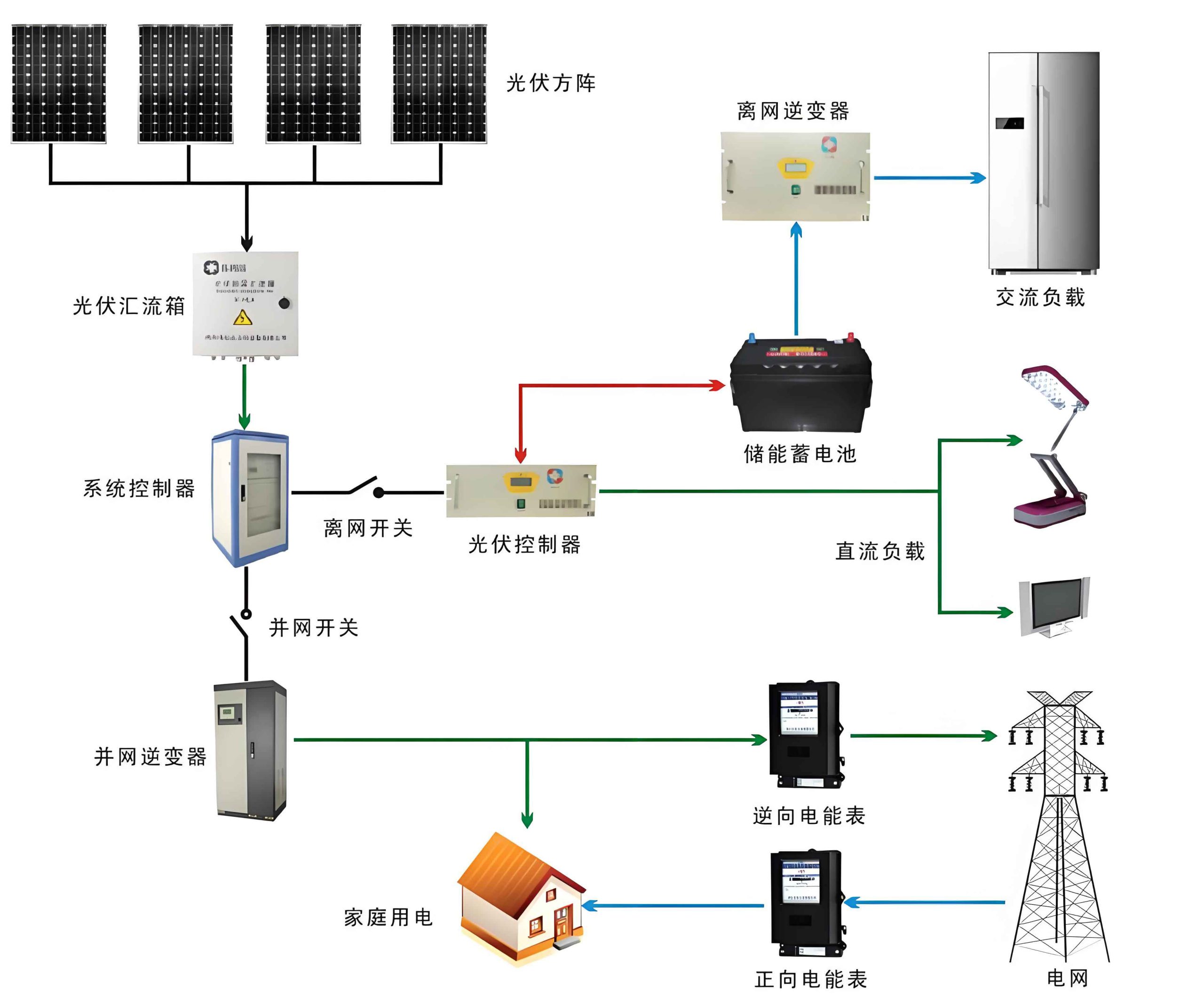
The core of the methodology involves estimating radiation where direct measurements are unavailable and translating horizontal radiation to tilted surfaces relevant for PV system design. For stations without radiometric measurements, GHI and DNI were calculated using empirical solar radiation climatology formulas, which establish statistical relationships between radiation and more widely observed sunshine duration.
The horizontal global solar radiation (\(Q_H\)) and direct solar radiation (\(D_H\)) are estimated by:
$$Q_H = Q_0 (a + b \cdot s)$$
$$D_H = Q_0 (a’ + b’ \cdot s^2)$$
where \(Q_0\) is the monthly extraterrestrial solar radiation on a horizontal surface (MJ/m²), \(s\) is the monthly sunshine percentage (%), and \(a\), \(b\), \(a’\), \(b’\) are empirical coefficients determined via linear regression using data from the reference radiation stations. Based on previous climatic zoning research for Guangxi, each non-radiation station was assigned to a specific solar climate zone, and the corresponding reference station’s coefficients were applied for calculation. The horizontal diffuse radiation (\(S_H\)) is then obtained by subtraction: \(S_H = Q_H – D_H\).
Since PV modules are typically installed at an angle to maximize energy yield, calculating the solar radiation incident on an inclined plane is crucial. The total radiation on a south-facing tilted surface (\(Q_S\), azimuth=0°) is composed of three components: beam, diffuse, and ground-reflected radiation. We employed the isotropic sky model for this conversion:
$$Q_S = D_S + S_S + R_S$$
$$D_S = D_H \cdot R_b$$
$$S_S = S_H \cdot \left( \frac{1 + \cos \beta}{2} \right)$$
$$R_S = Q_H \cdot \rho \cdot \left( \frac{1 – \cos \beta}{2} \right)$$
The geometric factor \(R_b\), the ratio of beam radiation on the tilted surface to that on the horizontal surface, is calculated as:
$$R_b = \frac{\cos(\phi – \beta)\cos\delta\sin\omega + (\pi/180)\omega\sin(\phi – \beta)\sin\delta}{\cos\phi\cos\delta\sin\omega + (\pi/180)\omega\sin\phi\sin\delta}$$
In these equations, \(\beta\) is the tilt angle of the surface (rad), \(\rho\) is the ground albedo (set to 0.2, a typical value for mixed surfaces), \(\phi\) is the local latitude (rad), \(\delta\) is the solar declination angle (rad), and \(\omega\) is the sunset hour angle (rad).
The optimum tilt angle (\(\beta_{opt}\)) for a fixed south-facing array is determined by calculating \(Q_S\) for tilt angles from 8° to 30° at 0.1° intervals. The angle that yields the maximum annual total \(Q_S\) is selected as \(\beta_{opt}\). The corresponding radiation is the annual optimum tilted surface radiation (\(Q_{S,opt}\)).
Key evaluation parameters for the solar resource and the PV system performance are derived as follows:
1. Direct Radiation Ratio (\(R_D\)): Indicates the proportion of direct beam radiation in the total global horizontal radiation, influencing the choice between standard and concentrating PV technologies.
$$R_D = \frac{D_H}{Q_H}$$
2. Stability Coefficient (\(R_W\)): Represents the uniformity of the solar resource throughout the year, calculated as the ratio of the minimum monthly average daily radiation to the maximum.
$$R_W = \frac{\min(\overline{Q_1}, \overline{Q_2}, …, \overline{Q_{12}})}{\max(\overline{Q_1}, \overline{Q_2}, …, \overline{Q_{12}})}$$
3. Annual Equivalent PV Utilization Hours (\(H\)): A critical indicator of potential energy generation, representing the number of hours a PV system would need to operate at its rated power to produce the annual energy yield corresponding to the received solar radiation.
$$H = Q_{S,opt} \cdot r$$
Here, \(r\) is the overall system efficiency of the PV power plant. Based on industry standards and local conditions, a value of \(r = 0.8\) (80%) was adopted for this assessment.
Our analysis reveals the spatial distribution and magnitude of key solar resource parameters across Guangxi. The results provide a detailed picture of the region’s potential for solar energy development.
Horizontal Solar Radiation: The annual average horizontal global solar radiation (\(Q_H\)) across Guangxi ranges from 3,717 to 5,727 MJ/m². The spatial distribution exhibits a clear pattern of higher values in the south and lower values in the north. Areas south of the Tropic of Cancer (23.5°N), including the Youjiang River valley, receive more than 4,600 MJ/m². The southern coastal regions, particularly around Beihai City, southern Qinzhou, Shangsi County, and parts of Yulin, exhibit the highest radiation, exceeding 4,900 MJ/m², with the Beihai area surpassing 5,200 MJ/m². The lowest radiation levels are found in the mountainous northern parts of Guilin, Hechi, and Liuzhou cities. The annual horizontal direct solar radiation (\(D_H\)) ranges from 1,484 to 2,711 MJ/m², also showing a south-high-north-low distribution, with the highest values concentrated in the eastern part of the southern coast, Shangsi and Ningming counties, eastern Guangxi bordering Guangdong, and parts of the Youjiang River valley.
Direct Radiation Ratio and Stability: The direct radiation ratio (\(R_D\)) varies between 0.38 and 0.47, indicating that diffuse radiation constitutes a significant majority (53-62%) of the total solar resource in Guangxi. Interestingly, the spatial pattern of \(R_D\) differs from that of \(D_H\). Higher direct ratios (>0.45) are primarily located in the northeastern and central parts of Guangxi (23°-25°N), as well as in northwestern Baise, not necessarily coinciding with the areas of highest absolute direct radiation. The stability coefficient (\(R_W\)) ranges from 0.31 to 0.48. Resources are more stable (\(R_W > 0.36\)) in areas south of the Tropic of Cancer and in most of northwestern Guangxi. The most stable resources (\(R_W > 0.47\)) are found in Beihai City and Shangsi County. Stability is generally lower (0.31-0.36) in northeastern Guangxi.
Optimum Tilt Angle and Tilted Surface Radiation: The calculated optimum tilt angle (\(\beta_{opt}\)) for maximizing annual yield on a south-facing surface ranges from 15.0° to 20.5°. The maximum is found in Quanzhou County in the north, and the minimum in Dongxing City in the far south. The distribution generally shows a decreasing trend from northeast to southwest, influenced by latitude, direct ratio, and local topography. The annual total radiation on these optimally tilted surfaces (\(Q_{S,opt}\)) ranges from 3,824 to 5,872 MJ/m². Tilting the surface increases the annual energy capture by 2.11% to 4.22% (an increase of 99 to 167 MJ/m²) compared to a horizontal surface. The spatial distribution of \(Q_{S,opt}\) closely follows that of \(Q_H\), remaining highest in the south and lowest in the north.
Annual Equivalent Utilization Hours: The annual equivalent PV utilization hours (\(H\)), derived from \(Q_{S,opt}\), range from 849.8 to 1,304.8 hours. This key performance indicator mirrors the radiation distribution, with higher values (>1,050 h) predominant in regions south of the Tropic of Cancer and in the Youjiang River valley. The highest values (>1,250 h) are concentrated in Beihai City and Shangsi County. Most areas north of the Tropic of Cancer range between 850 and 1,050 hours, with the lowest values in the northern mountains.
The following tables summarize the key statistical ranges and provide example calculations for major cities.
| Parameter | Symbol | Range in Guangxi | Primary Spatial Distribution Pattern |
|---|---|---|---|
| Annual Horizontal Global Radiation | \(Q_H\) | 3,717 – 5,727 MJ/m² | South (High) → North (Low) |
| Annual Horizontal Direct Radiation | \(D_H\) | 1,484 – 2,711 MJ/m² | South (High) → North (Low) |
| Direct Radiation Ratio | \(R_D\) | 0.38 – 0.47 | Central/Northeast (High) → South (Lower) |
| Stability Coefficient | \(R_W\) | 0.31 – 0.48 | Southwest/South (Stable) → Northeast (Less Stable) |
| Optimum Tilt Angle | \(\beta_{opt}\) | 15.0° – 20.5° | Northeast (High) → Southwest (Low) |
| Annual Optimum Tilted Radiation | \(Q_{S,opt}\) | 3,824 – 5,872 MJ/m² | South (High) → North (Low) |
| Annual Equivalent Utilization Hours | \(H\) | 849.8 – 1,304.8 h | South (High) → North (Low) |
| City | \(Q_H\) (MJ/m²) | \(\beta_{opt}\) (°) | \(Q_{S,opt}\) (MJ/m²) | Increase over Horizontal | \(H\) (hours) |
|---|---|---|---|---|---|
| Nanning | ~4,650 | 17.3 | 4,730.1 | ~1.7% | ~1,079 |
| Guilin | ~4,150 | 20.0 | 4,297.2 | ~3.5% | ~981 |
| Beihai | ~5,450 | 16.2 | 5,321.7 | ~2.4% | ~1,214 |
| Baise | ~4,750 | 17.7 | 4,897.8 | ~3.1% | ~1,117 |
To evaluate the overall abundance of solar energy resources for PV development in Guangxi, we established a comprehensive classification scheme. While national standards often use horizontal global radiation as the sole criterion, our assessment incorporates the annual equivalent utilization hours (\(H\)), a parameter directly linked to the actual energy generation potential of an optimized fixed-tilt PV system. This two-indicator approach provides a more practical evaluation for photovoltaic project planning. The horizontal radiation thresholds were adapted from national standards, with the “Rich” category further subdivided to reflect the gradation observed within Guangxi. Corresponding thresholds for \(H\) were defined based on its calculated distribution. The classification criteria are presented in Table 3.
| Grade | Abundance Level | Annual Horizontal Global Radiation \(Q_H\) (MJ/m²·a) | Annual Equivalent Utilization Hours \(H\) (h) |
|---|---|---|---|
| A | Most Abundant | ≥ 6,300 | ≥ 1,350 |
| B | Very Abundant | 5,040 – 6,300 | 1,150 – 1,350 |
| C1 | First-level Abundant | 4,620 – 5,040 | 1,050 – 1,150 |
| C2 | Second-level Abundant | 4,200 – 4,620 | 950 – 1,050 |
| C3 | Third-level Abundant | 3,780 – 4,200 | 850 – 950 |
| D | Generally Abundant | < 3,780 | < 850 |
Applying this classification to the calculated data yields the solar resource abundance map for Guangxi. The region south of the Tropic of Cancer, along with the Youjiang River valley, is classified as First-level Abundant (C1) or better. The most favorable areas, classified as Very Abundant (B), are concentrated in the southern coastal regions, specifically Beihai City and Shangsi County. Central Guangxi predominantly falls into the Second-level (C2) and Third-level Abundant (C3) categories. The Generally Abundant (D) areas are confined to small, high-altitude locations in the far north, bordering Hunan and Guizhou provinces. This graded distribution underscores that the vast majority of Guangxi possesses good to excellent solar resource conditions for PV development.
The results of this study align with and expand upon previous understandings of solar resources in Guangxi. The confirmed south-high-north-low distribution pattern of solar radiation is consistent with the region’s latitudinal span and prevailing cloud cover patterns influenced by the East Asian monsoon. The diffuse-dominated nature of the resource (\(R_D < 0.5\)) is a critical finding. It implies that technologies and solar system designs that perform well under diffuse light conditions are particularly suitable for the region. This characteristic also explains the spatial discrepancy between areas of high direct radiation and high direct ratio; a location can have a relatively high proportion of direct radiation (high \(R_D\)) even if its total direct radiation amount is not the absolute highest, depending on total cloud cover characteristics.
The calculated optimum tilt angles (15°-20.5°) are lower than those typically used in higher latitude regions, which is expected given Guangxi’s low latitude. The energy gain of 2-4% from optimal tilting, though modest, is significant for large-scale solar system economics and validates the importance of location-specific design over using rule-of-thumb angles. The gain is more pronounced in areas with moderate radiation, highlighting that proper solar system orientation can help improve yield in less resource-rich locales.
The parameter of annual equivalent utilization hours (\(H\)) effectively translates the solar resource into a pragmatic metric for energy yield estimation. The range of 850-1300 hours provides a clear benchmark for investors and planners. For instance, a region with 1,200 hours offers a fundamentally different project internal rate of return compared to one with 900 hours, assuming similar costs. This metric, combined with the stability coefficient, offers a robust framework for evaluating the technical and economic viability of PV projects. A stable resource (\(R_W > 0.36\)) reduces seasonal variability in power output, benefiting grid integration and revenue predictability for the solar system operator.
It is important to acknowledge certain limitations. The reliance on sunshine-derived empirical formulas, while established, introduces inherent estimation errors. The relatively short data record for the Beihai radiation station (post-1993) may affect the precision of coefficients for its associated climatic zone. Furthermore, local microclimates, fog, and aerosol effects (e.g., haze) are not explicitly captured by these models but can influence actual solar system performance. Future work could integrate satellite-derived radiation data to improve spatial resolution and validate the models, especially in complex terrain.
This comprehensive assessment elucidates the photovoltaic solar energy potential of Guangxi, China. The key findings are summarized as follows:
1. Guangxi possesses a significant solar resource, with annual horizontal global radiation ranging from 3,717 to 5,727 MJ/m² and direct radiation from 1,484 to 2,711 MJ/m². The resource distribution is characterized by higher values in the southern and western lowland regions and lower values in the northern mountainous areas.
2. The solar resource is predominantly diffuse, with a direct radiation ratio between 0.38 and 0.47. The stability of the resource is generally good to very good in the south and west (\(R_W > 0.36\)), and moderate in the northeast.
3. For fixed, south-facing photovoltaic arrays, the optimum tilt angle varies from 15.0° to 20.5°. Utilizing this optimal angle increases the annual captured radiation by 2.11% to 4.22% compared to a horizontal setup, resulting in annual optimum tilted surface radiation of 3,824 to 5,872 MJ/m².
4. The annual equivalent utilization hours, a direct indicator of potential energy generation, range from 849.8 to 1,304.8 hours.
5. Based on a synthesized classification using annual horizontal global radiation and annual equivalent utilization hours, Guangxi’s solar resources are graded from “Very Abundant” (B) to “Generally Abundant” (D). The most abundant areas (Grade B) are confined to the southern coastal regions of Beihai and Shangsi. The majority of the region, particularly south of the Tropic of Cancer, falls into the “Abundant” categories (C1-C3), indicating favorable conditions for widespread photovoltaic development.
In conclusion, the findings of this study provide a detailed scientific basis for the strategic planning and deployment of photovoltaic solar systems across Guangxi. The methodology and resulting parameter maps can guide site selection, system design optimization, and feasibility studies, ultimately supporting the region’s transition toward a sustainable and low-carbon energy future. Properly designed solar systems can become a cornerstone of Guangxi’s energy portfolio, leveraging its substantial and widely distributed solar resource.