
As a researcher in renewable energy, I have dedicated my career to exploring the vast potential of solar energy. The sun, as a clean, inexhaustible, and environmentally friendly source of power, has become a focal point for global attention. In this article, I will delve into the utilization of solar photovoltaic and thermal energy, often integrated into what we call a comprehensive solar system. From basic principles to practical applications, I aim to provide an in-depth analysis, supported by tables and formulas, to enhance understanding of this critical field. The journey toward sustainable energy relies heavily on optimizing every component of a solar system, and I believe that by sharing this knowledge, we can accelerate progress.
The increasing demand for energy, driven by economic growth and industrialization, has led to concerns about energy crises and atmospheric pollution. In response, there is a growing emphasis on clean energy sources like solar power. Solar photovoltaic (PV) and thermal technologies are at the forefront of this shift, converting solar radiation into electricity and heat, respectively. These technologies form the backbone of modern solar system designs, which aim to harness solar energy efficiently. In my experience, a well-designed solar system can significantly reduce reliance on fossil fuels, and I will explore how these systems work and their diverse applications.
To begin, let’s consider the fundamental principles behind solar energy conversion. Solar photovoltaic technology relies on the photovoltaic effect, where semiconductor materials in solar cells absorb photons and generate an electric current. This process can be described by the following formula for the photocurrent density $$J_{ph}$$ in a solar cell: $$J_{ph} = q \cdot G \cdot (1 – R) \cdot \alpha \cdot L_n$$ where $$q$$ is the electron charge, $$G$$ is the solar irradiance, $$R$$ is the reflectance, $$\alpha$$ is the absorption coefficient, and $$L_n$$ is the diffusion length of minority carriers. For a typical silicon-based PV cell, the efficiency $$\eta_{PV}$$ is given by: $$\eta_{PV} = \frac{P_{max}}{G \cdot A}$$ where $$P_{max}$$ is the maximum power output and $$A$$ is the area of the cell. This efficiency is influenced by factors like temperature, which I will discuss later in the context of thermal management within a solar system.
On the other hand, solar thermal technology converts solar energy into heat, which can then be used for electricity generation via thermodynamic cycles or direct heating applications. The basic energy balance for a solar thermal collector can be expressed as: $$Q_u = A_c \cdot [G \cdot (\tau \alpha) – U_L \cdot (T_c – T_a)]$$ where $$Q_u$$ is the useful heat gain, $$A_c$$ is the collector area, $$\tau \alpha$$ is the transmittance-absorptance product, $$U_L$$ is the overall heat loss coefficient, $$T_c$$ is the collector temperature, and $$T_a$$ is the ambient temperature. This equation highlights the importance of minimizing heat losses in a thermal solar system. In integrated photovoltaic-thermal (PVT) systems, both electricity and heat are harvested simultaneously, enhancing the overall efficiency of the solar system. The combined efficiency $$\eta_{PVT}$$ can be modeled as: $$\eta_{PVT} = \eta_{PV} + \eta_{th}$$ where $$\eta_{th}$$ is the thermal efficiency. This integration is a key advancement in modern solar system design.
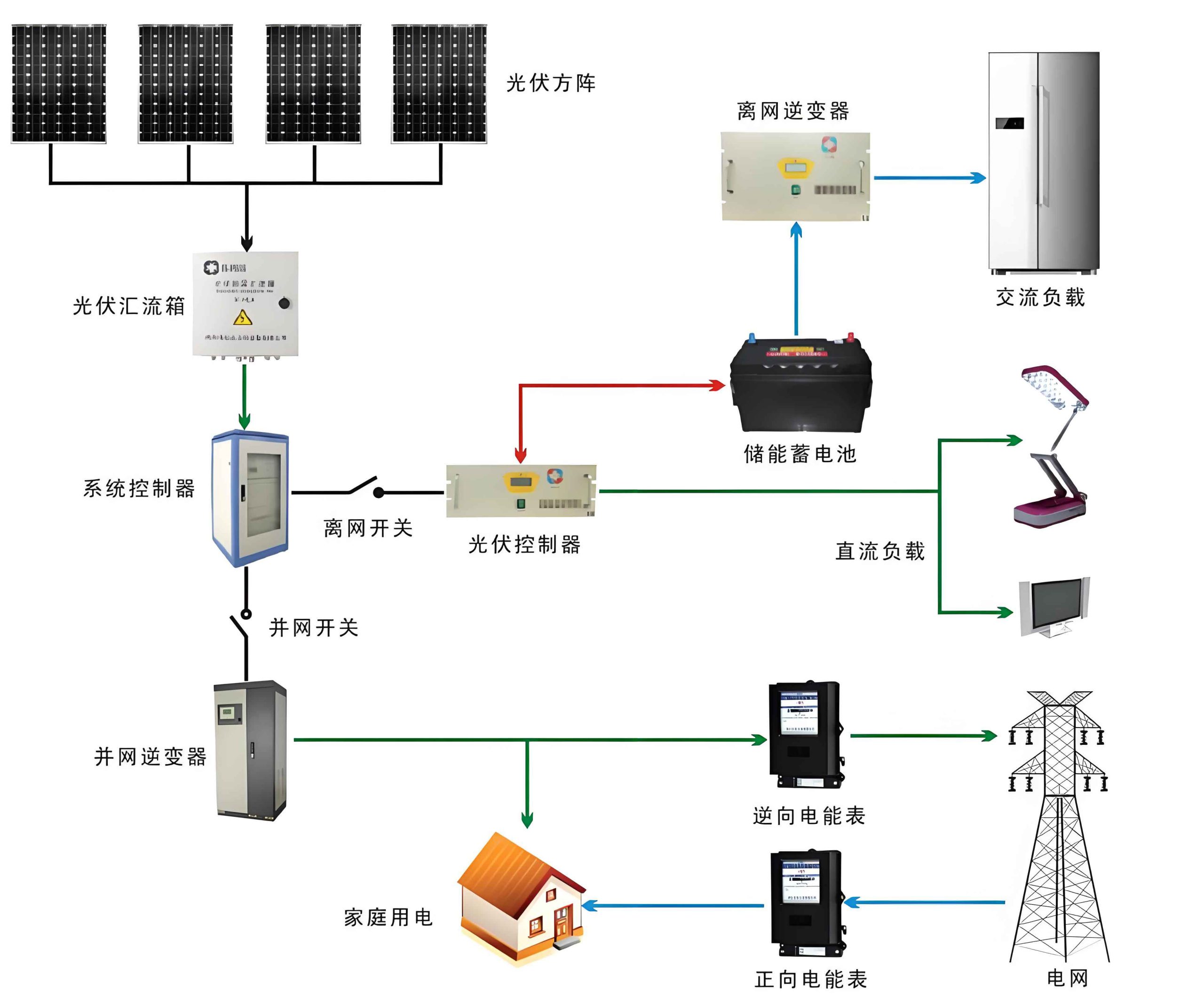
The image above illustrates a typical solar system setup, showcasing how photovoltaic panels and thermal collectors can be combined. In my work, I have seen such systems deployed in various settings, from residential rooftops to large-scale power plants. The synergy between PV and thermal components is crucial for maximizing energy yield, and I will now delve into specific applications and their technical details.
One of the most common applications of solar thermal energy is in solar water heating systems, often referred to as solar hot water systems. These are integral to many residential solar system installations. The principle is based on the greenhouse effect, where solar vacuum tubes or flat-plate collectors absorb solar radiation and transfer heat to water. The performance of such a system can be summarized using the following formula for the daily energy delivery $$E_d$$: $$E_d = \eta_0 \cdot A_c \cdot H – Q_{loss}$$ where $$\eta_0$$ is the optical efficiency, $$H$$ is the daily solar insolation, and $$Q_{loss}$$ represents heat losses. However, as I have observed, these systems face limitations in cold or cloudy climates, where auxiliary heating is required. This challenge has led to innovations like heat pump-assisted solar water heaters, which enhance the reliability of the solar system.
To better compare different solar thermal collector types, I have compiled a table based on my research data. This table highlights key parameters that influence the efficiency of a thermal solar system.
| Collector Type | Efficiency Range (%) | Temperature Range (°C) | Typical Applications | Cost Factor (Relative) |
|---|---|---|---|---|
| Flat-Plate | 30-50 | 30-80 | Domestic hot water | Low |
| Evacuated Tube | 50-70 | 50-120 | Space heating, industrial process heat | Medium |
| Parabolic Trough | 60-80 | 150-400 | Concentrated solar power (CSP) | High |
| Solar Air Collector | 20-40 | 20-60 | Agricultural drying, ventilation | Low |
Moving beyond water heating, solar space heating is another vital application. In a solar heating solar system, heat collected by solar thermal collectors is distributed through radiators, underfloor heating, or air-handling units. The energy requirement for heating a building can be estimated using: $$Q_h = U_{total} \cdot A_{envelope} \cdot (T_{in} – T_{out})$$ where $$Q_h$$ is the heating load, $$U_{total}$$ is the overall heat transfer coefficient of the building envelope, $$A_{envelope}$$ is the envelope area, and $$T_{in}$$ and $$T_{out}$$ are indoor and outdoor temperatures, respectively. Integrating a solar system with building design, such as through passive solar architecture, can reduce this load significantly. However, as I have noted in my projects, challenges like intermittent solar availability necessitate thermal storage or hybrid systems. For instance, phase-change materials (PCMs) can store heat in a solar system using latent heat: $$Q_{storage} = m \cdot L$$ where $$m$$ is the mass of PCM and $$L$$ is the latent heat of fusion.
Solar photovoltaic systems, on the other hand, are widely used for electricity generation. A grid-connected PV solar system includes modules, inverters, and balance-of-system components. The power output $$P_{PV}$$ from a PV array can be modeled as: $$P_{PV} = N \cdot V_{oc} \cdot I_{sc} \cdot FF$$ where $$N$$ is the number of cells, $$V_{oc}$$ is the open-circuit voltage, $$I_{sc}$$ is the short-circuit current, and $$FF$$ is the fill factor. Temperature effects on PV performance are critical; the efficiency decreases with rising temperature, which is described by: $$\eta_{PV}(T) = \eta_{ref} \cdot [1 – \beta_{ref} \cdot (T – T_{ref})]$$ where $$\eta_{ref}$$ is the efficiency at reference temperature $$T_{ref}$$, and $$\beta_{ref}$$ is the temperature coefficient. This underscores the need for cooling mechanisms in a PV solar system, such as integrated thermal management.
To illustrate the comparative performance of different PV technologies, here is a table based on recent data I have analyzed. This table helps in selecting appropriate components for a PV solar system.
| PV Technology | Efficiency (%) | Cost ($/W) | Temperature Coefficient (%/°C) | Lifespan (years) |
|---|---|---|---|---|
| Monocrystalline Silicon | 18-22 | 0.30-0.50 | -0.3 to -0.5 | 25-30 |
| Polycrystalline Silicon | 15-18 | 0.20-0.40 | -0.4 to -0.6 | 20-25 |
| Thin-Film (CdTe) | 10-12 | 0.15-0.30 | -0.2 to -0.3 | 15-20 |
| Perovskite Solar Cells | 20-25 | 0.10-0.20 (projected) | -0.1 to -0.2 | 10-15 (emerging) |
A promising advancement is the solar heat pump, which combines solar thermal and heat pump technologies to achieve high efficiency. In my research, I have focused on direct-expansion solar-assisted heat pumps, where the solar collector acts as the evaporator for the heat pump cycle. The coefficient of performance (COP) for such a solar system is given by: $$COP = \frac{Q_{heating}}{W_{compressor}}$$ where $$Q_{heating}$$ is the heat delivered and $$W_{compressor}$$ is the compressor work input. For a solar-assisted heat pump, the COP can exceed 4 under favorable conditions, compared to around 2-3 for conventional air-source heat pumps. The energy balance in the evaporator-collector can be expressed as: $$m_{ref} \cdot h_{fg} = A_c \cdot [G \cdot (\tau \alpha) – U_L \cdot (T_{evap} – T_a)]$$ where $$m_{ref}$$ is the refrigerant mass flow rate, $$h_{fg}$$ is the latent heat of vaporization, and $$T_{evap}$$ is the evaporation temperature. This integration enhances the stability and performance of the solar system, especially in variable weather.
Another critical aspect is energy storage within a solar system. For thermal storage, the sensible heat storage capacity is: $$Q_{sensible} = m \cdot c_p \cdot \Delta T$$ where $$c_p$$ is the specific heat capacity and $$\Delta T$$ is the temperature change. For electricity storage, batteries are commonly used, with their state of charge (SOC) modeled as: $$SOC(t) = SOC_0 + \frac{1}{C} \int_0^t I(\tau) d\tau$$ where $$C$$ is the battery capacity and $$I$$ is the current. In a hybrid solar system, combining PV, thermal, and storage optimizes energy use. For example, excess PV electricity can power heat pumps or charge batteries, while thermal storage can buffer heating demands. I have worked on simulations for such integrated systems, using software tools to model dynamic behavior.
To quantify the benefits of an integrated PVT solar system, consider the following formula for overall energy output per year $$E_{total}$$: $$E_{total} = \int_0^{8760} (P_{PV}(t) + Q_{th}(t)) dt$$ where $$P_{PV}(t)$$ and $$Q_{th}(t)$$ are the instantaneous electrical and thermal power outputs, respectively. In practice, the performance ratio (PR) of a PV solar system is used to assess efficiency: $$PR = \frac{E_{actual}}{E_{theoretical}} \times 100\%$$ where $$E_{actual}$$ is the actual energy yield and $$E_{theoretical}$$ is the yield under standard test conditions. For thermal systems, the solar fraction $$SF$$ indicates the portion of energy demand met by solar: $$SF = \frac{Q_{solar}}{Q_{total}}$$ These metrics are essential for evaluating and improving a solar system.
In large-scale applications, concentrated solar power (CSP) plants utilize thermal energy to generate electricity via steam turbines. The efficiency of a CSP solar system can be analyzed using the Rankine cycle. The net thermal efficiency $$\eta_{th,CSP}$$ is: $$\eta_{th,CSP} = \frac{W_{net}}{Q_{in}}$$ where $$W_{net}$$ is the net work output and $$Q_{in}$$ is the heat input from solar collectors. With thermal storage using molten salt, CSP plants can provide dispatchable power, addressing intermittency issues. The storage capacity is often described by: $$E_{storage} = m_{salt} \cdot c_{p,salt} \cdot (T_{hot} – T_{cold})$$ where $$m_{salt}$$ is the mass of molten salt, $$c_{p,salt}$$ is its specific heat, and $$T_{hot}$$ and $$T_{cold}$$ are the hot and cold tank temperatures. This makes CSP a reliable component of a utility-scale solar system.
Beyond technical aspects, economic and environmental factors are crucial. The levelized cost of energy (LCOE) for a solar system is calculated as: $$LCOE = \frac{\sum_{t=1}^n (I_t + M_t + F_t) / (1+r)^t}{\sum_{t=1}^n E_t / (1+r)^t}$$ where $$I_t$$ is the investment cost in year $$t$$, $$M_t$$ is maintenance cost, $$F_t$$ is fuel cost (zero for solar), $$E_t$$ is energy output, $$r$$ is the discount rate, and $$n$$ is the system lifetime. For PV systems, LCOE has fallen dramatically, making solar competitive with fossil fuels. Additionally, the carbon footprint reduction from deploying a solar system can be estimated as: $$\Delta CO_2 = E_{solar} \cdot EF_{grid}$$ where $$EF_{grid}$$ is the emission factor of the displaced grid electricity. In my assessments, a well-designed solar system can save tons of CO2 annually.
Looking at future trends, innovations like bifacial PV modules, which capture light from both sides, enhance the energy yield of a PV solar system. The gain can be modeled as: $$G_{bifacial} = G_{front} + G_{rear} \cdot \rho_{ground}$$ where $$\rho_{ground}$$ is the ground reflectance. Similarly, advanced coatings for thermal collectors improve absorptance and reduce emittance, boosting thermal efficiency. Research into hybrid systems combining solar with other renewables, like wind or biomass, is also growing. In such integrated energy systems, the solar system acts as a core component, providing flexible and clean power.
In conclusion, the utilization of solar photovoltaic and thermal energy is a dynamic and evolving field. From basic principles to complex integrated systems, the potential of a solar system to address energy and environmental challenges is immense. In my perspective, continued research and deployment are essential to overcome technical barriers, such as energy storage and efficiency improvements. By leveraging formulas and data, as I have shown here, we can optimize design and operation. The journey toward a sustainable energy future relies on harnessing every bit of solar energy, and I am committed to advancing this cause through my work. As technology progresses, I envision solar system becoming ubiquitous, powering homes, industries, and communities with clean, reliable energy.
To summarize key points, I have compiled a final table comparing different solar energy utilization pathways. This table reflects my analysis of various solar system configurations and their typical performance metrics.
| System Type | Primary Output | Overall Efficiency (%) | Storage Integration | Best Suited For |
|---|---|---|---|---|
| PV-Only System | Electricity | 15-22 | Battery required for off-grid | Residential, commercial rooftops |
| Solar Thermal Only | Heat | 30-70 | Thermal storage tanks | Water heating, industrial processes |
| PVT Hybrid System | Electricity and Heat | 40-80 (combined) | Hybrid storage (battery + thermal) | Buildings with high energy demands |
| CSP with Storage | Electricity (dispatchable) | 30-45 | Molten salt thermal storage | Utility-scale power plants |
| Solar Heat Pump | Heating/Cooling | COP 3-5 | Thermal or electrical storage | Climate control in residential/commercial |
Through this exploration, I hope to have conveyed the importance and versatility of solar energy systems. Whether through small-scale installations or large power plants, the solar system offers a path to a cleaner future. My ongoing research focuses on enhancing the interoperability of components within a solar system, and I encourage further collaboration in this vital field. With continued innovation, we can unlock the full potential of the sun, making solar energy a cornerstone of global energy supply.