
The imperative for carbon neutrality has positioned the building sector as a critical frontier for technological innovation. Among renewable solutions, solar energy utilization stands out, with photovoltaic (PV) technology becoming increasingly pivotal due to its high-grade energy output and system compactness. The transition is particularly relevant for the architectural fabric of small towns, villages, and rural areas, where lower building density offers superior potential for solar harvesting. Much of this built environment is characterized by traditional architectural forms, rich in cultural and regional identity. The integration of modern solar systems into these traditional structures, however, presents a fundamental aesthetic and technical challenge. The inherent contrast between the industrial aesthetic of conventional PV products and the historic or vernacular character of traditional buildings can lead to dissonant, “tacked-on” solutions that undermine architectural integrity. This necessitates a deliberate design philosophy where the technology adapts to the architecture, not vice versa. This article explores a dual-strategy framework—Passive Adaptation and Active Fusion—for the feasible and sensitive integration of photovoltaic solar systems into traditional buildings, ensuring their aesthetic continuity and functional enhancement.
The evolution of Building-Integrated Photovoltaics (BIPV) marks a shift from mere attachment (Building-Attached PV, BAPV) to true integration, where the solar system becomes a multifunctional building component. This integration is key for traditional settings. The core challenge lies in the mismatch: traditional aesthetics often feature specific colors, textures, forms (like tiles or carved stone), and a sense of material authenticity, whereas standard crystalline silicon (c-Si) PV panels are typically monochromatic (blue or black), smooth, flat, and modular. The strategy, therefore, must address this gap. Passive Adaptation involves using established, cost-effective PV technologies and employing architectural design intelligence to minimize their visual impact on the traditional form. Active Fusion, a more profound approach, leverages advances in PV materials and manufacturing to create building components that actively mimic or harmonize with traditional architectural features in color, shape, texture, and form.
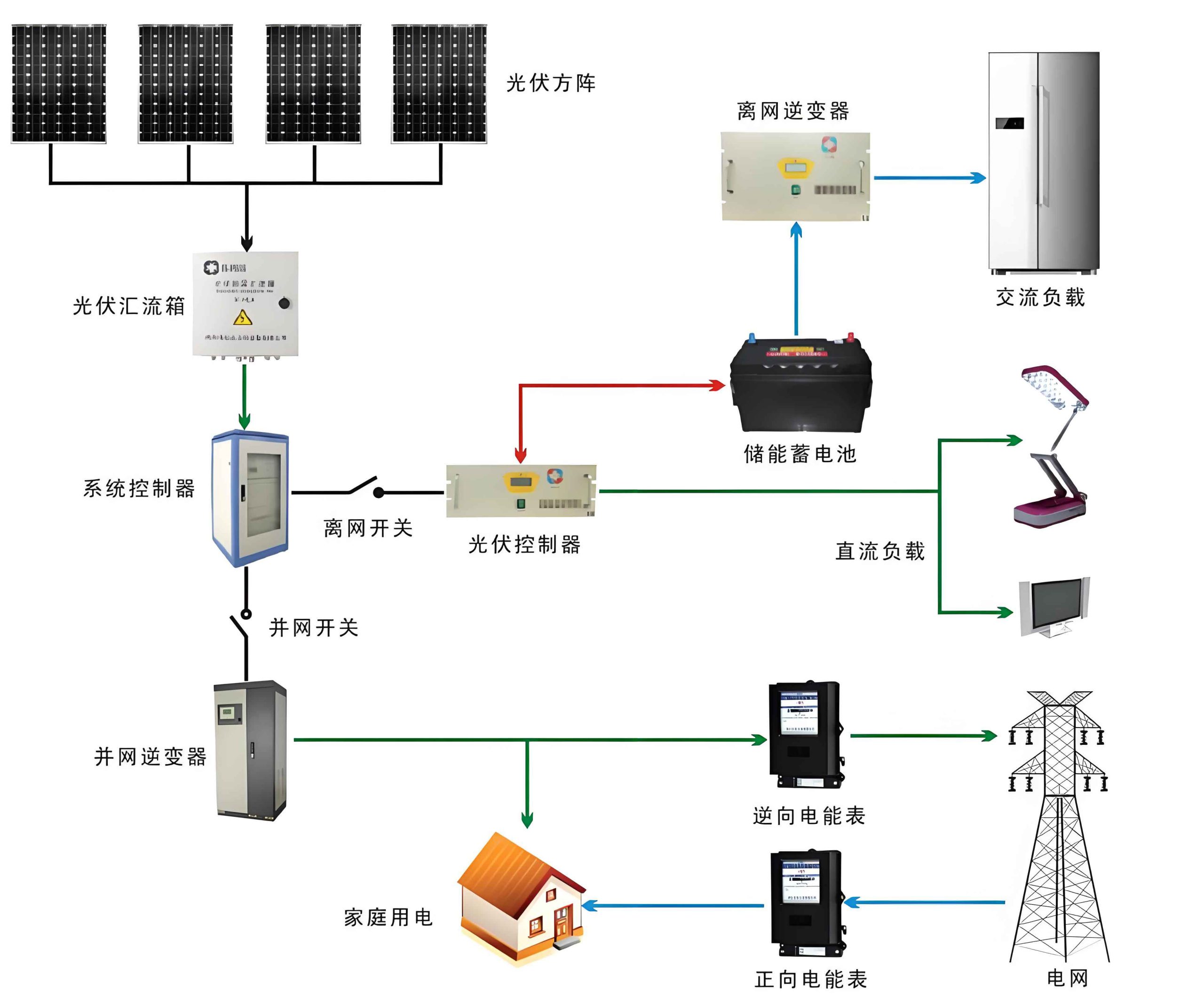
The choice of PV technology is fundamental to the application strategy. Crystalline silicon (monocrystalline and polycrystalline) cells dominate the market for their high efficiency and reliability but offer limited aesthetic flexibility. Thin-film technologies, such as amorphous silicon (a-Si), Cadmium Telluride (CdTe), and Copper Indium Gallium Selenide (CIGS), are crucial for Active Fusion. They can be deposited on various substrates (glass, polymer, metal), made in different colors and transparencies, and are more amenable to custom shaping and texturing. The performance of a solar system is quantified by its power output under Standard Test Conditions (STC), often given in kilowatt-peak (kWp). The actual energy yield depends on local irradiation and system performance ratio (PR). The energy produced \( E \) (in kWh) can be estimated as:
$$ E = A \cdot G \cdot \eta \cdot PR $$
where \( A \) is the array area (m²), \( G \) is the annual in-plane solar irradiation (kWh/m²), \( \eta \) is the module efficiency, and \( PR \) is a factor (typically 0.75-0.85) accounting for losses.
Passive Adaptation: Strategic Design with Standardized Technology
This strategy prioritizes the use of widely available, high-efficiency, and cost-optimized PV modules, primarily c-Si. The goal is to achieve visual compatibility through careful placement, pattern design, and color coordination, accepting that the technological aesthetic of the solar system will remain partially visible but managed. It is most suitable for 20th-century modern traditional buildings where the historical character is less about ornate detail and more about massing and simplified forms.
The primary tactic is Color and Pattern Camouflage. Black monocrystalline panels, with their homogeneous dark appearance, can be less visually intrusive on darker roof surfaces (e.g., slate, dark clay tile) or within deeply recessed facade elements. By aligning the panel layout with the building’s inherent rhythm—such as window bays, mullions, or structural spans—the solar system can read as an intentional, rhythmic element rather than a foreign object. For instance, arranging panels to form a symmetric, grid-like pattern on a facade can echo the proportionality of traditional fenestration.
Strategic Placement and Screening is another key method. Roofs, especially pitched roofs facing away from primary public views, are the most common and least obtrusive location. The solar system is installed parallel to the roof plane, with mounting hardware colored to match the roof or tiles. On facades, panels can be integrated into shaded areas, recessed balconies, or as part of new sun-shading brise-soleil, where their function as an environmental moderator aligns with their presence. Vegetation screens or architectural lattices can also be designed to partially veil PV arrays from critical vantage points without significantly impacting their yield.
The economic rationale for Passive Adaptation is strong. The Levelized Cost of Energy (LCOE) for a standard c-Si solar system is favorable and can be calculated as:
$$ LCOE = \frac{\sum_{t=0}^{n} \frac{I_t + M_t}{(1+r)^t}}{\sum_{t=0}^{n} \frac{E_t}{(1+r)^t}} $$
where \( I_t \) is the investment cost in year \( t \), \( M_t \) is the operation and maintenance cost, \( E_t \) is the energy produced, \( r \) is the discount rate, and \( n \) is the system lifetime. The high efficiency of c-Si panels (\( \eta_{c-Si} \approx 18-22\% \)) means less area is needed for a given output, which can be a constraint on smaller traditional structures. The table below summarizes the Passive Adaptation approach.
| Aspect | Description | Key Considerations |
|---|---|---|
| Core Technology | Standard crystalline silicon (c-Si) PV modules. | High efficiency, low LCOE, limited aesthetic flexibility. |
| Design Principle | Minimize visual impact through architectural design. | Color matching, alignment with building geometry, strategic placement. |
| Optimal Application | Pitched roofs, modern traditional facades with regular rhythms. | Less sensitive architectural contexts; cost-efficiency is a priority. |
| Integration Level | Often BAPV or simple BIPV (e.g., in-roof mounting). | Preserves existing roof membrane or facade; retrofit-friendly. |
Active Fusion: Technological Innovation for Aesthetic Harmony
Active Fusion represents a paradigm where the solar system is fundamentally redesigned to become a literal building material that replicates traditional features. This strategy is essential for historically significant or aesthetically distinct traditional buildings where preservation of character is paramount. It leverages thin-film and specialized PV technologies to achieve multi-dimensional harmony.
Color and Transparency Customization is the first frontier. Thin-film PVs, especially a-Si and CIGS, can be manufactured in various colors (red, brown, green, grey) and degrees of transparency by adjusting layer thicknesses and using laser patterning or colored interlayers. This allows for the creation of photovoltaic glass that can match the hue of traditional brick, stone, or timber, or be used in fenestration to create stained-glass effects while generating power.
Form and Shape Matching: The Photovoltaic Tile is a quintessential example. Unlike attaching a standard panel to a roof, Active Fusion develops PV elements that directly replace traditional roofing units. Two main types exist: 1) Laminates, where a standard cell laminate is bonded to a traditional tile-shaped substrate, and 2) Monolithic Thin-Film Tiles, where the PV material (like CIGS) is deposited directly onto a curved glass or ceramic base. These solar tiles can replicate the profile of Roman, flat, or slate tiles, interlocking exactly like their traditional counterparts. The system efficiency \( \eta_{tile} \) of such a roof is lower than a flat panel roof due to non-optimal tilt, gaps, and potentially lower cell efficiency, but the architectural payoff is significant. The total installed capacity \( P_{total} \) becomes:
$$ P_{total} = N_{tiles} \cdot P_{tile} $$
where \( N_{tiles} \) is the number of tiles and \( P_{tile} \) is the power of an individual PV tile (typically 10-50 Wp).
Texture and Surface Replication is the most advanced level of fusion. Using nano-imprint lithography, textured glass covers, or specialized backsheets, the surface of a PV module can be engineered to mimic the rough-hewn texture of stone, the grain of wood, or the pattern of brickwork. This goes beyond color matching to engage the tactile and light-reflective qualities of traditional materials. Such “cloaking” technologies allow a standard silicon solar system to be visually hidden within a facade that appears to be made of authentic historic material.
The trade-offs for Active Fusion are primarily economic and technical. The custom manufacturing processes, lower economies of scale, and sometimes lower individual cell efficiencies (e.g., \( \eta_{CIGS} \approx 12-16\% \), \( \eta_{a-Si} \approx 6-9\% \)) lead to a higher upfront cost per kWp and a larger required area for the same output. However, the value lies in preserving heritage asset value and achieving planning consent in sensitive areas. The table below contrasts Active Fusion technologies.
| Technology | Achievable Harmony | Typical Efficiency (η) | Primary Application |
|---|---|---|---|
| Colored Thin-Film (CIGS/a-Si) | Color matching for facades, roofs, and glass. | 6-16% | Curtain walls, spandrels, roof membranes. |
| Photovoltaic Tile/Metal Roof | Form, profile, and installation method of traditional roofing. | 10-18% (module)* | Pitched roofs replacing clay, slate, or metal tiles. |
| Textured/Patterned Glass Laminates | Surface texture and pattern of brick, stone, or timber. | 15-20% (cell under texture) | Ventilated facades, rainscreen cladding. |
*Efficiency depends on base cell technology (c-Si or thin-film) used in the tile.
Strategy Selection Guide: A Decision Matrix
The choice between Passive Adaptation and Active Fusion is not binary but guided by a matrix of factors related to the building’s character, the project’s objectives, and the specific integration location. A structured decision process ensures the solar system enhances rather than detracts.
1. Architectural Significance and Aesthetic Character:
For buildings with high heritage value, pronounced vernacular features (specific tile shapes, intricate brickwork, carved details), or where the visual character is the primary asset, Active Fusion is the necessary path. The solar system investment here includes a “preservation premium.” For buildings where the traditional character is more about massing, proportion, and overall style rather than delicate details—such as many 20th-century structures—Passive Adaptation is often sufficient and economically preferable.
2. Integration Location:
* Facades: The most sensitive location. Active Fusion is strongly recommended to achieve texture and color harmony. A facade-mounted solar system is highly visible and must be flawlessly integrated.
* Pitched Roofs: The most forgiving location. Passive Adaptation is frequently adequate, especially if the roof is not the primary elevation. The focus is on color matching and low-profile mounting. However, for prominent roofs on landmark buildings, Active Fusion with PV tiles may be required.
* Flat Roofs/Set-Back Areas: These offer the least visual intrusion. Standard, high-efficiency panels on tilted racks (Passive Adaptation) are perfectly acceptable, screened by parapets.
3. Project Drivers:
If the primary driver is maximizing renewable energy yield and financial return (minimizing LCOE), Passive Adaptation with high-efficiency c-Si is optimal. If the driver is regulatory compliance in a heritage zone, achieving planning permission, or a flagship sustainability statement for a historic building, then Active Fusion, despite its cost, becomes the viable strategy.
The following decision matrix synthesizes these considerations:
| Decision Factor | Favors PASSIVE ADAPTATION | Favors ACTIVE FUSION |
|---|---|---|
| Architectural Significance | Low to Moderate. Modern traditional buildings. | High. Historic, vernacular, or highly stylized buildings. |
| Primary Project Driver | Energy output & cost-effectiveness (Low LCOE). | Heritage preservation & aesthetic continuity. |
| Integration Location Visibility | Low-visibility roofs, rear elevations, service yards. | Primary facades, highly visible pitched roofs. |
| Available Budget | Constrained. Seeking standard solutions. | Ample. Willing to invest in customized technology. |
| Technology Priority | Efficiency (η) > Aesthetics. | Aesthetics/Harmony ≥ Efficiency. |
Performance Assessment and Lifecycle Considerations
Integrating any solar system into a traditional building requires a holistic performance assessment that goes beyond simple peak power rating. The effective performance is a function of technology choice, building orientation, shading, and the compromises made for aesthetics.
For an Active Fusion system using colored or textured glass, there is a measurable optical loss compared to a standard anti-reflective coated glass. This can be expressed as a relative reduction in short-circuit current \( I_{sc} \):
$$ I_{sc\text{–}custom} = I_{sc\text{–}std} \cdot (1 – L_{optical}) $$
where \( L_{optical} \) can range from 0.05 for slight tints to over 0.30 for deep colors or dense patterns. This directly reduces the module’s efficiency. Furthermore, non-optimal tilt angles inherent in following a roof pitch or facade plane affect the annual energy harvest. The irradiation on a tilted surface \( G_{tilt} \) compared to horizontal \( G_h \) is modified by the angle of incidence. For a surface with tilt \( \beta \) and azimuth \( \gamma \), the effective irradiation is complex but underscores that a facade-mounted solar system (high \( \beta \)) will yield less than an optimally tilted roof system, a factor that must be accounted for in system sizing.
The Lifecycle Analysis (LCA) of these integrated solar systems must include the dual function of the component. For a PV tile, it replaces both a conventional tile (avoiding its embodied energy) and a part of the electricity grid mix. The net environmental benefit \( B_{net} \) over lifecycle time \( T \) can be framed as:
$$ B_{net} = \int_0^T [E_{PV}(t) \cdot f_{grid}(t) + E_{mat\text{–}avoided}] dt – \int_0^T [E_{manuf}(t) + E_{EoL}(t)] dt $$
where \( E_{PV}(t) \) is energy produced by the solar system, \( f_{grid}(t) \) is the carbon intensity of the displaced grid electricity, \( E_{mat\text{–}avoided} \) is the embodied energy of the conventional building material replaced, and \( E_{manuf} \) and \( E_{EoL} \) are the energy costs of manufacturing and end-of-life processing. For traditional buildings, the avoided demolition and replacement of historic fabric due to a sensitive integration strategy is an intangible but significant preservation benefit.
Future Directions and Conclusion
The future of solar systems in traditional architecture lies in the continued advancement of Active Fusion technologies and the refinement of decision-support tools. Emerging trends include:
1. Perovskite Solar Cells: These promise high efficiency with ultra-thin, lightweight, and color-tunable form factors, potentially enabling even more versatile and efficient building-integrated products.
2. Dynamic Glazing and Adaptive Facades: PV elements that can change transparency or tint in response to light conditions, offering a blend of energy generation, daylight control, and privacy.
3. Digital Fabrication and Mass Customization: Using digital tools to survey unique traditional features and produce small batches of PV components that match them exactly, bringing down the cost of customization for heritage projects.
4. Integrated Design Optimization Tools: Software that can simultaneously optimize for energy yield, aesthetic parameters (color match, pattern alignment), and economic criteria within a 3D model of the traditional building.
In conclusion, the successful application of solar photovoltaic technology to traditional buildings demands a shift from a purely engineering-focused approach to a design-led, context-sensitive methodology. The dual strategy of Passive Adaptation and Active Fusion provides a clear framework. Passive Adaptation, using intelligently deployed standard technology, offers a pragmatic and cost-effective path for less sensitive contexts, particularly on roofs. Active Fusion, driven by innovative materials and component design, is the essential strategy for preserving the aesthetic integrity of historically and culturally significant structures, allowing the solar system to fade into the architectural narrative. As technology progresses, the gap between high-performance photovoltaics and authentic traditional aesthetics will continue to close, enabling a future where our architectural heritage is not a barrier to sustainability but a partner in the transition to a carbon-neutral built environment. The ultimate goal is a seamless solar system that respects the past while powering the future.