
In recent years, the global energy landscape has faced increasing challenges due to depletion of fossil fuels and environmental concerns. Renewable energy sources, particularly solar energy, have emerged as pivotal solutions for sustainable development. Among various applications, solar water heating systems have garnered significant attention for reducing building energy consumption. I have focused on advancing solar technology by integrating photovoltaic (PV) and thermal (T) components into a unified system, known as photovoltaic/thermal (PV/T) systems. These systems simultaneously generate electricity and heat, enhancing overall energy efficiency. However, in cold regions, traditional solar systems often encounter issues like freezing and low thermal efficiency. To address this, I have developed a novel solar photovoltaic/loop-heat-pipe (PV/LHP) water heating system that combines PV/T technology with a loop heat pipe mechanism, assisted by an electric heater for reliable hot water supply. This article presents an in-depth experimental study of this solar system, analyzing its photoelectric and photothermal performance under various conditions.
The core innovation of this solar system lies in its integration of a loop heat pipe, which facilitates efficient heat transfer even in low-temperature environments. The system comprises a PV/T collector-evaporator, a condenser immersed in a water tank, and an auxiliary electric heater. During periods of sufficient solar irradiance, the working fluid (R22) in the evaporator absorbs heat, vaporizes, and rises to the condenser, where it condenses and releases heat to water. When solar energy is inadequate, the electric heater activates to maintain desired water temperatures. This design not only improves thermal performance but also allows for building integration, making it suitable for cold climates like those in northern China. My experiments were conducted in Qinhuangdao, a city with a temperate climate, to evaluate the system’s year-round efficiency. The results demonstrate that this solar system offers robust performance across seasons, with potential for widespread adoption in residential and commercial buildings.
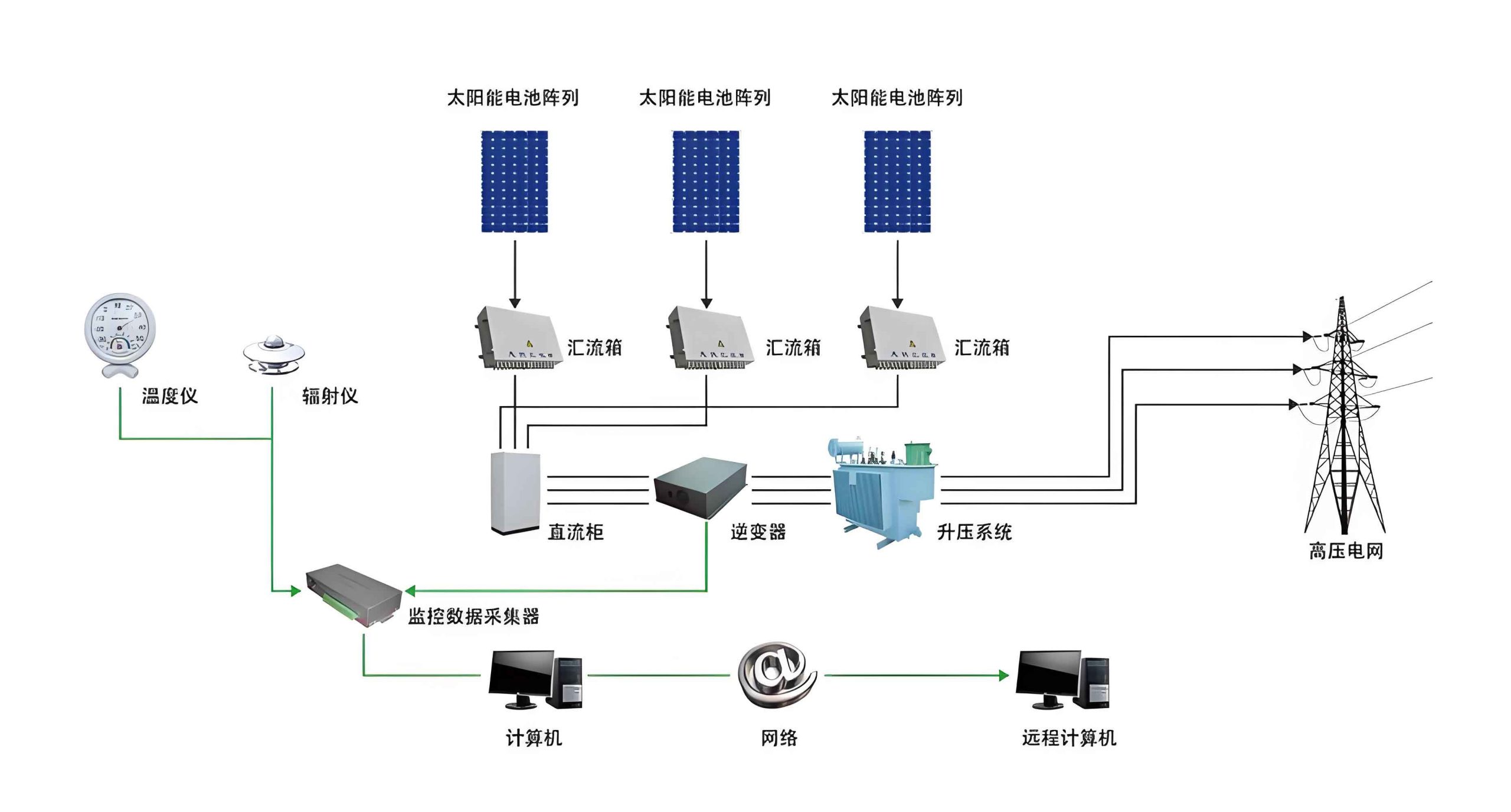
To understand the operational principles, let me detail the components of this solar system. The PV/T collector-evaporator is a flat-plate design with dimensions of 2000 mm × 1000 mm × 80 mm, featuring a glass cover, an absorber plate coated with black chromium, and copper tubes for fluid circulation. Monocrystalline silicon PV cells, with an effective area of 0.875 m² and a coverage ratio of 46.8%, are attached to the absorber plate via an EVA layer, insulated with TPT material. The condenser is a vertical spiral copper coil immersed in a 200-liter water tank, ensuring efficient heat exchange. The auxiliary electric heater has a power rating of 6 kW, providing rapid heating when needed. The entire solar system is designed for ease of installation and maintenance, with a focus on maximizing energy harvest from sunlight. In my experiments, I monitored parameters such as solar irradiance, temperatures at key points, and electrical output using precision instruments like Pt100 thermal resistors and a data acquisition system. This setup allowed for comprehensive analysis of the solar system’s behavior under real-world conditions.
The performance of a solar system is typically evaluated through energy and exergy analyses, based on the first and second laws of thermodynamics. Energy analysis focuses on the quantity of energy converted, while exergy analysis assesses the quality or usable work potential. For this solar system, I calculated key metrics including solar thermal efficiency (ηt), photovoltaic efficiency (ηpv), overall energy efficiency (ηpvt or ηsys), and overall exergy efficiency (ξpvt or ξsys). The formulas used are derived from standard thermodynamic principles, incorporating factors like solar irradiance, collector area, and environmental temperatures. For instance, the overall energy efficiency in loop-heat-pipe mode is given by:
$$ \eta_{pvt} = \frac{\int_{t_1}^{t_2} q_w dt + \int_{t_1}^{t_2} e_{pv} dt}{\int_{t_1}^{t_2} A_c G dt} $$
where \( q_w \) is the heat gain from the condenser, \( e_{pv} \) is the electrical power output from PV cells, \( A_c \) is the collector area, and \( G \) is solar irradiance. Similarly, the overall exergy efficiency accounts for the exergy of heat and electricity, considering ambient temperature and solar radiation temperature (assumed as 6000 K). These metrics provide a holistic view of the solar system’s effectiveness, guiding optimizations for better performance. In my study, I applied these formulas to experimental data collected over multiple days, covering different seasons and operating conditions. The analysis revealed insights into how the solar system performs under varying solar inputs and environmental factors.
My experimental design included three main phases: testing under typical seasonal conditions, evaluating full-day performance, and investigating the impact of refrigerant charge quantity. For seasonal tests, I selected representative days in winter (December 9), spring (April 28), and summer (July 12) to capture climatic variations. The solar system operated in loop-heat-pipe mode from 8:00 to 15:00, with data analysis focused on the stable period from 9:00 to 15:00. Solar irradiance and outdoor air temperature were recorded continuously, as shown in Table 1, which summarizes the average conditions for each season. The data indicates that winter had the highest average solar irradiance but the lowest air temperature, highlighting the challenges and opportunities for solar systems in cold climates.
| Season | Average Solar Irradiance (W/m²) | Average Outdoor Air Temperature (°C) |
|---|---|---|
| Winter | 792 | 4.5 |
| Spring | 772 | 19.2 |
| Summer | 655 | 36.1 |
The results from seasonal tests demonstrate the versatility of this solar system. In summer, the solar thermal efficiency reached a daily average of 62.1%, while the overall energy efficiency was 68.1%. This high performance is attributed to favorable temperatures and sufficient solar exposure. In winter, despite lower air temperatures, the photovoltaic efficiency peaked at 13.7%, and the overall exergy efficiency was 10.9%. These findings suggest that the solar system can effectively convert sunlight into both heat and electricity year-round, with seasonal variations influencing different aspects of performance. The spring conditions yielded intermediate values, with a solar thermal efficiency of 40.2% and overall energy efficiency of 46.2%. These outcomes align with expectations for a solar system designed for cold regions, where thermal efficiency is prioritized but electrical generation remains significant.
To further assess the solar system, I conducted full-day performance tests on December 9 and April 20. These tests included both loop-heat-pipe mode and auxiliary electric heating, providing a complete picture of daily operation. On December 9, the initial water temperature was 16°C, and after loop-heat-pipe operation, it reached 37.5°C, requiring additional heating from the electric heater to achieve the target of 45°C. The total electricity consumption was 1.7 kWh. On April 20, the initial temperature was 20.6°C, rising to 41.3°C, with 0.8 kWh of auxiliary electricity used. The performance metrics for these days are presented in Table 2, comparing loop-heat-pipe mode alone versus the entire solar system including auxiliary heating. The data shows that the overall energy and exergy efficiencies of the full system are slightly higher than those of loop-heat-pipe mode alone, due to the added heat input from the electric heater. This underscores the importance of hybrid design in ensuring reliable hot water supply, especially for solar systems in variable weather conditions.
| Date | Mode | Solar Thermal Efficiency (%) | Photovoltaic Efficiency (%) | Overall Energy Efficiency (%) | Overall Exergy Efficiency (%) |
|---|---|---|---|---|---|
| 2016-12-09 | Loop-Heat-Pipe | 53.3 | 13.7 | 59.7 | 10.9 |
| Total System | N/A | N/A | 67.0 | 11.7 | |
| 2017-04-20 | Loop-Heat-Pipe | 66.9 | 9.9 | 70.7 | 7.7 |
| Total System | N/A | N/A | 75.7 | 9.1 |
Another critical factor in optimizing a solar system is the refrigerant charge quantity in the loop heat pipe. I investigated this by testing with 30% and 40% charge ratios (relative to the total system volume) on similar days in April. The results, summarized in Table 3, indicate that a 30% charge enhances solar thermal efficiency and overall energy efficiency, while a 40% charge improves photovoltaic efficiency and overall exergy efficiency. Specifically, the average solar thermal efficiency was 55.5% for 30% charge and 40.2% for 40% charge, whereas the overall exergy efficiency was 5.2% and 8.5%, respectively. This trade-off arises because higher charge quantities reduce the operating temperature of PV cells, boosting electrical output but lowering thermal performance. For designers of such solar systems, this insight is valuable for tailoring the system based on priority—whether heat or electricity generation is more important for the application.
| Charge Quantity | Average Solar Thermal Efficiency (%) | Average Photovoltaic Efficiency (%) | Average Overall Energy Efficiency (%) | Average Overall Exergy Efficiency (%) |
|---|---|---|---|---|
| 30% | 55.5 | 9.8 | 55.0 | 5.2 |
| 40% | 40.2 | 11.2 | 46.2 | 8.5 |
The energy and exergy analyses are supported by mathematical formulations that quantify the performance of this solar system. For energy analysis, the solar thermal efficiency is defined as:
$$ \eta_t = \frac{\int_{t_1}^{t_2} q_w dt}{\int_{t_1}^{t_2} A_c G dt} $$
and the photovoltaic efficiency as:
$$ \eta_{pv} = \frac{\int_{t_1}^{t_2} e_{pv} dt}{\int_{t_1}^{t_2} A_{pv} G dt} $$
where \( A_{pv} \) is the PV cell area. The overall energy efficiency in loop-heat-pipe mode combines these:
$$ \eta_{pvt} = \eta_t + \zeta \eta_{pv} $$
with \( \zeta = A_{pv} / A_c \) being the PV coverage ratio. For the total system including auxiliary heating, the overall energy efficiency is:
$$ \eta_{sys} = \frac{\int_{t_1}^{t_2} q_w dt + \int_{t_2}^{t_3} q_p dt + \int_{t_1}^{t_2} e_{pv} dt}{\int_{t_1}^{t_2} A_c G dt + \int_{t_2}^{t_3} w_p dt} $$
where \( q_p \) is the heat input from the electric heater, and \( w_p \) is the electrical power consumption. For exergy analysis, the exergy of heat gain is calculated as:
$$ Ex_w = q_w \left(1 – \frac{T_a}{T_w}\right) $$
where \( T_a \) is the ambient air temperature and \( T_w \) is the water temperature. The exergy of solar radiation is:
$$ Ex_{rad} = G \left(1 – \frac{T_a}{T_{sun}}\right) $$
with \( T_{sun} = 6000 \, K \). The overall exergy efficiency in loop-heat-pipe mode is then:
$$ \xi_{pvt} = \frac{\int_{t_1}^{t_2} Ex_w dt + \int_{t_1}^{t_2} Ex_{pv} dt}{\int_{t_1}^{t_2} A_c Ex_{rad} dt} $$
where \( Ex_{pv} = e_{pv} \). For the total system, it extends to include auxiliary components. These equations form the basis for evaluating the solar system’s thermodynamic performance, and my experimental data fits well within this framework.
In discussing the results, it is evident that this solar system performs robustly across different conditions. The integration of loop heat pipe technology addresses common issues in cold climates, such as freezing and low efficiency, by enabling efficient heat transfer even at low temperatures. Moreover, the PV/T design maximizes energy harvest from limited roof space, making it ideal for building-integrated applications. Compared to traditional solar water heaters, this solar system offers higher overall efficiency due to simultaneous electricity generation. The auxiliary electric heater ensures reliability, though it adds to energy consumption; however, in my tests, the electricity usage was minimal, especially in sunny seasons. Future improvements could involve using phase-change materials for thermal storage or advanced refrigerants to enhance performance further. Overall, this solar system represents a significant step toward sustainable building energy solutions.
From an environmental perspective, adopting such solar systems can reduce carbon emissions and reliance on non-renewable energy. In residential buildings, hot water preparation accounts for a substantial portion of energy use, and solar-assisted systems can cut this demand by over 50%. The photovoltaic component also contributes to on-site electricity generation, potentially offsetting grid power. Economic analyses, though not covered here, would likely show favorable payback periods due to energy savings. My experiments confirm that even in colder regions, this solar system is viable, encouraging wider deployment. Policymakers and engineers should consider such integrated designs when promoting renewable energy adoption.
To ensure accuracy, I conducted error analysis for key measurements. Independent variables like solar irradiance and temperature had relative errors below 2%, based on instrument precision. Derived parameters, such as efficiencies, were calculated using propagation formulas, resulting in average relative errors of 6.19% for solar thermal efficiency and 0.28% for photovoltaic efficiency. These errors are within acceptable limits for engineering studies, validating the reliability of my findings. The consistency of results across multiple test days also supports the robustness of this solar system’s performance.
In conclusion, my experimental investigation of a solar photovoltaic/loop-heat-pipe water heating system demonstrates its effectiveness in cold climates. The system achieves high solar thermal efficiency in summer (62.1%) and high photovoltaic efficiency in winter (13.7%), with overall energy and exergy efficiencies surpassing those of conventional systems. The refrigerant charge quantity influences performance, offering a trade-off between thermal and electrical outputs. The inclusion of auxiliary electric heating ensures reliable hot water supply, making the solar system practical for real-world applications. These insights contribute to the optimization of solar systems for building integration, supporting global efforts toward energy sustainability. Future work could explore long-term durability, cost-benefit analysis, and integration with smart grid technologies to enhance the solar system’s impact.