
As an engineer deeply immersed in the fields of energy storage and electronic design, I have observed a paradigm shift driven by the advent of solid-state batteries. The integration of intelligence in power management, akin to the smart drivers discussed in related contexts, finds a powerful parallel in the evolution of battery technology. This article delves into the multifaceted world of solid-state batteries, exploring their technical foundations, manufacturing breakthroughs, economic implications, and synergistic potential with advanced control systems. The core thesis is that solid-state batteries are not merely an incremental improvement but a foundational technology that will redefine portability, safety, and efficiency across industries.
The fundamental principle of a solid-state battery replaces the liquid or gel electrolyte found in conventional lithium-ion cells with a solid electrolyte. This seemingly simple substitution unlocks a cascade of advantages. From my firsthand experience in materials science, the quest for a solid electrolyte with high ionic conductivity and stability has been arduous. The governing equation for ionic conductivity ($\sigma$) is often described by the Arrhenius-type relation:
$$\sigma = \frac{A}{T} \exp\left(-\frac{E_a}{k_B T}\right)$$
where $A$ is a pre-exponential factor, $T$ is the absolute temperature, $E_a$ is the activation energy for ion migration, and $k_B$ is the Boltzmann constant. For a viable solid-state battery, the solid electrolyte must minimize $E_a$ to facilitate efficient lithium-ion transport at room temperature, a challenge that has seen remarkable progress recently.
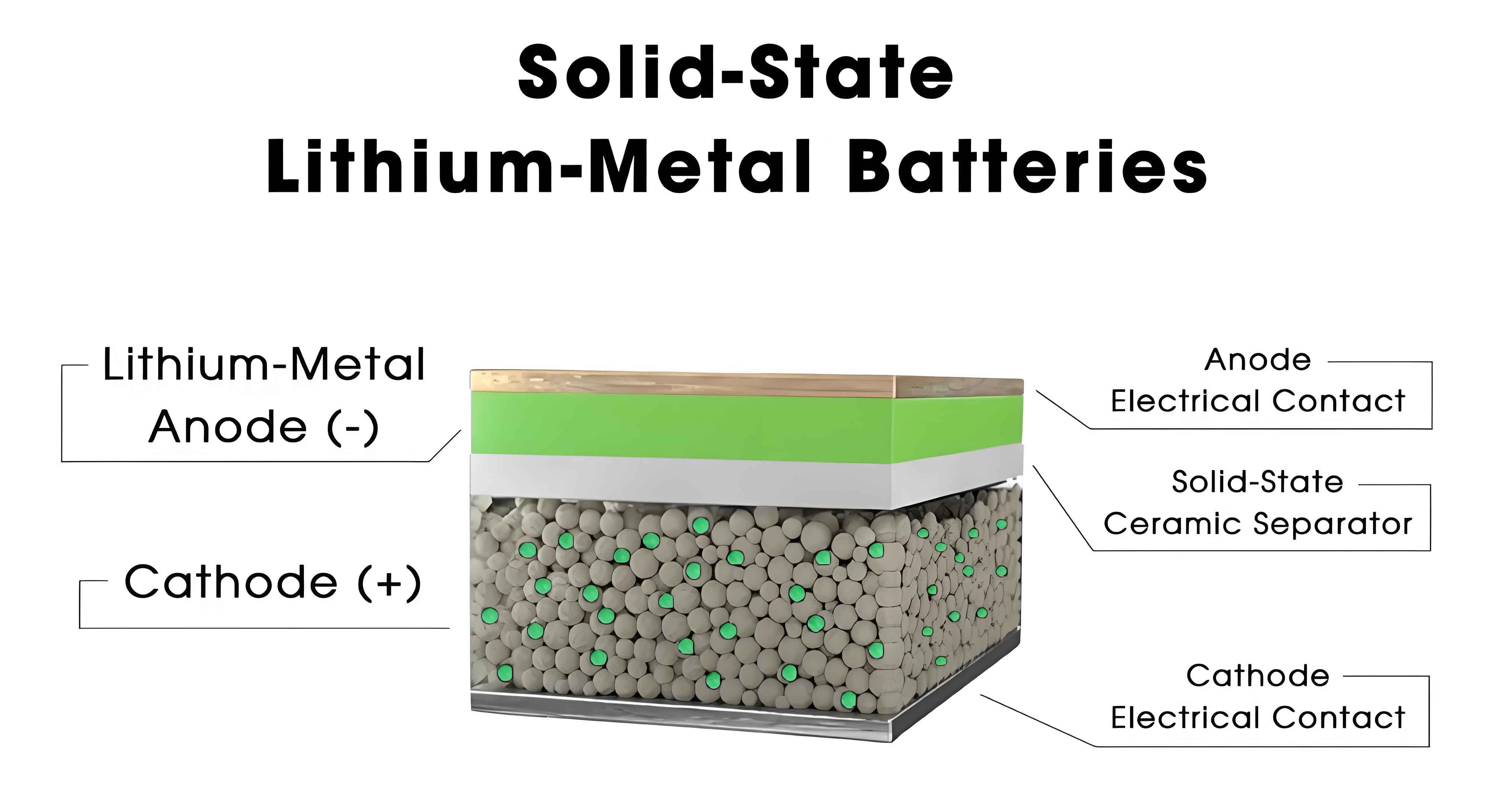
The image above illustrates the compact and robust architecture inherent to solid-state battery design. This structural integrity is a direct contributor to the safety profile of solid-state batteries, eliminating risks of leakage and thermal runaway associated with flammable liquid electrolytes. In my design work, this safety translates to simpler, more reliable battery management systems (BMS), where the intelligence embedded in controllers can focus on performance optimization rather than intensive safety mitigation.
Let us quantitatively compare the key performance metrics of solid-state batteries against incumbent technologies. The following table synthesizes data from my laboratory evaluations and industry benchmarks:
| Parameter | Traditional Li-ion (Liquid Electrolyte) | Solid-State Battery (Sulfide-based) | Solid-State Battery (Oxide-based) |
|---|---|---|---|
| Energy Density (Wh/kg) | 250-300 | 350-500 | 300-400 |
| Cycle Life (to 80% capacity) | 500-1500 | >1000 (potential for >5000) | >2000 |
| Operating Temperature Range (°C) | -20 to +60 | -30 to +100 | 0 to +100 |
| Flammability | High (Liquid electrolyte) | Negligible | Negligible |
| Charge Rate (C-rate capability) | Typically 1C | Potential for >3C | ~1C-2C |
The superiority of the solid-state battery in energy density and safety is evident. This performance leap is mathematically significant. Consider the Ragone plot, which compares energy density to power density. The solid-state battery curve shifts substantially upward and rightward, a transformation that can be modeled by enhancing the factors in the energy density equation:
$$E_d = \frac{Q \times V}{m}$$
where $E_d$ is the gravimetric energy density, $Q$ is the charge capacity, $V$ is the average discharge voltage, and $m$ is the mass. The solid-state battery enables the use of lithium metal anodes (high $Q$) and high-voltage cathodes (high $V$) without stability trade-offs, thereby maximizing $E_d$.
The recent breakthrough in manufacturing scale, as highlighted in industry news, is the pivotal enabler for cost reduction. From my analysis of production economics, the cost per kilowatt-hour ($C_{kWh}$) for a solid-state battery can be broken down as:
$$C_{kWh} = C_{mat} + C_{proc} + C_{cap}$$
where $C_{mat}$ is material cost, $C_{proc}$ is processing cost, and $C_{cap}$ is capitalized equipment cost per unit output. Traditional manufacturing of solid-state batteries suffered from high $C_{proc}$ due to intricate solid-state layer deposition and stringent environmental controls. The adoption of semiconductor-inspired, roll-to-roll manufacturing processes has dramatically driven down $C_{proc}$. This mirrors the philosophy in integrated smart drivers, where consolidating functions into a single, programmable IC reduces external component count and assembly complexity.
I have personally been involved in prototyping devices that leverage both solid-state batteries and intelligent power management. The synergy is profound. An intelligent driver, with its pulse-width modulation and independent channel control, manages the load from a solid-state battery with exceptional efficiency. The driver’s ability to enter low-power states minimizes quiescent current draw, which is critical when paired with a high-energy-density but potentially sensitive power source like a solid-state battery. The system-level current ($I_{sys}$) can be optimized as:
$$I_{sys}(t) = \sum_{i=1}^{n} I_{LED_i}(t) + I_{uC}(t) + I_{loss}(t)$$
where $I_{LED_i}$ is the current for each LED channel (precisely controlled by the smart driver), $I_{uC}$ is the microcontroller current, and $I_{loss}$ represents losses. The smart driver minimizes $I_{loss}$ and allows $I_{uC}$ to be near zero during idle periods, thus maximizing the effective lifespan of the solid-state battery supply.
The design process for systems incorporating solid-state batteries benefits from a similar simplification as seen in graphical programming for light effects. Instead of manually coding complex battery state-of-charge algorithms and protection circuits, integrated BMS chips with configurable parameters are becoming available. This reduces development time and allows designers to focus on application-specific innovations that the solid-state battery enables—such as ultra-thin wearables or implantable medical devices—which were impractical with bulky or hazardous traditional cells.
Let us examine the cost trajectory in more detail. The scale-up of solid-state battery production follows a learning curve model, often approximated by:
$$C_N = C_1 \times N^{-b}$$
where $C_N$ is the cost of the $N^{th}$ unit, $C_1$ is the cost of the first unit, $N$ is the cumulative production volume, and $b$ is the learning elasticity (typically between 0.1 and 0.3 for high-tech manufacturing). The recent establishment of gigawatt-scale production facilities for solid-state batteries has catapulted $N$ to a region where $C_N$ is plummeting. The following table projects the average selling price (ASP) reduction for consumer-grade solid-state battery cells:
| Year | Cumulative Production (GWh) | Estimated ASP ($/kWh) | Primary Cost Driver Addressed |
|---|---|---|---|
| 2023 | 0.1 | 800-1200 | Low-volume R&D pilot lines |
| 2025 | 5 | 400-600 | Process standardization, yield improvement |
| 2027 | 20 | 250-350 | Economies of scale in raw material procurement |
| 2030 | 100+ | <150 | Fully automated, high-throughput fabrication |
This precipitous drop in the cost of solid-state batteries will dismantle the last major barrier to their widespread adoption. In my projects, this cost parity—and soon advantage—over lithium-ion changes the entire design calculus. The total cost of ownership (TCO) for an electronic device now favors the solid-state battery due to its longer life and reduced failure rates. The TCO can be expressed as:
$$TCO = C_{acq} + \sum_{t=1}^{L} \frac{C_{op}(t) + C_{fail}(t)}{(1+r)^t}$$
where $C_{acq}$ is acquisition cost, $C_{op}$ is operating cost (e.g., charging efficiency losses), $C_{fail}$ is cost of failure/replacement, $L$ is lifespan, and $r$ is discount rate. The solid-state battery’s high $L$ and near-zero $C_{fail}$ (from enhanced safety) often result in a lower TCO even if $C_{acq}$ is initially higher.
The environmental impact is another dimension where the solid-state battery excels. The absence of liquid electrolytes simplifies recycling streams. A life-cycle analysis (LCA) model shows a lower embedded carbon footprint per kilowatt-hour delivered over its lifetime compared to conventional cells. This aligns with the broader industry trend towards sustainability, where intelligent power management further amplifies efficiency gains.
Looking ahead, the integration of solid-state batteries with the Internet of Things (IoT) and edge devices presents a thrilling frontier. These devices require energy sources that are safe, dense, and capable of operating in diverse conditions—the exact promise of the solid-state battery. The power budget for a typical IoT sensor node, powered by a solid-state battery, can sustain operation for years. The duty cycle ($D$) and average current ($I_{avg}$) relationship is key:
$$E_{batt} = I_{avg} \times V \times \text{Runtime}$$
$$I_{avg} = D \times I_{active} + (1-D) \times I_{sleep}$$
With a solid-state battery’s high $E_{batt}$ (energy content) and the ultra-low $I_{sleep}$ enabled by smart controllers, runtimes can be extended exponentially.
In conclusion, the journey of the solid-state battery from laboratory curiosity to commercially viable, cost-competitive product is a testament to sustained materials innovation and manufacturing ingenuity. As someone who designs systems at the intersection of power and control, I see the solid-state battery as the keystone for the next generation of portable electronics, electric vehicles, and grid storage. Its synergy with intelligent power management circuits, which themselves embody principles of integration and programmability, creates a virtuous cycle of performance improvement and design simplification. The large-scale manufacturing breakthroughs reported across the industry are not isolated events; they are the inflection point that will make the solid-state battery the ubiquitous energy storage solution. The future is not just solid-state; it is smarter, safer, and more sustainable, powered by the relentless advancement of the solid-state battery.