
The global automotive industry stands at a pivotal crossroads. The transition from internal combustion engines is undeniable, yet the path forward is bifurcated by competing technological visions: the relentless refinement of hybrid systems, the promising but nascent hydrogen fuel cell, and the current mainstream—lithium-ion battery electric vehicles. From my perspective, having observed the breakneck evolution of this sector, it is clear that while lithium-ion technology has propelled the electric vehicle (EV) revolution, its reign is being challenged by fundamental limitations and fierce international competition. The core of this impending technological shift lies in the next generation of energy storage: the solid-state battery.
The dominance of lithium-ion batteries, particularly Nickel Manganese Cobalt (NMC) and Lithium Iron Phosphate (LFP) chemistries, has been the bedrock of modern EVs. The industry’s progress has been staggering, with global lithium battery output for vehicles soaring from mere gigawatt-hours to hundreds in less than a decade. This growth, primarily driven by policy incentives and market demand, has cemented the position of several leading manufacturers. However, this rapid expansion has sown the seeds of significant structural issues. A concerning phenomenon, which I term “hollow investment,” has emerged. Capital floods into the sector, but often consolidates around mature, even outdated, technological paradigms. This creates vast swathes of low-end manufacturing capacity that lacks true innovation and competitiveness. The data is telling: while nameplate capacity skyrockets, overall utilization rates remain worryingly low, indicating a severe mismatch between high-quality, innovative supply and commoditized, excess production.
| Parameter | Current Li-ion (Liquid Electrolyte) | Next-Gen Solid-State Battery (Target) |
|---|---|---|
| Energy Density (Wh/kg) | 250 – 300 | 400 – 500+ |
| Anode Material | Graphite / Silicon-Graphite | Lithium Metal |
| Electrolyte | Liquid Organic Solvents + Li Salts | Solid Ceramic, Polymer, or Sulfide |
| Safety | Moderate (Flammable electrolyte, dendrite risk) | High (Non-flammable, suppresses dendrites) |
| Fast-Charge Target | 30-40 min (to 80%) | 10 min (to 80%) |
| Cycle Life (Target) | 1000 – 2000 cycles | > 5000 cycles |
| Operating Temperature | Limited range | Wider range (potential) |
The limitations of current batteries are multifaceted. Range anxiety, cost pressures, and safety concerns related to thermal runaway are persistent hurdles. The fundamental equation governing vehicle range can be simplified as:
$$ \text{Range} \propto \frac{\text{Battery Pack Energy Density} \times \text{Pack Mass}}{\text{Vehicle Energy Consumption}} $$
To significantly increase range, we must either drastically improve the numerator (battery energy density) or reduce the denominator (vehicle consumption). While vehicle lightweighting and aerodynamic improvements continue, the most impactful lever is the intrinsic energy density of the cell itself. This is where the promise of the solid-state battery becomes compelling. By replacing the liquid electrolyte with a solid medium and enabling the use of a pure lithium metal anode, we can theoretically achieve a step-change in energy density. The potential gain can be conceptualized by comparing the specific capacity of anode materials:
$$ \text{Specific Capacity (Graphite)} \approx 372 \ \text{mAh/g} $$
$$ \text{Specific Capacity (Lithium Metal)} \approx 3860 \ \text{mAh/g} $$
The order-of-magnitude higher capacity of lithium metal is the fundamental driver. Furthermore, the solid electrolyte is intrinsically non-flammable, dramatically enhancing safety by eliminating the primary fire hazard in current batteries.
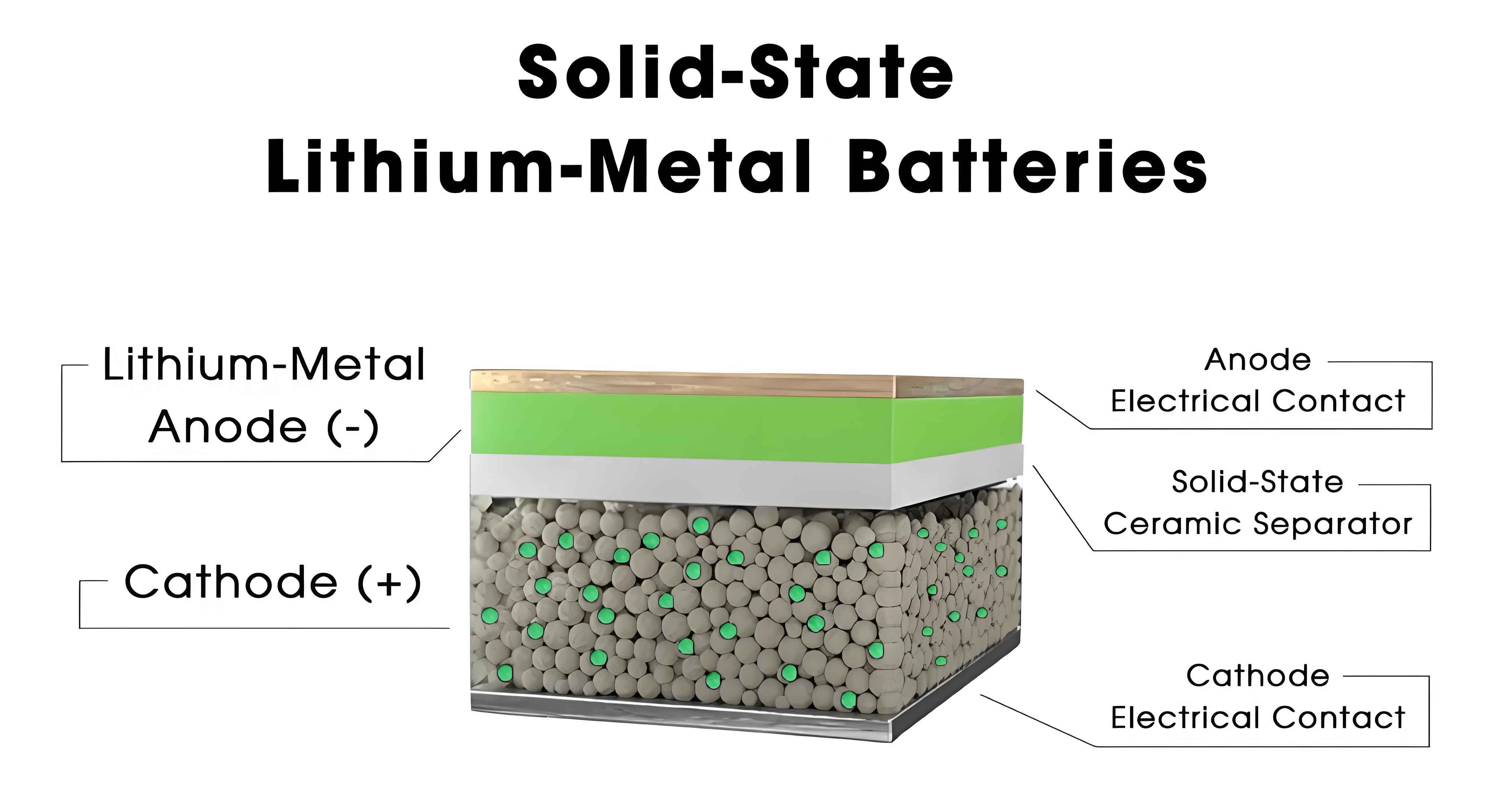
However, the development trajectory of the solid-state battery is not a simple linear path. It is crucial to distinguish between two distinct conceptual levels. The first, and more immediate, approach involves retaining the current lithium-ion cathode and anode materials (e.g., NMC, LFP) and simply swapping the liquid electrolyte and separator for a solid-state alternative. This path primarily addresses safety and may offer moderate energy density gains, but it is fraught with immense technical challenges related to interfacial resistance and ionic conductivity. The second, and truly transformative, path involves a complete overhaul of the cell chemistry: a solid electrolyte coupled with a lithium metal or lithium-sulfur anode and a new high-capacity cathode. This is the ultimate goal, but industry consensus suggests it remains a decade or more from widespread commercialization.
The technical bottlenecks are formidable. The core performance metric for a solid electrolyte is its ionic conductivity, $\sigma_i$, which must rival that of advanced liquid electrolytes ($\sim 10^{-2}$ S/cm at room temperature). Many solid electrolytes suffer from much lower conductivity, described by the Arrhenius equation for ion hopping:
$$ \sigma_i T = A \exp\left(-\frac{E_a}{k_B T}\right) $$
where $E_a$ is the activation energy for ion migration, $k_B$ is Boltzmann’s constant, and $T$ is temperature. Reducing $E_a$ is a primary materials science challenge. Beyond bulk conductivity, the interfaces between the solid electrolyte and the solid electrodes (the cathodic and anodic interfaces) are critical. High interfacial resistance, poor physical contact during cycling, and chemical instability plague current designs. The stability window of the electrolyte against lithium metal is another key parameter, defined by the electrochemical potential range within which it does not decompose.
| Material Class | Example | Ionic Conductivity (RT) | Key Challenges |
|---|---|---|---|
| Oxide Ceramics | LLZO (Garnet) | ~$10^{-4}$ to $10^{-3}$ S/cm | Brittle, high interfacial resistance, sintering temperature |
| Sulfide Ceramics | LPS, LGPS | ~$10^{-3}$ to $10^{-2}$ S/cm | Air sensitivity, moisture reaction (H₂S generation), interface stability |
| Solid Polymers | PEO with Li salt | ~$10^{-5}$ to $10^{-4}$ S/cm (at 60-80°C) | Low conductivity at room temperature, limited oxidative stability |
| Composites/Hybrids | Polymer + Ceramic filler | Varies | Optimizing percolation pathways, interfacial design |
The international race for solid-state battery supremacy is intensifying. After ceding leadership in conventional lithium-ion manufacturing, major industrial nations are launching concerted, nationally-backed efforts to capture the next technological frontier. The objective is clear: to reduce battery pack cost per kilowatt-hour to one-third of current lithium-ion levels and slash fast-charging times to mere minutes. This competition should be viewed not as a threat, but as a powerful motivator for domestic innovation ecosystems to accelerate their efforts and deepen collaboration between academia, national labs, and industry.
Beyond the laboratory, the broader industrial ecosystem faces severe headwinds. The sustainability and security of the raw material supply chain is a critical vulnerability. Key elements like lithium, cobalt, and nickel are geographically concentrated, creating oligopolistic market structures. While lithium reserves are more distributed, the refining capacity and high-grade mineral resources are controlled by a handful of nations and companies. Cobalt is far more critical, with a single nation dominating supply, creating immense geopolitical and ethical risks. This dependency can be quantified as a supply risk index, $R_s$, for a material $m$:
$$ R_s^{(m)} = f(\text{Geo-concentration}, \text{Substitutability}, \text{Recycling Rate}, \text{Demand Growth}) $$
For cobalt and nickel, $R_s$ is alarmingly high for many manufacturing economies. The recent volatility in prices for these raw materials, coupled with downward pressure on battery pack prices from automakers, squeezes manufacturers’ margins, threatening the financial health of all but the most robust players.
| Material | Primary Supply Source (2023) | Key Use in Batteries | Demand Growth Forecast (2023-2030) | Major Risk Factors |
|---|---|---|---|---|
| Lithium (Li) | Australia, Chile, China (refining) | Cathode, Electrolyte (all batteries) | ~20% CAGR | Refining capacity, brine vs. hard rock economics, water use |
| Cobalt (Co) | Democratic Republic of Congo (~70%) | Cathode stabilizer (NMC, NCA) | Slowing (due to chemistries like low-Co NMC & LFP) | Geopolitical instability, artisanal mining ethics, supply chain concentration |
| Nickel (Ni) | Indonesia, Philippines, Russia | High-energy cathodes (High-Ni NMC, NCA) | ~15% CAGR (for batteries) | Class I vs. Class II supply, environmental standards, export policies |
Therefore, the innovation imperative is twofold. First, we must push the boundaries of current lithium-ion technology through cell-to-pack integration, silicon anode integration, and high-nickel/low-cobalt cathodes to bridge the gap. Second, and concurrently, we must make strategic, sustained investments in the foundational science of post-lithium-ion technologies. The solid-state battery is the most prominent candidate, but the landscape of exploration is rich. Lithium-sulfur (Li-S) batteries offer tremendous weight-based energy density, governed by the reaction:
$$ 16\text{Li} + \text{S}_8 \rightarrow 8\text{Li}_2\text{S} $$
with a theoretical specific energy of ~2500 Wh/kg. Lithium-air (Li-O₂) systems theorize even higher energies by utilizing atmospheric oxygen as a reactant. Sodium-ion batteries, leveraging abundant sodium, present a compelling alternative for stationary storage and lower-range vehicles, though with lower energy density. Each of these systems has its own complex set of redox reactions, degradation mechanisms, and material challenges, represented by their respective governing equations and overpotential losses ($\eta$).
The path to a commercial solid-state battery is a marathon, not a sprint. It requires a disciplined, stage-gated approach to development. The industry must simultaneously “manufacture the current generation, develop the next generation, and research the future generation.” This tripartite focus is essential for maintaining competitiveness. The development timeline is fraught with Valley of Death challenges between lab-scale proof-of-concept and pilot-scale validation, and again between pilot production and gigawatt-scale manufacturing. The cost trajectory is perhaps the most critical unknown. Learning curves and scale economies must drive down cost according to a progress ratio (PR):
$$ C_n = C_0 \times (n)^{-\log_2(PR)} $$
where $C_n$ is the cost at cumulative production volume $n$, and $C_0$ is the initial cost. For a novel technology like the solid-state battery, the initial $C_0$ is extremely high, and the progress ratio $PR$ is uncertain, hinging on breakthroughs in scalable deposition techniques for thin solid electrolyte layers and the integration of lithium metal anodes.
| Phase | Timeframe | Technical Characteristic | Target Application | Key Hurdles |
|---|---|---|---|---|
| Initial Commercialization | 2025 – 2028 | Hybrid/Semi-solid; Limited Li-metal; Moderate energy density gain (~20-30%) | Premium EVs, Aviation niches | Yield, cost >$200/kWh, limited form factors |
| Generation 1 (Full Solid) | 2028 – 2035 | Full solid electrolyte; Li-metal anode; Energy density >400 Wh/kg | Mainstream premium & luxury EVs | Li-metal cycling stability, cathode interface, supply chain for solid electrolytes |
| Generation 2 (Advanced) | 2035+ | Advanced cathodes (e.g., sulfur-containing); Energy density >500 Wh/kg; Ultra-fast charge | Mass-market EVs, Long-haul transport | Fundamental electrochemistry, system-level integration (thermal, BMS) |
From my standpoint, a deeper systemic issue underpins these technological and supply chain challenges: the disconnect between fundamental research and applied industrial development. Public research institutions and universities often pursue scientific curiosity without a clear line of sight to market needs or manufacturability. Conversely, corporate R&D is increasingly focused on short-term, incremental improvements to protect market share. This broken “innovation chain” fails to adequately address the high-risk, high-reward foundational science required for breakthroughs like the durable solid-state battery. Rebuilding this bridge, perhaps through mission-oriented public-private partnerships focused on pre-competitive research, is not an optional luxury but a strategic necessity for long-term leadership.
In conclusion, the landscape is one of simultaneous promise and peril. The solid-state battery represents a beacon of transformative potential, capable of resolving the core dilemmas of energy density, safety, and charging speed that constrain today’s electric mobility. Yet, the journey from promising prototype to affordable, reliable commodity is arduous, littered with formidable scientific, engineering, and manufacturing obstacles. The competition is global and fiercely strategic, with nations and corporations staking their claims on the future of energy storage. Success will not belong merely to those who produce at the largest scale today, but to those who can master the complex interplay of materials science, electrochemistry, supply chain resilience, and scalable manufacturing. The next decade will be decisive, determining whether the solid-state revolution becomes a reality or remains a perennial technology of the future. The imperative for focused, collaborative, and deeply foundational innovation has never been greater.