
The recent announcement by a prominent electric vehicle manufacturer regarding the planned integration of a solid-state battery pack into its flagship sedan, promising a range of 1000 kilometers, has sent shockwaves through the materials science community, the battery industry, and financial markets. This single piece of news has ignited fervent debate and speculation: Has the long-anticipated commercial era of the solid-state battery finally arrived? As someone deeply immersed in electrochemical energy storage research, I find it crucial to dissect the hype from the tangible scientific and engineering progress. The journey towards a true, commercially viable solid-state battery is far more complex and nuanced than headlines suggest.
To understand the promise of solid-state batteries, one must first grasp the fundamentals and limitations of the incumbent technology: the liquid electrolyte lithium-ion battery. Commercialized by Sony in 1991, this technology powers our world, from portable electronics to electric vehicles and grid storage. Its operation hinges on the shuttling of lithium ions between a cathode and an anode through a liquid electrolyte medium. During charging, lithium ions de-intercalate from the cathode material, travel through the electrolyte, and embed themselves into the anode matrix. The process reverses during discharge.
The widespread success of this system, however, is shadowed by intrinsic safety concerns rooted in its liquid components. The common organic carbonate-based electrolytes are volatile and flammable. Over repeated charge-discharge cycles, a series of detrimental physical and chemical processes occur:
- Continuous growth of the Solid-Electrolyte Interphase (SEI) on the anode, consuming active lithium and electrolyte.
- Transition metal dissolution from the cathode, leading to capacity fade.
- Oxidative decomposition of the electrolyte at high voltages.
These processes degrade performance and, more critically, can lead to thermal runaway—a vicious, self-accelerating cycle of heat generation leading to fire or explosion, especially under conditions of mechanical abuse (like crushing or penetration), electrical overstress, or elevated ambient temperature. The quest for a safer alternative fundamentally drives the exploration of non-flammable, solid electrolytes, giving rise to the concept of the all-solid-state battery.
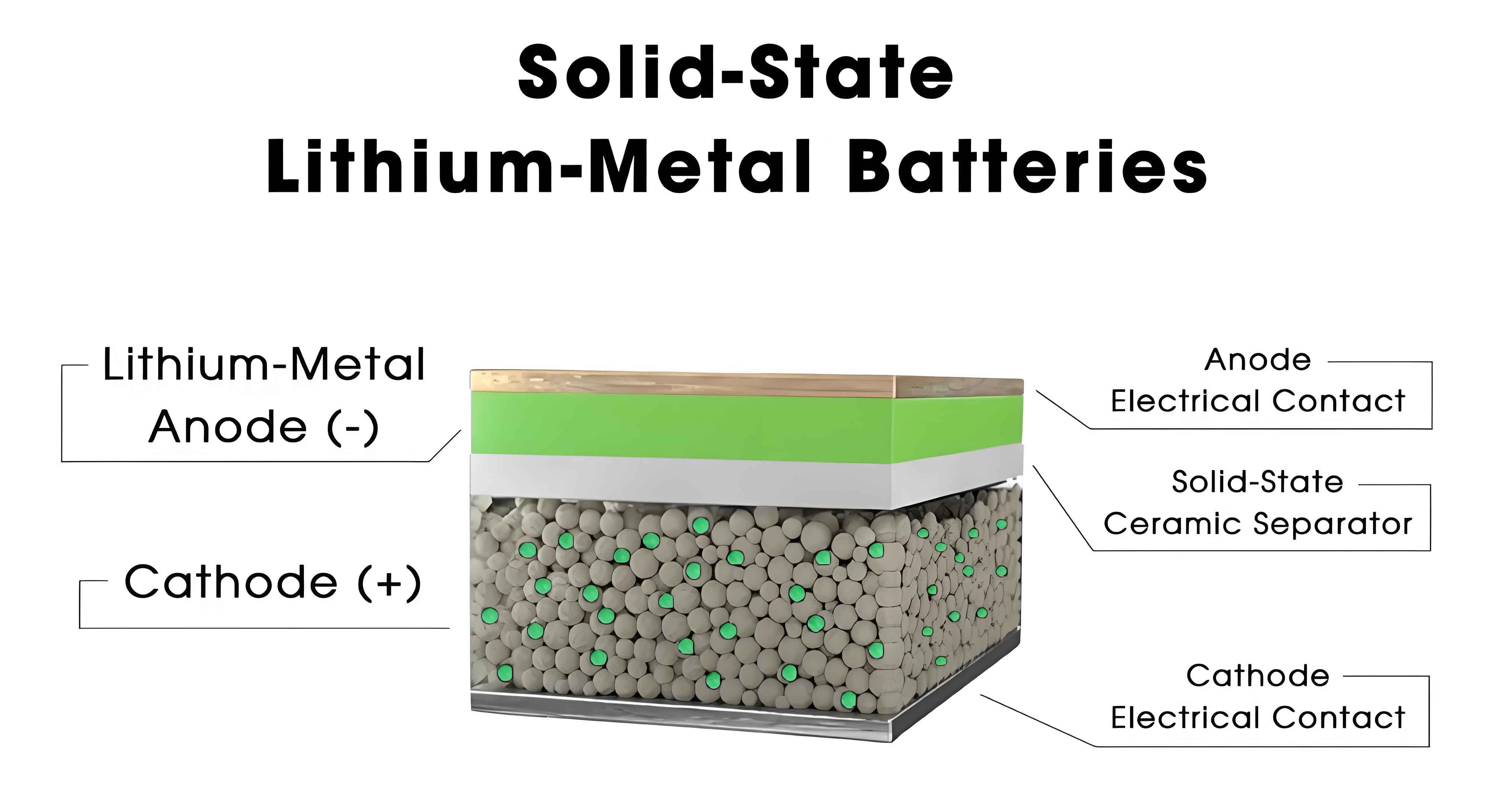
It is essential to clarify the terminology that often causes confusion. “Solid-state battery” is a broad umbrella term. A more precise classification based on the physical state of the electrolyte is as follows:
| Battery Type | Electrolyte Composition | Key Subtypes | Primary Characteristics |
|---|---|---|---|
| Liquid Electrolyte Battery | 100% Liquid | Liquid Li-ion, Liquid Li-metal | Current mainstream technology; high ionic conductivity but safety risks. |
| Hybrid Solid-Liquid Electrolyte Battery | Solid + Liquid | Semi-solid, Quasi-solid-state | Transitional technology; aims to enhance safety while leveraging existing manufacturing. |
| All-Solid-State Battery (ASSB) | 100% Solid | All-Solid-State Li-ion, All-Solid-State Li-metal | Ultimate goal; uses solid electrodes and solid electrolyte only. |
Therefore, the visionary “solid-state battery” that captures the imagination is typically the all-solid-state lithium-metal battery (ASSB), which promises a step-change in performance. The core innovation is the replacement of the liquid electrolyte and separator with a solid-state electrolyte (SSE). The properties of this SSE are paramount and dictate the feasibility of the entire solid-state battery system. Key requirements include:
- High ionic conductivity at room temperature ($\sigma_{Li^+} > 10^{-4}$ S/cm).
- Negligible electronic conductivity.
- Wide electrochemical stability window (>5 V vs. Li/Li⁺).
- Excellent chemical and electrochemical stability against both cathode and anode materials.
- Good mechanical properties (to suppress Li dendrites).
- Thermal stability and non-flammability.
- Low cost and ease of processing.
No single material excels in all these areas, leading to three main families of SSEs, each with distinct trade-offs:
| Electrolyte Class | Examples | Room-Temp $\sigma_{Li^+}$ (S/cm) | Advantages | Disadvantages |
|---|---|---|---|---|
| Polymer | PEO-LiTFSI, PAN, PVC | ~10-5 – 10-4 | Flexible, good processability, low interfacial resistance. | Low ionic conductivity at RT, narrow voltage window (~3.8V), poor thermal stability. |
| Oxide | LLZO (Garnet), LATP, LLTO (Perovskite) | ~10-4 – 10-3 | Good stability vs. Li metal, wide voltage window. | Brittle, high grain boundary resistance, poor interfacial contact. |
| Sulfide | LPS (Li3PS4), LGPS (Li10GeP2S12) | ~10-3 – 10-2 | Highest ionic conductivity, soft mechanical properties. | Narrow electrochemical window, instability in air (H2S generation), poor stability vs. Li metal. |
The ionic conductivity often follows the Arrhenius equation, highlighting the temperature sensitivity of many SSEs, especially polymers:
$$ \sigma = A \exp\left(-\frac{E_a}{k_B T}\right) $$
where $\sigma$ is the ionic conductivity, $A$ is the pre-exponential factor, $E_a$ is the activation energy for ion migration, $k_B$ is Boltzmann’s constant, and $T$ is the absolute temperature. This is why many early solid-state battery demonstrations require elevated temperatures (>60°C) to function adequately.
The most formidable challenge in realizing a practical all-solid-state battery is not just the bulk electrolyte property, but the management of solid-solid interfaces. Unlike a liquid electrolyte that can wet and permeate every pore of a porous electrode, creating intimate contact, solid particles merely touch each other. This results in high interfacial resistance, severely limiting power density and cycle life. The interface problems are twofold:
1. Cathode-SSE Interface: High-voltage oxide cathodes (e.g., NCM, NCA) tend to react with many SSEs, forming high-resistance interphases. Volume changes during cycling can break contact, leading to “voids” and catastrophic capacity fade.
2. Anode-SSE Interface (especially with Li metal): Even with a mechanically rigid SSE, inhomogeneous lithium plating/stripping can cause dendrite-like penetration. Furthermore, chemical instability leads to continuous side reactions. The interface resistance $R_{int}$ for a solid-state battery can be modeled as a combination of charge transfer resistance and constriction resistance due to limited contact area:
$$ R_{int} = R_{ct} + R_{constrict} $$
Minimizing $R_{constrict}$ requires innovative electrode design, such as creating composite cathodes where SSE particles are intimately mixed with active material and conductive carbon, or applying sophisticated interfacial coating layers.
The two primary selling points for the solid-state battery are enhanced safety and superior energy density. Let’s scrutinize both.
Safety: While the removal of flammable liquid is a definitive safety advantage, declaring the all-solid-state battery as “inherently safe” is premature. Thermal runaway can still be triggered by internal short circuits (from Li dendrites or manufacturing defects), external heating, or overcharging. Some sulfide SSEs are thermally unstable and can exothermically decompose. A comprehensive safety assessment over the cell’s entire lifecycle is still lacking. The safety benefit of a solid-state battery is significant but must be proven for each specific chemistry and cell design.
Energy Density: The Critical Reality Check
Claims of energy densities 2-5 times that of current Li-ion batteries are pervasive but often misleading. Such projections typically assume the pairing of a lithium-metal anode (theoretical capacity: 3860 mAh/g) with a high-capacity cathode (e.g., sulfur or air) in an idealized, weightless package. The reality of today’s materials is far more constrained.
For a fair comparison, consider replacing only the liquid electrolyte in a conventional Li-ion cell with a solid-state electrolyte, keeping the same graphite anode and NCM811 cathode. The inorganic SSE, being dense and incompressible, occupies more volume and weight within the composite cathode than the liquid it replaces. This often results in a lower cell-level energy density for the all-solid-state lithium-ion configuration.
The true potential for higher energy density comes from enabling the lithium-metal anode. Let’s calculate the practical gravimetric energy density ($E_{grav}$) for a simplified all-solid-state lithium-metal battery pouch cell:
$$ E_{grav} = \frac{V_{cell} \times C_{cathode}}{Weight_{cathode} + Weight_{anode} + Weight_{SSE} + Weight_{inactive}} $$
Assuming:
– Cathode: NCM811 (Capacity $C_{cathode}$ ≈ 200 mAh/g, average voltage $V_{cell}$ ≈ 3.8 V)
– Anode: Thin Li foil (50 µm excess)
– SSE: Sulfide-based (dense, ~1.5x weight of liquid electrolyte in conventional cell)
– Inactive components (current collectors, pouch): ~20% of total weight
A realistic calculation for such a cell yields an energy density in the range of 350-450 Wh/kg, which is about 1.3 to 1.7 times that of a state-of-the-art 300 Wh/kg liquid Li-ion cell—a commendable improvement, but far from a 5x leap. To reach beyond 500 Wh/kg, we would need to integrate ultra-high-capacity cathodes like Li-rich manganese-based materials or sulfur, which introduce a host of new stability and cycle life challenges. The following table summarizes the evolutionary path:
| Battery Generation | Anode | Cathode | Electrolyte | Practical Cell-Level Energy Density (Wh/kg) | Timeline (Est.) |
|---|---|---|---|---|---|
| Current State-of-the-Art | Graphite/Si-C | High-Ni NCM/NCA | Liquid | 280 – 320 | Now |
| Hybrid Solid-Liquid | Graphite/Si-C or Thin Li | High-Ni NCM/NCA | Solid-Liquid Hybrid | 300 – 400 | Near-term (3-7 years) |
| All-Solid-State Li-metal (1st Gen) | Lithium Metal | High-Ni NCM/NCA, Coating | Sulfide/Oxide SSE | 350 – 450 | Mid-term (5-10 years) |
| All-Solid-State Li-metal (2nd Gen) | Lithium Metal | Li-Rich or Sulfur | Advanced SSE | >500 | Long-term (10+ years) |
The immense technical hurdles—from interface engineering and Li metal cycling stability to cost-effective, scalable manufacturing of moisture-sensitive materials like sulfides—make it unequivocally clear that the pure, all-solid-state lithium-metal battery is not ready for immediate commercialization in electric vehicles. The supply chain, from raw material processing to cell assembly equipment, is in its infancy.
Given this reality, the most rational and pragmatic path forward is the development of hybrid solid-liquid electrolyte batteries. This approach strategically combines a moderate amount of liquid or gel electrolyte with a solid electrolyte framework (e.g., a polymer matrix or a porous oxide scaffold). The goals are:
- Enhanced Safety: The liquid content is reduced and/or made less flammable, while the solid framework can physically suppress dendrite growth.
- Mitigated Interfaces: The residual liquid helps maintain good interfacial contact, lowering impedance.
- Manufacturing Compatibility: These systems can largely adapt the existing slurry casting, rolling, and stacking processes of the lithium-ion industry, lowering the barrier to production scale-up.
This hybrid strategy represents a critical bridging technology. It allows for incremental but meaningful improvements in energy density and safety while the foundational science and engineering for the ultimate all-solid-state battery continue to mature. The recent vehicle announcement likely pertains to such a hybrid solid-state battery technology, not a pure all-solid-state battery.
In conclusion, the narrative surrounding the solid-state battery is at a crossroads between justifiable excitement and overhyped speculation. The fundamental promise—a safer, denser energy storage paradigm—is undeniably powerful and is driving global research efforts. However, the transition from laboratory coin cells to reliable, affordable, and high-performance automotive battery packs is a marathon, not a sprint. The solid-state battery, particularly in its ultimate all-solid-state form, faces profound scientific and engineering challenges that time, sustained investment, and relentless innovation must overcome. The near-term future belongs to evolutionary hybrid systems, which will serve as the essential proving ground for the materials and concepts that will one day define the true solid-state battery era. For now, a measured perspective, grounded in electrochemical principles and manufacturing realities, is our most valuable guide.