
The relentless pursuit of higher energy density and enhanced safety in electrochemical energy storage has positioned the solid-state battery as a pivotal technology for the next generation of electric vehicles (EVs). As a researcher deeply immersed in this field, I have witnessed the limitations of conventional lithium-ion batteries firsthand. Their flammable liquid electrolytes pose inherent safety risks, while the low theoretical capacity of graphite anodes (372 mA·h/g) fundamentally caps the achievable energy density. These bottlenecks are significant impediments to realizing EVs with longer ranges and absolute operational safety. Our work, therefore, focuses on addressing the core challenge within one of the most promising alternatives: the polymer-based solid-state battery.
Replacing liquid electrolytes with solid counterparts offers a paradigm shift. The solid-state battery inherently eliminates leakage and flammability concerns. More importantly, it unlocks the possibility of employing lithium metal as the anode, boasting a theoretical capacity of 3,860 mA·h/g, which is an order of magnitude higher than graphite. This is the primary route to achieving energy densities exceeding 300 Wh/kg at the cell level, a critical benchmark for the EV industry. Among solid electrolytes, poly(ethylene oxide) (PEO)-based systems are particularly attractive due to their excellent processability, low cost, and good interfacial contact with electrodes, making them a leading candidate for early industrialization of solid-state batteries.
However, the practical deployment of PEO-based solid-state batteries faces two major hurdles: low ambient temperature ionic conductivity and inadequate mechanical strength to suppress lithium dendrite growth. Dendrites are needle-like metallic lithium structures that can grow during charging (plating). In a soft polymer matrix, these dendrites can easily penetrate the electrolyte, causing internal short circuits, rapid capacity fade, and serious safety hazards. Therefore, the inhibition of lithium dendrite growth is not just a performance issue but a fundamental safety prerequisite for automotive-grade solid-state batteries.
Our research strategy centers on composite electrolytes. We postulate that by incorporating a ceramic filler with high ionic conductivity and superior mechanical rigidity into the PEO matrix, we can synergistically enhance both ionic transport and dendrite suppression. We selected the garnet-type Li7La3Zr2O12 (LLZO) as the filler of choice. LLZO is renowned for its high bulk ionic conductivity (on the order of 10-4 S/cm at room temperature) and a high Young’s modulus (>150 GPa), theoretically making it an ideal physical barrier against dendrite penetration.
The synthesis of our composite system involved several key steps. First, we prepared phase-pure, Al-doped cubic-phase LLZO powder via a sol-gel method. The X-ray diffraction pattern confirmed the successful formation of the high-conductivity cubic phase, a critical prerequisite. The PEO-based electrolyte was prepared by dissolving PEO and lithium bis(trifluoromethanesulfonyl)imide (LiTFSI) salt in a molar ratio of EO:Li = 10:1 in tetrahydrofuran. To fabricate the composite, varying mass fractions of LLZO powder (from 10% to 50%) were dispersed into the PEO-LiTFSI solution, which was then cast and thoroughly dried to form freestanding membranes.
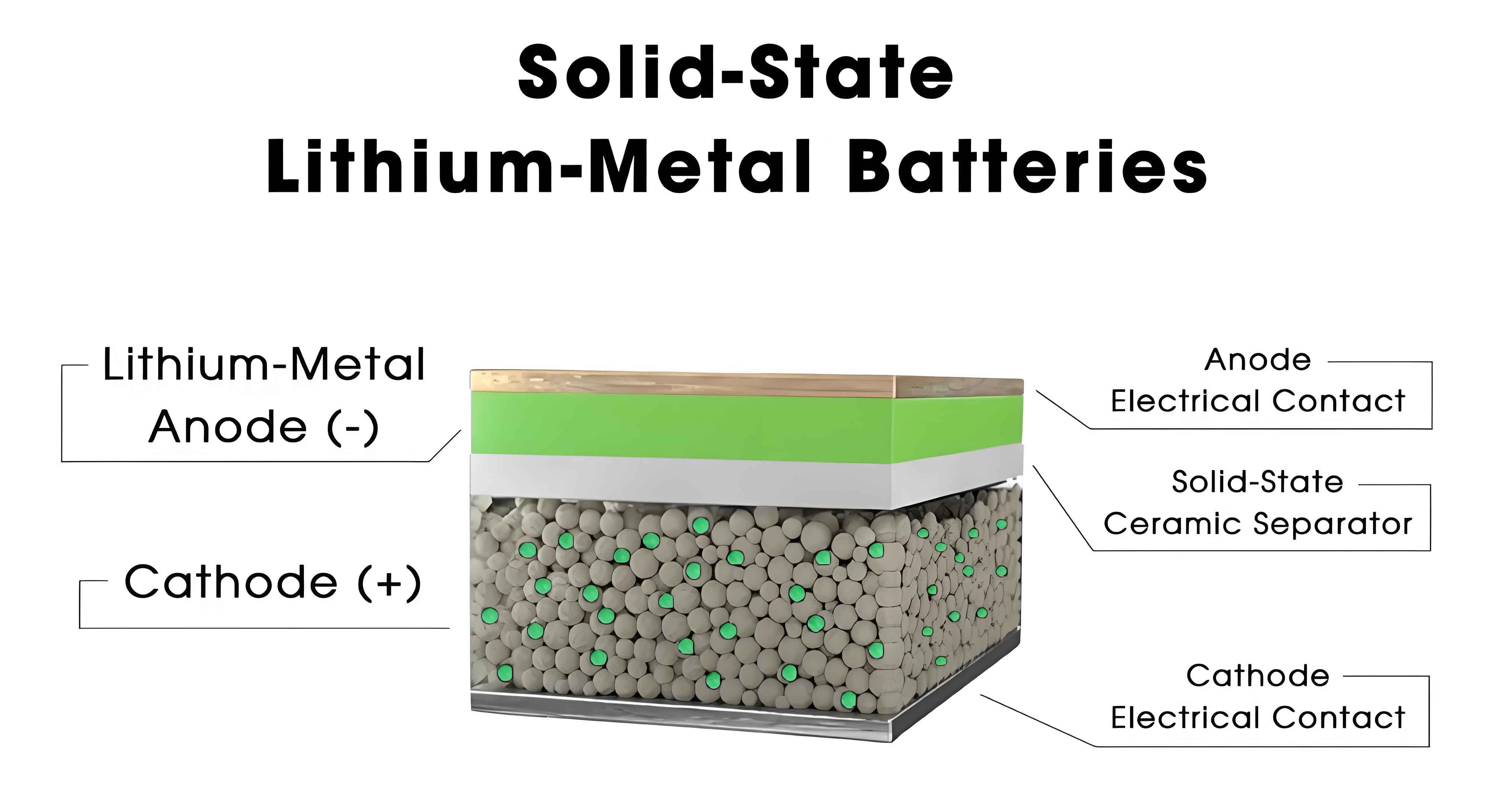
Our initial characterization focused on the ionic conductivity (σ) of the different electrolyte systems, determined using electrochemical impedance spectroscopy with blocking electrodes. The ionic conductivity is calculated using the formula:
$$ \sigma = \frac{L}{R \times A} $$
where \( L \) is the thickness, \( R \) is the bulk resistance obtained from the impedance spectrum, and \( A \) is the contact area. The activation energy (\( E_a \)) for ion transport was derived from the Arrhenius equation:
$$ \sigma T = \sigma_0 \exp\left(-\frac{E_a}{k_B T}\right) $$
where \( \sigma_0 \) is the pre-exponential factor, \( k_B \) is the Boltzmann constant, and \( T \) is the absolute temperature.
| Electrolyte Type | Thickness (mm) | Ionic Conductivity at 25°C (S/cm) | Activation Energy, \( E_a \) (eV) |
|---|---|---|---|
| Pure LLZO Pellet | 1.0 | 5.9 × 10⁻⁴ | 0.40 |
| Pure PEO Membrane | 0.3 | 9.8 × 10⁻⁶ | 0.57 |
| PEO-40%LLZO Composite | 0.3 | 3.8 × 10⁻⁴ | 0.43 |
The data reveals a compelling narrative. While the pure LLZO ceramic exhibits high conductivity, its brittle nature and high interfacial resistance with lithium metal are well-known drawbacks for standalone use. The pure PEO membrane suffers from very low room-temperature conductivity due to its high crystallinity, as reflected in the high \( E_a \). Remarkably, the PEO-40%LLZO composite electrolyte achieved an ionic conductivity of 3.8 × 10⁻⁴ S/cm, which is comparable to the ceramic pellet and two orders of magnitude higher than pure PEO. This enhancement stems from the LLZO filler disrupting PEO chain crystallization, creating more amorphous regions for ion conduction, while also providing fast Li+ transport pathways through the ceramic phase itself. The \( E_a \) dropped to 0.43 eV, closer to that of LLZO, indicating a lower energy barrier for ion migration. This level of conductivity is sufficient to support the rate capabilities required for EV driving cycles.
The true test for a solid-state battery electrolyte intended for use with a lithium metal anode is its ability to withstand dendrite propagation. We quantitatively evaluated this using the critical current density (CCD) test in Li||Li symmetric cells. The CCD is the maximum current density at which lithium can be plated and stripped repeatedly without causing a short circuit. The test protocol involves cycling the symmetric cell with stepwise increasing current density (e.g., +0.2 mA/cm² per step) until a sudden voltage drop or spike indicates a short.
| Symmetric Cell Configuration | Critical Current Density (mA/cm²) | Key Limiting Factor |
|---|---|---|
| Li | Pure LLZO Pellet | Li | 0.6 | High interfacial impedance leading to uneven Li plating/stripping. |
| Li | Pure PEO Membrane | Li | 0.4 | Low mechanical strength, allowing easy dendrite penetration. |
| Li | PEO-40%LLZO Composite | Li | 1.6 | Synergy of good interfacial contact and high mechanical barrier. |
The results are striking. The pure LLZO cell’s low CCD is attributed to its poor interfacial wettability with lithium, leading to locally high current density and dendritic growth along grain boundaries. The pure PEO cell failed at an even lower current due to its mechanical softness. In contrast, our composite electrolyte enabled a CCD of 1.6 mA/cm², a four-fold improvement over pure PEO. This is a cornerstone achievement for the solid-state battery. The mechanism is dual-functional: 1) The soft PEO matrix ensures intimate and uniform contact with the lithium metal anode, promoting homogeneous lithium flux. 2) The dispersed, high-modulus LLZO particles act as a “rock in a stream,” physically blocking and diverting the tip of any propagating dendrite, preventing it from traversing the entire electrolyte thickness. The interfacial resistance of the composite with lithium, derived from impedance spectra, was only 37 Ω·cm², further confirming the stability of the interface.
To bridge the gap between material science and application, we assembled practical pouch cells to assess the real-world potential of this composite electrolyte for electric vehicles. We evaluated two configurations: a full cell with a conventional graphite anode (representing a more near-term, safer option) and a half-cell with a lithium metal anode (representing the ultimate high-energy-density goal). The cathode was high-voltage LiCoO2 (LCO).
| Pouch Cell Configuration | Active Anode Material | Voltage Window | Initial Specific Energy (Wh/kg) | Cycling Performance (1C rate) |
|---|---|---|---|---|
| Full Cell (30 Ah) | Graphite | 3.0 – 4.4 V | 218.2 | 92.3% capacity retention after 1,000 cycles. |
| Half Cell (15 Ah) | Lithium Metal | 3.0 – 4.5 V | 334.5 | 81.7% capacity retention after 200 cycles. |
The full cell delivers an impressive initial energy density of 218.2 Wh/kg, which is highly competitive with current advanced liquid-electrolyte Li-ion cells. Its exceptional cycle life—92.3% retention after 1,000 cycles—demonstrates the outstanding interfacial stability and dendrite-suppressing capability of the composite electrolyte in a practical, commercially relevant format. This performance directly addresses EV requirements for long calendar and cycle life.
The lithium metal half-cell, as anticipated, achieved a groundbreaking energy density of 334.5 Wh/kg, surpassing the 300 Wh/kg threshold. This single data point highlights the transformative potential of the lithium metal solid-state battery for revolutionizing EV range. However, the cycling stability (81.7% after 200 cycles), while promising, requires further improvement. The capacity fade is likely due to continuous side reactions at the lithium/composite interface and remaining inhomogeneities in lithium plating/stripping, leading to “dead lithium” and increased polarization. This underscores that while our composite electrolyte significantly suppresses dendrite-related shorts, achieving a perfectly stable lithium metal interface remains the grand challenge for the solid-state battery community.
Our study validates a powerful materials strategy for advancing solid-state batteries. By compositing a processable polymer with a rigid, high-conductivity ceramic, we created an electrolyte that successfully decouples and enhances the required properties: ionic transport and mechanical robustness. The PEO-LLZO composite effectively raises the critical current density, a direct metric for dendrite inhibition, paving the way for safer operation. The successful demonstration in multi-tens-of-Ampere-hour pouch cells, especially the graphite-based full cell with superior cycle life, provides a strong foundation for the near-term deployment of solid-state battery technology. For the lithium metal configuration, while the high energy density is confirmed, future work must focus on interface engineering—perhaps through artificial interlayers or electrolyte surface modifications—to further stabilize the lithium metal anode and unlock the full, durable potential of the solid-state battery for the electric vehicles of tomorrow.