
As a researcher deeply involved in the advancement of new energy vehicles (NEVs), I recognize that these vehicles are pivotal in addressing global energy shortages and environmental pollution. NEVs, including battery electric vehicles (BEVs) and plug-in hybrid electric vehicles (PHEVs), are gaining widespread adoption worldwide. The battery system, often termed the “heart” of NEVs, directly influences vehicle performance, safety, and reliability. Traditional lithium-ion batteries, while prevalent, exhibit safety concerns due to liquid electrolytes that can leak under high temperatures or vibration, limiting their lifespan and operational conditions. In contrast, solid-state batteries offer remarkable advantages such as high energy density, long cycle life, excellent thermal stability, and enhanced safety. These attributes position solid-state batteries as a transformative technology for next-generation power systems. In this article, I explore the optimization design of NEV power systems based on solid-state batteries, focusing on extending range, improving safety, and boosting reliability through innovative approaches.
The working principle of solid-state batteries parallels that of conventional lithium-ion batteries, involving lithium-ion shuttling between cathode and anode during charge and discharge cycles. However, the key distinction lies in the use of a solid electrolyte instead of a liquid one. During charging, lithium ions de-intercalate from the cathode material, migrate through the solid electrolyte, and intercalate into the anode material to store energy. Discharging reverses this process, with lithium ions moving back to the cathode via the electrolyte, releasing stored energy through an external circuit. The solid electrolyte, typically composed of inorganic materials like oxides (e.g., Li7La3Zr2O12 or LLZO), sulfides (e.g., Li10GeP2S12 or LGPS), or organic polymers (e.g., polyethylene oxide-based), serves dual functions: facilitating ion conduction and providing mechanical support to maintain electrode separation stability.
One of the most prominent features of solid-state batteries is their superior safety profile. Since solid electrolytes contain no liquid components, risks associated with electrolyte leakage, evaporation, and subsequent fire or explosion are drastically reduced. Moreover, solid electrolytes exhibit higher chemical stability and mechanical strength than their liquid counterparts. Even under physical damage, internal short circuits or uncontrolled chemical reactions are less likely, bolstering overall safety. Another standout characteristic is the high energy density and extended lifespan of solid-state batteries. The use of solid electrolytes enables the integration of high-capacity electrode materials, such as lithium metal anodes, which boast a theoretical specific capacity of approximately 3860 mAh/g, far exceeding the 372 mAh/g of traditional graphite anodes. This significantly enhances energy density. Additionally, the stability of solid electrolytes helps suppress structural degradation of electrode materials and lithium dendrite growth during long-term cycling, key factors that affect battery longevity and performance.
The ionic conductivity σ of solid electrolytes is a critical parameter governing performance. For many solid electrolytes, σ follows the Arrhenius equation:
$$ \sigma = \sigma_0 \exp\left(-\frac{E_a}{k_B T}\right) $$
where σ0 is the pre-exponential factor, Ea is the activation energy, kB is the Boltzmann constant, and T is the absolute temperature. Achieving high σ at room temperature (e.g., >10-3 S/cm) is essential for fast charging and high power output in solid-state batteries.
To illustrate the characteristics, consider the following table comparing solid-state batteries with traditional lithium-ion batteries:
| Feature | Solid-State Battery | Traditional Lithium-Ion Battery |
|---|---|---|
| Electrolyte Type | Solid (oxides, sulfides, polymers) | Liquid or gel |
| Energy Density | High (potentially >500 Wh/kg) | Moderate (150–300 Wh/kg) |
| Safety | Excellent (non-flammable, leak-proof) | Moderate (prone to thermal runaway) |
| Cycle Life | Long (>2000 cycles) | Standard (500–1500 cycles) |
| Operating Temperature Range | Wide (-30°C to 100°C) | Limited (0°C to 45°C typically) |
| Interface Resistance | Can be high, requiring optimization | Relatively low due to liquid contact |
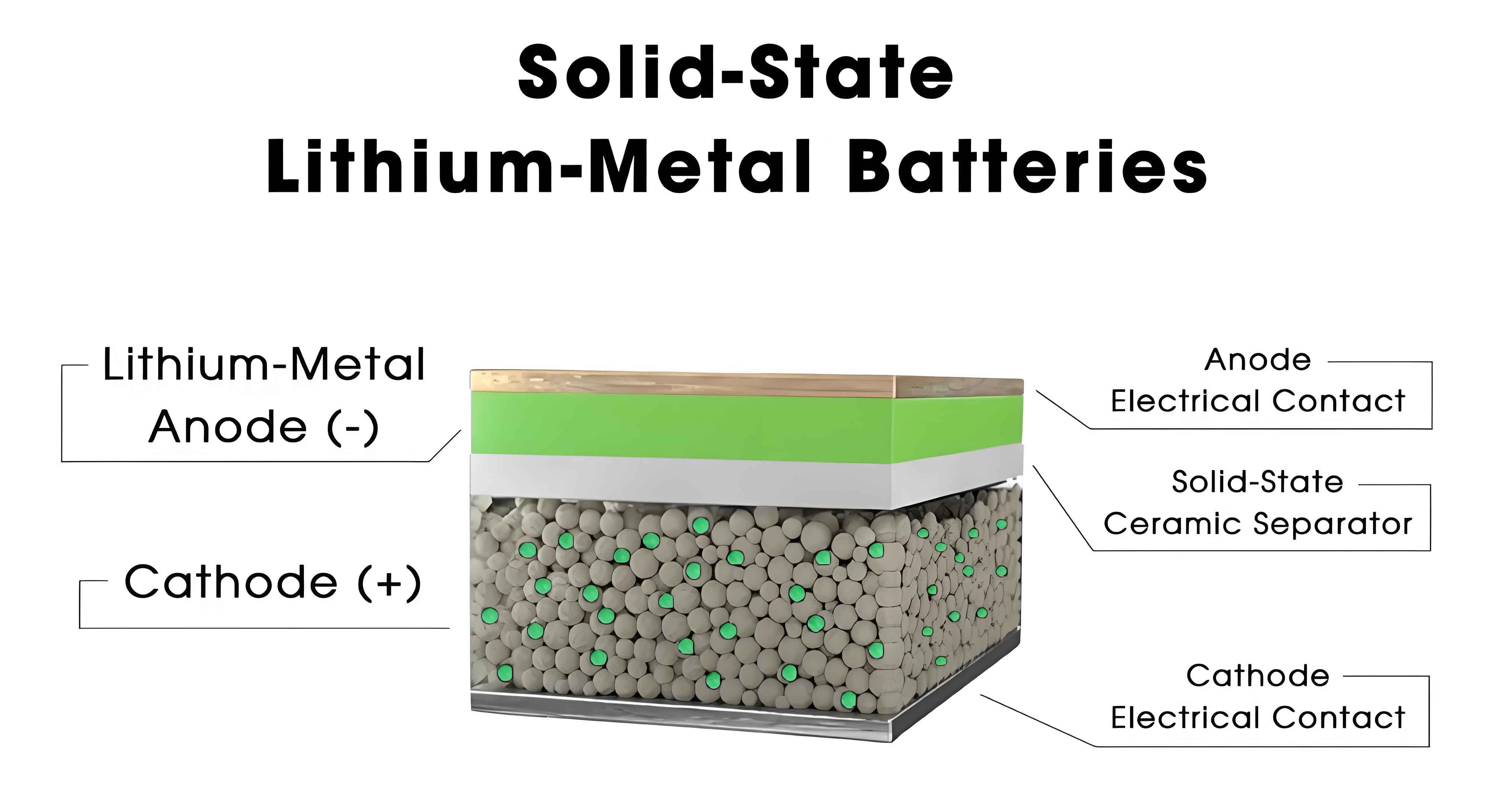
Despite the promise, solid-state batteries face several technical challenges that must be addressed for widespread adoption in NEVs. These include low ionic conductivity in some solid electrolytes, high interface resistance between electrodes and electrolyte, mechanical stress from volume changes during cycling, and manufacturing complexities. To overcome these, interdisciplinary efforts in materials science and engineering are crucial. For instance, interface resistance Rint can be modeled as:
$$ R_{\text{int}} = \frac{\delta}{\sigma_{\text{int}}} $$
where δ is the interface thickness and σint is the interfacial conductivity. Reducing δ or increasing σint through material design is vital for enhancing solid-state battery performance.
In optimizing solid-state battery cell structure, I focus on interface engineering and mechanical integrity. The goal is to maximize ion transport while ensuring durability. Strategies include selecting chemically compatible electrode and electrolyte materials to prevent adverse reactions, and employing nanostructured designs (e.g., electrolyte coatings, porous architectures) to increase contact area and shorten lithium-ion transport paths. The effective ionic conductivity σeff in composite structures can be estimated using effective medium theory:
$$ \sigma_{\text{eff}} = \phi \sigma_e + (1-\phi) \sigma_i $$
where φ is the volume fraction of electrolyte, σe is the electrolyte conductivity, and σi is the interfacial conductivity. By optimizing φ and σi, overall solid-state battery performance can be enhanced. Mechanical stability is another key consideration; stress from volume changes must be managed to avoid cracking. The strain ε in the electrolyte can be related to pressure P and Young’s modulus E:
$$ \epsilon = \frac{P}{E} $$
Designing flexible electrolytes or incorporating stress-relief layers can mitigate such issues. Thermal management is also critical; Fourier’s law of heat conduction applies:
$$ q = -k \nabla T $$
where q is heat flux, k is thermal conductivity, and ∇T is the temperature gradient. Integrating high-thermal-conductivity materials or active cooling systems helps maintain optimal operating temperatures for solid-state batteries.
For battery module integration optimization, I emphasize thermal and electrical homogeneity. A well-designed module ensures uniform temperature distribution and current flow. Using computational fluid dynamics (CFD) simulations, heat generation Q from each cell can be modeled:
$$ Q = I^2 R + I \left| \frac{\partial U}{\partial T} \right| \Delta T $$
where I is current, R is internal resistance, U is cell voltage, and ΔT is temperature difference. Minimizing Q through efficient cooling (e.g., liquid systems, phase change materials) extends module lifespan. The table below summarizes key integration aspects:
| Aspect | Optimization Strategy | Impact on Solid-State Battery Module |
|---|---|---|
| Cell Arrangement | Modular series/parallel configuration | Reduces internal resistance, improves power output |
| Thermal Management | Liquid cooling, heat pipes, PCM | Enhances safety and cycle life |
| BMS Integration | Real-time monitoring of SOC, voltage, temperature | Ensures safe operation, predicts maintenance |
| Mechanical Design | Vibration-resistant enclosures | Improves durability under dynamic loads |
The battery management system (BMS) is tailored for solid-state batteries, accounting for unique aging mechanisms. State of charge (SOC) estimation can involve coulomb counting with corrections:
$$ \text{SOC}(t) = \text{SOC}_0 – \frac{1}{C_{\text{nom}}} \int_0^t I(\tau) d\tau $$
where Cnom is nominal capacity and I is current. Advanced BMS algorithms incorporate temperature and aging effects to maintain accuracy for solid-state batteries.
In overall power system optimization, I integrate solid-state batteries with power electronics and control algorithms. System-level efficiency ηsys is a key metric:
$$ \eta_{\text{sys}} = \eta_{\text{batt}} \cdot \eta_{\text{conv}} \cdot \eta_{\text{mgmt}} $$
where ηbatt is battery efficiency, ηconv is power converter efficiency, and ηmgmt is energy management efficiency. An energy management system (EMS) using machine learning can optimize ηmgmt by predicting driving patterns and dynamically adjusting energy flows. Additionally, grid interaction capabilities, such as peak shaving and load balancing, require fast energy response. The gravimetric energy density Eg of a solid-state battery pack is given by:
$$ E_g = \frac{C \cdot V}{m} $$
where C is capacity in Ah, V is average voltage in V, and m is mass in kg. With lithium metal anodes, Eg can exceed 500 Wh/kg, significantly boosting NEV range.
The adoption of advanced materials and manufacturing techniques further optimizes solid-state battery-based power systems. For example, sulfide-based electrolytes offer high ionic conductivity, while 3D printing enables precise component fabrication. The table below outlines challenges and solutions for solid-state batteries in NEVs:
| Challenge | Description | Potential Solutions | Impact on Solid-State Battery Performance |
|---|---|---|---|
| Ionic Conductivity | Low ion mobility in solid electrolytes at room temperature | Doping, composite electrolytes, nanostructuring | Improves power density and charging speed |
| Interface Resistance | High resistance at electrode-electrolyte interface | Surface coatings, interlayers, pressure application | Enhances efficiency and cycle life |
| Mechanical Stress | Cracking due to volume changes during cycling | Flexible electrolytes, 3D structures, stress-relief layers | Increases durability and safety |
| Manufacturing Cost | High cost of materials and production processes | Scale-up, alternative materials, automation | Reduces overall system cost for NEVs |
Looking ahead, I anticipate that solid-state battery technology will mature within the next decade, enabling commercial applications in NEVs. This will facilitate faster charging times (e.g., 10-minute charges for 500 km range), alleviating range anxiety. Moreover, the supply chain for materials like lithium and solid electrolytes will expand, creating economic opportunities. Recycling of solid-state batteries will also gain importance, supporting a circular economy. With continued innovation, solid-state batteries are poised to become the standard for NEV power systems, driving the transition to sustainable transportation.
In conclusion, solid-state batteries represent a paradigm shift for NEV power systems. Through optimization at the cell, module, and system levels—encompassing interface engineering, advanced thermal management, and intelligent energy control—we can unlock their full potential. As technology advances, solid-state batteries will contribute significantly to safer, longer-range, and more efficient NEVs, underpinning global efforts toward carbon neutrality. The journey from lab to road demands persistent research and collaboration, but the rewards—cleaner air, energy security, and economic growth—are immense. I am confident that solid-state battery-based power systems will play a central role in the future of mobility.