
As summer approaches each year, I have observed with growing concern the frequent reports of electric vehicle (EV) fires, often linked to the very heart of these vehicles—the power battery. The recurring incidents, particularly during hot seasons, highlight a critical flaw in contemporary EV technology: the inherent flammability of liquid electrolyte batteries. These batteries, while enabling the EV revolution, suffer from vulnerabilities under high temperatures or rapid charging, leading to thermal runaway and, in severe cases, combustion. This persistent safety issue has not only alarmed consumers but has also emerged as a significant bottleneck for automakers, compelling regulatory bodies to mandate thorough safety inspections. In response, the search for safer alternatives has intensified, and among the myriad of emerging battery technologies, the solid-state battery has risen as a promising candidate. This innovative approach aims to replace traditional liquid electrolytes with solid compounds, potentially revolutionizing EV safety and performance. In this article, I will delve into the principles, advancements, challenges, and future prospects of solid-state batteries, supported by data, tables, and formulas to provide a comprehensive analysis.
The fundamental issue with current lithium-ion batteries lies in their liquid electrolyte, which is typically composed of organic solvents that are highly flammable. When subjected to operational stresses such as overheating or overcharging, these electrolytes can ignite, triggering a chain reaction known as thermal runaway. Statistics from industry surveys indicate that over 50% of power battery safety incidents between 2011 and 2019 were attributed to thermal runaway diffusion. This has spurred a shift in focus from mere technological innovation to enhanced safety, with solid-state batteries gaining traction. A solid-state battery utilizes solid electrolytes—often glass compounds based on lithium or sodium—instead of liquid ones, thereby eliminating the flammable component. This design not only mitigates fire risks but also offers potential improvements in energy density and longevity. For instance, the basic energy density of a battery can be expressed as:
$$ \text{Energy Density} = \frac{\text{Total Energy}}{\text{Volume or Mass}} $$
where higher values correlate with longer driving ranges. In solid-state batteries, the removal of liquid elements allows for more compact cell designs and the use of high-capacity electrodes, such as lithium metal, which could push energy densities beyond 400 W·h/kg. To illustrate the contrast, consider the following table comparing key characteristics of liquid electrolyte batteries and solid-state batteries:
| Characteristic | Liquid Electrolyte Battery | Solid-State Battery |
|---|---|---|
| Flammability | High (due to organic solvents) | Low (solid electrolytes are non-flammable) |
| Typical Energy Density | Up to 297 W·h/kg (for soft-pack cells) | Potential for 400-500 W·h/kg (with lithium metal anode) |
| Ionic Conductivity | High (10⁻² to 10⁻¹ S/cm) | Variable (10⁻⁵ to 10⁻³ S/cm, depending on material) |
| Safety Profile | Prone to thermal runaway | Enhanced resistance to overheating |
| Cost | Relatively low (mature production) | High (2-3 times current batteries) |
In my assessment, the transition to solid-state batteries is not merely incremental but represents a paradigm shift in energy storage. The solid electrolyte acts as both ion conductor and separator, reducing the risk of short circuits. To visualize the structure, consider the following image that depicts a typical solid-state battery configuration:
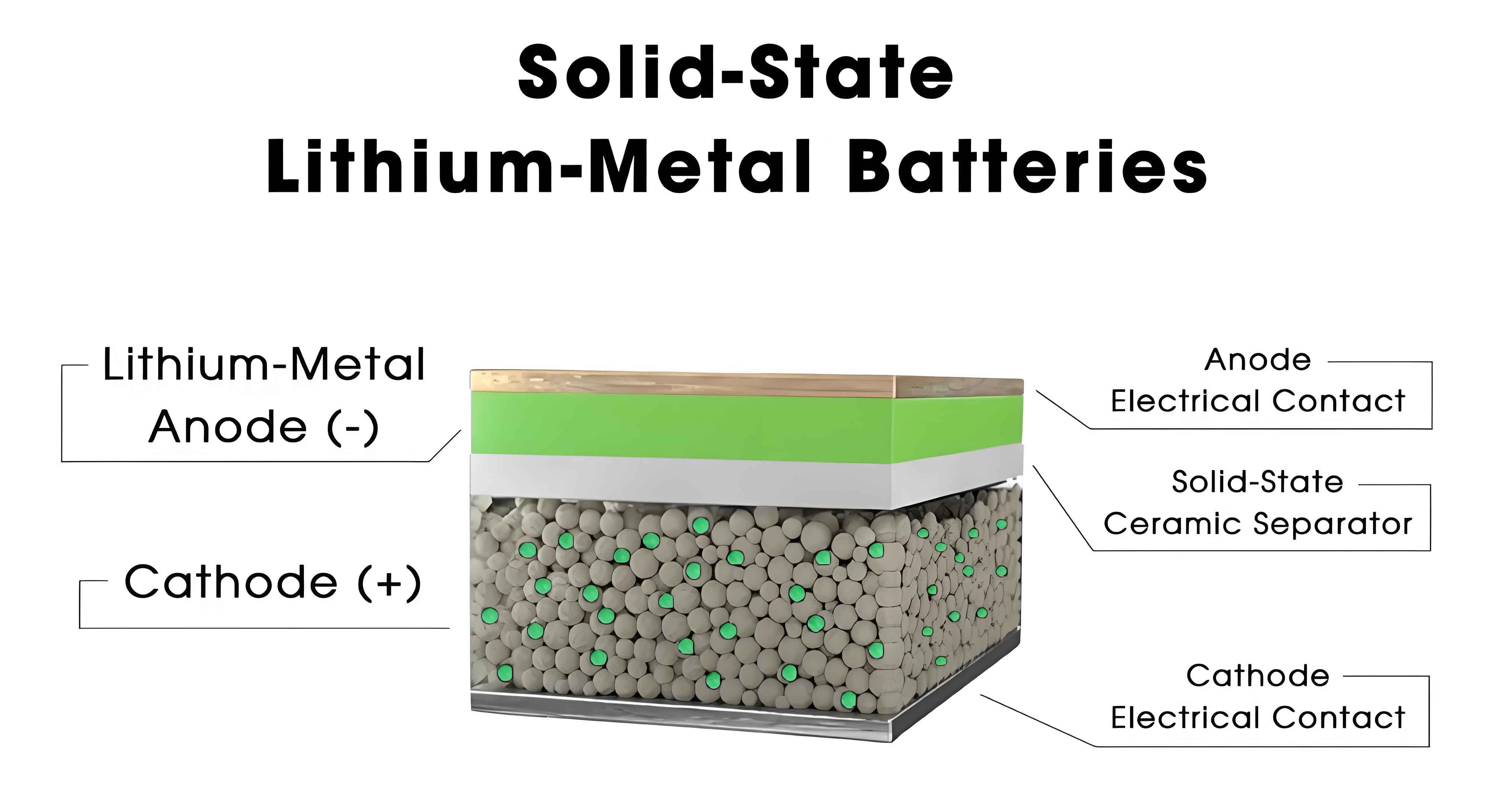
As shown, the solid electrolyte layer replaces the liquid counterpart, enabling a more robust and safer cell architecture. This innovation has captured global attention, with numerous companies and research institutions racing to develop viable solid-state battery solutions. The enthusiasm is driven by the promise of addressing EV safety concerns while boosting performance metrics. However, the path to commercialization is fraught with technical hurdles, which I will explore in detail.
The global landscape for solid-state battery development is vibrant, with over 100 entities—including major automakers and traditional lithium-ion battery manufacturers—actively involved. Investments have surged, reflecting the high stakes in this domain. For example, some automotive giants have allocated billions to startups and in-house research, aiming to integrate solid-state batteries into their EV lineups by the mid-2020s. These efforts are backed by extensive patent portfolios, covering materials like sulfide-based electrolytes and novel cell designs. The push is partly regulatory, with government initiatives such as China’s New Energy Vehicle Industry Development Plan (2021-2035) emphasizing solid-state battery R&D as a core technological breakthrough. This collective momentum underscores the belief that solid-state batteries could redefine EV capabilities, but progress remains uneven across regions.
Despite the optimism, technical challenges loom large. One critical aspect is energy density. While solid-state batteries theoretically offer superior numbers, current prototypes often fall short. Based on expert calculations, the energy density of cells with various solid electrolytes can be compared using the formula for volumetric energy density:
$$ E_v = \frac{C \times V}{\rho} $$
where \( C \) is capacity, \( V \) is voltage, and \( \rho \) is density. The following table summarizes measured energy densities for different solid electrolyte materials against a baseline liquid electrolyte cell:
| Electrolyte Type | Energy Density (W·h/kg) | Notes |
|---|---|---|
| Liquid Electrolyte (Baseline) | 297 | Soft-pack cell, common in EVs |
| PEO-LiTFSi (Polymer) | 301.5 | Slightly higher than liquid |
| LLZO (Lithium Lanthanum Zirconium Oxide) | 186 | Lower due to lower ionic conductivity |
| LAGP (Lithium Aluminum Germanium Phosphate) | 216.8 | Moderate improvement potential |
| LLTO (Lithium Lanthanum Titanium Oxide) | 187 | Similar challenges to LLZO |
As evident, only polymer-based solid electrolytes like PEO-LiTFSi match or slightly exceed liquid counterparts, while inorganic options lag. However, with a lithium metal anode, projections suggest energy densities could soar to 400-500 W·h/kg, as indicated by consortia like Battery 500. The equation for theoretical energy density with lithium metal is:
$$ E_{\text{theoretical}} = \frac{F \times E_{\text{cell}}}{M} $$
where \( F \) is Faraday’s constant, \( E_{\text{cell}} \) is cell voltage, and \( M \) is molar mass. Achieving this requires overcoming interfacial issues, which I consider a primary technical bottleneck.
The interface between solid electrolyte and electrodes poses significant challenges. In liquid electrolytes, ions move freely, ensuring low contact resistance and efficient transport. For solid-state batteries, the ionic conductivity \( \sigma \) is given by:
$$ \sigma = n q \mu $$
where \( n \) is charge carrier density, \( q \) is charge, and \( \mu \) is mobility. Solid electrolytes often exhibit lower \( \sigma \) values, leading to higher internal resistance. Moreover, during charge-discharge cycles, electrode particles expand and contract, degrading physical contact at interfaces. This increases impedance, reducing power output. The problem intensifies with lithium metal anodes, where lithium plating at the interface under high currents can block electrochemical reactions. Addressing these issues demands advanced materials engineering and innovative cell designs.
Cost is another formidable barrier. Currently, semi-solid batteries—a transitional form with mixed liquid-solid electrolytes—cost approximately 2.5 to 3.0 RMB/Wh, which is two to three times higher than conventional liquid electrolyte batteries. Given that power batteries account for nearly 40% of an EV’s total cost, such premiums could hinder consumer adoption. The cost equation can be simplified as:
$$ \text{Total Battery Cost} = \text{Material Cost} + \text{Manufacturing Cost} + \text{R&D Amortization} $$
For solid-state batteries, material costs for exotic compounds like sulfides or garnets are high, and manufacturing processes—such as thin-film deposition—are complex and expensive. Scaling production to reduce costs will take years, delaying widespread adoption.
In terms of产业化, the timeline remains uncertain. While some automakers target the 2025-2030 window for solid-state battery integration, experts caution that full commercialization may take a decade or more. Semi-solid batteries, which blend liquid and solid electrolytes, are seen as an intermediate step. Their properties are closer to liquid batteries, but they offer improved safety. The transition can be modeled as a gradual shift:
$$ \text{Solid Content Ratio} = \frac{V_{\text{solid}}}{V_{\text{solid}} + V_{\text{liquid}}} $$
where ratios above 0.5 denote semi-solid, approaching 1 for all-solid. Industry players are already piloting semi-solid production lines, but achieving stable performance at scale is elusive. The table below outlines a plausible产业化 roadmap based on current projections:
| Phase | Timeframe | Description | Key Challenges |
|---|---|---|---|
| R&D and Prototyping | Present – 2023 | Lab-scale solid-state battery development | Interface stability, material synthesis |
| Semi-Solid Commercialization | 2024 – 2026 | Initial use in consumer electronics and niche EVs | Cost reduction, cycle life improvement |
| Full Solid-State Pilots | 2027 – 2030 | Limited EV integration and testing | Scalability, safety validation |
| Mass Adoption | 2030+ | Widespread use in EVs and grid storage | Supply chain maturation, cost parity |
From my perspective, the solid-state battery journey is marked by both promise and patience. Venture capital investments have fueled hype, but true technological breakthroughs require sustained effort. As one industry insider noted, moving from sample validation to mass production could span six years or more, with consumer electronics serving as a proving ground before EV deployment. This cautious outlook stems from the myriad of unsolved problems, from electrolyte-electrode compatibility to production yield rates.
Looking ahead, the evolution of solid-state batteries will likely be iterative. Researchers are exploring hybrid approaches, such as solid polymer electrolytes infused with ionic liquids, to balance conductivity and safety. Mathematical models help optimize these systems; for instance, the Nernst-Planck equation describes ion transport in mixed conductors:
$$ J_i = -D_i \nabla c_i + \frac{z_i F}{RT} D_i c_i \nabla \phi $$
where \( J_i \) is flux, \( D_i \) is diffusivity, \( c_i \) is concentration, \( z_i \) is charge number, \( \phi \) is potential, and \( R \), \( T \), and \( F \) are constants. Such models guide material selection and cell design. Additionally, advancements in nanotechnology may enable thinner solid electrolyte layers, reducing resistance and enhancing energy density.
In conclusion, the solid-state battery represents a pivotal innovation in the quest for safer, higher-performance electric vehicles. While current liquid electrolyte batteries dominate the market, their flammability issues underscore the urgency for alternatives. The solid-state battery, with its non-flammable solid electrolyte, offers a compelling solution, albeit one shrouded in technical and economic challenges. From energy density limitations to interfacial woes and high costs, the path to产业化 is long and winding. However, with global R&D efforts intensifying and transitional technologies like semi-solid batteries emerging, progress is inevitable. As I reflect on the industry’s trajectory, I believe that solid-state batteries will eventually overcome these hurdles, transforming EV safety and efficiency. Until then, stakeholders must balance optimism with realism, fostering collaboration to accelerate this critical technology. The future of mobility may well depend on the success of the solid-state battery, making it a focal point for innovation in the coming decades.