
The rapid development of renewable energy sources, such as solar and wind power, has highlighted the critical need for efficient energy storage systems to address their intermittent nature. Among various energy storage technologies, the lithium ion battery stands out due to its high energy density, long cycle life, and wide application range. The cathode material is a key component determining the performance of a lithium ion battery. In recent years, high-nickel ternary cathode materials, particularly LiNi0.8Co0.1Mn0.1O2 (NCM811), have garnered significant attention for their high specific capacity and cost-effectiveness. However, challenges such as cation mixing, surface instability, and poor thermal stability hinder their widespread adoption. This article comprehensively reviews the modification strategies for NCM811 to enhance its electrochemical performance, focusing on ion doping, surface coating, and structural design. We incorporate tables and formulas to summarize key findings and provide an in-depth analysis from a research perspective.
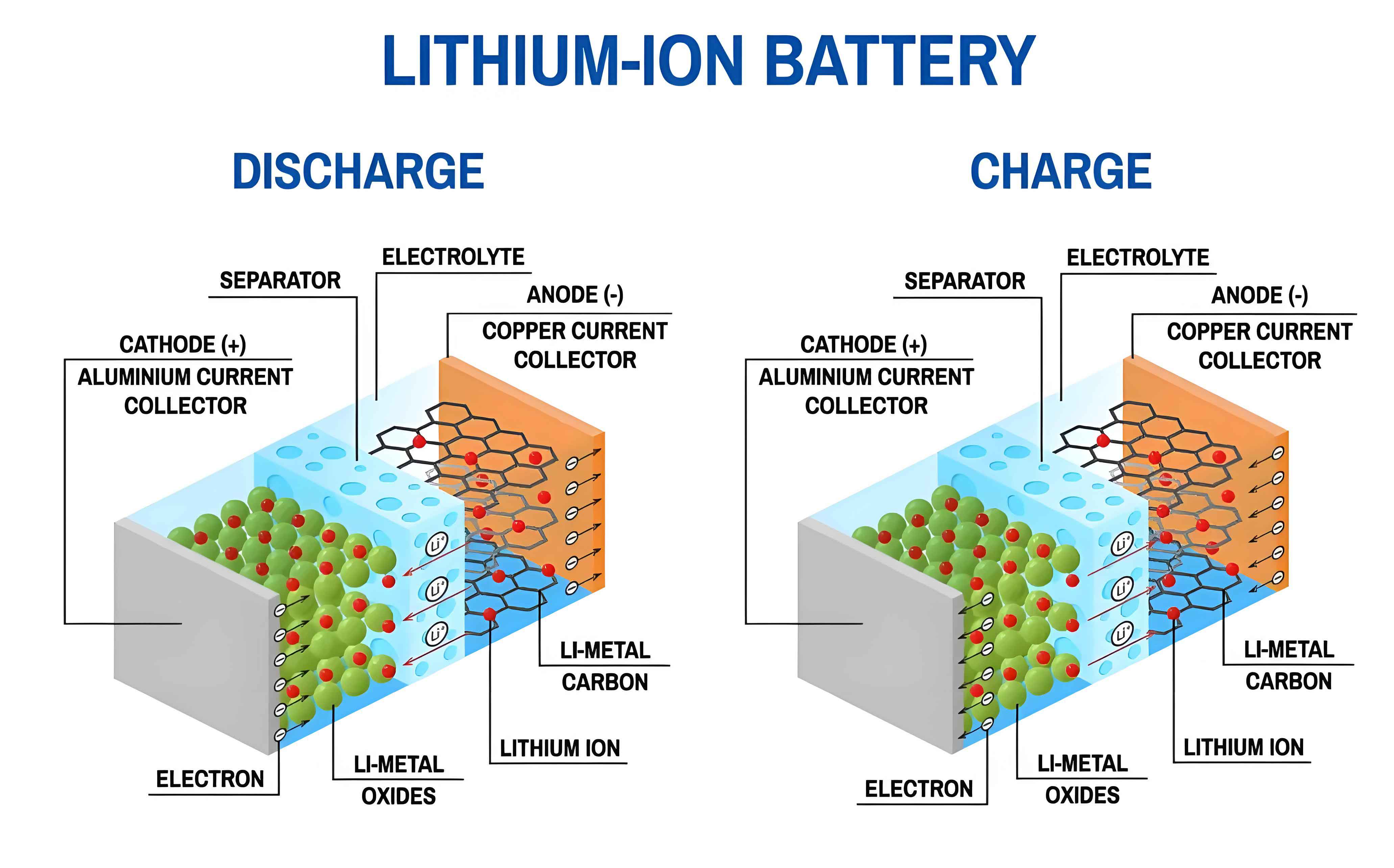
The lithium ion battery operates on the principle of lithium-ion intercalation and deintercalation between the cathode and anode. The cathode material’s structure directly influences ion diffusion kinetics, capacity, and stability. NCM811 belongs to the layered α-NaFeO2 structure with a hexagonal crystal system (space group R-3m). In this structure, oxygen anions form a close-packed framework, while lithium ions and transition metal ions (Ni, Co, Mn) occupy alternating octahedral sites. The general formula for layered cathode materials can be expressed as LiTMO2, where TM represents transition metals. For NCM811, the composition is specific, but the crystal parameters can be described using lattice constants a and c. The theoretical capacity of NCM811 is high due to the redox reactions involving Ni2+/Ni3+/Ni4+ and Co3+/Co4+. The charge-discharge process can be represented by the following equation:
$$ \text{LiNi}_{0.8}\text{Co}_{0.1}\text{Mn}_{0.1}\text{O}_2 \leftrightarrow \text{Li}_{1-x}\text{Ni}_{0.8}\text{Co}_{0.1}\text{Mn}_{0.1}\text{O}_2 + x\text{Li}^+ + x\text{e}^- $$
However, practical applications reveal several intrinsic issues. First, cation mixing occurs because the ionic radii of Ni2+ (0.69 Å) and Li+ (0.76 Å) are similar, leading to Ni2+ migration into Li sites. This disrupts the layered structure and causes irreversible capacity loss. Second, surface reactions with moisture and CO2 form Li2CO3 and LiOH, which react with electrolytes to produce HF, corroding the electrode. Third, at high voltages, unstable Ni4+ and Co4+ ions catalyze electrolyte decomposition, accelerating capacity fade. Fourth, thermal instability arises from oxygen release at high states of charge, posing safety risks in lithium ion batteries. To address these, modification strategies are essential.
Ion doping involves substituting ions in the crystal lattice to stabilize the structure. This can be cation doping (replacing Li+ or transition metal ions), anion doping (replacing O2-), or co-doping. The effectiveness depends on the dopant’s ionic radius, charge, and bonding characteristics. For example, doping with larger ions can expand the Li layer spacing, facilitating Li+ diffusion. The change in lattice parameters after doping can be quantified using Vegard’s law for solid solutions:
$$ a_{\text{doped}} = a_{\text{pure}} + k \cdot x $$
where a is the lattice constant, k is a proportionality constant, and x is the dopant concentration. Table 1 summarizes common dopants and their effects on NCM811 performance in lithium ion batteries.
| Dopant Type | Example Ions | Mechanism | Impact on Electrochemical Performance |
|---|---|---|---|
| Cation Doping | K+, Mg2+, Al3+, Ti4+ | Reduces cation mixing, stabilizes structure, enhances Li+ diffusion | Improved cycle stability, higher capacity retention |
| Anion Doping | F–, S2- | Increases bond strength, expands interlayer spacing | Better rate capability, reduced interfacial resistance |
| Co-doping | Al-Mg, P-F | Synergistic effects from multiple ions | Enhanced overall performance, including thermal stability |
Surface coating involves applying a protective layer on NCM811 particles to prevent direct contact with the electrolyte. Coating materials can be classified into oxides, carbon-based materials, and phosphates. The coating thickness, uniformity, and conductivity play crucial roles. A thin, conformal coating can suppress side reactions without hindering Li+ transport. The effect of coating on charge transfer resistance can be modeled using an equivalent circuit for electrochemical impedance spectroscopy (EIS). For a coated electrode, the total resistance Rtotal includes bulk resistance Rb, coating layer resistance Rc, and charge transfer resistance Rct:
$$ R_{\text{total}} = R_b + R_c + R_{ct} $$
An ideal coating minimizes Rc and Rct. Table 2 compares different coating materials for NCM811 in lithium ion batteries.
| Coating Material | Type | Key Benefits | Performance Enhancement |
|---|---|---|---|
| Al2O3 | Metal Oxide | HF scavenging, structural stability | Cycling life improvement by 15-20% |
| Graphene | Carbon-based | High electronic conductivity, flexibility | Rate capability boost, capacity retention >90% after 200 cycles |
| Li3PO4 | Phosphate | Li+ conductivity, chemical inertness | Reduced voltage decay, enhanced thermal safety |
| Mg-Al LDH | Layered Double Hydroxide | Alkali removal, barrier properties | Suppressed gas evolution, improved storage stability |
Structural design focuses on optimizing the macro- and microstructure of NCM811 to mitigate internal stress and improve durability. Common approaches include core-shell structures, concentration gradient materials, and nano-sizing. Core-shell structures involve a high-nickel core for capacity and a stable shell (e.g., Mn-rich layer) for protection. Concentration gradient materials gradually vary composition from core to surface, balancing capacity and stability. Nano-sizing reduces particle size to shorten Li+ diffusion paths, enhancing rate performance. The diffusion time τ for Li+ in spherical particles can be estimated using Fick’s law:
$$ \tau = \frac{r^2}{D} $$
where r is the particle radius and D is the diffusion coefficient. Smaller r leads to faster kinetics. Table 3 outlines structural design strategies for NCM811 in lithium ion batteries.
| Design Strategy | Description | Advantages | Challenges |
|---|---|---|---|
| Core-Shell | Core with high Ni content, shell with stable composition | High capacity from core, stability from shell | Interfacial stress, complex synthesis |
| Concentration Gradient | Continuous composition change from core to surface | Smooth transition, minimized phase separation | Precise control required, scalability issues |
| Nano-sized Particles | Particle size reduced to nanometer scale | Enhanced rate capability, reduced cracking | Increased surface area leading to more side reactions |
| Full Concentration Gradient | Linear variation of all transition metals | Optimal balance of properties | High manufacturing cost |
Ion doping modifies the bulk properties of NCM811. For cation doping, Mg2+ doping is particularly effective. When Mg2+ substitutes Ni2+, it reduces cation mixing because Mg2+ has a stable oxidation state and does not participate in redox reactions. This stabilizes the lattice during cycling. The doped material LiNi0.77Co0.1Mn0.1Mg0.03O2 shows improved capacity retention. The change in capacity fade rate can be expressed as:
$$ \frac{dC}{dN} = -k \cdot C^\alpha $$
where C is capacity, N is cycle number, k is a degradation constant, and α is an exponent. Doping reduces k, slowing degradation. For anion doping, F– substitution strengthens the metal-oxygen bonds due to higher electronegativity, inhibiting oxygen release. The bond energy E can be approximated using Pauling’s formula:
$$ E \propto \frac{\chi_A \cdot \chi_B}{d} $$
where χ are electronegativities and d is bond length. F– increases E, enhancing thermal stability. Co-doping, such as Al-Mg, combines benefits: Al3+ stabilizes the structure, while Mg2+ improves Li+ mobility. This synergistic effect is crucial for high-performance lithium ion batteries.
Surface coating acts as a physical barrier. For oxide coatings like ZrO2, the coating layer prevents electrolyte penetration and reduces HF attack. The coating thickness should be optimized; too thick a coating increases resistance, while too thin may be ineffective. The optimal thickness t can be derived from a balance between protection and ion transport:
$$ t_{\text{opt}} = \sqrt{\frac{D_c \cdot \tau}{C}} $$
where Dc is the diffusivity in the coating, τ is the desired cycle life, and C is a constant related to degradation rate. Carbon-based coatings, such as carbon nanotubes (CNTs), form conductive networks on the particle surface, lowering impedance. The electronic conductivity σ of a CNT-coated electrode follows percolation theory:
$$ \sigma = \sigma_0 (p – p_c)^t $$
where p is the volume fraction of CNTs, pc is the percolation threshold, and t is a critical exponent. This enhances rate performance in lithium ion batteries. Phosphate coatings like AlPO4 provide chemical stability and Li+ conduction. The Li+ transference number tLi+ in coated systems is higher, reducing polarization.
Structural design addresses mechanical and electrochemical stability. Core-shell structures, such as a Ni-rich core and Mn-rich shell, leverage the core’s high capacity and the shell’s stability. However, interfacial strain due to lattice mismatch can cause cracking. The strain energy U at the interface is given by:
$$ U = \frac{E \cdot \epsilon^2 \cdot V}{2(1-\nu)} $$
where E is Young’s modulus, ϵ is strain, V is volume, and ν is Poisson’s ratio. Concentration gradient materials mitigate this by gradual composition change, reducing stress. Nano-sized particles offer high surface area, but this increases susceptibility to side reactions. The surface area to volume ratio for spherical particles is:
$$ \frac{A}{V} = \frac{3}{r} $$
Thus, smaller r increases surface reactions, requiring careful electrolyte optimization. Full concentration gradient materials represent an advanced design where all transition metals vary linearly, achieving optimal performance in lithium ion batteries.
In addition to these strategies, the synthesis method plays a vital role. Co-precipitation is commonly used for uniform particle morphology. The reaction kinetics can be described using the LaMer model for nucleation and growth. Post-treatment like annealing affects crystallinity. The degree of cation mixing can be quantified using the Rietveld refinement of X-ray diffraction patterns. The mixing parameter δ is defined as the fraction of Ni in Li sites. For ideal NCM811, δ should be minimal. Doping and coating reduce δ, improving electrochemical performance.
Thermal stability is critical for safety in lithium ion batteries. Differential scanning calorimetry (DSC) measurements show that modified NCM811 has higher onset temperatures for exothermic reactions. The heat release Q during thermal runaway can be modeled as:
$$ Q = \int_{T_1}^{T_2} C_p \, dT + \Delta H_{\text{rxn}} $$
where Cp is heat capacity, T is temperature, and ΔHrxn is reaction enthalpy. Coatings and doping reduce ΔHrxn by stabilizing the surface and bulk. For instance, Al2O3 coating can decrease heat release by up to 30%, enhancing safety.
Cycle life testing under various conditions reveals the effectiveness of modifications. For example, at high voltage (4.5 V), unmodified NCM811 suffers rapid capacity fade due to electrolyte oxidation. Coated samples show better retention. The capacity fade rate often follows a power-law relationship with cycle number. Electrochemical impedance spectroscopy (EIS) data can be fitted to equivalent circuits to extract parameters like charge transfer resistance and double-layer capacitance. Modified materials typically show lower resistance growth over cycles.
Rate capability is another key metric. The C-rate performance depends on Li+ diffusion and electronic conductivity. Doping with ions like Ti4+ expands Li layer spacing, enhancing diffusion. The diffusion coefficient DLi can be calculated from galvanostatic intermittent titration technique (GITT) data using the equation:
$$ D_{\text{Li}} = \frac{4}{\pi \tau} \left( \frac{nV_m}{A} \right)^2 \left( \frac{\Delta E_s}{\Delta E_t} \right)^2 $$
where τ is pulse time, n is number of moles, Vm is molar volume, A is area, and ΔE are voltage changes. Higher DLi correlates with better rate performance in lithium ion batteries.
Future directions for NCM811 modification include multifunctional approaches combining doping, coating, and structural design. For instance, a gradient-doped and coated material could offer superior performance. Machine learning may aid in optimizing composition and synthesis parameters. Moreover, compatibility with solid-state electrolytes is an emerging area, as solid-state lithium ion batteries promise higher safety and energy density. The interfacial compatibility between modified NCM811 and solid electrolytes needs exploration.
In conclusion, the modification of high-nickel NCM811 cathode material is essential for advancing lithium ion battery technology. Ion doping stabilizes the bulk structure, surface coating protects against side reactions, and structural design enhances mechanical integrity. Tables and formulas provided summarize key aspects. Continued research should focus on scalable synthesis methods and understanding degradation mechanisms at the atomic level. By addressing these challenges, NCM811 can realize its full potential in next-generation lithium ion batteries for electric vehicles and grid storage.