
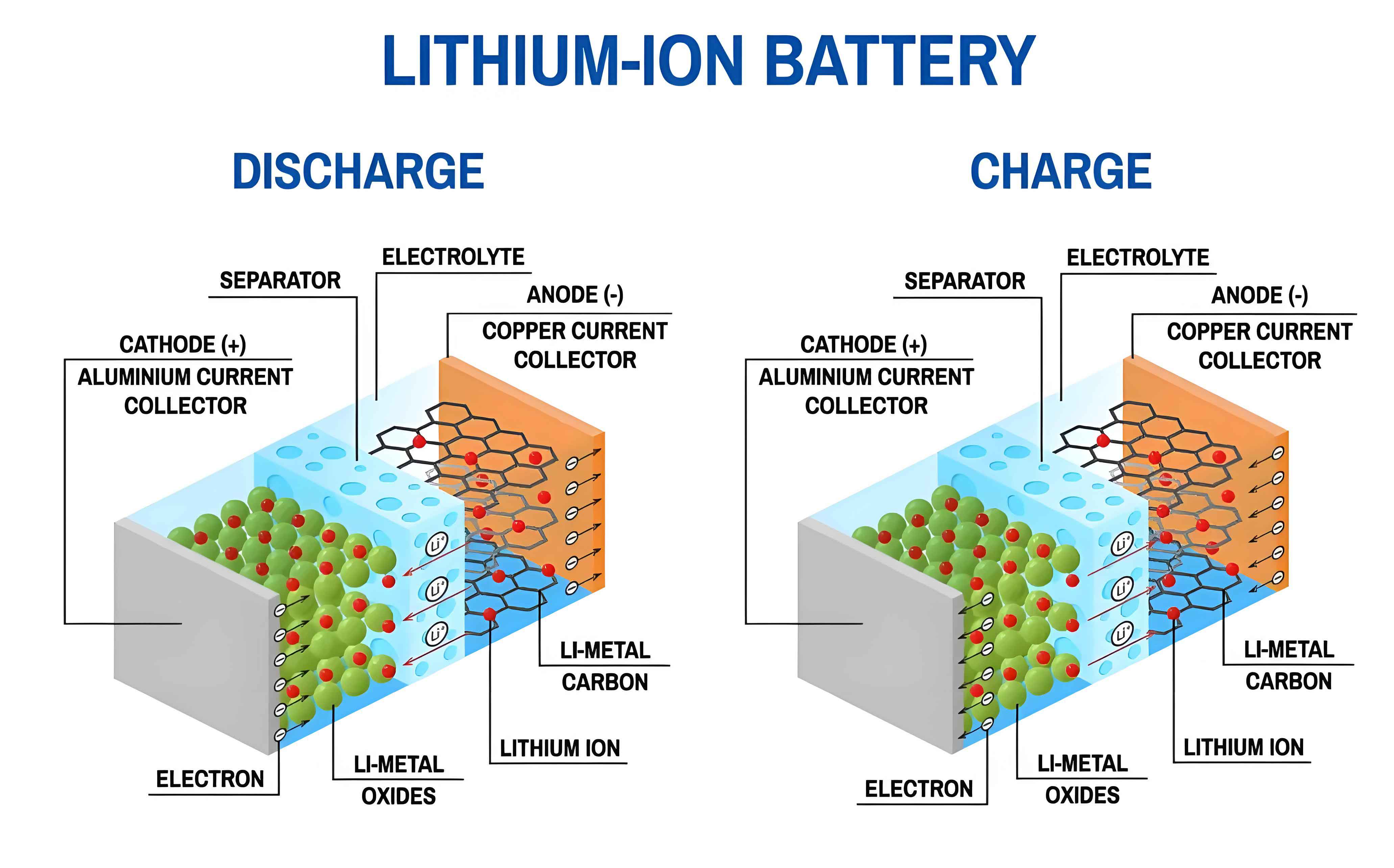
The transition towards sustainable transportation has positioned the electric vehicle (EV) at the forefront of automotive innovation. At the heart of every EV lies its energy storage system, with the lithium-ion battery being the dominant technology due to its high energy density, long cycle life, and declining cost. The safe, efficient, and reliable operation of this complex electrochemical system is governed by the Battery Management System (BMS). Among its critical functions, the accurate and real-time estimation of the battery’s State of Charge (SOC) is paramount. SOC, defined as the ratio of remaining capacity to nominal capacity, is the fundamental “fuel gauge” for an EV, informing driving range, charge/discharge control strategies, and overall system health.
However, estimating SOC for a traction lithium-ion battery is a significant challenge. A lithium-ion battery is a highly nonlinear, time-varying system whose behavior is influenced by numerous factors including temperature, aging, hysteresis, and varying load profiles. SOC itself is an internal state variable that cannot be measured directly; it must be inferred from measurable parameters such as terminal voltage, current, and temperature. Over the years, a vast body of research has been dedicated to developing robust SOC estimation algorithms. In this review, I will explore and analyze these methods, categorizing them broadly into traditional techniques, learning algorithm-based approaches, and model-based strategies, discussing their principles, advantages, and limitations.
1. Traditional SOC Estimation Methods
Traditional methods are often computationally simple and form the historical basis for SOC indication. They are typically open-loop and rely on direct relationships between measurable signals and SOC.
1.1 Coulomb Counting Method (CCM)
Also known as the current integration method, CCM is perhaps the most intuitive approach. It calculates SOC by integrating the current flowing into or out of the battery over time. The fundamental equation is:
$$ SOC(t) = SOC(t_0) – \frac{1}{C_n} \int_{t_0}^{t} \eta I_b(\tau) d\tau $$
where $SOC(t_0)$ is the initial SOC, $C_n$ is the nominal battery capacity, $I_b(t)$ is the battery current (positive for discharge), and $\eta$ is the coulombic efficiency. While simple and easy to implement, CCM suffers from several critical drawbacks: it is highly sensitive to the accuracy of the initial SOC $SOC(t_0)$; current sensor bias and noise lead to accumulating integration errors; and it requires precise knowledge of the battery capacity $C_n$ and coulombic efficiency $\eta$, both of which degrade with battery aging and vary with temperature and C-rate. Therefore, standalone CCM is rarely used in modern EV BMS without periodic correction from other methods.
1.2 Open Circuit Voltage (OCV) Method
This method exploits the monotonic relationship between the battery’s open-circuit voltage and its SOC. After a sufficiently long rest period, the terminal voltage of a lithium-ion battery relaxes to its OCV. A pre-characterized lookup table or function, $SOC = f(OCV)$, is then used to determine the SOC. The primary advantage is its potential accuracy if a stable OCV is obtained. The major limitation is the requirement for a long rest period (often hours) to allow internal electrochemical equilibrium, making it unsuitable for real-time estimation during driving. Furthermore, the OCV-SOC curve for some chemistries like Lithium Iron Phosphate (LFP) is very flat in the middle SOC range, causing large SOC errors from small voltage measurement inaccuracies. Hysteresis, where the OCV path differs during charge and discharge, further complicates this method.
1.3 Electrochemical Impedance Spectroscopy (EIS)
EIS characterizes a battery by applying a small sinusoidal AC voltage over a wide frequency range and measuring the impedance response. The impedance spectrum contains information about internal kinetics and can correlate with SOC. While a powerful laboratory tool for understanding battery phenomena, EIS is generally impractical for online BMS applications due to the need for expensive, precise instrumentation, lengthy measurement times, and complex interpretation of spectra. It is more commonly used for state-of-health (SOH) diagnosis or for parameterizing advanced models.
The characteristics of these traditional methods are summarized below:
| Method | Key Principle | Primary Advantage | Major Limitation |
|---|---|---|---|
| Coulomb Counting | Integration of current over time. | Simple, low computational cost. | Error accumulation; requires accurate initial SOC and capacity. |
| Open Circuit Voltage | Mapping from relaxed voltage to SOC. | Can be accurate if battery is at equilibrium. | Requires long rest periods; hysteresis effects; flat curves for some chemistries. |
| EIS | Correlating impedance spectrum features with SOC. | Provides deep electrochemical insight. | Offline, slow, expensive; not suitable for real-time online estimation. |
2. Learning Algorithm-Based SOC Estimation Methods
This category leverages the power of machine learning and computational intelligence to establish a direct, often black-box, nonlinear mapping from battery measurements to SOC. These data-driven approaches require extensive datasets for training but can model complex behaviors without explicit knowledge of internal electrochemistry.
2.1 Artificial Neural Networks (ANN)
ANNs, inspired by biological neural networks, are universal function approximators capable of modeling highly nonlinear dynamics. For SOC estimation, measurable parameters like voltage, current, temperature, and sometimes historical values are fed as inputs to a network (e.g., multi-layer perceptron, recurrent neural network-RNN), which outputs the estimated SOC. Their strength lies in their adaptability and ability to learn from operational data. However, they require large, comprehensive, and representative datasets for training. Challenges include overfitting, the risk of getting trapped in local minima during training, and the “black-box” nature which can hinder interpretability. Advanced architectures like Long Short-Term Memory (LSTM) networks have shown promise in capturing temporal dependencies in lithium-ion battery data.
2.2 Adaptive Neuro-Fuzzy Inference System (ANFIS)
ANFIS combines the learning capabilities of neural networks with the intuitive, knowledge-based reasoning of fuzzy logic. It uses a fuzzy system whose membership function parameters are tuned via a learning algorithm. This hybrid approach can effectively model the nonlinear and uncertain behavior of a lithium-ion battery. While it can achieve high accuracy, the performance heavily depends on the initial design of the fuzzy rule base and membership functions, which often relies on expert knowledge. The training process can also be computationally intensive.
2.3 Support Vector Machine (SVM)
SVM, particularly Support Vector Regression (SVR), is a powerful tool for solving nonlinear regression problems. It works by mapping input data into a high-dimensional feature space where a linear regression is performed. SVM aims to maximize the generalization ability, potentially offering better performance than ANN on smaller datasets. It has been successfully applied to SOC estimation for lithium-ion batteries. The main drawbacks are the computational complexity of the quadratic programming optimization during training and the sensitivity to the choice of kernel function and its parameters.
A comparative summary of learning-based methods is provided:
| Algorithm | Core Mechanism | Strengths | Weaknesses |
|---|---|---|---|
| Artificial Neural Network | Interconnected layers of neurons that learn input-output mappings. | High approximation capability for complex nonlinearities; adaptive. | Needs massive, high-quality data; prone to overfitting; black-box model. |
| ANFIS | Fuzzy logic system whose parameters are optimized via neural learning. | Combines explicit knowledge representation with learning ability. | Design of fuzzy rules/membership functions can be subjective; complex training. |
| SVM/SVR | Maps data to high-dimensional space for linear regression, maximizing margin. | Strong generalization performance, effective on smaller datasets. | Computationally intensive training; sensitive to kernel and parameter selection. |
3. Model-Based SOC Estimation Methods
This is currently the most prevalent and researched approach for online SOC estimation in EVs. It involves creating a mathematical model of the lithium-ion battery and using state estimation filters, primarily from the Kalman filter family, to recursively correct the SOC prediction based on the error between the model’s voltage output and the measured voltage. The general structure is a closed-loop observer.
3.1 Battery Modeling
The accuracy of model-based methods hinges on the fidelity of the battery model. Two main categories are used:
1. Equivalent Circuit Models (ECM): These use electrical components (resistors, capacitors, voltage sources) to represent the battery’s dynamic behavior. Common models include the Rint model, Thevenin model (1st or 2nd order RC pairs), and Partnership for a New Generation of Vehicles (PNGV) model. They offer a good balance between accuracy and computational simplicity. For example, a first-order Thevenin model’s state-space equations can be expressed as:
$$ SOC_{k+1} = SOC_k – \frac{\eta \Delta t}{C_n} I_k $$
$$ U_{p,k+1} = e^{-\Delta t / (R_p C_p)} U_{p,k} + R_p (1 – e^{-\Delta t / (R_p C_p)}) I_k $$
$$ V_{t,k} = OCV(SOC_k) – U_{p,k} – R_0 I_k $$
where $U_p$ is the polarization voltage across the RC pair, $R_0$ is the ohmic resistance, $R_p$ and $C_p$ are the polarization resistance and capacitance, and $V_t$ is the terminal voltage.
2. Electrochemical Models: Such as the Single Particle Model (SPM) or Doyle-Fuller-Newman model, these are derived from first principles of electrochemistry. They are highly accurate but computationally complex, making them less common for real-time BMS applications, though reduced-order versions are being explored.
3.2 State Estimation Filters
Given a battery model, state estimators are used to optimally infer the hidden state (SOC) from noisy measurements.
Extended Kalman Filter (EKF): The standard workhorse for nonlinear systems. The EKF linearizes the nonlinear battery model around the current state estimate at each time step using a first-order Taylor expansion (Jacobian matrices). It then applies the standard Kalman filter equations to this linearized model. While effective for mild nonlinearities, the linearization error can be significant for highly nonlinear systems like a lithium-ion battery, potentially leading to instability or divergence. Its performance also depends on a priori knowledge of process and measurement noise statistics.
Adaptive Extended Kalman Filter (AEKF): An enhancement of the EKF that addresses one of its key weaknesses: the assumption of known, constant noise statistics. AEKF incorporates algorithms to estimate or adapt the process and/or measurement noise covariance matrices ($\mathbf{Q}$ and $\mathbf{R}$) online. For instance, it can use innovation sequences (the difference between measured and predicted voltage) to adjust $\mathbf{R}$, improving robustness against changing sensor noise and model uncertainty in the lithium-ion battery system.
Unscented Kalman Filter (UKF): The UKF uses a deterministic sampling technique called the Unscented Transform (UT) to handle nonlinearities. Instead of linearizing, it propagates a carefully chosen set of “sigma points” through the true nonlinear model to capture the mean and covariance of the state distribution more accurately than the EKF’s first-order approximation. This makes it generally more accurate and stable for strongly nonlinear systems like a lithium-ion battery, albeit at a slightly higher computational cost. It does not require the calculation of Jacobians.
Other Advanced Filters: The field actively explores other filters like the Cubature Kalman Filter (CKF), Particle Filter (PF), Sliding Mode Observer (SMO), and various combinations (e.g., EKF with forgetting factor, multi-model estimators) to further improve accuracy, convergence speed, and robustness against model inaccuracies and aging of the lithium-ion battery.
The table below contrasts the key model-based filtering approaches:
| Filter | Core Idea | Advantages for Li-ion Battery SOC | Disadvantages |
|---|---|---|---|
| Extended Kalman Filter (EKF) | Local linearization of the nonlinear model at each step. | Well-established, moderate computational load. | Linearization errors can cause inaccuracy/divergence; requires noise statistics. |
| Adaptive EKF (AEKF) | EKF with online estimation of noise covariances. | More robust to model uncertainty and sensor noise variation. | Increased complexity; tuning of adaptation mechanism is critical. |
| Unscented Kalman Filter (UKF) | Propagates sigma points through nonlinear model (no Jacobian). | Superior accuracy for strong nonlinearities; no linearization error. | Higher computational cost than EKF; sensitive to parameter tuning. |
4. Discussion and Comparative Analysis
Selecting the appropriate SOC estimation method for an EV’s lithium-ion battery involves balancing accuracy, computational complexity, robustness, and implementation cost. Traditional methods are simple but inadequate as standalone solutions for dynamic EV operation. Learning-based methods offer high accuracy and the ability to model complex, non-physical relationships directly from data. However, they demand extensive training data covering all possible operational scenarios (temperatures, aging states, drive cycles), and their generalization outside training conditions can be a concern. Their “black-box” nature also makes validation and functional safety certification challenging for the automotive industry.
Model-based methods, particularly those using ECMs with advanced filters like AEKF or UKF, currently represent the dominant paradigm. They offer a good compromise, providing physically interpretable models, closed-loop correction that mitigates error accumulation, and strong real-time performance. The ongoing research focuses on improving model accuracy (e.g., accounting for hysteresis, temperature, and aging), enhancing filter robustness, and reducing computational burden for microcontroller deployment.
A holistic comparison encapsulating all discussed categories is essential:
| Method Category | Representative Techniques | Key Advantages | Major Limitations & Challenges |
|---|---|---|---|
| Traditional | CCM, OCV, EIS | Conceptual simplicity, low computation. | Open-loop, error-prone, not suitable for online dynamic estimation alone. |
| Learning-Based | ANN, ANFIS, SVM | High accuracy, models complex nonlinearities without explicit physics. | Large labeled data requirement, risk of poor generalization, black-box, high memory/processing needs. |
| Model-Based | ECM + EKF/AEKF/UKF | Closed-loop accuracy, robust to noise and initial error, physically interpretable. | Dependent on model accuracy; parameter identification needed; filter tuning complexity. |
5. Conclusion and Future Perspectives
Accurate SOC estimation remains a cornerstone for unlocking the full potential of EV lithium-ion battery packs. This review has systematically analyzed the landscape of SOC estimation methods. Traditional methods serve as foundational concepts but are insufficient for modern BMS. Model-based methods, especially those employing adaptive nonlinear filters like AEKF and UKF with equivalent circuit models, have proven to be the most practical and widely adopted solution, offering an effective balance of accuracy, robustness, and implementability.
Looking forward, I believe the evolution will move towards hybrid and data-enhanced approaches. While pure model-based methods dominate today, the future likely lies in the fusion of model-based and learning-based techniques. For instance, machine learning can be used to adaptively identify model parameters online or to correct for model deficiencies caused by aging and unmodeled dynamics. Furthermore, with the advancement of edge computing capabilities in vehicles and the accumulation of vast operational data from connected EVs, sophisticated yet efficient learning algorithms (e.g., lightweight deep learning models) may become increasingly feasible for online adaptation and estimation. The ultimate goal is a resilient, self-calibrating SOC estimation system that maintains high accuracy throughout the entire lifecycle of the EV’s lithium-ion battery, under all real-world operating conditions.