
In recent years, the global shift towards sustainable energy solutions has propelled electric vehicles (EVs) to the forefront of transportation innovation. As a critical component of EVs, the lithium-ion battery serves as the primary power source, and its efficient management is paramount for ensuring safety, reliability, and performance. The state of charge (SOC) and state of health (SOH) are two fundamental indicators that reflect the operational and aging conditions of a lithium-ion battery. Accurate estimation of SOC and SOH is essential for optimizing energy utilization, preventing safety hazards, and extending battery lifespan. However, SOC and SOH are coupled parameters; isolated estimation can lead to inaccuracies due to their interdependence. Therefore, joint estimation strategies have emerged as a vital research focus. In this review, I will explore and analyze various joint SOC and SOH estimation methods for lithium-ion batteries, categorizing them into model-based approaches, data-driven techniques, and hybrid methods. I will incorporate tables and mathematical formulations to summarize key concepts, and discuss future trends in this evolving field.
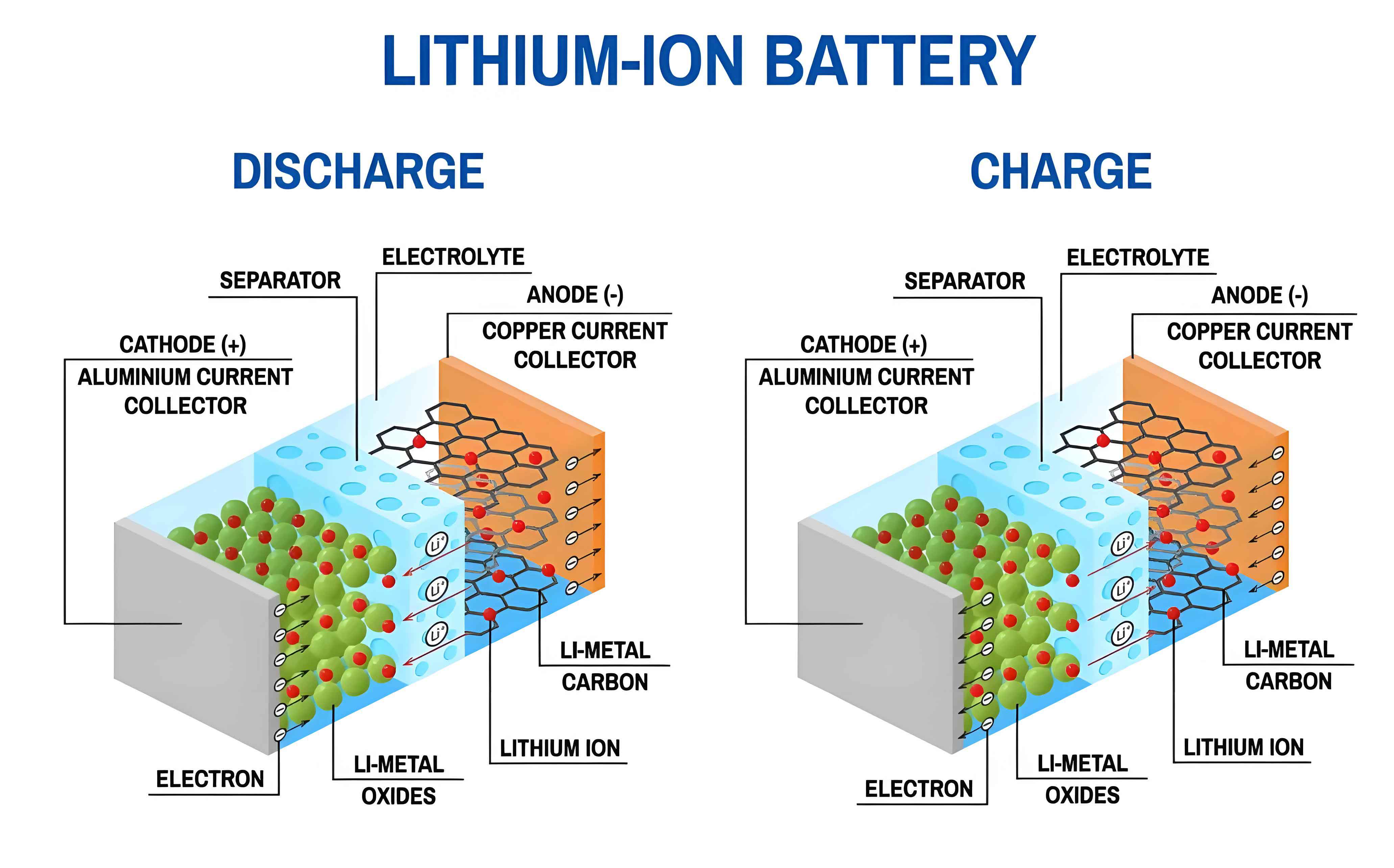
The lithium-ion battery is a complex electrochemical system, and its states cannot be measured directly. SOC represents the remaining capacity relative to the total available capacity, often defined as:
$$ \text{SOC} = \frac{Q_{\text{current}}}{Q_{\text{total}}} \times 100\% $$
where \( Q_{\text{current}} \) is the current remaining charge, and \( Q_{\text{total}} \) is the total capacity. SOH, on the other hand, quantifies the degradation of the lithium-ion battery, typically based on capacity fade or internal resistance increase. For capacity-based SOH:
$$ \text{SOH} = \frac{Q_{\text{now}}}{Q_{\text{new}}} \times 100\% $$
with \( Q_{\text{now}} \) as the current capacity and \( Q_{\text{new}} \) as the nominal capacity. For resistance-based SOH:
$$ \text{SOH} = \frac{R_{\text{aged}} – R_{\text{now}}}{R_{\text{aged}} – R_{\text{new}}} \times 100\% $$
where \( R_{\text{aged}} \), \( R_{\text{now}} \), and \( R_{\text{new}} \) denote the resistance at end-of-life, current state, and initial state, respectively. The coupling between SOC and SOH arises because aging affects battery parameters like capacity and internal resistance, which in turn influence SOC estimation. Thus, joint estimation is necessary to enhance accuracy and robustness in battery management systems for lithium-ion batteries.
Model-Based Joint Estimation Strategies for Lithium-Ion Batteries
Model-based methods rely on mathematical models to describe the behavior of lithium-ion batteries, combined with estimation algorithms such as filters and observers. These approaches are widely adopted due to their interpretability and real-time feasibility. The models commonly used include equivalent circuit models (ECMs) and electrochemical models (EMs).
Equivalent Circuit Models and Filtering Techniques
ECMs simplify the lithium-ion battery into electrical components like resistors and capacitors. Popular ECMs include the Thevenin model and second-order RC model. For joint SOC and SOH estimation, various filters are applied to these models.
The extended Kalman filter (EKF) linearizes nonlinear systems using Taylor expansion. A dual EKF (DEKF) can be employed, with one filter estimating SOC and another updating capacity or resistance for SOH. The state-space model for a lithium-ion battery based on a second-order ECM is:
$$ \begin{cases}
\dot{x}(t) = f(x(t), u(t)) + w(t) \\
y(t) = h(x(t), u(t)) + v(t)
\end{cases} $$
where \( x(t) \) represents states like SOC and polarization voltages, \( u(t) \) is the input current, \( y(t) \) is the terminal voltage, and \( w(t) \), \( v(t) \) are process and measurement noises. The EKF predicts and corrects states iteratively. To improve performance, multi-innovation EKF (MI-EKF) incorporates historical innovation data, enhancing SOC estimation accuracy for lithium-ion batteries.
The unscented Kalman filter (UKF) uses sigma points to handle nonlinearities without linearization. For joint estimation, adaptive UKF (AUKF) adjusts noise covariances dynamically. The state estimation for a lithium-ion battery with UKF involves:
$$ \chi_{k|k-1} = f(\chi_{k-1}, u_{k-1}) $$
where \( \chi \) are sigma points. A dual UKF can simultaneously estimate SOC and SOH parameters.
Particle filters (PFs) utilize Monte Carlo sampling to approximate state distributions, suitable for non-Gaussian noises. In joint estimation, dual PFs or unscented PFs (UPFs) are used. The importance weight for a particle \( i \) is:
$$ w^i = \frac{p(y_k | x^i_k)}{\sum_j p(y_k | x^j_k)} $$
where \( p(y_k | x^i_k) \) is the likelihood. PFs can capture complex dynamics in lithium-ion batteries but suffer from particle degeneracy.
H∞ filters minimize the worst-case estimation error, providing robustness against uncertainties. The cost function is:
$$ J = \frac{\| \hat{x} – x \|^2}{\| w \|^2 + \| v \|^2} $$
This approach is beneficial for lithium-ion batteries under varying operating conditions.
Observers, such as nonlinear observers (NOs) and sliding-mode observers (SMOs), estimate states by constructing dynamic systems. For instance, an SMO for a lithium-ion battery uses:
$$ \dot{\hat{x}} = f(\hat{x}, u) + K \cdot \text{sign}(y – \hat{y}) $$
where \( K \) is the gain. SMOs offer fast convergence and robustness for SOC and SOH estimation in lithium-ion batteries.
| Method | Key Features | Advantages | Disadvantages |
|---|---|---|---|
| Extended Kalman Filter (EKF) | Linearizes nonlinear systems; dual EKF for joint estimation | Computationally efficient; widely used | Sensitive to model inaccuracies; ignores higher-order terms |
| Unscented Kalman Filter (UKF) | Uses sigma points; no linearization needed | Handles nonlinearities better; higher accuracy | Parameter tuning sensitive; higher computational cost |
| Particle Filter (PF) | Monte Carlo sampling; non-Gaussian noise handling | Flexible; good for complex dynamics | Particle degeneracy; high computational demand |
| H∞ Filter | Minimizes worst-case error; robust to uncertainties | Strong robustness; no statistical assumptions | Design complexity; performance depends on parameters |
| Sliding-Mode Observer (SMO) | Uses discontinuous control; fast convergence | Robust to disturbances; simple implementation | Chattering issues; sensitive to sliding surface design |
Electrochemical Models for Joint Estimation
Electrochemical models, such as the pseudo-two-dimensional (P2D) model, describe internal physico-chemical processes of lithium-ion batteries. They offer high accuracy but are computationally intensive. A simplified P2D model for joint SOC and SOH estimation involves governing equations like:
$$ \frac{\partial c_s}{\partial t} = D_s \nabla^2 c_s $$
where \( c_s \) is the solid-phase lithium concentration, and \( D_s \) is the diffusion coefficient. Reduced-order models or single-particle models (SPMs) are often used to balance accuracy and computation. For instance, SPM approximates electrodes as single particles, enabling joint estimation of SOC and SOH through state observers. The lithium-ion battery’s SOH can be linked to capacity loss due to side reactions, modeled as:
$$ Q_{\text{loss}} = \int j_{\text{side}} \, dt $$
where \( j_{\text{side}} \) is the side reaction current. Integrating EM with filters like EKF allows for precise state tracking in lithium-ion batteries.
Data-Driven Joint Estimation Strategies for Lithium-Ion Batteries
Data-driven methods bypass explicit modeling by learning patterns from historical data of lithium-ion batteries. They are particularly useful when battery dynamics are complex or poorly understood.
Neural Network Approaches
Neural networks (NNs) approximate nonlinear mappings between input data (e.g., voltage, current, temperature) and output states (SOC and SOH). For lithium-ion batteries, common NNs include:
- Artificial Neural Networks (ANNs): Basic feedforward networks for regression.
- Recurrent Neural Networks (RNNs): Capture temporal dependencies; long short-term memory (LSTM) networks avoid gradient vanishing.
- Convolutional Neural Networks (CNNs): Extract spatial features from data sequences.
The general NN output for joint estimation is:
$$ [\widehat{\text{SOC}}, \widehat{\text{SOH}}] = \text{NN}(I, V, T, \ldots) $$
where \( I \), \( V \), and \( T \) are current, voltage, and temperature. Multi-task learning (MTL) frameworks can simultaneously estimate SOC and SOH for lithium-ion batteries by sharing representations. For example, an LSTM-based model uses:
$$ h_t = \text{LSTM}(x_t, h_{t-1}) $$
with \( h_t \) as the hidden state. Attention mechanisms enhance focus on relevant time steps, improving accuracy for lithium-ion battery state estimation.
Support Vector Machines and Gaussian Process Regression
Support vector machines (SVMs) perform regression by finding optimal hyperplanes. For lithium-ion batteries, SVM models map inputs to SOC and SOH using:
$$ f(x) = \sum_{i=1}^N \alpha_i K(x_i, x) + b $$
where \( K(\cdot) \) is a kernel function, and \( \alpha_i \) are weights. Least squares SVM (LSSVM) simplifies computation. Gaussian process regression (GPR) provides probabilistic estimates, with the predictive distribution:
$$ p(y_* | X, y, x_*) = \mathcal{N}(\mu_*, \sigma_*^2) $$
where \( \mu_* \) and \( \sigma_*^2 \) are mean and variance. GPR is effective for quantifying uncertainty in lithium-ion battery state estimation.
| Method | Key Features | Advantages | Disadvantages |
|---|---|---|---|
| Neural Networks (NNs) | Learns complex patterns; adaptable | High accuracy; handles big data | Requires large datasets; prone to overfitting |
| Support Vector Machines (SVMs) | Kernel-based regression; structural risk minimization | Good generalization; robust to noise | Sensitive to kernel choice; computationally heavy for large data |
| Gaussian Process Regression (GPR) | Probabilistic framework; uncertainty quantification | Provides confidence intervals; flexible | High computational cost; assumes Gaussian noise |
Hybrid Joint Estimation Strategies for Lithium-Ion Batteries
Hybrid methods combine model-based and data-driven techniques to leverage their strengths. For lithium-ion batteries, this often involves using models for state prediction and data-driven tools for error correction or parameter adaptation.
For example, a hybrid approach might integrate an EKF with a neural network. The EKF estimates SOC and SOH based on an ECM, while a neural network compensates for model inaccuracies. The correction term can be:
$$ \Delta = \text{NN}(I, V, T, \widehat{\text{SOC}}) $$
Another hybrid method uses particle filters with Gaussian process regression. The PF samples states, and GPR refines health indicators. This enhances robustness for lithium-ion batteries under varying aging conditions.
| Hybrid Approach | Components | Benefits | Challenges |
|---|---|---|---|
| EKF-Neural Network | EKF for state estimation; NN for error compensation | Improves accuracy; adapts to nonlinearities | Integration complexity; training data needed |
| PF-Gaussian Process | PF for state sampling; GPR for health prediction | Handles uncertainties; probabilistic outputs | High computational load; parameter tuning |
| Observer-SVM | Observer for dynamics; SVM for mapping | Robust; efficient for large-scale data | Requires feature engineering; sensitivity to kernels |
Comparative Analysis and Future Trends
The joint estimation of SOC and SOH for lithium-ion batteries is a multifaceted challenge. Below, I summarize the overall strategies with a comprehensive table.
| Strategy Category | Representative Methods | Advantages | Disadvantages |
|---|---|---|---|
| Model-Based | EKF, UKF, PF, H∞, Observers | Interpretable; real-time feasible; physical insights | Model dependency; parameter sensitivity; computational cost for complex models |
| Data-Driven | NNs, SVMs, GPR | No model needed; handles complex patterns; adaptive | Large data requirements; black-box nature; overfitting risks |
| Hybrid | EKF-NN, PF-GPR, Observer-SVM | Combines strengths; improved accuracy and robustness | Design complexity; integration challenges; high computation |
Future research directions for lithium-ion battery state estimation include:
- Multi-Physics Data Fusion: Incorporating additional sensors (e.g., strain, acoustic) to enrich data for more accurate SOC and SOH estimation in lithium-ion batteries.
- Cloud Computing and IoT Integration: Leveraging vehicle-to-cloud networks for real-time data processing and collaborative estimation across fleets of lithium-ion batteries.
- Advanced Hybrid Algorithms: Developing novel combinations of deep learning with adaptive filters to enhance robustness under diverse operating conditions for lithium-ion batteries.
- Explainable AI: Improving transparency in data-driven methods to build trust in battery management systems for lithium-ion batteries.
In conclusion, the joint estimation of SOC and SOH is crucial for the optimal performance and safety of lithium-ion batteries in electric vehicles. While model-based methods offer interpretability, data-driven approaches provide flexibility, and hybrid techniques strive for a balance. As technology advances, integrating multi-source data and cloud-based analytics will further refine these strategies, ensuring reliable management of lithium-ion batteries in sustainable transportation systems.