
The relentless pursuit of higher energy density in lithium-ion batteries (LIBs) is a central theme in modern electrochemistry. As demand grows for electric vehicles, grid storage, and portable electronics, the limitations of conventional electrode materials become increasingly apparent. A primary bottleneck is the substantial loss of active lithium during the initial charge-discharge cycle, leading to a low Initial Coulombic Efficiency (ICE). This irreversible consumption, often exceeding 20-50% for next-generation anodes like silicon, severely compromises the attainable energy density of the full cell. To overcome this fundamental challenge, pre-lithiation has emerged as a critical and promising technological pathway.
Pre-lithiation, also known as pre-cycling or lithium compensation, refers to the intentional introduction of supplemental lithium into the battery system before its normal operation. This added lithium source is designed to sacrificially degrade, compensating for the irreversible lithium lost primarily to Solid Electrolyte Interphase (SEI) formation on the anode. The core equation governing the full-cell capacity highlights the problem:
$$ Q_{cell} = \min(Q_{cathode}, Q_{anode}) – Q_{irrev} $$
Here, \(Q_{cell}\) is the usable capacity of the lithium-ion battery, \(Q_{cathode}\) and \(Q_{anode}\) are the theoretical capacities of the cathode and anode, respectively, and \(Q_{irrev}\) represents the irreversible capacity loss from side reactions. Pre-lithiation aims to supply an extra lithium reservoir, \(Q_{pre}\), such that:
$$ Q_{cell}^{pre-lithiated} = \min(Q_{cathode}, Q_{anode} + Q_{pre}) – (Q_{irrev} – Q_{pre}) \approx \min(Q_{cathode}, Q_{anode} + Q_{pre}) $$
when \(Q_{pre} \approx Q_{irrev}\). This effectively decouples the energy density from the irreversible loss, unlocking the true potential of high-capacity materials.
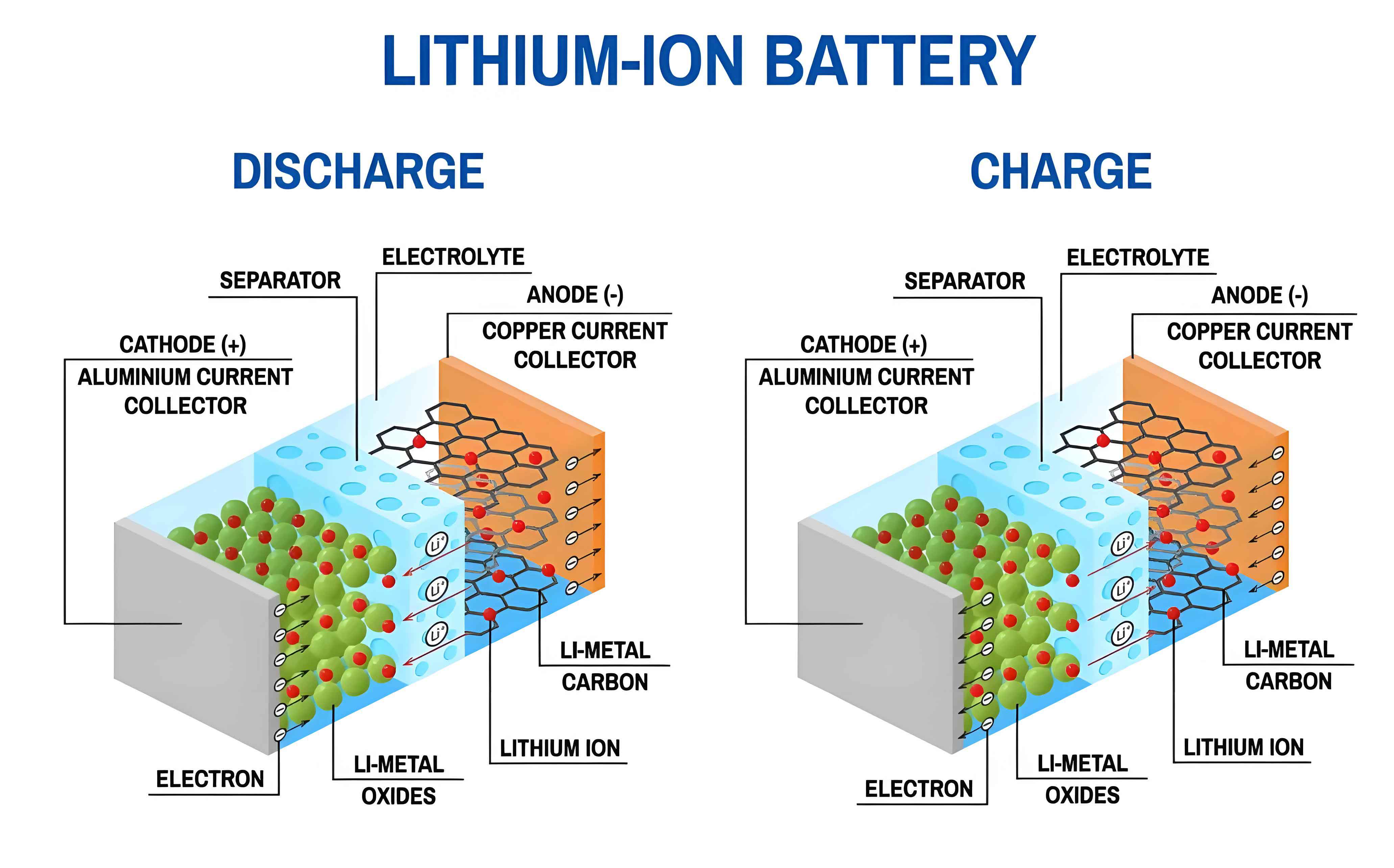
The genesis of irreversible capacity is multifaceted. For most anode materials, especially those undergoing alloying or conversion reactions (Si, SnO2, Fe2O3), the dominant loss mechanism is the electrochemical reduction of the electrolyte to form the SEI layer. This layer is essential for stability but consumes Li+ ions and electrons irreversibly. Other factors include the irreversible reduction of surface oxides (e.g., forming Li2O from SnO2), electrolyte decomposition, and particle isolation due to large volume changes. The following table categorizes common anode materials and their primary sources of initial capacity loss.
| Anode Material Class | Typical First Cycle Coulombic Efficiency (FCE) | Major Causes of Irreversible Capacity Loss | Example Reaction (Irreversible Part) |
|---|---|---|---|
| Graphite (Intercalation) | 85-95% | SEI formation on large surface area. | Electrolyte (e.g., EC) + Li+ + e– → (CH2OCO2Li)2 (SEI components) |
| Silicon (Alloying) | 65-85% (nanostructured) | SEI formation, particle cracking, Li trapping in amorphous LixSi. | Si + xLi+ + xe– → LixSi (partially irreversible); Electrolyte reduction. |
| Silicon Oxide (SiOx) | 50-75% | Formation of irreversible Li silicates (Li4SiO4, Li2Si2O5) and SEI. | SiO2 (in SiOx) + 4Li+ + 4e– → 2Li2O + Si (Li2O is irreversible matrix). |
| Tin/Tin Oxide (Alloying/Conversion) | 45-70% | Irreversible conversion (Li2O formation), SEI, particle aggregation. | SnO2 + 4Li+ + 4e– → Sn + 2Li2O (Li2O is irreversible). |
| Transition Metal Oxides (Conversion, e.g., Fe2O3, Co3O4) | 60-75% | Irreversible conversion reaction, SEI formation, electrolyte decomposition. | Fe2O3 + 6Li+ + 6e– → 2Fe + 3Li2O (Li2O is irreversible). |
| Hard Carbon | ~70-80% | SEI formation on highly porous/disordered structure, Li trapping in nanopores. | Electrolyte reduction on defective carbon sites. |
To mitigate these losses and realize the promise of advanced lithium-ion batteries, various pre-lithiation strategies have been developed. They can be broadly classified based on where and how the supplemental lithium is introduced: at the anode or at the cathode. Each approach has distinct mechanisms, advantages, and challenges for integration into lithium-ion battery manufacturing.
1. Anode-Focused Pre-lithiation Methods
These methods directly treat the anode material or electrode before cell assembly, aiming to pre-form an SEI or pre-fill lithium into the anode’s host structure.
1.1 Chemical Pre-lithiation
Chemical methods utilize reactive lithium-containing compounds to transfer lithium to the anode material via spontaneous chemical reactions in a solution or solid state.
a) Solution Immersion Method: This is one of the most promising and scalable chemical techniques. The anode electrode or powder is immersed in a solution containing a strong lithium-based reducing agent. The most common reagent is lithium arenides, such as lithium biphenyl (Li-Bp) or its derivatives, dissolved in ethers like dimethoxyethane (DME).
The reduction potential of Li-Bp is around 0.1-0.5 V vs. Li/Li+, which is lower than the working potential of many anode materials (e.g., Si, ~0.4 V). This potential gradient drives the reaction:
$$ \text{Anode} + \text{Li-Bp (sol)} \rightarrow \text{Li}_x\text{Anode} + \text{Bp (sol)} $$
Where the anode is lithiated, and biphenyl (Bp) is released into the solution. The degree of pre-lithiation (\(x\) in LixAnode) can be precisely controlled by adjusting immersion time, concentration, and solvent. A key advantage is the simultaneous formation of a pre-formed, uniform “artificial SEI” layer during the chemical reaction, which is often more stable than the electrochemically formed one. For instance, pre-lithiating hard carbon via this method has shown to boost ICE from ~75% to over 90% and significantly improve cycling stability.
b) Direct Chemical Synthesis: This involves creating pre-lithiated compounds during the material synthesis stage. A notable example is the treatment of silicon or SiOx with lithium-containing reagents at elevated temperatures. One reported process involves heating Si to form a thin native SiOx shell, followed by reaction with lithium borohydride (LiBH4) at high temperature:
$$ \text{Si@SiO}_x + \text{LiBH}_4 \xrightarrow{\Delta} \text{Si@Li}_2\text{SiO}_3 + \text{by-products} $$
The resulting Li2SiO3 shell is a lithium-containing, ionically conductive, and mechanically robust layer. This layer acts as a built-in lithium reservoir and a stable interface, reducing further irreversible reactions during the first cycle. This method can push the ICE of silicon anodes from below 60% to nearly 90%. However, it requires careful control of synthesis conditions and may not be easily integrated into all material production lines for lithium-ion batteries.
1.2 Electrochemical Pre-lithiation
These methods use an external lithium source, typically metallic lithium, in a controlled electrochemical manner to transfer lithium to the anode.
a) External Short-Circuit (Discharge) Method: The anode electrode is assembled against a lithium metal foil in a temporary cell with electrolyte. The two electrodes are then connected through an external circuit with a controlled resistance, allowing for a slow, controlled discharge. The driving force is the potential difference between Li metal (0 V vs. Li/Li+) and the anode material. The process can be modeled as a discharge with an external load \(R_{ext}\):
$$ V(t) = E_{anode}(t) – I(t)R_{ext} $$
where \(V(t)\) is the monitored voltage (kept above 0 V to avoid Li plating), \(E_{anode}(t)\) is the increasing potential of the anode as it lithiates, and \(I(t)\) is the current. By controlling \(R_{ext}\) and the cutoff voltage, a precise amount of lithium can be transferred. This method is effective but time-consuming and requires an additional cell assembly/disassembly step, posing challenges for high-throughput manufacturing of lithium-ion batteries.
b) Stabilized Lithium Metal Powder (SLMP): SLMP technology utilizes micron-sized lithium particles whose surface is passivated with a thin, controlled layer of lithium carbonate (Li2CO3). This layer allows the powder to be handled briefly in dry air. The powder is dispersed in an inert solvent (e.g., hexane) to form a slurry, which is then coated onto the surface of the anode electrode. During cell assembly and electrolyte filling, the Li2CO3 layer dissolves or fractures upon pressure/contact, exposing fresh Li to the anode and electrolyte. The lithium spontaneously reacts, lithiating the anode and forming the SEI. The amount of pre-lithiation is easily controlled by the mass of SLMP applied:
$$ m_{Li, transferred} \propto m_{SLMP} \cdot f_{active} $$
where \(f_{active}\) is the active lithium fraction in the SLMP. This method is promising for roll-to-roll processing but adds cost and requires uniform dispersion and integration.
c) Direct Contact/Calendar Aging: A simpler but less controlled method involves physically pressing a lithium foil against the anode in the presence of electrolyte and letting it stand. Lithium diffuses into the anode driven by chemical potential. However, it is prone to inhomogeneous lithiation and risks excessive lithium plating if not carefully monitored.
1.3 Additive-Based Pre-lithiation (in Anode)
Here, pre-lithiated compounds are mixed directly into the anode slurry as inactive (sacrificial) additives. During the first charge, these additives decompose at a low potential, releasing lithium ions and electrons that compensate for the irreversible loss. Classic examples are binary lithium alloys like LiZ (Z=Si, Ge, Sn). For example, Li22Si5 has a theoretical capacity of ~2000 mAh/g as a lithium donor. Upon charging:
$$ \text{Li}_{22}\text{Si}_5 \rightarrow 22\text{Li}^+ + 22e^- + 5\text{Si} $$
The released lithium ions migrate to the cathode, while the in-situ formed Si nanostructure may contribute some capacity in subsequent cycles. The challenges include the high reactivity and air sensitivity of these alloys, the volume change associated with their decomposition, and ensuring good electronic contact within the electrode. Finding additives with optimal decomposition potential, high lithium content, and benign byproducts is crucial for advancing this approach in lithium-ion batteries.
2. Cathode-Focused Pre-lithiation Methods
These approaches integrate the supplemental lithium source at the cathode side, offering potential safety and compatibility advantages with existing lithium-ion battery production lines.
2.1 Over-lithiated Cathode Active Materials
This method involves chemically or electrochemically pre-lithiating the cathode material itself beyond its normal stoichiometry. The extra lithium is then extracted during the first charge and used to compensate for anode losses. For example, Li-rich layered oxides (xLi2MnO3·(1-x)LiMO2) inherently contain excess lithium. More deliberately, materials like Li3V2(PO4)3 can be chemically lithiated to Li5V2(PO4)3 using agents like n-BuLi. In a full cell:
First Charge: $$ \text{Li}_5\text{V}_2(\text{PO}_4)_3 \rightarrow \text{Li}_3\text{V}_2(\text{PO}_4)_3 + 2\text{Li}^+ + 2e^- $$
The 2 Li+ ions travel to the anode, compensating for SEI formation.
Subsequent Cycles: The cathode cycles normally between Li3V2(PO4)3 and LiV2(PO4)3.
The main challenge is that many cathode structures cannot accommodate significant extra lithium without phase transformation or structural degradation, limiting the choice of materials.
2.2 Cathode Additives (Sacrificial Lithium Salts)
This is currently the most industrially relevant pre-lithiation strategy. A lithium-rich compound that is electrochemically active at a potential above the cathode’s working window is added in small amounts to the cathode composite. During the initial charge, this additive is oxidized first, releasing lithium ions and electrons, while the cathode material remains largely inactive. The released lithium subsequently compensates for the anode’s irreversible loss.
Ideal cathode additives require: 1) High specific capacity (mAh/g of additive), 2) Decomposition potential slightly above the cathode operating voltage, 3) Clean decomposition without gaseous or harmful byproducts, 4) Good electronic conductivity, and 5) Stability in air during electrode processing.
| Additive Type | Example Compound | Theoretical Capacity (mAh/g) | Decomposition Reaction (Approx.) | Advantages/Challenges |
|---|---|---|---|---|
| Binary Lithium Compounds | Li2O, Li2O2, Li3N | ~1797 (Li2O), 1168 (Li2O2) | Li2O → 2Li+ + ½O2 + 2e– | Very high capacity. Major challenge: Gas evolution (O2, N2) causes swelling and safety issues. |
| Lithium Transition Metal Oxides (Li-rich) | Li6CoO4, Li5FeO4 (LFO), Li2NiO2 | ~700-900 | Li5FeO4 → Fe2O3 + 5Li+ + 5e– | No gas evolution, relatively stable. Lower capacity than binaries. Byproducts (e.g., Fe2O3) are mostly inert. |
| Lithium Peroxides/Superoxides | Li2(C2O4) (Lithium Oxalate) | ~623 | Li2C2O4 → 2CO2 + 2Li+ + 2e– | Moderate capacity. Decomposes to gaseous CO2, which can be managed but is not ideal. |
Among these, Li5FeO4 (LFO) has garnered significant attention due to its high theoretical capacity (~867 mAh/g), suitable decomposition voltage (~4.0 V vs. Li/Li+), and benign oxide byproducts. The amount of additive needed, \(m_{add}\), for a desired pre-lithiation capacity \(Q_{pre}\) can be calculated as:
$$ m_{add} = \frac{Q_{pre}}{C_{add} \cdot \eta_{add}} $$
where \(C_{add}\) is the theoretical capacity of the additive and \(\eta_{add}\) is its practical utilization efficiency in the composite electrode. This approach integrates seamlessly into standard cathode coating processes, making it highly attractive for upgrading conventional lithium-ion battery production.
Comparative Analysis and Technical Considerations
Choosing a pre-lithiation strategy involves trade-offs between effectiveness, cost, safety, and compatibility with existing manufacturing flows for lithium-ion batteries.
| Pre-lithiation Method | Mechanism | Control Precision | Process Compatibility | Key Challenges | Potential for Scalability |
|---|---|---|---|---|---|
| Anode: Solution Immersion | Chemical reduction by Li-arene complex. | High (via time/concentration). | Moderate (requires solvent handling, drying). | Solvent recovery, cost of reagent, possible electrode swelling. | High with proper engineering. |
| Anode: SLMP | Direct contact/reactivity of stabilized Li powder. | High (via mass loading). | High (slurry coating process). | Cost of SLMP, uniform dispersion, dry room requirements. | High. |
| Anode: External Short | Controlled electrochemical discharge. | High (via voltage cutoff). | Low (extra cell assembly step). | Time-consuming, not continuous, adds complexity. | Low for mass production. |
| Cathode: Additive (e.g., LFO) | Electrochemical oxidation of sacrificial salt. | Moderate (via additive %). | Very High (direct slurry addition). | Finding ideal additive (capacity, voltage, byproducts). | Very High. |
| Cathode: Over-lithiation | Using Li-rich cathode material. | Fixed by material design. | High (material synthesis change). | Limited material choice, possible structural instability. | Moderate. |
A critical metric for evaluating pre-lithiation is the achieved ICE improvement. The effectiveness \(E\) of a method for a given anode can be expressed as:
$$ E = \frac{ICE_{pre-lithiated} – ICE_{pristine}}{1 – ICE_{pristine}} \times 100\% $$
where \(ICE_{pristine}\) is the initial Coulombic efficiency of the untreated anode. An \(E\) of 100% means the irreversible loss has been completely compensated. For a silicon anode with a pristine ICE of 75% boosted to 95%, \(E = (0.95-0.75)/(1-0.75) \times 100\% = 80\%\), indicating a highly effective compensation.
Future Perspectives and Conclusions
The development of pre-lithiation technologies is no longer a peripheral research topic but a central engineering challenge for the next generation of lithium-ion batteries. As silicon-based and other high-capacity anodes move towards commercialization, integrating an efficient and cost-effective pre-lithiation step becomes imperative.
Future research and development will likely focus on several key areas:
1. Hybrid and Novel Methods: Combining approaches, such as using a small amount of cathode additive alongside a mildly pre-lithiated anode from solution, could offer optimal balance. Exploration of new, air-stable lithium donor compounds with higher capacities and cleaner decomposition profiles remains a vibrant field of material discovery.
2. Process Integration and Scalability: The ultimate success of any pre-lithiation technology hinges on its seamless integration into gigafactory-scale production lines for lithium-ion batteries. This demands not only technical effectiveness but also considerations of speed, yield, safety, and environmental impact. Continuous processes like roll-to-roll SLMP application or in-line solution treatment need further engineering maturation.
3. Beyond Anode SEI Compensation: While SEI formation is the primary target, pre-lithiation can also help mitigate other losses, such as lithium trapping in defective carbon structures or irreversible phase transformations. A holistic understanding of all irreversible sinks is necessary to tailor pre-lithiation strategies precisely.
4. System-Level Optimization: Pre-lithiation changes the initial state-of-charge balance (N/P ratio) in the lithium-ion battery. This requires re-optimization of electrode loadings and electrolyte formulations to maximize the benefits in energy density and long-term cycling stability.
In conclusion, pre-lithiation stands as an indispensable key to unlocking the full potential of high-energy-density lithium-ion batteries. By directly addressing the fundamental issue of irreversible lithium consumption, it bridges the gap between the promising capacities of advanced materials and their practical realization in commercial cells. Whether through elegant chemical treatments, clever additive engineering, or innovative electrochemical processes, the continued advancement of pre-lithiation technology will be a cornerstone in the evolution of more powerful, longer-lasting, and cost-effective energy storage systems. The journey towards the ultimate lithium-ion battery is, in many ways, a journey towards perfecting the art and science of lithium compensation.