
In recent years, lithium ion batteries have become ubiquitous in modern technology due to their high energy density, long cycle life, good stability, and environmental friendliness. They are extensively used in smartphones, laptops, electric bicycles, electric vehicles, and energy storage systems. However, as a high-energy载体, lithium ion batteries are highly sensitive to temperature, which critically impacts their lifespan, electrical performance, and safety. Prolonged exposure to high temperatures can accelerate aging, increase internal resistance, shorten service life, and elevate the risk of thermal runaway. Therefore, accurately characterizing the heat generation characteristics of lithium ion batteries is essential for optimizing battery design and energy management, thereby enhancing thermal safety.
Battery models play a pivotal role in thermal studies, enabling precise temperature prediction and providing a foundation for heat generation analysis. In this article, I explore the current state of research on heat generation models for lithium ion batteries, offering insights that can inform battery optimization and thermal management strategies. By examining various modeling approaches, I aim to elucidate how these tools contribute to safer and more efficient lithium ion battery systems.
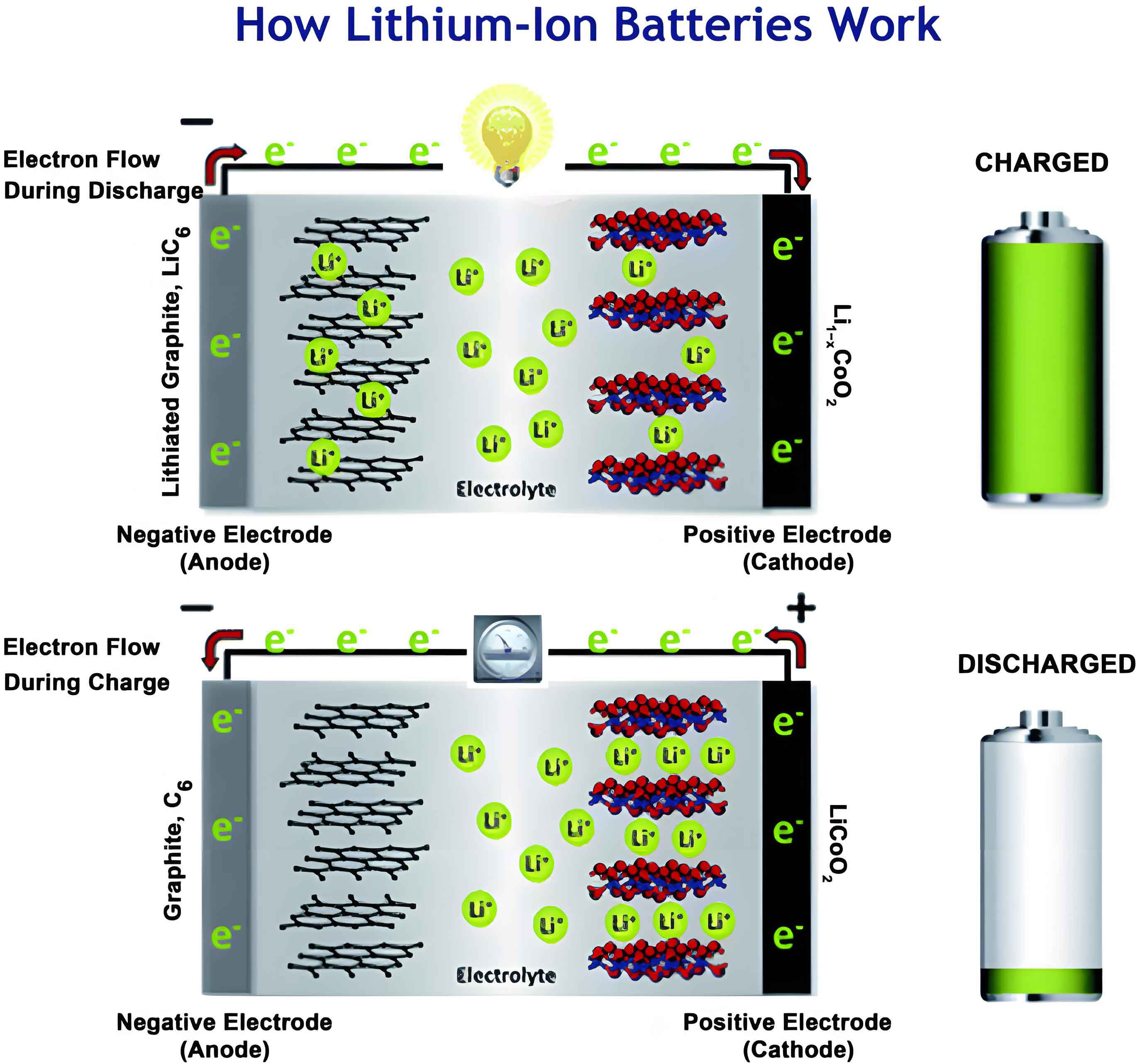
The structure of a lithium ion battery is fundamental to understanding its heat generation mechanisms. A typical lithium ion battery cell consists of a positive electrode, a negative electrode, a separator, and an electrolyte. The current collectors for the positive and negative electrodes are usually aluminum foil and copper foil, respectively, chosen for their excellent conductivity. Active materials are coated onto these collectors to form the electrodes. The electrolyte, which can be liquid or solid, serves as the medium for ion transport; most commercial lithium ion batteries use liquid organic solvent-based lithium salt electrolytes. The separator, typically a porous polymer membrane made of polyethylene or polypropylene, prevents direct contact between the electrodes while allowing ions to pass through. This intricate design underpins the electrochemical processes that generate heat during operation.
Heat generation in a lithium ion battery arises from multiple sources during charge and discharge cycles. Broadly, the heat can be categorized into reversible and irreversible components. Reversible heat is associated with entropy changes in the electrochemical reactions, while irreversible heat includes ohmic heat from internal resistance and polarization heat from kinetic limitations. Additionally, under abusive conditions, side chemical reactions can produce significant heat, leading to thermal runaway. Understanding these heat sources is crucial for developing accurate thermal models.
The overall heat generation rate in a lithium ion battery is often described by a foundational model. A common representation, derived from energy balance principles, is:
$$ q = q_{\text{rev}} + q_{\text{irr}} $$
where \( q \) is the total heat generation rate per unit volume. The reversible heat \( q_{\text{rev}} \) is given by:
$$ q_{\text{rev}} = I T \frac{\partial E_{\text{OC}}}{\partial T} $$
Here, \( I \) is the current, \( T \) is the absolute temperature, and \( \frac{\partial E_{\text{OC}}}{\partial T} \) is the temperature coefficient of the open-circuit voltage, representing entropy changes. The irreversible heat \( q_{\text{irr}} \) encompasses ohmic and polarization losses and can be expressed as:
$$ q_{\text{irr}} = I (E_{\text{OC}} – E) = I^2 R_{\text{total}} $$
where \( E_{\text{OC}} \) is the open-circuit voltage, \( E \) is the operating voltage, and \( R_{\text{total}} \) is the total internal resistance. This model serves as a basis for more sophisticated simulations of lithium ion battery thermal behavior.
To systematically analyze heat generation in lithium ion batteries, researchers have developed various modeling frameworks. These can be broadly classified into three categories: electrochemical-thermal coupled models, electrical-thermal coupled models, and thermal abuse models. Each approach has distinct advantages and limitations, tailored to different applications and scales. The following sections delve into each model type, supported by formulas and comparative tables.
Electrochemical-Thermal Coupled Models
Electrochemical-thermal coupled models integrate detailed electrochemical kinetics with thermal dynamics to capture the intrinsic heat generation processes in lithium ion batteries. These models are grounded in fundamental laws of charge conservation, mass conservation, and reaction kinetics, often using the Doyle-Fuller-Newman framework. They simulate microscopic behaviors such as lithium-ion diffusion, intercalation reactions, and electrolyte transport, thereby providing high-fidelity predictions of internal temperature distributions.
The governing equations typically include:
- Charge conservation in the solid phase: $$ \nabla \cdot (\sigma_{\text{eff}} \nabla \phi_s) = a_s j $$
- Charge conservation in the electrolyte phase: $$ \nabla \cdot (\kappa_{\text{eff}} \nabla \phi_e) + \nabla \cdot (\kappa_{\text{D,eff}} \nabla \ln c_e) = -a_s j $$
- Mass conservation of lithium in the solid phase: $$ \frac{\partial c_s}{\partial t} = \nabla \cdot (D_s \nabla c_s) $$
- Mass conservation of lithium in the electrolyte: $$ \frac{\partial c_e}{\partial t} = \nabla \cdot (D_e \nabla c_e) + \frac{1 – t_+}{F} a_s j $$
- Butler-Volmer kinetics: $$ j = i_0 \left[ \exp\left(\frac{\alpha_a F}{RT} \eta\right) – \exp\left(-\frac{\alpha_c F}{RT} \eta\right) \right] $$
- Energy balance: $$ \rho C_p \frac{\partial T}{\partial t} = \nabla \cdot (k \nabla T) + q $$ where \( q \) is the heat generation rate from electrochemical processes.
These models excel in capturing localized heat effects within a single lithium ion battery cell, making them ideal for electrode-level optimization and understanding degradation mechanisms. For instance, they can predict how temperature variations affect solid-electrolyte interphase growth or lithium plating. However, the computational cost is high due to the coupled nonlinear partial differential equations, limiting their use for large battery packs or real-time applications.
To enhance computational efficiency, reduced-order electrochemical models have been proposed. One simplification involves assuming uniform lithium concentration in electrodes, leading to a single-particle model. The heat generation rate in such a model can be approximated as:
$$ q = \sum_{i} \left( I \eta_i + I T \frac{\partial E_{\text{OC},i}}{\partial T} \right) $$
where \( \eta_i \) is the overpotential in each electrode. Another approach incorporates polynomial approximations or lumped thermal elements to reduce dimensionality while retaining accuracy for specific operating conditions, such as high-rate charging of electric vehicles.
Table 1 summarizes key aspects of electrochemical-thermal coupled models for lithium ion batteries.
| Feature | Description | Advantages | Limitations |
|---|---|---|---|
| Model Basis | Doyle-Fuller-Newman framework with energy balance | High accuracy in predicting internal temperature and electrochemical states | Computationally intensive; requires detailed material parameters |
| Heat Source Inclusion | Reversible entropy heat and irreversible polarization/ohmic heat | Comprehensive heat generation accounting | Complex calibration for diverse lithium ion battery chemistries |
| Typical Applications | Single-cell design, electrode optimization, degradation studies | Insights into microscopic phenomena | Not suitable for large-scale systems due to high computational load |
| Computational Tools | COMSOL, MATLAB/Simulink, custom finite-element codes | Flexible for multiphysics simulation | Steep learning curve and long simulation times |
In practice, electrochemical-thermal models have been validated against experimental data for various lithium ion battery types, such as lithium iron phosphate and nickel manganese cobalt oxides. For example, simulations of a 18650 cylindrical lithium ion battery under different discharge rates show good agreement with infrared thermography measurements, highlighting the model’s capability to capture surface and core temperature differences. These models are indispensable for advancing fundamental understanding but require careful parameterization, especially for newer lithium ion battery formulations.
Electrical-Thermal Coupled Models
Electrical-thermal coupled models simplify the electrochemical details by representing the lithium ion battery as an equivalent circuit, focusing on macroscopic electrical and thermal interactions. These models are particularly useful for system-level design, thermal management optimization, and real-time monitoring. By coupling circuit equations with heat transfer equations, they predict temperature distributions based on current flow and resistive losses.
A typical electrical-thermal model uses an equivalent circuit to describe the battery’s electrical behavior, such as the Thevenin model or higher-order RC networks. The state-space representation is:
$$ \dot{x} = A x + B u $$
$$ y = C x + D u $$
where \( x \) includes states like state of charge and capacitor voltages, \( u \) is the input current, and \( y \) is the terminal voltage. The heat generation rate is derived from the circuit parameters:
$$ q = I^2 R_0 + \sum_{i} I^2 R_i (1 – e^{-t/\tau_i}) $$
Here, \( R_0 \) is the ohmic resistance, and \( R_i \) and \( \tau_i \) represent polarization resistances and time constants. The thermal part often employs a lumped or distributed thermal model, such as:
$$ \rho C_p \frac{\partial T}{\partial t} = \nabla \cdot (k \nabla T) + q $$
with boundary conditions for convection and radiation. This approach allows efficient simulation of temperature profiles in lithium ion battery modules and packs.
These models are advantageous for optimizing geometric aspects like electrode size, tab placement, and cooling system design. For instance, studies on pouch lithium ion batteries have used electrical-thermal models to demonstrate that repositioning tabs can improve temperature uniformity, thereby enhancing performance and longevity. Similarly, for cylindrical lithium ion batteries, models have analyzed the impact of discharge rates and ambient temperatures on heat accumulation, guiding thermal management strategies in electric vehicles.
Table 2 compares different electrical-thermal modeling approaches for lithium ion batteries.
| Model Type | Circuit Configuration | Thermal Representation | Typical Use Case |
|---|---|---|---|
| Lumped Parameter | Simple RC circuit | Single-node thermal mass | Fast system-level simulations for lithium ion battery packs |
| Distributed Parameter | Multi-segment RC networks | Finite-difference or finite-element thermal mesh | Detailed temperature mapping in large-format lithium ion batteries |
| Enhanced Equivalent Circuit | Variable resistors dependent on SOC and temperature | Coupling with computational fluid dynamics | Optimizing cooling systems for high-power lithium ion battery applications |
Furthermore, electrical-thermal models facilitate the study of lithium ion battery behavior under extreme conditions. For example, low-temperature heating protocols for lithium ion battery modules can be simulated to assess electrical performance consistency and thermal stress. By adjusting parameters like discharge cutoff voltage, these models help design heating strategies that minimize temperature gradients, crucial for safety in automotive lithium ion battery systems.
Despite their simplicity, electrical-thermal models require accurate parameter identification, often through experiments at various temperatures and states of charge. Advances in machine learning have enabled adaptive parameter estimation, improving model fidelity for dynamic operating conditions of lithium ion batteries.
Thermal Abuse Models
Thermal abuse models focus on predicting thermal runaway in lithium ion batteries, a critical safety concern. These models incorporate chemical kinetics of side reactions that occur at elevated temperatures, such as solid-electrolyte interphase decomposition, electrode-electrolyte reactions, and electrolyte decomposition. By coupling these reactions with heat transfer equations, they simulate the onset and propagation of thermal runaway.
The heat generation during abuse is the sum of contributions from various exothermic reactions:
$$ q_a = q_{\text{SEI}} + q_n + q_p + q_{\text{ele}} $$
where \( q_{\text{SEI}} \) is the heat from SEI layer decomposition, \( q_n \) from negative electrode reactions, \( q_p \) from positive electrode reactions, and \( q_{\text{ele}} \) from electrolyte decomposition. Each component can be expressed using Arrhenius-type equations:
$$ q_i = H_i m_i A_i \exp\left(-\frac{E_{a,i}}{RT}\right) (1 – \theta_i)^{n_i} $$
Here, \( H_i \) is the enthalpy change, \( m_i \) the mass of reactant, \( A_i \) the pre-exponential factor, \( E_{a,i} \) the activation energy, \( \theta_i \) the reaction progress, and \( n_i \) the order of reaction. The overall energy balance becomes:
$$ \rho C_p \frac{\partial T}{\partial t} = \nabla \cdot (k \nabla T) + q_a + q_{\text{normal}} $$
where \( q_{\text{normal}} \) is the heat from normal operation, often modeled using electrochemical or electrical-thermal approaches.
Thermal abuse models are essential for designing safety mechanisms, such as venting systems or thermal barriers, in lithium ion battery packs. They help identify critical temperature thresholds and assess the effectiveness of cooling interventions. For instance, simulations have shown that increasing charging rates or ambient temperatures can accelerate the onset of thermal runaway in lithium ion batteries, underscoring the need for robust battery management systems.
Table 3 lists key reactions considered in thermal abuse models for lithium ion batteries.
| Reaction | Temperature Range (°C) | Enthalpy Change (J/g) | Typical Kinetic Parameters |
|---|---|---|---|
| SEI decomposition | 80-120 | 257 | \( A = 1.67 \times 10^{15} \, \text{s}^{-1} \), \( E_a = 140 \, \text{kJ/mol} \) |
| Negative electrode with electrolyte | 120-250 | 1714 | \( A = 2.5 \times 10^{13} \, \text{s}^{-1} \), \( E_a = 134 \, \text{kJ/mol} \) |
| Positive electrode decomposition | 150-300 | Variable by chemistry | Depends on material (e.g., NMC, LFP) |
| Electrolyte decomposition | 200-400 | ~1500 | Complex multi-step kinetics |
Integrating thermal abuse models with electrical-thermal or electrochemical-thermal models creates comprehensive safety assessment tools. For example, a coupled electro-thermal-abuse model can predict how operational stressors, like overcharging or short circuits, lead to thermal runaway in a lithium ion battery module. These integrated approaches are vital for developing standards and regulations for lithium ion battery safety across industries.
Comparative Analysis and Future Directions
Each modeling paradigm for lithium ion batteries offers unique benefits tailored to specific stages of battery development and operation. Electrochemical-thermal models provide deep insights into material-level phenomena but are computationally demanding. Electrical-thermal models strike a balance between accuracy and efficiency, ideal for system design and control. Thermal abuse models prioritize safety analysis under extreme conditions. The choice of model depends on the application: for instance, electrode optimization in a new lithium ion battery chemistry might use electrochemical-thermal models, while thermal management system design for an electric vehicle pack might rely on electrical-thermal models.
To illustrate the differences, consider the following summary of model attributes in the context of lithium ion battery thermal management:
| Model Type | Primary Focus | Computational Cost | Best Suited For |
|---|---|---|---|
| Electrochemical-Thermal | Microscopic heat sources and internal temperature gradients | High | Single-cell design, material selection, fundamental research on lithium ion batteries |
| Electrical-Thermal | Macroscopic temperature distribution and system-level thermal behavior | Medium | Battery pack thermal management, real-time monitoring, optimization of lithium ion battery geometry |
| Thermal Abuse | Safety under abusive conditions and thermal runaway propagation | Variable (often high when coupled) | Safety assessment, failure analysis, and design of protection systems for lithium ion batteries |
Future advancements in lithium ion battery modeling will likely involve hybrid approaches that combine the strengths of these paradigms. For example, reduced-order electrochemical models could be integrated with electrical-thermal frameworks to enhance accuracy without prohibitive computational costs. Additionally, data-driven techniques like artificial neural networks can complement physics-based models, enabling adaptive thermal management for lithium ion batteries in dynamic environments. As lithium ion battery technologies evolve towards higher energy densities and faster charging, sophisticated heat generation models will remain indispensable for ensuring safety and performance.
Conclusion
In summary, heat generation models are vital tools for understanding and managing the thermal behavior of lithium ion batteries. Through electrochemical-thermal, electrical-thermal, and thermal abuse models, researchers and engineers can predict temperatures, optimize designs, and enhance safety. The electrochemical-thermal models offer high precision for internal analysis but are complex; electrical-thermal models provide efficient system-level insights; and thermal abuse models focus on critical safety scenarios. As the demand for lithium ion batteries grows across sectors, continued refinement of these models will support the development of safer, more efficient energy storage solutions. By leveraging formulas, tables, and computational simulations, the field can address the thermal challenges inherent in lithium ion battery technology, paving the way for sustainable innovation.