
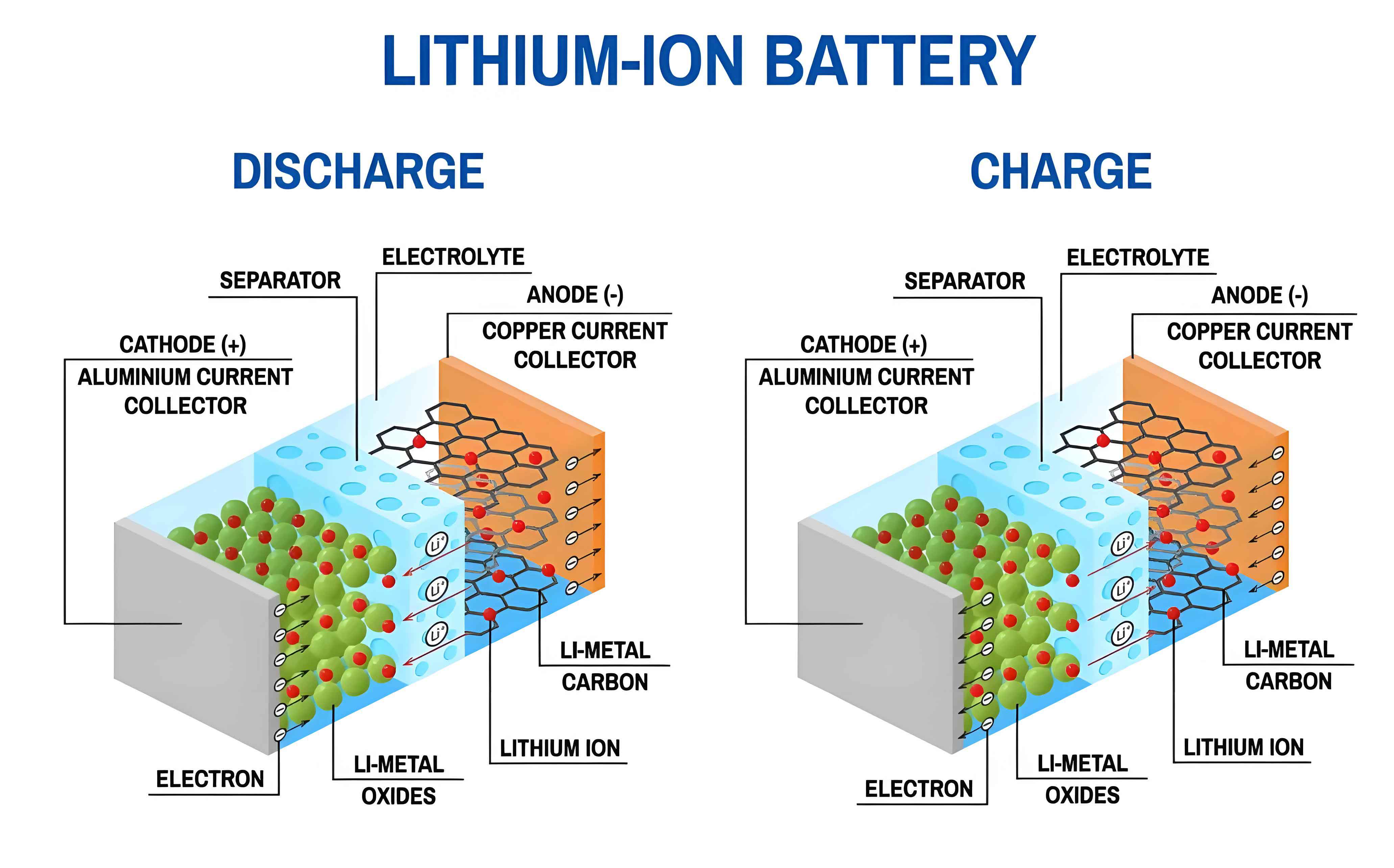
The widespread adoption of electric vehicles is intrinsically linked to the performance and safety of their core energy storage component: the li ion battery. While advancements continuously push the boundaries of energy density, fast-charging capability, and cycle life, safety incidents related to thermal runaway remain a critical barrier to consumer confidence and technological proliferation. A thermal runaway event is a catastrophic, self-accelerating exothermic process where heat generation within a cell exceeds its ability to dissipate it, leading to rapidly rising temperatures, gas generation, and potentially fire or explosion. Therefore, a precise, quantitative understanding of the internal heat generation mechanisms across different li ion battery chemistries is paramount for designing safer cells and effective mitigation strategies.
This work employs high-precision microcalorimetry (C80) to deconstruct and quantify the complex heat flow profiles of commercial li ion battery systems. By systematically analyzing the thermal behavior of individual components, binary mixtures (e.g., anode-electrolyte), and full cell configurations, we establish a detailed, reaction-by-reaction map of the thermal runaway process. A key focus is the comparative analysis between two dominant cathode chemistries: Lithium Nickel Cobalt Manganese Oxide (NCM) and Lithium Iron Phosphate (LFP). Furthermore, we apply a deconvolution methodology and develop semi-empirical models to attribute specific heat release values to each major reaction step. The core finding elucidates a sequential reaction pathway: the electrolyte is preferentially and completely consumed by the lithiated anode, and the residual lithiated anode subsequently reacts with the destabilized cathode, with the intensity of this latter reaction being highly dependent on the cathode’s material properties.
Experimental Methodology and Heat Flow Deconvolution
Commercial pouch cells (NCM and LFP) were brought to a defined state of charge (SOC) before being disassembled in an argon-filled glovebox. Electrodes and separators were precisely cut to maintain the mass ratios present in the original commercial li ion battery. For testing, these components were reassembled in a high-pressure C80 crucible with a precise amount of electrolyte matching the commercial cell’s impregnation coefficient. The C80 calorimeter, with its 3D thermopile array, measures the heat flow as the sample is heated from ambient temperature to 300°C at a controlled rate (e.g., 0.2-0.5°C/min). This setup accurately replicates the multi-phase, sealed environment of a failing cell.
The raw heat flow curve for a full cell is a superposition of multiple overlapping exothermic reactions. To isolate the contribution of each reaction, a mathematical deconvolution process is employed. This technique fits the composite curve with a sum of individual peak functions (often Gaussian or asymmetric sigmoidal models). The integrated area under each fitted peak corresponds to the total heat released by that specific reaction step, $Q_i$.
$$
Q_{\text{total}} = \sum_{i=1}^{n} Q_i = \sum_{i=1}^{n} \int_{T_{\text{start},i}}^{T_{\text{end},i}} \text{HF}_i(T) \, dT
$$
Where $Q_{\text{total}}$ is the total heat released, $n$ is the number of deconvoluted peaks, $\text{HF}_i(T)$ is the heat flow function of the $i$-th peak, and $T_{\text{start},i}$ and $T_{\text{end},i}$ are its onset and end temperatures, respectively. The specific heat release per unit mass of the active material involved in that reaction is then calculated as:
$$
q_i = \frac{Q_i}{m_{\text{active},i}}
$$
This deconvolution is the cornerstone for quantitatively comparing reactions between different li ion battery systems.
Quantitative Heat Release in Full Cell Systems: NCM vs. LFP vs. Hybrid
The thermal profiles of NCM, LFP, and an LFP/NCM hybrid (65/35 wt%) full cell are profoundly different. The measured total heat release follows the order: NCM >> Hybrid > LFP. The deconvolution results are quantitatively summarized in Table 1.
| Cell System | Peak Temp. Range (°C) | Attributed Reaction | Total Heat, Qpeak (J) | Specific Heat, q (J/gactive) | Key Observation |
|---|---|---|---|---|---|
| NCM Full Cell | 130 – 210 | Anode + Electrolyte (SEI breakdown & reaction) | 444 | 1632 (vs. anode mass) | Massive, sharp exotherm from cathode reaction dominates total heat. |
| 200 – 240 | Residual Anode (LixC6) + NCM Cathode (O2 release & reduction) | 652 | 1285 (vs. NCM mass) | ||
| >240 | Minor reactions/phase changes | ~0 | ~0 | ||
| Total | 30 – 300 | – | ~1096 | – | – |
| LFP Full Cell | 130 – 220 | Anode + Electrolyte | 73 | 448 (vs. anode mass) | Main cathode-related exotherm is broad, occurs at higher temperature, and is significantly less intense. |
| 220 – 300 | Residual Anode + LFP Cathode (Limited O2 release) | 122 | 240 (vs. LFP mass) | ||
| – | – | – | – | ||
| Total | 30 – 300 | – | ~242 | – | – |
| LFP/NCM Hybrid Full Cell | 130 – 205 | Anode + Electrolyte | 383 | 1408 (vs. anode mass) | Sequential cathode reactions are visible. NCM reaction heat is more intense per gram than in pure NCM cell due to limited anode availability. |
| 213 – 228 | Minor/Transition | 140 | – | ||
| 231 – 236 | Residual Anode + NCM Cathode | 267 | 2293 (vs. NCM mass in blend) | ||
| 240 – 287 | Residual Anode + LFP Cathode | 50 | 152 (vs. LFP mass in blend) | ||
| Total | 30 – 300 | – | ~831 | – | – |
Table 1: Deconvoluted Heat Release Analysis for Different Li-ion Battery Full Cell Systems.
The analysis of Table 1 reveals critical mechanistic insights:
- Universal Anode-Electrolyte Reaction: All systems exhibit significant exotherms between 130-220°C. This is attributed to the breakdown of the Solid Electrolyte Interphase (SEI) and the subsequent violent reaction between the intercalated lithium in the graphite anode (LixC6) and the organic carbonate electrolyte. The reaction can be schematically represented as:
$$
\text{Li}_x\text{C}_6 + \text{Electrolyte (EC, DMC, LiPF}_6) \rightarrow \text{LiF, } \text{C}_x\text{H}_y\text{O}_z\text{ (polymers/oligomers)}, \text{ gases (CO, CO}_2, \text{C}_2\text{H}_4\text{)} + \text{Heat}
$$
The specific heat release (q) for this reaction varies, indicating SOC and electrolyte accessibility effects.
- Cathode-Defined High-Temperature Reactions:
- NCM Systems: A sharp, intense exotherm peaks around 230-240°C. This corresponds to the thermal decomposition of the delithiated NCM structure, releasing oxygen, which rapidly oxidizes the remaining lithium in the anode and any nearby combustibles (e.g., electrolyte solvents, binder).
- LFP Systems: A much broader, less intense exotherm occurs at higher temperatures (240-300°C). The olivine structure of LFP is more thermally stable, and any oxygen release is minimal and slower, leading to a less violent reaction with the anode.
- Hybrid System: The heat flow clearly shows two distinct high-temperature peaks, proving the sequential reaction of the residual anode first with the NCM component and then with the LFP component. Crucially, the specific heat for the NCM reaction in the hybrid cell (2293 J/gNCM) is higher than in the pure NCM cell (1285 J/gNCM). This discrepancy points to a reactant-limiting scenario, which is explored in the next section.
The Anode-Electrolyte Reaction: SOC Dependence and Reactant Consumption
To understand the reactant-limiting behavior, we isolated the anode-electrolyte system. Figure 3a (referenced from the source material) shows heat flow curves for anodes at different SOCs (90%, 70%, 30%) mixed with a fixed, commercial-grade amount of electrolyte. The results are quantified in Table 2.
| Anode SOC | Total Heat Release (J/ganode) | Peak 1 (130-220°C) (J/ganode) | High-T Peaks (>220°C) (J/ganode) | Interpretation |
|---|---|---|---|---|
| 90% | ~1721 | ~845 | ~876 | Electrolyte is fully consumed. Abundant LixC6 remains for later reactions. |
| 70% | ~1765 | ~1189 | ~576 | Electrolyte is fully consumed. Significant LixC6 remains. |
| 30% | ~992 | ~907 | ~85 | Electrolyte may be fully consumed, but very little reactive LixC6 remains for high-T reactions. |
Table 2: Impact of State of Charge (SOC) on Anode-Electrolyte Reaction Heat.
The key finding is that for high SOC anodes (70-90%), the total heat from the anode-electrolyte reaction plateaus. More importantly, the electrolyte mass, dictated by the commercial impregnation coefficient, is the limiting reactant in this first stage. This leads to the fundamental sequential model:
Stage 1: Electrolyte Consumption. Upon heating, the electrolyte is completely consumed by reaction with the high-SOC anode. The amount of heat released ($Q_{AE}$) is primarily a function of the electrolyte mass ($m_{elyte}$) and its effective heat of reaction ($\Delta H_{elyte}$).
$$
Q_{AE} \approx \eta \cdot m_{elyte} \cdot (-\Delta H_{elyte})
$$
where $\eta$ is a utilization coefficient (~1 for commercial cells under runaway conditions).
Stage 2: Residual Anode Mass. After Stage 1, a certain amount of lithiated anode ($m_{An, res}$) remains unreacted. This mass can be estimated from the initial anode mass ($m_{An,0}$), its degree of lithiation ($x$ in LixC6), and the stoichiometry of the anode-electrolyte reaction.
Stage 3: Cathode Reaction. The remaining $m_{An, res}$ becomes the limiting reactant for the high-temperature exotherm with the cathode. The heat released ($Q_{CA}$) is proportional to this remaining anode mass and the specific reactivity of the cathode material.
$$
Q_{CA} \propto m_{An, res} \cdot f(\text{Cathode Type})
$$
The function $f(\text{Cathode Type})$ is much larger for NCM than for LFP, explaining the order-of-magnitude difference in their full-cell runaway severity.
This model explains the data in Table 1: In the pure NCM full cell, after Stage 1, $m_{An, res}$ is relatively large, but the NCM cathode mass is in excess. Therefore, the measured $Q_{CA}$ is high, but the specific heat per gram of NCM ($q_{NCM} = Q_{CA}/m_{NCM}$) is moderate (1285 J/g). In the hybrid cell, the available $m_{An, res}$ is similar, but it is now distributed between a smaller mass of NCM and the LFP. Consequently, the NCM component reacts more completely with its share of the anode, yielding a much higher specific heat value (2293 J/g).
Mathematical Modeling of Sequential Heat Release
Based on the above mechanism, we can construct a simplified quantitative framework for predicting the heat release during thermal runaway of a li ion battery. The total heat ($Q_{TR}$) is the sum of the main sequential reactions:
$$
Q_{TR} = Q_{SEI} + Q_{AE} + Q_{CA}
$$
Where:
$Q_{SEI}$ is the heat from initial SEI decomposition (relatively small).
$Q_{AE}$ is the heat from the anode-electrolyte reaction (Stage 1).
$Q_{CA}$ is the heat from the cathode-anode reaction (Stage 3).
We can express $Q_{AE}$ and $Q_{CA}$ in terms of cell design parameters:
$$
Q_{AE} = \alpha \cdot m_{elyte} \cdot \Delta H_{eff, elyte}
$$
$$
Q_{CA} = \beta \cdot \text{min}( \gamma \cdot m_{An, res}, \ \delta \cdot m_{cathode} ) \cdot \Delta H_{eff, CA}
$$
Here:
– $\alpha, \beta$ are reaction completion factors (0 to 1).
– $\Delta H_{eff, elyte}$ and $\Delta H_{eff, CA}$ are the effective heats of reaction for the two main stages.
– The $\text{min}()$ function in $Q_{CA}$ captures the limiting reactant concept: the reaction is limited either by the available residual anode ($\gamma \cdot m_{An, res}$, where $\gamma$ is an effective stoichiometric coefficient) or by the reactive capacity of the cathode ($\delta \cdot m_{cathode}$, where $\delta$ is a material-specific factor, high for NCM, low for LFP).
The residual anode mass $m_{An, res}$ is itself a function of initial conditions:
$$
m_{An, res} \approx m_{An,0} – \kappa \cdot m_{elyte}
$$
where $\kappa$ is a mass consumption coefficient linking electrolyte used to anode consumed.
This model, while simplified, provides a foundation for understanding how cell design choices (cathode chemistry $(\delta)$, electrolyte mass $(m_{elyte})$, anode loading $(m_{An,0})$, and N/P ratio) directly influence the magnitude and sequence of heat release during a thermal runaway event in a li ion battery.
Conclusions and Implications for Safer Li-ion Battery Design
Through meticulous microcalorimetric analysis and deconvolution, this work quantitatively delineates the thermal runaway mechanism in commercial li ion battery systems. The process is unambiguously sequential and cathode-dominated:
- Electrolyte-Limited Anode Reaction (130-220°C): The organic electrolyte is the first major fuel, completely consumed by exothermic reactions with the lithiated graphite anode. The heat from this stage is significant but constrained by the fixed electrolyte mass in a commercial li ion battery design.
- Cathode-Material-Defined Catastrophic Stage (200-300°C): The remaining lithiated anode acts as a reducing agent for the thermally decomposing cathode. The intensity of this reaction is the primary differentiator between safe and hazardous li ion battery chemistries.
- NCM-based cells undergo a violent, high-heat-release reaction due to prolific oxygen release from the cathode structure around 230°C.
- LFP-based cells undergo a milder, more protracted reaction at higher temperatures due to the exceptional structural stability of the olivine phosphate.
- Reaction Stoichiometry is Key: The specific heat release values per gram of cathode material are not intrinsic constants but depend on the availability of the other reactant (the residual anode). This highlights the importance of the N/P ratio and component balancing not just for cycling, but for safety.
The derived sequential model and associated parameters provide a quantitative toolkit for evaluating thermal runaway risk. This knowledge directly informs strategies for safer li ion battery development: (i) developing more stable cathode materials (e.g., ultra-stable NCM compositions, LFMP), (ii) formulating less reactive or flame-retardant electrolytes, (iii) designing anode coatings to delay or mitigate the initial anode-electrolyte reaction, and (iv) optimizing cell balance and component design to minimize the total available chemical energy that can be released in an uncontrolled sequence. Ultimately, moving from a qualitative to a quantitative understanding of these exothermic cascades is essential for engineering the next generation of inherently safer energy storage systems.