
The relentless pursuit of higher energy density for li ion battery technology, particularly to extend the driving range of electric vehicles, has placed layered lithium nickel-cobalt-manganese oxides (LiNixCoyMnzO2, or NCM) at the forefront of cathode material research. These ternary materials represent a strategic compromise, harnessing the high capacity of nickel, the structural stability and electronic conductivity of cobalt, and the thermal and structural reinforcement provided by manganese. The specific ratio of these transition metals (TMs)—denoted by x, y, and z—serves as the primary tuning knob, directly dictating the fundamental electrochemical and thermal properties of the cathode, and consequently, the performance and safety profile of the entire li ion battery. This deep dive explores how systematic variations in the TM ratio, especially the nickel content, intricately govern the structural integrity, lithium-ion kinetics, cycling stability, and, most critically, the thermal runaway characteristics of NCM cathodes.
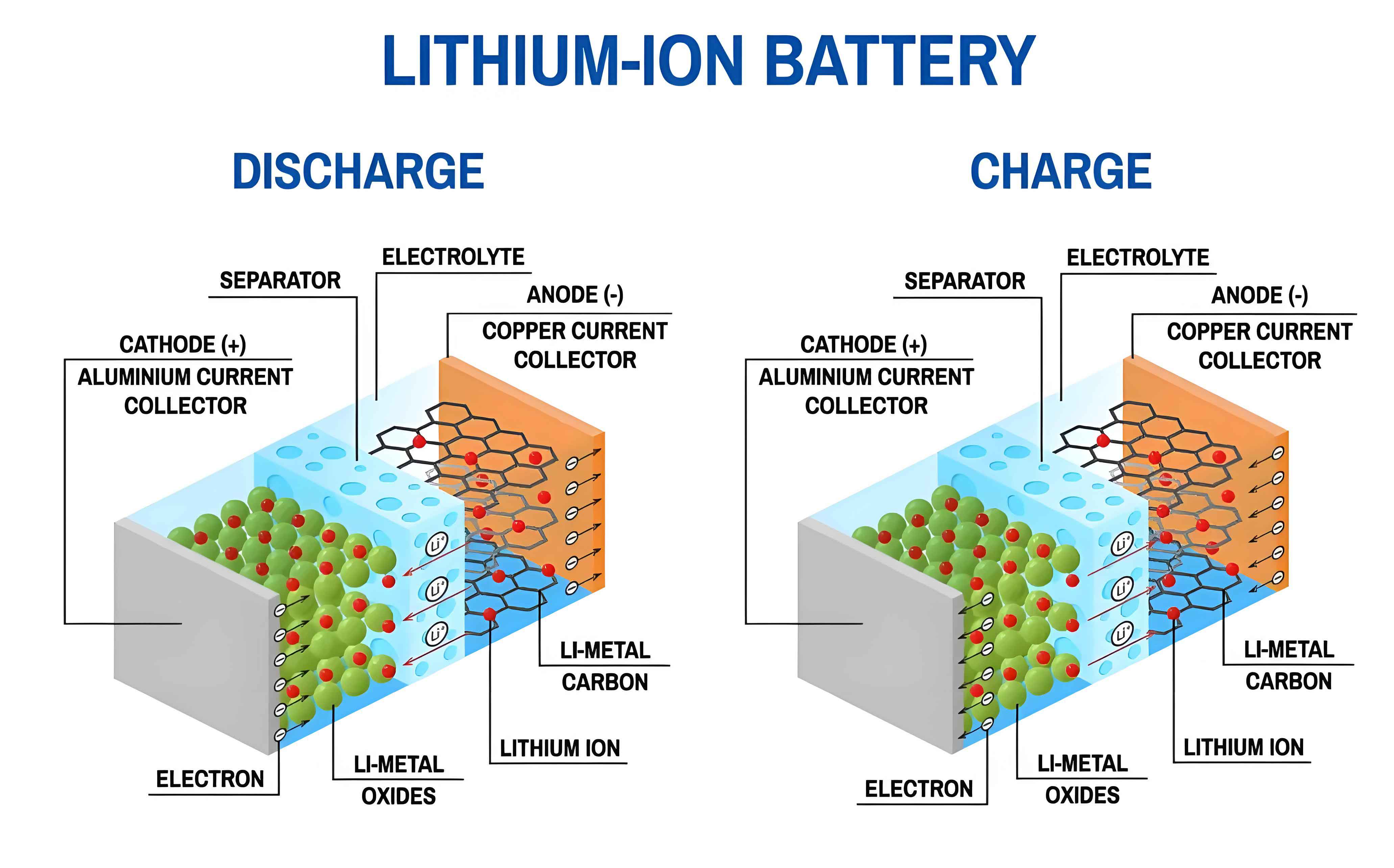
The evolution of NCM chemistry has followed a clear trajectory: increasing the nickel content (x) to boost specific capacity. Materials progress from NCM111 (LiNi1/3Co1/3Mn1/3O2) to NCM523, NCM622, and the ultra-high-energy NCM811. While this progression delivers on the promise of higher energy density, it introduces a complex trade-off matrix. The very properties that make nickel attractive—its rich redox activity involving Ni2+/Ni3+/Ni4+ couples—also sow the seeds of instability. Elevated nickel levels exacerbate cation mixing between Li+ and Ni2+ (due to their similar ionic radii), promote oxygen release at high states of charge, and accelerate detrimental interfacial reactions with the electrolyte. Therefore, a fundamental understanding of the TM ratio’s role is not merely academic; it is essential for designing the next generation of li ion battery cathodes that do not sacrifice safety for performance.
Structural and Morphological Footprint Dictated by Composition
At the atomic level, the TM ratio leaves a distinct signature on the crystal structure and particle morphology of NCM materials. While all NCMs crystallize in the hexagonal α-NaFeO2 structure (space group R$\bar{3}$m), subtle but critical lattice parameter shifts occur. Refinement of X-ray diffraction data consistently shows that as the nickel content increases and the proportion of smaller Co3+ and Mn4+ ions decreases, the a-axis lattice parameter expands. Concurrently, the c-axis parameter contracts slightly. This is intrinsically linked to the need for charge balance: a higher Mn4+ content (in low-Ni NCMs) necessitates a higher proportion of Ni2+ (rather than Ni3+) to maintain electroneutrality. Since Ni2+ is larger than Ni3+, this results in an expansion of the c-axis. The lattice parameters for a series of NCM cathodes are summarized below:
| Material | a-axis (Å) | c-axis (Å) | Ni in Li Layer (%) |
|---|---|---|---|
| NCM111 | 2.8726 | 14.2907 | ~4.9 |
| NCM523 | 2.8759 | 14.2694 | ~5.7 |
| NCM622 | 2.8797 | 14.2661 | ~5.9 |
| NCM811 | 2.8835 | 14.2608 | ~7.6 |
A more profound structural defect induced by high Ni content is cation mixing or Li/Ni disordering. The table above quantifies this phenomenon, showing a clear increase in the occupancy of Ni ions in the lithium (3a) sites as the overall Ni fraction rises. This antisite defect blocks Li+ diffusion pathways, increases impedance, and acts as nucleation points for phase transformation from the layered structure to inactive rock-salt phases on the particle surface, which is a primary cause of capacity fade in Ni-rich li ion battery cathodes.
Morphologically, commercial NCM materials typically consist of secondary spherical agglomerates (5-15 μm) composed of nano-sized primary particles. While secondary particle size may be similar across compositions, the primary particle size often decreases with increasing Ni content. Smaller primary grains increase the surface area-to-volume ratio, which can be a double-edged sword: it shortens the Li+ diffusion pathlength but also dramatically increases the interfacial area in contact with the electrolyte, accelerating parasitic side reactions. Furthermore, the surface chemistry is heavily composition-dependent. Ni-rich particles tend to have significantly higher amounts of residual lithium compounds (Li2CO3 and LiOH) due to spontaneous reduction of unstable Ni3+ and subsequent reaction with atmospheric CO2 and H2O. These residuals consume active lithium in the first cycle, reduce coulombic efficiency, and increase slurry pH, causing processing difficulties in li ion battery manufacturing.
Electrochemical Performance: The Capacity-Stability Trade-off
The electrochemical profile of an NCM cathode is a direct function of its TM stoichiometry. The paramount trend is the increase in reversible discharge capacity with nickel content, as the Ni2+/Ni4+ redox couple provides the majority of the capacity within typical voltage windows (e.g., 2.8-4.3 V vs. Li/Li+).
| Material | 1st Cycle Discharge Capacity (mAh/g) | 1st Cycle Coulombic Efficiency (%) | Capacity Retention after 100 cycles (Typical, %) |
|---|---|---|---|
| NCM111 | ~150-155 | ~87-90 | >95 |
| NCM523 | ~160-165 | ~85-88 | >93 |
| NCM622 | ~170-175 | ~84-87 | >90 |
| NCM811 | ~190-205 | ~80-85 | <85 |
However, this gain in capacity comes at a steep cost to longevity and kinetics. The cycling stability deteriorates markedly with increasing Ni, as seen in the estimated capacity retention. The reasons are multifaceted: (1) pronounced Li/Ni disorder hinders Li+ transport, (2) aggressive lattice volume changes during the H2 to H3 phase transition at high voltage cause microcracking, exposing fresh surfaces to the electrolyte, and (3) the highly oxidized Ni4+ state at the end of charge is a strong oxidant that accelerates electrolyte decomposition at the cathode-electrolyte interphase (CEI).
Rate capability, a critical metric for power-intensive li ion battery applications, also shows a non-linear dependence on composition. While cobalt enhances electronic conductivity, the overall rate performance is a complex interplay between electronic conductivity, Li+ diffusion, and particle morphology. NCM111 often exhibits good rate performance due to its high Co content and stable structure. Paradoxically, NCM811 may show better rate capability than NCM622 in some cases, despite higher Ni, because its typically smaller primary particles reduce the solid-state diffusion distance. The ionic and electronic transport bottlenecks are clearly visible in electrochemical impedance spectroscopy (EIS), where the charge transfer resistance (Rct) increases substantially with Ni content.
The differential capacity (dQ/dV) plots offer a window into the phase behavior during cycling. Low-Ni NCMs like NCM111 show a single, major redox peak pair. As Ni content increases, additional peaks emerge, signifying multiple phase transitions between hexagonal (H1, H2, H3) and monoclinic (M) structures. The voltage of the main oxidation peak also shifts downward with higher Ni, reflecting changes in the metal-oxygen bond covalency and stabilization energy. The large, sharp peak associated with the H2->H3 transition in Ni-rich materials is particularly deleterious, as it coincides with the abrupt c-lattice collapse and release of mechanical stress within the secondary particles.
Thermal Stability and Safety: The Paramount Concern
The most critical influence of the TM ratio is on the thermal stability of the delithiated cathode, which is the primary factor determining the safety threshold of a li ion battery. Thermal abuse, overcharge, or internal short circuits can drive the cell temperature upward, triggering exothermic decomposition of the charged cathode. This process is intrinsically oxygen-driven and is severely exacerbated in Ni-rich NCMs.
The thermal decomposition of a charged NCM material (LinNixCoyMnzO2, where n < 1) follows a stepwise pathway:
1. Layered to Spinel Transition: Onset typically between 180-250°C for Ni-rich materials.
2. Spinel to Rock-Salt Transition: Occurs at higher temperatures, ~250-350°C.
Each step involves oxygen release and recombination with the electrolyte, generating massive heat.
The amount of oxygen released can be theoretically modeled based on the residual lithium content (n) and the TM oxidation states. For a generic charged cathode LinMO2 (M = Ni, Co, Mn), the layered-to-spinel transition can be approximated as:
$$ \text{Li}_n\text{MO}_2 \rightarrow \text{Li}_n\text{M}_2\text{O}_4 + \text{O}_2 \uparrow $$
The subsequent rock-salt formation releases more oxygen. The key is that the driving force for oxygen release is the instability of high-valent Ni4+. Since Ni-rich cathodes achieve a higher average Ni oxidation state upon full charge, they contain a greater proportion of unstable Ni4+, which readily reduces to Ni2+ by releasing lattice oxygen. Manganese (as Mn4+) and cobalt (largely inert Co3+) play stabilizing roles, making oxygen loss less favorable.
This theory is starkly confirmed by experimental differential scanning calorimetry (DSC) data on charged cathodes:
| Material (Charged) | Onset Temp. of Major Exotherm (°C) | Total Heat Release (J/g) | O2 Release (Theoretical, mol per mol) |
|---|---|---|---|
| NCM111 | ~230-250 | ~480-500 | ~0.26 |
| NCM523 | ~210-230 | ~580-620 | ~0.27 |
| NCM622 | ~190-210 | ~650-700 | ~0.28 |
| NCM811 | ~150-180 | ~720-780 | ~0.31 |
The trend is unambiguous: higher nickel content lowers the thermal runaway trigger temperature and increases the total heat output. This makes a li ion battery with an NCM811 cathode fundamentally more hazardous under abusive conditions than one with NCM523 or NCM111. The released oxygen reacts violently with the organic carbonate electrolyte, leading to a self-accelerating reaction that can result in fire or explosion.
Operando Heat Generation: The Dynamic Safety Signature
Beyond catastrophic failure, the TM ratio also influences heat generation during normal operation, which impacts thermal management system design. In-situ calorimetry of half-cells reveals that heat generation during discharge (lithiation) is generally greater than during charge (delithiation), primarily due to polarization overpotentials. The heat flow profile becomes increasingly spiked at the end of charge for Ni-rich cathodes. This is attributed to the sharply increasing polarization caused by kinetic limitations (high Rct) and the onset of detrimental surface重构 as Li+ is extracted from a structure increasingly riddled with Ni in the Li layer.
When comparing the total reversible heat generated per unit capacity, an interesting picture emerges. While Ni-rich cathodes generate more absolute heat, medium-nickel compositions like NCM523 can sometimes exhibit a favorable balance, offering high capacity without the extreme heat generation of NCM811. This operational thermal behavior is a crucial but often overlooked aspect of li ion battery design, directly affecting pack cooling requirements and efficiency.
The Optimization Landscape and Future Directions
The comprehensive analysis of the role of transition metal ratio paints a clear picture: there is no free lunch. The quest for energy density via nickel enrichment directly compromises cycle life, rate capability, and—most severely—thermal safety. The optimal composition is therefore application-dependent, requiring a careful balance.
For the mainstream electric vehicle market where energy density, longevity, and safety are all paramount, the compromise often settles around the NCM523 to NCM622 range. NCM523, in particular, has been identified in many studies as striking a remarkably well-balanced combination of decent specific capacity (~165 mAh/g), good cycling stability, manageable first-cycle loss, and significantly superior thermal stability compared to NCM811. It represents a pragmatic sweet spot in the NCM evolution for the current generation of li ion battery technology.
Future advancements aim to break this trade-off. The strategies are multifaceted:
1. Surface Engineering: Applying stable coating layers (e.g., Al2O3, Li3PO4) on Ni-rich particles to physically suppress oxygen release and minimize direct electrolyte contact.
2. Bulk Doping: Incorporating small amounts of dopants (e.g., Al, Mg, Ti, Zr) into the crystal lattice to strengthen the metal-oxygen bonds, suppress Li/Ni mixing, and stabilize the structure against phase transitions.
3. Core-Shell and Concentration-Gradient Architectures: Designing particles with a Ni-rich core for capacity and a Mn-rich or stability-enhanced shell to protect the surface, creating a smooth transition in composition.
4. Electrolyte Engineering: Developing novel electrolytes and additives that form a more robust and thermally stable CEI on the aggressive Ni-rich surface.
In conclusion, the transition metal ratio in LiNixCoyMnzO2 is the fundamental variable that orchestrates its identity. Nickel grants the high capacity essential for modern li ion battery applications, cobalt facilitates kinetics, and manganese provides the structural and thermal backbone. Understanding the profound and interconnected effects of varying x, y, and z—from atomic-scale cation mixing to macro-scale heat release—is not just an academic exercise. It is the essential knowledge required to navigate the complex trade-offs and engineer the next generation of cathode materials that can safely power our electrified future. The ongoing research is not about abandoning Ni-rich materials but about intelligently mitigating their inherent weaknesses through sophisticated material design, making the high-energy li ion battery both powerful and safe.