
The relentless pursuit of higher energy density, longer cycle life, and improved safety continues to drive innovation in energy storage technologies. Among these, the li ion battery stands as the dominant power source for portable electronics and is rapidly becoming the cornerstone of electric mobility and grid-scale storage. The performance of a li ion battery is intrinsically governed by its constituent materials, with the anode playing a critical role in determining overall capacity and stability. For decades, graphite has served as the commercial standard anode material due to its good conductivity and structural stability. However, its relatively low theoretical capacity of 372 mAh/g presents a fundamental bottleneck for the next generation of high-energy li ion battery systems.
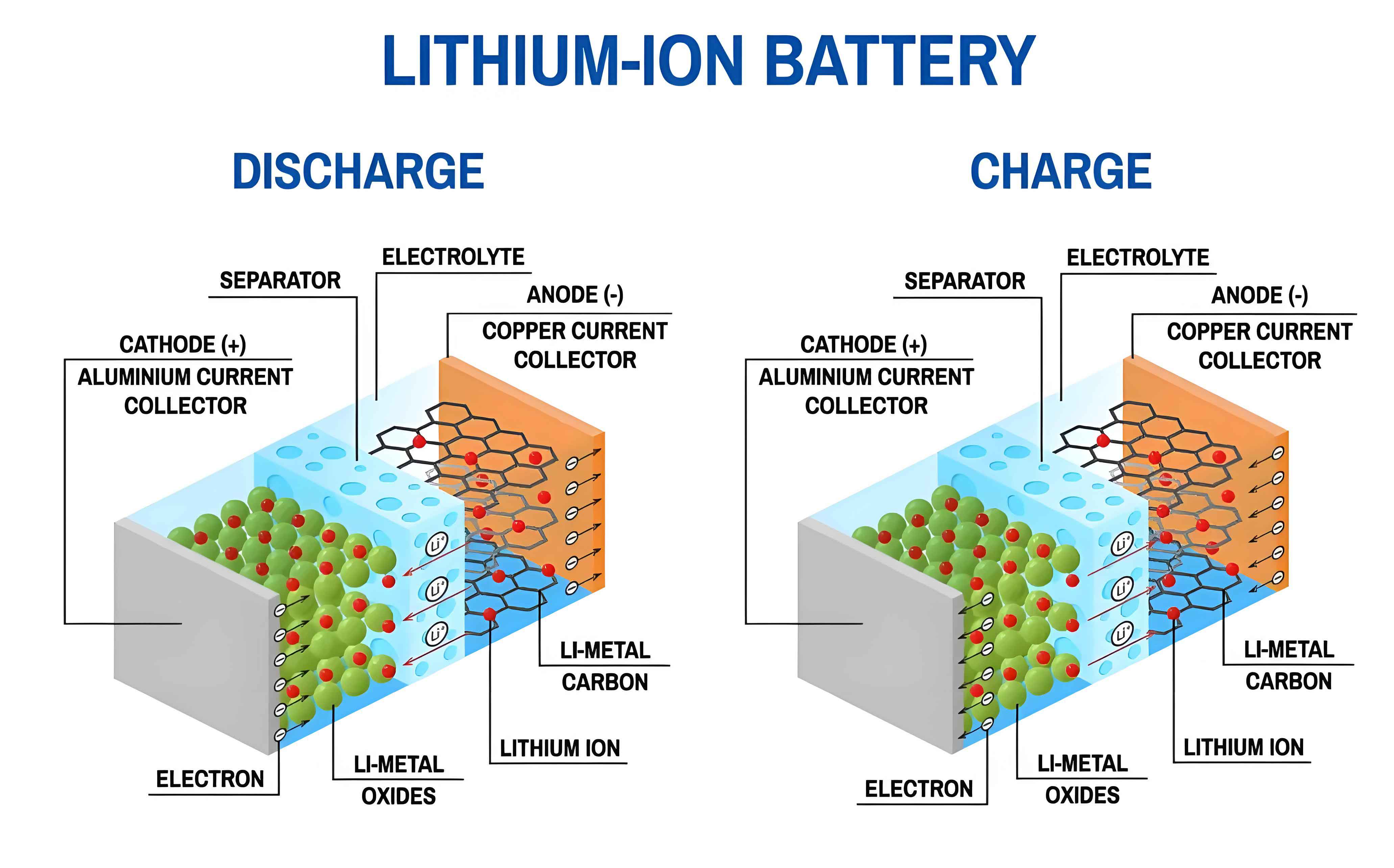
This limitation has spurred extensive research into alternative anode materials with higher intrinsic capacity. Among the various candidates, conversion-type metal oxides have attracted significant attention. Molybdenum trioxide (MoO3) emerges as a particularly promising candidate for next-generation li ion battery anodes. Its appeal lies in a compelling combination of properties: a high theoretical specific capacity of approximately 1117 mAh/g (based on a multi-electron transfer process), a naturally layered orthorhombic (α-MoO3) structure that facilitates ion intercalation, and good chemical stability. The layered structure consists of double layers of MoO6 octahedra sharing edges, forming sheets that are held together by weak van der Waals forces along the [010] direction, creating diffusion channels for Li+ ions. The theoretical capacity can be derived from the conversion reaction:
$$ \text{MoO}_3 + 6\text{Li}^+ + 6e^- \leftrightarrow \text{Mo} + 3\text{Li}_2\text{O} $$
This reaction suggests a high lithium storage capability. However, the practical deployment of pure MoO3 in a li ion battery is severely hampered by several intrinsic drawbacks. Its poor electronic conductivity (∼10-5 S/cm) leads to sluggish reaction kinetics and poor rate performance. The significant volume expansion and contraction (often exceeding 100%) during the repeated lithium insertion and extraction processes cause severe pulverization of the electrode material, loss of electrical contact, and rapid capacity decay. Furthermore, the initial conversion reaction often involves irreversible phase transitions and the formation of a solid electrolyte interphase (SEI), resulting in low initial Coulombic efficiency (ICE).
Therefore, the central challenge in utilizing MoO3 for li ion battery applications is to engineer its morphology, composition, and composite structure to overcome these limitations while harnessing its high capacity. This review aims to consolidate recent strategies, analyze their underlying mechanisms, and provide a comprehensive overview of the pathways toward high-performance MoO3-based anodes for the advanced li ion battery.
Fundamental Electrochemical Mechanisms and Challenges
A deep understanding of the (de)lithiation mechanism in MoO3 is essential for rational material design. The electrochemical process is more complex than the simple conversion reaction previously mentioned and is known to proceed in stages. Upon the first discharge (lithiation), lithium ions initially intercalate into the van der Waals gaps of the layered α-MoO3 structure, forming a lithiated phase often described as LixMoO3 (x ≤ 1.5). This intercalation process is partially reversible. Upon further discharge to lower potentials, an irreversible conversion reaction takes place, decomposing the material into metallic molybdenum nanoclusters embedded in a Li2O matrix. The subsequent charge process does not fully reconstruct the original MoO3 lattice. Instead, it may form amorphous or partially oxidized phases like Li2MoO3 or other lithium molybdenum oxides. This irreversibility is a primary cause of capacity loss and low ICE in the first cycle.
The volumetric strain ($\epsilon_v$) associated with this phase transformation can be approximated by comparing the molar volumes of the reactants and products, contributing to mechanical degradation. The poor electronic conductivity further exacerbates polarization, reducing the usable capacity, especially at high current rates. The combined effects of these challenges are summarized in the following relationship governing the practical capacity ($C_{prac}$) of a MoO3 electrode:
$$ C_{prac} = \eta_{ICE} \cdot C_{theo} \cdot f(\sigma, D_{Li^+}, \epsilon_v) $$
where $\eta_{ICE}$ is the initial Coulombic efficiency, $C_{theo}$ is the theoretical capacity, and $f(\sigma, D_{Li^+}, \epsilon_v)$ is a function that decreases with lower electronic conductivity ($\sigma$), lower lithium-ion diffusion coefficient ($D_{Li^+}$), and higher volumetric strain ($\epsilon_v$). The overarching goal of modern research is to maximize this function through strategic material engineering.
Strategic Engineering of MoO3 for Enhanced Li-Ion Battery Performance
To transform MoO3 from a promising material into a viable high-capacity anode for li ion battery technology, researchers have developed a multi-faceted arsenal of strategies. These approaches can be broadly categorized and are often used synergistically.
1. Nanostructuring and Morphological Control
Reducing the bulk material to nanoscale dimensions is a fundamental and powerful strategy. Nanostructures such as nanowires, nanobelts, nanorods, and nanoflowers offer shortened diffusion paths for both Li+ ions and electrons, enhancing rate capability. Their high surface area provides more active sites for electrochemical reactions. Furthermore, nanomaterials can better accommodate mechanical stress from volume changes compared to bulk particles, improving cycling stability.
For instance, one-dimensional (1D) MoO3 nanobelts synthesized via hydrothermal methods exhibit superior electrochemical properties compared to their bulk counterparts. The 1D morphology facilitates efficient charge transport along the longitudinal axis. Similarly, two-dimensional (2D) nanosheets or three-dimensional (3D) hierarchical structures assembled from primary nanosheets create porous networks. These structures not only shorten diffusion lengths but also allow for electrolyte penetration and provide void space to buffer volume expansion, which is critical for maintaining the integrity of the li ion battery anode over many cycles.
2. Compositing with Conductive Matrices
To address the cripplingly low electronic conductivity, compositing MoO3 with conductive materials, particularly carbon-based materials, has become a mainstream approach. Carbon coatings, graphene, carbon nanotubes (CNTs), and porous carbon frameworks create a conductive percolation network that wraps around or supports the MoO3 nanoparticles.
- Carbon Coating: A uniform amorphous carbon layer on MoO3 nanoparticles significantly enhances surface electronic conductivity, protects the material from direct electrolyte exposure (stabilizing the SEI), and confines volume changes.
- Graphene/MoO3 Composites: Graphene or reduced graphene oxide (rGO) sheets serve as an excellent flexible and highly conductive scaffold. MoO3 nanostructures anchored on graphene prevent their aggregation and graphene restacking. The synergistic effect often leads to exceptional performance. The charge transfer resistance ($R_{ct}$) in such composites can be modeled as a parallel connection, significantly lower than that of pure MoO3.
- CNT/MoO3 Hybrids: CNTs act as one-dimensional conductive wires, connecting MoO3 particles and creating highways for electron transport.
- Metal-Organic Framework (MOF)-Derived Composites: Pyrolyzing Mo-containing MOFs can yield MoO3 nanoparticles uniformly embedded in a porous carbon matrix. This in-situ method ensures intimate contact and prevents nanoparticle coalescence.
The enhancement in conductivity directly improves the power density of the resulting li ion battery.
| Strategy | Primary Function | Key Mechanism | Typical Performance Improvement |
|---|---|---|---|
| Nanostructuring | Improve kinetics & strain tolerance | Shortens Li+/e– path, increases surface area, accommodates strain | Higher capacity at high rates (>500 mAh/g at 2 A/g), improved cycle life |
| Carbon Compositing | Enhance electronic conductivity | Provides conductive network, buffers volume change, stabilizes SEI | Dramatically improved rate capability, higher ICE, stable long-term cycling |
| Ion Pre-intercalation/Doping | Modify intrinsic conductivity & structure | Increases basal spacing, introduces donor states, stabilizes structure | Enhanced Li+ diffusion coefficient, better structural stability during cycling |
| Hybridization with Active/Inactive Phases | Synergistic effects & catalytic activation | One component buffers volume, another provides capacity or catalyzes reactions | Very high specific capacity (>1000 mAh/g), superior cycling stability |
3. Ion Pre-Intercalation and Doping
This strategy involves chemically modifying the MoO3 crystal lattice itself to improve its intrinsic properties. Pre-intercalating ions (e.g., H+, NH4+, Na+) into the interlayer space can widen the gallery spacing, facilitating faster Li+ diffusion. More importantly, it can significantly increase the electronic conductivity by several orders of magnitude. For example, hydrogen molybdenum bronze (HxMoO3) exhibits a metallic-like conductivity due to the introduction of electrons into the Mo 4d band.
An advanced variant of this is nitridation or nitrogen doping. Treating MoO3 with ammonia at moderate temperatures can lead to the formation of oxynitrides (MoOxNy) or N-doped MoO3. The incorporation of nitrogen atoms creates donor states, enhancing n-type conductivity. Furthermore, the process often involves simultaneous hydrogen intercalation. This dual modification results in compounds like HxMo(O,N)3, which demonstrate not only higher electronic conductivity but also faster lithium-ion transport, as evidenced by a higher calculated Li+ diffusion coefficient ($D_{Li^+}$) from galvanostatic intermittent titration technique (GITT) or electrochemical impedance spectroscopy (EIS) data. The $D_{Li^+}$ can be estimated from the EIS Warburg region using the formula:
$$ D_{Li^+} = \frac{R^2T^2}{2A^2n^4F^4C^2\sigma_\omega^2} $$
where $R$ is the gas constant, $T$ is temperature, $A$ is electrode area, $n$ is number of electrons, $F$ is Faraday’s constant, $C$ is Li+ concentration, and $\sigma_\omega$ is the Warburg coefficient. N-doped materials typically show a lower $\sigma_\omega$, indicating higher $D_{Li^+}$.
4. Construction of Hybrid and Composite Metal Oxides
Combining MoO3 with other metal oxides (e.g., Co3O4, Fe2O3, SnO2) or forming mixed metal molybdates (e.g., CoMoO4, NiMoO4) can yield synergistic effects. In these composites, one component may act as a buffer to mitigate volume changes, while the other provides high capacity. A particularly interesting concept is the use of a catalytic metal phase to promote the reversibility of the Li2O formation/decomposition reaction, which is often irreversible in pure MoO3.
For example, in a rationally designed porous hybrid material containing both MoO3 and CoMoO4, the Co nanoparticles generated from the reduction of CoMoO4 during the first discharge can act as a catalyst. These nanocatalysts lower the activation energy for the decomposition of Li2O in subsequent charge cycles, making the conversion reaction more reversible. This catalytic effect can be conceptually linked to a reduction in the overpotential ($\eta$) for the charge reaction, leading to higher reversible capacity and Coulombic efficiency over cycling. The design of such bi- or multi-functional composites represents a sophisticated approach to unlocking the full potential of conversion anodes for high-energy li ion battery applications.
| Material Architecture | Synthetic Method | Specific Capacity (mAh/g) | Cycle Performance (Capacity Retention) | Rate Capability | Key Feature |
|---|---|---|---|---|---|
| MoO3 Nanobelts | Hydrothermal | ~900 (0.1C) | ~70% after 100 cycles | Moderate | 1D morphology, shortened path |
| MoO3@Carbon Core-Shell | Sol-gel + CVD | ~1050 (0.1C) | >85% after 200 cycles | Good | Conductive coating, SEI stabilization |
| MoO3/rGO Nanocomposite | Self-assembly | ~1200 (0.1A/g) | >90% after 300 cycles | Excellent | Graphene conductive network, flexibility |
| HxMo(O,N)3 Nanosheets | Ammonia Treatment | ~1000 (0.2C) | >80% after 300 cycles | Very Good | Enhanced intrinsic conductivity & ion diffusion |
| Porous MoO3/CoMoO4 Hybrid | Template + Calcination | >1500 (0.2A/g) | High stability over 100 cycles | Good | Catalytic effect from Co, porous buffer |
Future Perspectives and Conclusion
The journey to develop a commercially viable, high-capacity MoO3-based anode for the next-generation li ion battery has seen remarkable progress. From fundamental studies elucidating its complex (de)lithiation mechanisms to advanced engineering of its nano/microstructure, electronic properties, and composite formation, researchers have devised multiple strategies to tackle its inherent weaknesses. The integration of MoO3 with conductive carbon matrices, the intelligent design of hybrid architectures with catalytic phases, and the chemical modification of its lattice stand out as particularly effective directions.
However, several challenges persist on the path from laboratory coin cells to practical li ion battery cells. The initial Coulombic efficiency, while improved, often remains below 80%, indicating active lithium loss that must be compensated from the cathode in a full cell. The long-term cycling stability under high mass loading (areal capacity > 3 mAh/cm²) needed for practical cells requires further investigation. The scalability and cost-effectiveness of some sophisticated synthesis methods also need to be evaluated.
Future research will likely focus on several key areas: (1) Developing simpler, scalable methods to produce optimized MoO3-carbon hybrids; (2) Exploring new dopants or pre-intercalants to further enhance ionic and electronic transport; (3) Designing more robust electrode architectures using free-standing or binder-free electrodes to maximize the content of active material; and (4) Gaining deeper insights through advanced in-situ and operando characterization techniques to observe degradation mechanisms in real time.
In conclusion, MoO3, through strategic material engineering, holds substantial promise as a high-capacity anode material. Its successful integration could significantly push the energy density boundaries of the ubiquitous li ion battery, enabling longer-range electric vehicles and more efficient large-scale energy storage systems. The continued interdisciplinary effort combining materials science, electrochemistry, and nanotechnology will be crucial in turning this promise into reality.