
The relentless pursuit of higher energy density, longer cycle life, and enhanced safety continues to drive innovation in energy storage. At the heart of this technological evolution lies the li ion battery, a power source that has become indispensable for modern portable electronics, electric vehicles, and grid-scale storage. While significant attention is often given to cathode and anode materials, one component silently dictates the fundamental safety and performance limits of the cell: the separator. This critical, porous membrane, positioned between the cathode and anode, performs the dual, seemingly contradictory, roles of physically preventing electrical short circuits while facilitating the unhindered transport of lithium ions. Its properties are not merely supplementary; they are central to the operational integrity of the entire li ion battery system. In this comprehensive analysis, I will dissect and compare the physical and electrochemical properties of the most commercially prevalent separator types, providing a data-driven framework for understanding their impact on battery performance.
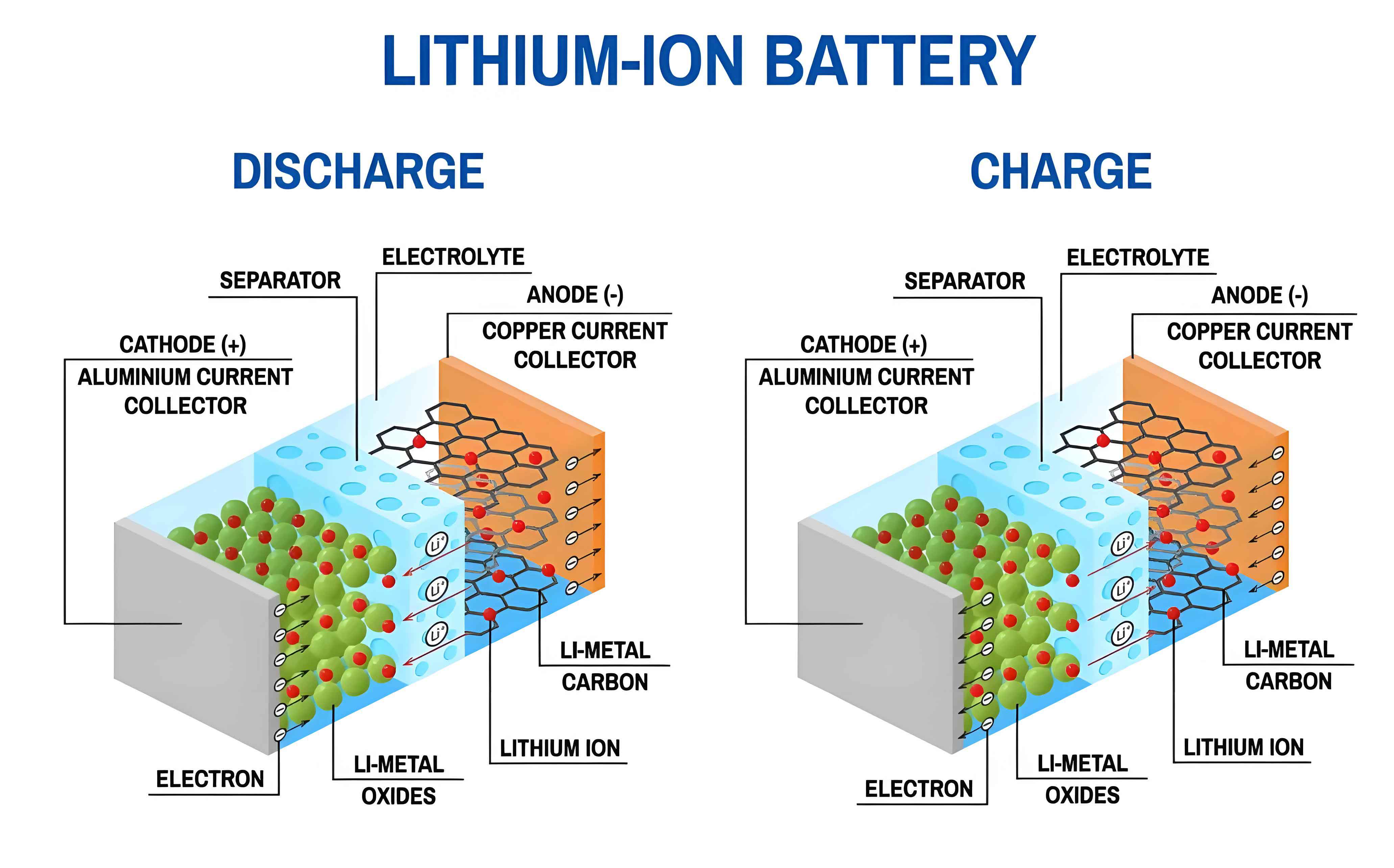
The ideal separator for a li ion battery must satisfy a stringent set of requirements, often presenting trade-offs that engineers must carefully balance. These requirements include:
- Mechanical Robustness: Sufficient tensile and puncture strength to withstand the rigors of cell winding/stacking and to resist penetration by electrode burrs or lithium dendrites during cycling.
- Electrochemical Inertness: Stability within the highly reducing and oxidizing potentials of the anode and cathode, and resistance to degradation by the electrolyte over time.
- Excellent Wettability: Rapid and complete absorption of the liquid electrolyte to ensure uniform ion transport and reduce cell “wetting” time after assembly.
- High Ionic Conductivity: Minimal resistance to Li⁺ ion flow, which is directly influenced by porosity, pore structure, and wettability.
- Thermal Stability: Dimensional integrity at elevated temperatures to prevent thermal runaway initiated by separator shrinkage and consequent electrode contact.
- Uniform Microstructure: Consistent pore size and distribution to ensure homogeneous current density and prevent localized hot spots.
To meet these diverse demands, the industry has developed several distinct manufacturing processes, each yielding separators with unique characteristic profiles. The four dominant types are: Polyethylene (PE, wet-process), Polypropylene (PP, dry-process), Polypropylene/Polyethylene/Polypropylene (PP/PE/PP trilayer, dry-process), and ceramic-coated variants, most commonly Alumina-coated Polyethylene (PE-Al₂O₃).
Manufacturing Processes and Resultant Morphologies
The foundational properties of a separator are indelibly linked to its method of manufacture. The two primary techniques are “wet” (or phase separation) and “dry” (or melt-stretch) processes, with ceramic coating serving as a vital post-processing modification.
Wet Process (for PE separators): This method involves creating a homogeneous mixture of a high-molecular-weight polyolefin (like polyethylene) with a low-viscosity liquid plasticizer (e.g., paraffin oil). The mixture is melted, extruded into a film, and then stretched biaxially (in both machine and transverse directions). The plasticizer is subsequently extracted using a volatile solvent, leaving behind a highly porous, interconnected network. Finally, the film is heat-set to stabilize its dimensions. The biaxial stretching results in a more isotropic, circular pore structure.
Dry Process (for PP and PP/PE/PP separators): In this method, polypropylene (or a combination of PP and PE for trilayer) is melted and extruded to form a thin film with a highly crystalline structure. The film is then stretched uniaxially at a temperature below the polymer’s melting point. This controlled stretching creates microvoids by pulling apart the crystalline lamellae, resulting in characteristic slit-like pores aligned in the stretching direction. The trilayer PP/PE/PP separator is co-extruded, leveraging the lower melting point of the inner PE layer (approx. 130°C) to provide a built-in thermal shutdown feature.
Ceramic Coating Process (for PE-Al₂O₃ separators): This is a secondary process where a slurry containing ceramic particles (most commonly Al₂O₃ or SiO₂), a polymeric binder (e.g., polyacrylic acid, PVDF), and a solvent is uniformly applied onto a pre-formed base separator (typically wet-process PE). The coating is then dried and calendared. The ceramic layer does not block the pores of the base membrane but instead creates a robust, porous top layer that dramatically alters surface properties and thermal stability.
The fundamental differences in manufacturing are vividly reflected in the microscopic morphology, as summarized in the table below alongside other physical characteristics.
| Separator Type | Manufacturing Process | Typical Pore Shape & Structure | Typical Porosity (%) | Typical Thickness (µm) |
|---|---|---|---|---|
| Polyethylene (PE) | Biaxial Stretch Wet Process | Isotropic, interconnected sub-micron circular pores. | ~40-50 | 16-25 |
| Polypropylene (PP) | Uniaxial Stretch Dry Process | Anisotropic, slit-like pores aligned in the stretching direction. | ~40-55 | 20-25 |
| PP/PE/PP Trilayer | Uniaxial Stretch Dry Process | Similar anisotropic slit-pores; layered structure. | ~40-50 | 20-25 |
| PE-Al₂O₃ Ceramic Coated | Wet Process + Coating | PE base with circular pores + porous network of ceramic particles on surface. | ~40-45 (affected by coating) | Base (e.g., 12-16) + Coating (2-4 per side) |
Physical and Mechanical Property Analysis
The mechanical integrity of a separator is paramount for both cell assembly and long-term operational safety in a li ion battery. It must resist tearing during winding and, crucially, withstand the mechanical pressure from growing lithium dendrites.
Tensile Strength: Measured in the machine direction (MD), tensile strength indicates the separator’s resistance to elongation and tearing. Dry-process separators, due to their highly oriented polymer chains from uniaxial stretching, generally exhibit high tensile strength in the MD. The PP/PE/PP trilayer separator often shows the highest values, sometimes exceeding 200 MPa, as the composite structure synergistically combines the strength of PP layers. Wet-process PE separators have good but typically lower MD tensile strength. The ceramic coating on a PE-Al₂O³ separator adds mechanical reinforcement, increasing its tensile strength compared to the uncoated PE base, though it may not surpass that of a premium trilayer film. The relationship between stress ($\sigma$) and strain ($\epsilon$) can be modeled for polymeric materials, but practically, the key metric is the ultimate tensile strength (UTS) before failure.
Puncture Strength: This is arguably a more critical metric for li ion battery safety, as it simulates resistance to a local stress concentrator like a dendrite or electrode burr. It is measured as the force per unit thickness required for a needle to penetrate the membrane. Here, ceramic-coated separators demonstrate a decisive advantage. The hard, densely packed Al₂O₃ particles on the surface create a formidable barrier, often doubling or tripling the puncture strength compared to uncoated polymeric separators. For instance, while a standard PE separator may have a puncture strength around 300-400 gf (≈ 3-4 N), a PE-Al₂O₃ separator can exceed 1000 gf (≈ 10 N). The dry-process separators (PP, PP/PE/PP) generally fall in between. The enhancement can be conceptually related to the composite’s ability to distribute the localized load:
$$ F_{puncture} \propto H \cdot A_{def} $$
where $H$ is the hardness of the surface layer and $A_{def}$ is the deformed area under the puncture probe. The high hardness ($H_{Al_2O_3}$) of the ceramic significantly increases the required force $F_{puncture}$.
| Mechanical Property | PE Separator | PP Separator | PP/PE/PP Separator | PE-Al₂O₃ Separator |
|---|---|---|---|---|
| Tensile Strength (MD, MPa) | Moderate (e.g., 120-160) | High (e.g., 100-150) | Very High (e.g., 180-250) | High-Moderate (Enhanced vs. base PE) |
| Puncture Strength (N/mm) | Moderate-Low | Moderate | Moderate-High | Very High (Superior) |
| Primary Failure Mode | Ductile tearing | Brittle splitting along pores | Delamination & splitting | Composite failure; ceramic layer crack & peel |
Thermal Stability and Safety Performance
Thermal stability is the cornerstone of safety for a li ion battery. Separator failure at elevated temperature is a primary trigger for thermal runaway.
Melting Point and Shutdown: Each polymer has a characteristic melting temperature ($T_m$). Polyethylene melts around 130-135°C, while polypropylene melts at a higher temperature, around 160-165°C. Upon melting, the pores collapse, increasing resistance and effectively “shutting down” ionic conduction. The PP/PE/PP trilayer is engineered to exploit this: the inner PE layer melts first, providing an early shutdown, while the outer PP layers retain mechanical integrity to prevent direct electrode contact.
Thermal Shrinkage: More dangerous than melting is dimensional shrinkage at temperatures below $T_m$. If a separator shrinks excessively, electrodes can make physical contact, causing a massive internal short circuit. This is quantified by the shrinkage percentage after heat treatment at a specific temperature (e.g., 90°C, 120°C) for 1 hour. Dry-process separators, with their oriented structure, can exhibit significant anisotropic shrinkage, primarily in the transverse direction (TD). Wet-process PE separators shrink more isotropically. The superior performance of ceramic-coated separators is most evident here. The inorganic Al₂O₃ coating (with a melting point >2000°C) acts as a thermally stable skeleton, physically pinning the underlying polymer membrane and dramatically reducing shrinkage, even at temperatures approaching the base polymer’s $T_m$. A PE-Al₂O₃ separator may show negligible shrinkage (<2%) at 150°C for 1 hour, whereas an uncoated PE separator would have melted or shrunk completely.
The thermal performance can be summarized by the following key temperatures and behaviors:
$$ T_{shutdown} \approx T_{m,PE} \quad \text{(for PE-containing separators)} $$
$$ \text{Shrinkage Rate} = \frac{L_0 – L_T}{L_0} \times 100\% $$
where $L_0$ is initial length and $L_T$ is length after heat treatment.
| Thermal Property / Test | PE Separator | PP Separator | PP/PE/PP Separator | PE-Al₂O₃ Separator |
|---|---|---|---|---|
| Melting Point (DSC Peak, °C) | ~130-135 | ~160-165 | ~130 (PE) & ~165 (PP) | ~130-135 (PE base) |
| Shrinkage @ 120°C, 1h (%) | High (>10% isotropic) | Moderate-High (Anisotropic, high in TD) | Moderate (Anisotropic) | Very Low (<2%) |
| Shrinkage @ 150°C, 1h (%) | Melted / >50% | High (>20%) | High (PE layer melted) | Low (Ceramic structure intact) |
| Key Safety Feature | Early thermal shutdown | Higher melt temperature | Shutdown + mechanical backup | Ultra-high thermal dimensional stability |
Electrochemical and Interfacial Properties
The separator’s role as an ionic conductor is critical to the rate capability, efficiency, and longevity of the li ion battery. Its electrochemical properties are largely governed by its interaction with the liquid electrolyte.
Wettability and Electrolyte Uptake: Wettability describes how readily the electrolyte spreads across and into the porous structure. It is commonly assessed by measuring the contact angle of an electrolyte droplet on the separator surface. A smaller contact angle indicates better wettability. Polyolefins (PE, PP) are inherently hydrophobic, leading to poor initial wetting and potentially uneven electrolyte distribution. The hydrophilic nature of metal oxides like Al₂O₃ is transformative. The ceramic coating turns the separator surface from hydrophobic to highly hydrophilic, resulting in near-instantaneous, spontaneous electrolyte absorption (contact angle often <15°). This superior wettability directly leads to higher electrolyte uptake (the mass of electrolyte held per mass of dry separator), ensuring ample ion-conducting medium within the pore network. The uptake can be calculated as:
$$ \text{Uptake (\%)} = \frac{W_{wet} – W_{dry}}{W_{dry}} \times 100\% $$
Ionic Conductivity: This is the definitive metric for the separator’s ionic transport efficiency. It depends on the porosity ($\epsilon$), tortuosity ($\tau$ – a measure of path winding), thickness ($d$), and the conductivity of the imbibed electrolyte ($\kappa_0$). The effective ionic conductivity ($\kappa_{eff}$) of the separator saturated with electrolyte is given by:
$$ \kappa_{eff} = \frac{\epsilon}{\tau} \cdot \kappa_0 $$
Experimentally, it is determined by Electrochemical Impedance Spectroscopy (EIS) on a symmetric cell (e.g., stainless steel | separator + electrolyte | stainless steel). The bulk resistance ($R_b$) from the high-frequency intercept on the real axis is related to conductivity by:
$$ \kappa_{eff} = \frac{d}{R_b \cdot A} $$
where $A$ is the electrode area. Superior wettability ensures complete pore filling, maximizing the effective area for ion transport ($\epsilon/\tau$ term). Furthermore, some studies suggest ceramic particles may interact favorably with electrolyte ions, potentially reducing interfacial resistance. Consequently, PE-Al₂O₃ separators consistently report higher ionic conductivity (often >0.7 mS/cm) compared to their uncoated counterparts (~0.5-0.6 mS/cm). This directly translates to lower cell internal resistance and improved power performance.
Interfacial Stability and Cycle Life: A stable interface between the separator and the electrodes is crucial for long-term cycling. The ceramic coating can act as a physical barrier, suppressing the growth of lithium dendrites more effectively than a soft polymer surface. Additionally, the improved thermal stability prevents internal short circuits caused by localized heating or shrinkage over hundreds of cycles. When assembled into full cells, batteries employing PE-Al₂O₃ separators typically demonstrate superior capacity retention over extended cycling, especially under high-rate or high-temperature conditions. This is because the robust and stable interface mitigates parasitic side reactions and maintains uniform current distribution.
| Electrochemical Property | PE Separator | PP Separator | PP/PE/PP Separator | PE-Al₂O₃ Separator |
|---|---|---|---|---|
| Electrolyte Contact Angle | High (>35°) | High (>35°) | High (>35°) | Very Low (<15°) |
| Electrolyte Uptake (%) | ~100-130 | ~90-120 | ~100-125 | High (~140-180) |
| Ionic Conductivity (mS/cm)* | ~0.45-0.55 | ~0.50-0.60 | ~0.45-0.55 | ~0.65-0.80 |
| Typical Cell DC-IR | Higher | Moderate | Moderate | Lower |
| Cycle Life at 1C (Capacity Retention after 500 cycles) | Good | Good | Good | Excellent (Often >5-10% improvement) |
*Values are typical ranges and depend on specific porosity, electrolyte, and test conditions.
Performance Summary and Application Mapping
The comprehensive comparison reveals a clear, application-driven hierarchy. No single separator is universally perfect, but each excels in scenarios that prioritize specific attributes of the li ion battery.
Polyethylene (PE) Separators: Their key advantage is a consistent, isotropic pore structure from the wet process, which can support good rate capability. The relatively low melting point provides a reliable thermal shutdown function. They are widely used in consumer electronics where cost and consistent performance are key, but inherent thermal shrinkage is a safety concern for high-energy applications.
Polypropylene (PP) Separators: The higher melting point offers a safety margin in terms of melt integrity. However, anisotropic properties, lower puncture strength, and poorer wettability can be limitations. They find use in cost-sensitive applications or where higher temperature resilience is valued over ultimate power performance.
PP/PE/PP Trilayer Separators: This design is an elegant engineering solution, combining the early shutdown of PE with the higher-temperature mechanical integrity of PP. It offers excellent balance and is a benchmark for safety-conscious designs, particularly in power tools and some electric vehicle modules. Its mechanical properties are outstanding.
PE-Al₂O₃ Ceramic-Coated Separators: This category represents the current high-performance standard for demanding applications. It synergistically combines the good baseline properties of wet-process PE with transformative enhancements:
- Safety: Exceptional thermal dimensional stability and superior puncture resistance directly address major failure modes.
- Performance: Outstanding wettability and high ionic conductivity enable excellent rate capability and lower heat generation.
- Longevity: Stable interface and mechanical robustness contribute to extended cycle life.
Consequently, PE-Al₂O₃ separators have become the dominant choice for high-energy-density electric vehicle batteries and premium energy storage systems where safety, power, and lifetime are non-negotiable. The trade-off is a slight increase in cost, thickness, and weight due to the coating, and a marginal reduction in porosity.
Beyond Alumina: Future Trends and Advanced Concepts
The evolution of the separator continues. While Al₂O₃ coating is prevalent, other ceramics like SiO₂, TiO₂, and composite coatings are being explored for specific benefits, such as better adhesion or enhanced electrolyte affinity. Furthermore, the separator is becoming a more “active” component. Key research frontiers include:
Single-Ion Conducting Separators: These advanced materials have anions covalently bonded to the polymer backbone, allowing only Li⁺ ions to move. This could eliminate concentration polarization, vastly improving power and cycle life. The ionic conductivity in such a system is defined solely by the Li⁺ mobility: $\kappa_{SIC} = F \cdot c_{Li} \cdot u_{Li}$, where $F$ is Faraday’s constant, $c_{Li}$ is the lithium ion concentration in the membrane, and $u_{Li}$ is its mobility.
Solid-State and Hybrid Electrolytes: The ultimate safety play is the elimination of liquid electrolytes. Solid-state separators (ceramic, polymer, or composite) are inherently non-flammable and can physically block dendrites. The challenge lies in achieving high ionic conductivity at room temperature and maintaining low interfacial resistance.
Artificial SEI/Functional Coatings: Coatings are being designed not just for thermal stability but to form stable interphases on electrode surfaces, pre-stabilizing the cell and improving first-cycle efficiency and long-term calendar life.
Smart Separators: Incorporating materials that respond to internal cell conditions (overheat, overcharge) by changing resistivity or releasing flame-retardant agents is an active area of research for next-generation li ion battery safety systems.
In conclusion, the separator is far more than a passive spacer in a li ion battery. It is a sophisticated, multi-functional component whose properties resonate through every aspect of cell performance—from safety and power to lifetime and cost. The systematic comparison underscores that ceramic-coated polyethylene separators currently offer the most compelling portfolio of properties for high-performance, high-safety applications. As the demands on energy storage intensify, the continued innovation in separator technology will remain a critical enabler for the next generation of lithium-ion batteries, ensuring they are not only more powerful but also inherently safer and more durable. The choice of separator is, therefore, a foundational decision in li ion battery design, one that balances the intricate interplay of physics, chemistry, and engineering to meet the specific needs of the application.