
The precise and reliable determination of the State of Health (SOH) is paramount for ensuring the safety, longevity, and optimal performance of lithium-ion battery systems, which are the cornerstone of modern electrified transportation and grid storage. SOH, typically defined as the ratio of current maximum capacity to its nominal value, quantifies the battery’s degradation level. However, direct measurement of capacity during real-world operation is often impractical. Consequently, data-driven estimation methods that infer SOH from readily measurable signals like current, voltage, and temperature have gained significant traction. While promising, these methods face critical challenges: their accuracy is highly sensitive to model parameters and hyperparameters, limiting generalizability across different batteries or operating conditions, and they are vulnerable to corruption from sensor noise and measurement anomalies commonly encountered in field applications. This inherent vulnerability can severely degrade the quality of health indicators extracted from raw data, leading to unreliable estimates. This work introduces a novel, robust hybrid model that synergistically combines a Denoising Autoencoder (DAE) with a Gated Recurrent Unit Recurrent Neural Network (GRU-RNN) to achieve high-accuracy SOH estimation with enhanced immunity to data noise and disturbances.
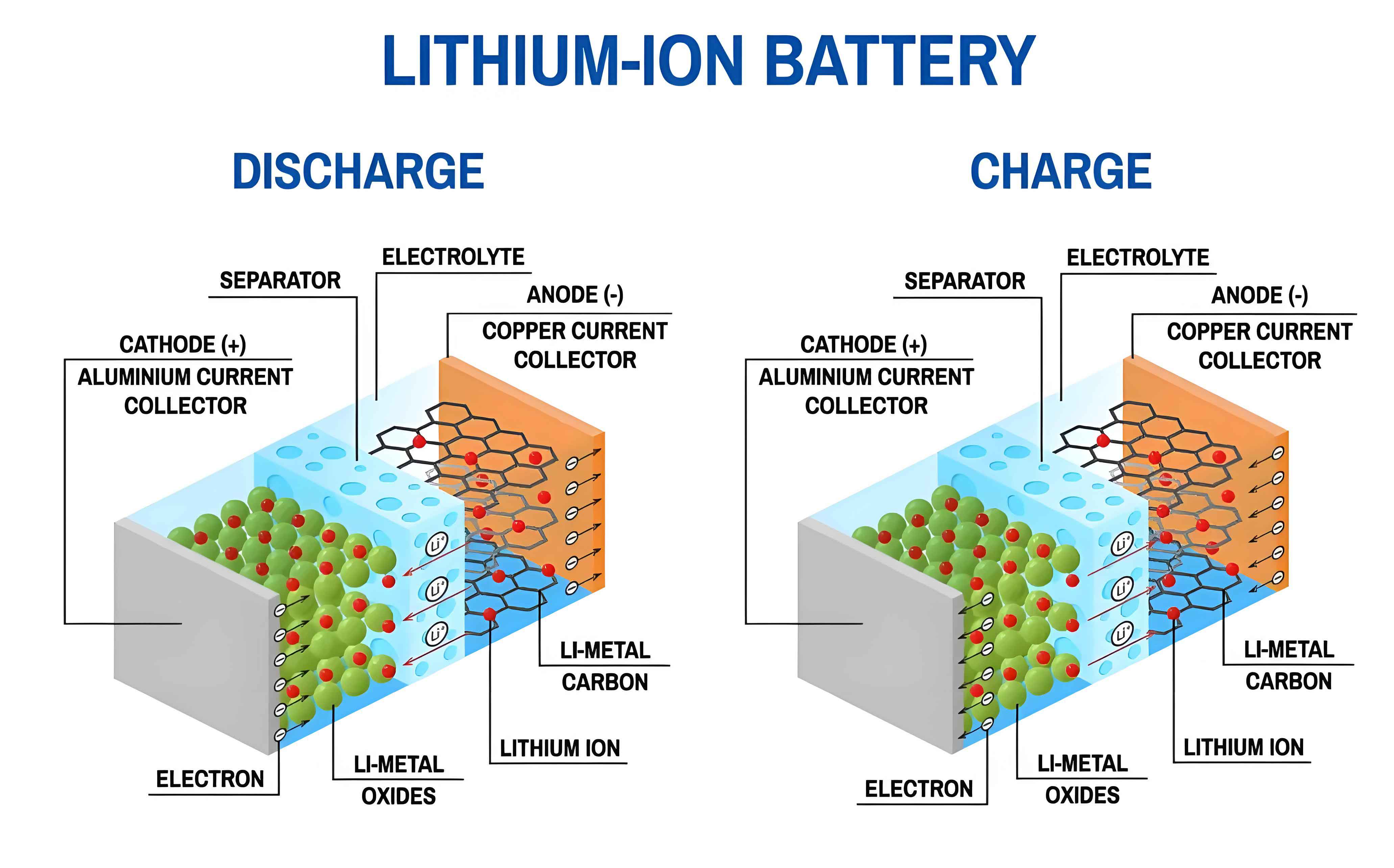
The proposed methodology begins with addressing the noise issue at the feature extraction stage. Instead of directly processing noisy voltage-current data to derive health indicators like Incremental Capacity (IC) curves—a process highly sensitive to noise—we employ a model-based reconstruction of the voltage curve during the constant-current (CC) charging phase. A Voltage-Capacity (VC) model, grounded in battery electrochemistry and equivalent circuit theory, is fitted to the measured data. This model smooths out sensor noise, providing a clean, reconstructed voltage trajectory, $V_{recon}(Q)$, as a function of charged capacity $Q$. The mathematical representation of the reconstructed terminal voltage during CC charging is given by:
$$
U(Q) = \sum_{k=0}^{m} a_{ref,k} \left( s_{soc,0} + \frac{Q}{Q_{c,max}} \right)^k – I R – U_p \left( 1 – e^{-Q/(I \tau)} \right) + I (R + R_p)
$$
where $I$ is the constant current, $R$ is the ohmic resistance, $R_p$ and $U_p$ are the polarization resistance and voltage, $\tau$ is the time constant, $s_{soc,0}$ is the initial state-of-charge, and $Q_{c,max}$ is the maximum capacity. Parameters are identified using nonlinear least squares. From this clean $V_{recon}(Q)$ curve, highly informative health features are extracted robustly. These features include metrics from the voltage curve itself and from the subsequently calculated IC curve ($IC = dQ/dV$), which is now free from the spurious noise that plagues direct numerical differentiation of raw data. Key extracted features are summarized below.
| Feature Category | Specific Features (Examples) | Description |
|---|---|---|
| Voltage-Curve Based | $\Delta t_{V1-V2}$, $A_{V1-V2}$, $K_{V1-V2}$ | Time interval, area under the curve, and slope for voltage window [V1, V2]. Extracted from multiple voltage segments. |
| IC-Curve Based | $IC_{peak2}$, $V_{peak2}$, $IC_{area1}$, $IC_{area2}$ | Amplitude and voltage location of the second IC peak, and areas under specific IC curve segments. |
The core innovation lies in processing these extracted features. Even after reconstruction, feature vectors can contain outliers or residual noise patterns from cell-to-cell variations or abnormal operating conditions. To learn a robust internal representation that is invariant to such corruptions, we employ a Denoising Autoencoder in an unsupervised pre-training stage. The DAE takes the raw feature vector $\mathbf{x}$ and intentionally corrupts it to create a noisy version $\mathbf{\tilde{x}}$, for instance by adding Gaussian noise or applying a masking operator. It then learns to encode and subsequently decode this noisy input to reconstruct the original, clean feature vector $\mathbf{\hat{x}}$. The training objective is to minimize the reconstruction loss, often the Mean Squared Error: $J_{recon} = ||\mathbf{x} – \mathbf{\hat{x}}||^2$. Through this process, the encoder learns to capture the essential, noise-free manifold of the healthy feature space. The operation of the encoder is defined as:
$$
\mathbf{h} = \sigma_{DAE}(\mathbf{W}_{encoder} \mathbf{\tilde{x}} + \mathbf{b}_{encoder})
$$
where $\mathbf{h}$ is the latent, robust representation, $\sigma_{DAE}$ is a non-linear activation function (e.g., sigmoid), and $\mathbf{W}_{encoder}$, $\mathbf{b}_{encoder}$ are the weight matrix and bias vector of the encoder.
This robust feature representation $\mathbf{h}$ is then fed into a supervised GRU-RNN model for SOH estimation. The GRU-RNN is particularly suited for capturing temporal dependencies in the battery aging process across cycles. Its gating mechanism allows it to retain long-term degradation trends while being computationally efficient. The core GRU cell updates are as follows:
$$
\begin{aligned}
\mathbf{z}_t &= \sigma_{GRU}(\mathbf{W}_{xz} \mathbf{h}_t + \mathbf{W}_{hz} \mathbf{H}_{t-1} + \mathbf{b}_z) \quad &\text{(Update Gate)} \\
\mathbf{r}_t &= \sigma_{GRU}(\mathbf{W}_{xr} \mathbf{h}_t + \mathbf{W}_{hr} \mathbf{H}_{t-1} + \mathbf{b}_r) \quad &\text{(Reset Gate)} \\
\mathbf{\tilde{H}}_t &= \tanh(\mathbf{W}_{xh} \mathbf{h}_t + \mathbf{W}_{hh} (\mathbf{r}_t \odot \mathbf{H}_{t-1}) + \mathbf{b}_h) \quad &\text{(Candidate State)} \\
\mathbf{H}_t &= \mathbf{z}_t \odot \mathbf{H}_{t-1} + (1 – \mathbf{z}_t) \odot \mathbf{\tilde{H}}_t \quad &\text{(New Hidden State)}
\end{aligned}
$$
Here, $\mathbf{H}_t$ is the hidden state at cycle $t$, $\sigma_{GRU}$ is the sigmoid function, and $\odot$ denotes the Hadamard product. The final SOH estimate $\hat{y}_t$ for cycle $t$ is obtained from the hidden state via a fully connected layer: $\hat{y}_t = \mathbf{W}_{out} \mathbf{H}_t + b_{out}$. The combined DAE-GRU-RNN model is trained end-to-end, where the DAE’s pre-trained encoder weights can be fine-tuned. This architecture ensures that the GRU-RNN operates on features that are inherently denoised and representative of the true degradation physics, significantly improving estimation robustness.
The proposed framework was rigorously validated using publicly available lithium-ion battery aging datasets (CALCE CS2 and CX2 series). The experiments were designed to test two critical aspects: 1) Comparative performance under noise, and 2) Generalizability using partial charging data. To simulate realistic sensor noise, Gaussian noise was added to the original current and voltage measurements before feature extraction. The model’s performance was compared against standard Deep Neural Network (DNN) and standalone GRU-RNN models. The results, quantified using Mean Absolute Error (MAE) and Root Mean Squared Error (RMSE), clearly demonstrate the superiority of the DAE-GRU-RNN approach.
| Battery Cell | Model | MAE (%) | RMSE (%) |
|---|---|---|---|
| CS-35 | DNN | 0.746 | 0.938 |
| GRU-RNN | 0.701 | 0.889 | |
| DAE-GRU-RNN (Proposed) | 0.627 | 0.810 | |
| CX-34 | DNN | 1.296 | 1.622 |
| GRU-RNN | 1.134 | 1.423 | |
| DAE-GRU-RNN (Proposed) | 0.995 | 1.248 |
The proposed method achieved a 6.4% to 23.2% reduction in MAE compared to the other models, highlighting its enhanced accuracy and robustness when features are derived from noisy data. In the second experiment, the model trained on features from full CC charging curves was tested using features extracted from only partial voltage segments (e.g., 3.8V to 4.0V), a common scenario in real-world applications where a full charge cycle may not be available. The results confirmed that while estimation accuracy naturally decreased compared to using full features, the DAE-GRU-RNN framework still provided viable and significantly better estimates than using partial features with simpler models, demonstrating its strong generalization capability and practical utility for online battery management systems.
In conclusion, this work presents a comprehensive and robust solution for lithium-ion battery SOH estimation. By integrating a model-based voltage reconstruction for clean feature extraction, an unsupervised denoising autoencoder for learning robust feature representations, and a GRU-RNN for capturing temporal degradation dynamics, the proposed DAE-GRU-RNN hybrid model effectively mitigates the negative impacts of sensor noise and data anomalies. The framework demonstrates superior estimation accuracy, improved generalization across different batteries and partial data scenarios, and strong potential for reliable implementation in real-world battery management systems for electric vehicles and energy storage, ultimately contributing to the safer and more efficient utilization of lithium-ion battery technology.