
In the pursuit of advancing electric vehicle technology, the safety and reliability of energy storage systems, particularly li-ion batteries, have become paramount. As a researcher focused on battery electrochemistry and thermal management, I have dedicated significant effort to understanding failure mechanisms that compromise battery integrity. Among these, internal short circuit (ISC) faults stand out as a critical precursor to thermal runaway, a catastrophic event that poses severe risks to both life and property. The early stages of ISC, often initiated by lithium dendrite growth during low-temperature fast charging, present a diagnostic challenge due to their subtle electrical and thermal signatures. In this comprehensive study, we leverage advanced electrochemical-thermal modeling to unravel the characteristics of early ISC in li-ion batteries, aiming to provide a foundation for proactive fault detection and safety预警 in battery management systems.
The widespread adoption of li-ion batteries in electric vehicles is tempered by operational challenges, such as capacity fade in cold climates, which exacerbates range anxiety and encourages frequent fast-charging practices. This低温快充 regimen can induce lithium plating on anode surfaces, fostering the growth of needle-like lithium dendrites. These dendrites may penetrate the separator, creating an internal electronic pathway between electrodes and triggering an ISC. While extensive experimental work has explored ISC through methods like nail penetration or crush tests, these approaches are often destructive, costly, and难以重复. Moreover, they primarily capture external manifestations during中期 or末期 stages, leaving the early-phase internal processes and subtle特征 obscure. Therefore, computational modeling offers a powerful alternative to probe the intricacies of early ISC without physical intervention.
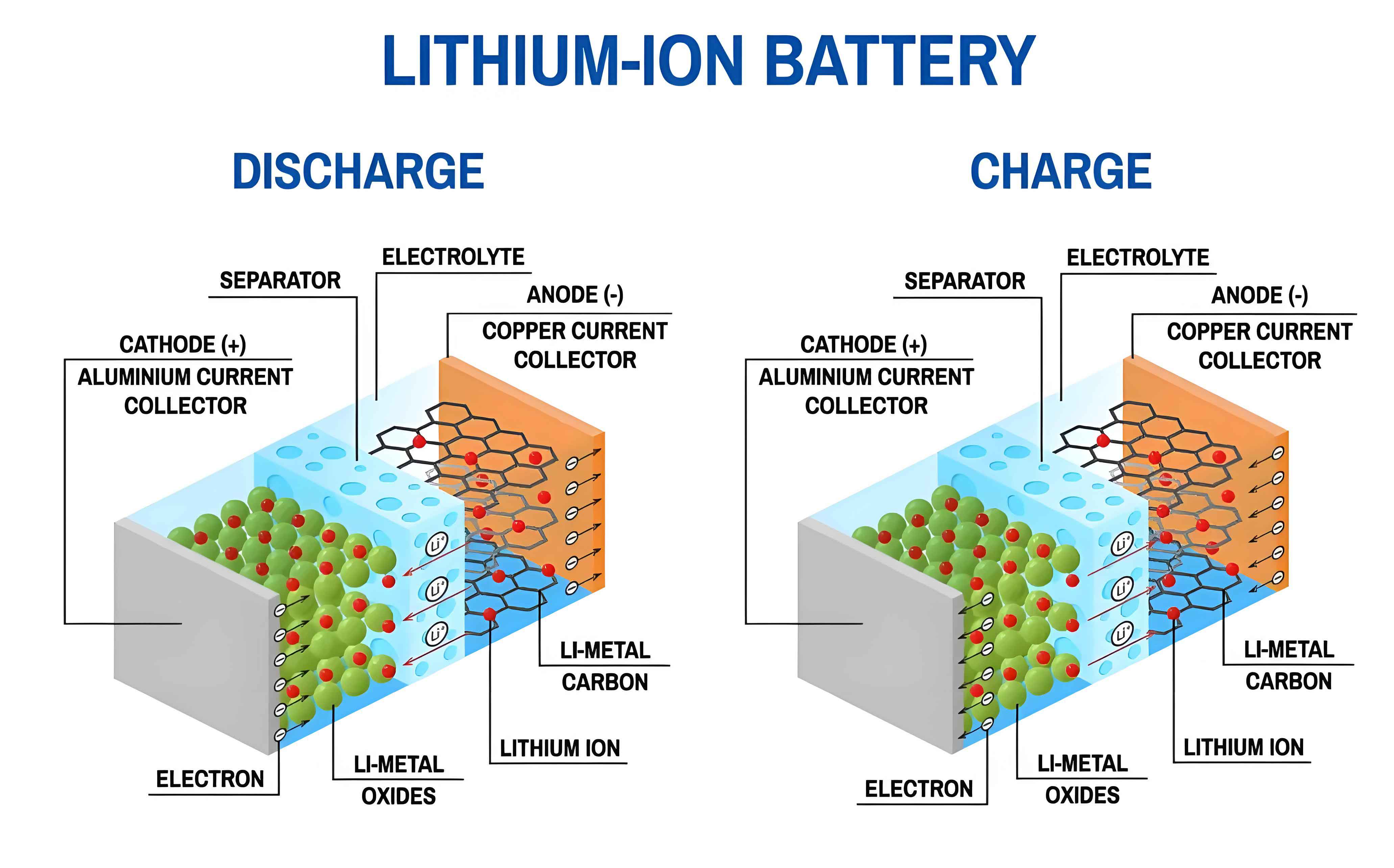
Our investigation is grounded in the pseudo-two-dimensional (P2D) electrochemical model, which mathematically describes the charge and mass transport phenomena within a li-ion battery. This model comprises six governing equations that capture lithium-ion conservation in both solid and liquid phases, Ohm’s law for potential distributions, charge conservation, and electrochemical kinetics via the Butler-Volmer equation. The core equations are summarized below:
Liquid-phase material conservation (accounting for diffusion and migration):
$$
\varepsilon_e \frac{\partial c_e}{\partial t} = \frac{\partial}{\partial x} \left( D_e^{\text{eff}} \frac{\partial c_e}{\partial x} \right) + a (1 – t_+^0) j_r
$$
Solid-phase material conservation (Fick’s second law within active particles):
$$
\frac{\partial c_s}{\partial t} = D_s \left( \frac{2}{r} \frac{\partial c_s}{\partial r} + \frac{\partial^2 c_s}{\partial r^2} \right)
$$
Liquid-phase Ohm’s law (incorporating concentration and potential gradients):
$$
\kappa^{\text{eff}} \frac{\partial \phi_e}{\partial x} = (1 – t_+^0) \frac{2RT\kappa^{\text{eff}}}{F} \frac{\partial \ln c_e}{\partial x} – i_e
$$
Solid-phase Ohm’s law:
$$
\sigma^{\text{eff}} \frac{\partial \phi_s}{\partial x} = -i_s
$$
Charge conservation (linking interfacial reaction flux to current densities):
$$
\frac{\partial i_e}{\partial x} = aF j_r, \quad \frac{\partial i_s}{\partial x} = -aF j_r
$$
Butler-Volmer kinetics for the electrochemical reaction at the solid-electrolyte interface:
$$
j_r = i_0 \left( \exp\left(\frac{\alpha_a F}{RT} \eta\right) – \exp\left(-\frac{\alpha_c F}{RT} \eta\right) \right)
$$
where the overpotential $\eta = \phi_s – \phi_e – E_{\text{OCV}}$. These equations, when solved with appropriate boundary conditions, yield the terminal voltage $U_t = \phi_s|_{x=x_p} – \phi_s|_{x=0}$ for a given current input, forming the basis for analyzing normal and fault conditions in li-ion batteries.
To simulate the thermal behavior of a li-ion battery during early ISC, we developed a three-dimensional multi-physics model coupling electrochemistry with heat transfer. The geometry includes current collectors, positive electrode (NCM), separator, negative electrode (graphite), and a lithium dendrite domain embedded within the separator to represent the internal short. The ISC resistance $R_{\text{ISC}}$ is determined by the dendrite’s geometry and lithium metal conductivity:
$$
R_{\text{ISC}} = \frac{L}{\sigma S}
$$
where $L$ and $S$ are the length and cross-sectional area of the dendrite, respectively. We parameterized the model with material properties from literature and COMSOL’s built-in库, as detailed in Table 1. The heat generation within the li-ion battery comprises reversible entropic heat, irreversible polarization heat, and Joule heating, governed by the energy conservation equation:
$$
\frac{\partial (\rho c_p T)}{\partial t} = \nabla \cdot (k \nabla T) + q_e + q_p + q_j
$$
with source terms defined as:
$$
q_e = j_{\text{Li}} \left( T \frac{\partial U}{\partial T} \right), \quad q_p = j_{\text{Li}} (\phi_s – \phi_e – U), \quad q_j = \sigma^{\text{eff}} \nabla \phi_s \cdot \nabla \phi_s + \kappa^{\text{eff}} \nabla \phi_e \cdot \nabla \phi_e + \kappa^{\text{eff}} \nabla \ln c_e \cdot \nabla \phi_e + \sigma \nabla \phi_{\text{Li}} \cdot \nabla \phi_{\text{Li}}
$$
The coupling between thermal and electrochemical models is achieved through Arrhenius-type dependencies of kinetic parameters on temperature, such as the solid-phase diffusion coefficient:
$$
D_s(T) = 1.4523 \times 10^{-13} \times \exp\left[ \frac{68025.7}{8.314} \left( \frac{1}{T} – \frac{1}{298.15} \right) \right]
$$
This comprehensive approach allows us to simulate temperature distributions and internal reactions under various ISC resistance values, providing insights into the thermal特征 of early-stage faults in li-ion batteries.
| Component | Parameter | Value | Unit |
|---|---|---|---|
| Positive Electrode (NCM) | Thickness | 56 | μm |
| Solid phase volume fraction | 0.48 | – | |
| Maximum solid-phase Li concentration | 29000 | mol/m³ | |
| Solid-phase diffusion coefficient (at 298.15 K) | 5×10⁻¹³ | m²/s | |
| Thermal conductivity | 3.4 | W/(m·K) | |
| Separator | Thickness | 13 | μm |
| Porosity | 0.4 | – | |
| Initial electrolyte concentration | 1200 | mol/m³ | |
| Thermal conductivity | 0.15 | W/(m·K) | |
| Negative Electrode (Graphite) | Thickness | 98 | μm |
| Solid phase volume fraction | 0.62 | – | |
| Maximum solid-phase Li concentration | 31507 | mol/m³ | |
| Solid-phase diffusion coefficient (temperature-dependent) | See Eq. above | m²/s | |
| Thermal conductivity | 1 | W/(m·K) | |
| Lithium Dendrite | Density | 535 | kg/m³ |
| Electrical conductivity | 1×10⁷ | S/m | |
| Radius (simulated cases) | 0.643, 2.034, 6.433 | μm | |
| Thermal conductivity | 85 | W/(m·K) | |
| General | Faraday constant | 96485 | C/mol |
| Universal gas constant | 8.314 | J/(mol·K) | |
| Ambient temperature | 293.15 | K |
For analyzing the electrical characteristics of early ISC with reduced computational burden, we developed a one-dimensional isothermal electrochemical model that simplifies the geometry by neglecting edge effects and representing current collectors as points. This model incorporates the ISC fault by modifying boundary conditions: at the separator-electrode interfaces, the solid-phase current density includes the internal short-circuit current $I_{\text{ISC}}$, and the liquid-phase current density accounts for the combined external and internal currents. The ISC current is approximated by:
$$
I_{\text{ISC}} \approx \frac{\phi_{s,p} – \phi_{s,n}}{R_{\text{ISC}}}
$$
where $\phi_{s,p}$ and $\phi_{s,n}$ are the solid-phase potentials of the positive and negative electrodes, respectively. To ensure model accuracy, we parameterized it using experimental data from a commercial li-ion battery (INR18650MJ1) subjected to constant-current charging at 0.5 C rate. Key parameters, such as solid-phase diffusion coefficients and particle radii, were identified via optimization algorithms, as summarized in Table 2. This validated model enables us to simulate voltage responses and state-of-charge (SOC) evolution under early ISC conditions with different resistance values, providing clear electrical signatures for fault diagnosis.
| Parameter | Positive Electrode | Negative Electrode | Unit |
|---|---|---|---|
| Solid-phase diffusion coefficient $D_s$ | 9.95×10⁻¹⁴ | 2.33×10⁻¹⁴ | m²/s |
| Particle radius $R_s$ | 13.5 | 8.2 | μm |
| Liquid phase volume fraction $\varepsilon_e$ | 0.6291 | 0.50593 | – |
| Initial solid-phase Li concentration $c_{s,0}$ | 14521 | 2473 | mol/m³ |
Simulating the thermal behavior of a li-ion battery with an early ISC reveals that Joule heating in the electrodes dominates the heat generation process. For a dendrite radius of 0.643 μm (corresponding to $R_{\text{ISC}} \approx 1000$ mΩ), the localized temperature near the short rises rapidly to about 318 K within 0.2 seconds, while the overall battery temperature distribution remains largely unaffected. As shown in Table 3, the contribution of different components to the total heat generation power highlights that over 98% stems from Joule heat in the positive and negative electrodes, with minimal heat from the lithium dendrite or current collectors. This is because the electrode materials, especially the positive electrode with higher porosity, exhibit higher electrical resistance, leading to significant焦耳热 under the internal current flow. The reversible entropic heat is positive for the positive electrode (exothermic during lithiation) and negative for the negative electrode (endothermic during delithiation), but its magnitude is negligible compared to irreversible contributions.
| Heat Source | Positive Electrode | Negative Electrode | Lithium Dendrite | Current Collectors | Total |
|---|---|---|---|---|---|
| Joule Heat | ~8.2 | ~7.5 | < 0.001 | < 0.001 | ~15.7 |
| Polarization Heat | ~0.05 | ~0.04 | – | – | ~0.09 |
| Entropic Heat | ~+0.001 | ~-0.001 | – | – | ~0.000 |
| Total per Component | ~8.251 | ~7.539 | < 0.001 | < 0.001 | ~15.79 |
Varying the dendrite radius, and thus the ISC resistance, we observe a direct relationship between the internal short-circuit current and thermal response. For radii of 0.643, 2.034, and 6.433 μm (corresponding to $R_{\text{ISC}}$ values of approximately 1000, 100, and 10 mΩ), the peak internal temperatures reach about 318 K, 322 K, and 326 K, respectively, as summarized in Table 4. Despite these increases, all temperatures remain well below the threshold for SEI decomposition (~353–393 K) that triggers thermal runaway in li-ion batteries. Crucially, the surface temperature of current collectors shows a maximum rise of less than 1.5 K during the early ISC, indicating that external thermal features are too subtle for reliable fault diagnosis. This underscores the challenge of detecting early ISC in li-ion batteries based solely on thermal monitoring.
| Dendrite Radius (μm) | Approx. $R_{\text{ISC}}$ (mΩ) | ISC Current $I_{\text{ISC}}$ (A) | Total Heat Generation Power (W) | Maximum Internal Temperature (K) | Surface Temperature Rise (K) |
|---|---|---|---|---|---|
| 0.643 | 1000 | 0.004 | 0.0165 | 318 | < 1.5 |
| 2.034 | 100 | 0.04 | 0.035 | 322 | < 1.5 |
| 6.433 | 10 | 0.4 | 0.048 | 326 | < 1.5 |
Transitioning to electrical characteristics, our one-dimensional model simulations demonstrate that early ISC induces distinct deviations in voltage and SOC profiles compared to a healthy li-ion battery. Under constant-current charging, the fault battery exhibits a slower voltage rise and reduced charging speed due to internal current分流 that consumes部分 of the input energy. During relaxation (open-circuit), the voltage of an ISC-affected li-ion battery declines abnormally, whereas a normal battery maintains a relatively stable voltage. For instance, with $R_{\text{ISC}} = 10$ Ω, the voltage after 3600 seconds of relaxation drops to 3.964 V, significantly lower than the 4.08 V of a normal cell. Similarly, during discharge, the fault battery depletes faster due to additional internal leakage. These effects are quantified in Table 5, which compares key metrics across different ISC resistances.
| Condition | ISC Resistance (Ω) | Charging Time to 4.2 V (s) | Voltage after 3600 s Relaxation (V) | SOC after 3600 s Relaxation (%) | Discharge Time to 2.5 V (s) |
|---|---|---|---|---|---|
| Normal | ∞ | ~7200 | 4.080 | 80.0 | ~7200 |
| Early ISC | 100 | ~7350 | 4.050 | 78.5 | ~7100 |
| Early ISC | 50 | ~7500 | 4.020 | 77.0 | ~7000 |
| Early ISC | 20 | ~7800 | 3.990 | 75.0 | ~6800 |
| Early ISC | 10 | ~8000 | 3.964 | 73.7 | ~6600 |
The underlying mechanism for these electrical signatures lies in the internal电子通路 established by the lithium dendrite. The ISC current $I_{\text{ISC}}$ not only causes continuous capacity loss (leakage) but also alters the internal polarization states. This dual effect manifests as a voltage offset and altered SOC dynamics. The leakage can be estimated by:
$$
Q_{\text{ISC}} = \frac{V_e}{R_{\text{ISC}}} t_e
$$
where $V_e$ is the nominal voltage, and $t_e$ is the duration. For example, with $R_{\text{ISC}}=10$ Ω over 3600 seconds, $Q_{\text{ISC}} \approx 0.03887$ Ah, aligning with experimental observations from external resistor-based ISC simulations. This confirms that even high-resistance early ISC (e.g., 100 Ω) produces measurable electrical anomalies in li-ion batteries, though the signals are微弱 compared to later stages.
To further elucidate the electrochemical shifts during early ISC, we analyze the spatial distributions of lithium concentration and overpotential within the li-ion battery. The internal short circuit creates localized depletion and accumulation of lithium ions near the fault site, perturbing the normal concentration gradients. This perturbation can be described by modifying the boundary conditions for the solid-phase diffusion equation to account for the additional flux from the ISC current. The resulting concentration profiles, solved numerically, show that the negative electrode experiences faster lithium plating or stripping near the dendrite, while the positive electrode sees accelerated intercalation or deintercalation. These changes exacerbate local polarization, leading to the observed voltage deviations. Mathematically, the overpotential $\eta$ in the Butler-Volmer equation becomes spatially non-uniform, with higher magnitudes near the short, which can be expressed as:
$$
\eta(x) = \phi_s(x) – \phi_e(x) – E_{\text{OCV}}(c_{s,\text{surf}}(x)) + \Delta \eta_{\text{ISC}}
$$
where $\Delta \eta_{\text{ISC}}$ represents the additional polarization due to the internal current. This nuanced understanding helps explain why even small ISC resistances can alter the voltage-SOC relationship in li-ion batteries.
In discussing the implications for battery management systems (BMS), the subtle electrical features of early ISC in li-ion batteries offer a viable pathway for fault diagnosis. Unlike thermal signatures, which are insignificant on the surface, voltage-based metrics such as relaxation voltage decay, charging time延长, and discharge acceleration can be monitored in real-time. Advanced algorithms, like time-series similarity analysis or machine learning models, can quantify the voltage偏移 and detect anomalies before the fault escalates. For instance, by comparing the voltage trajectories of individual cells within a series-connected module, a BMS can identify the faulty li-ion battery exhibiting abnormal voltage drops during rest periods. This proactive approach enhances the safety of electric vehicles by enabling early warning and mitigating thermal runaway risks.
Moreover, the model insights guide design improvements for li-ion batteries to resist early ISC. For example, optimizing separator mechanical strength to deter dendrite penetration, enhancing electrolyte formulations to suppress lithium plating, or incorporating internal sensors for localized current monitoring could be informed by our simulations. The electrochemical-thermal framework also allows for exploring the impact of operating conditions, such as temperature and charge rate, on early ISC progression. We plan to extend this work to study multi-cell interactions and module-level fault propagation in li-ion battery packs, which is critical for practical applications.
In conclusion, our electrochemical-thermal modeling study delineates the characteristics of early internal short circuit in li-ion batteries with clarity. The thermal analysis reveals that Joule heating in electrodes dominates heat generation, but external temperature rises are minimal (<1.5 K), making thermal-based detection challenging for early-stage faults. Conversely, electrical signatures—including slowed charging, accelerated discharging, and abnormal voltage relaxation—provide robust indicators for diagnosis. These findings underscore the importance of voltage monitoring and advanced data analytics in BMS for early ISC detection. As li-ion battery technology evolves towards higher energy densities and faster charging, understanding and mitigating early failure modes like ISC will remain crucial for ensuring the safety and longevity of electric vehicles and other energy storage applications. Future work will focus on experimental validation of these model-predicted signatures and developing embedded diagnostic algorithms for real-world implementation.