
In the rapidly evolving landscape of new energy vehicles, the li-ion battery has emerged as a cornerstone technology, driving the transition toward sustainable transportation. As a secondary battery, the li-ion battery operates primarily through the movement of lithium ions between the positive and negative electrodes during charge and discharge cycles. During charging, lithium ions de-intercalate from the positive electrode, migrate through the electrolyte, and intercalate into the negative electrode, resulting in a lithium-rich state at the negative electrode. Conversely, during discharge, the process reverses. This fundamental mechanism underpins the widespread adoption of li-ion batteries in new energy vehicles, owing to their high energy density, low self-discharge, and long cycle life. However, despite these advantages, challenges such as performance degradation in battery packs, high costs, and safety concerns persist, hindering the full potential of li-ion batteries. In this article, we explore the application of li-ion batteries in new energy vehicles, analyze their strengths and limitations, propose optimization strategies, and validate these approaches through simulation analysis, aiming to foster enhanced design and utilization of li-ion battery technology.
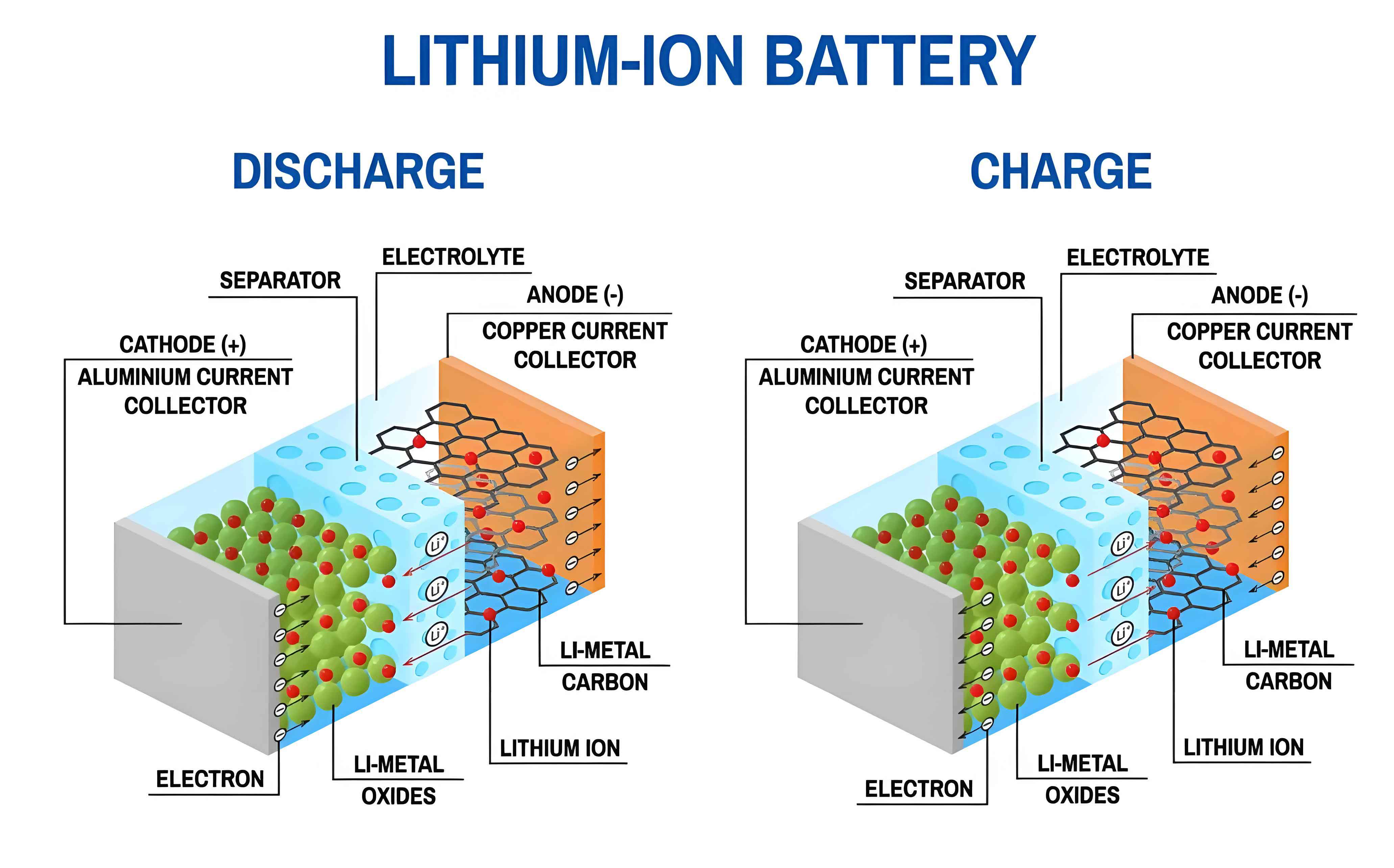
The li-ion battery’s prominence in new energy vehicles stems from several key advantages that align with the demanding requirements of electric propulsion systems. Firstly, the li-ion battery offers superior energy density, which is critical for extending vehicle range and improving energy utilization. The working voltage of a typical li-ion battery exceeds 3.6 V, significantly higher than that of many other battery types, such as lead-acid or nickel-metal hydride batteries, which generally operate between 1.5 V and 3.0 V. This high voltage contributes to greater energy storage per unit mass. To quantify this, we can express energy density (\(E_d\)) as:
$$E_d = \frac{E}{m}$$
where \(E\) represents the total energy stored in watt-hours (W·h) and \(m\) is the mass in kilograms (kg). For li-ion batteries, \(E_d\) typically ranges from 150 to 250 W·h/kg, as shown in Table 1, which compares various batteries used in new energy vehicles. This makes the li-ion battery a top contender, especially when considering trade-offs with cost and manufacturability.
| Battery Type | Energy Density (W·h/kg) |
|---|---|
| Li-ion Battery | 150–250 |
| Lithium Polymer Battery | 200–300 |
| Nickel-Metal Hydride Battery | 50–100 |
| Sodium-ion Battery | 80–150 |
| Lead-acid Battery | 30–50 |
Table 1: Energy density comparison of batteries used in new energy vehicles. The li-ion battery demonstrates competitive performance, though lithium polymer batteries offer higher density at increased cost and complexity.
Secondly, the li-ion battery exhibits low self-discharge rates, which minimizes energy loss during storage and enhances overall efficiency. Self-discharge rate (\(S_d\)) can be modeled as:
$$S_d = \frac{Q_{loss}}{Q_{initial} \times t} \times 100\%$$
where \(Q_{loss}\) is the lost charge, \(Q_{initial}\) is the initial charge, and \(t\) is time in months. For li-ion batteries, \(S_d\) is approximately 2–3% per month, as detailed in Table 2. This is notably lower than alternatives like nickel-metal hydride batteries, which have self-discharge rates of 10–20% per month, ensuring that li-ion batteries retain charge better over time and reduce waste.
| Battery Type | Self-discharge Rate (%/month) |
|---|---|
| Li-ion Battery | 2–3 |
| Lithium Polymer Battery | 1–1.5 |
| Nickel-Metal Hydride Battery | 10–20 |
| Sodium-ion Battery | 5–10 |
| Lead-acid Battery | 5–15 |
Table 2: Self-discharge rates of various batteries. The li-ion battery’s low rate contributes to its reliability in new energy vehicle applications.
Thirdly, the li-ion battery boasts a long cycle life, enabling repeated charge-discharge cycles without significant capacity fade. Cycle life (\(N_{cycle}\)) is a function of material properties and operational conditions, often expressed empirically. For li-ion batteries, \(N_{cycle}\) ranges from 800 to 1,500 cycles, as compared in Table 3. This durability reduces replacement frequency and lowers long-term costs, making the li-ion battery a sustainable choice for new energy vehicles.
| Battery Type | Cycle Life (cycles) |
|---|---|
| Li-ion Battery | 800–1,500 |
| Lithium Polymer Battery | 300–3,000 |
| Nickel-Metal Hydride Battery | 800–1,200 |
| Sodium-ion Battery | 500–1,000 |
| Lead-acid Battery | 300–500 |
Table 3: Cycle life comparison of batteries. The li-ion battery’s robust cycle performance supports its dominance in the new energy vehicle sector.
Despite these advantages, the application of li-ion batteries in new energy vehicles faces several drawbacks. One major issue is performance degradation when batteries are grouped into packs. Due to inconsistencies in parameters such as capacity, internal resistance, and electrode characteristics among individual cells, the overall pack efficiency declines. This can be described by a degradation model:
$$P_{deg} = P_{initial} \times e^{-\alpha t}$$
where \(P_{deg}\) is the degraded performance, \(P_{initial}\) is the initial performance, \(\alpha\) is the degradation coefficient, and \(t\) is time or cycle count. For li-ion battery packs, \(\alpha\) tends to be higher than in isolated cells, leading to reduced energy output and shorter lifespan. Additionally, the high cost of li-ion batteries remains a barrier, driven by expensive materials like cobalt and complex manufacturing processes. For instance, ternary li-ion batteries may only last 300–500 cycles, necessitating frequent replacements and increasing ownership costs. Safety is another concern; li-ion batteries are susceptible to risks such as overcharge, over-discharge, and thermal runaway, which can lead to fires or explosions. The exothermic reactions during failure modes can be approximated by:
$$\Delta H = \sum \Delta H_{products} – \sum \Delta H_{reactants}$$
where \(\Delta H\) is the enthalpy change, indicating heat release. In li-ion batteries, side reactions at the electrodes or electrolyte decomposition can generate excessive heat, compromising safety.
To address these challenges, we propose optimization思路 for li-ion batteries in new energy vehicles. First, to mitigate performance degradation, we suggest adopting advanced materials and designs. For example, using carbon-based anode materials and coating the electrolyte with organic conductive films can enhance stability. This approach, akin to lithium polymer batteries, improves consistency in battery packs. The modified li-ion battery’s performance can be modeled as:
$$P_{optimized} = P_{initial} \times (1 – \beta)$$
where \(\beta\) represents the reduced degradation factor due to material enhancements. Second, cost reduction can be achieved by increasing battery capacity and expanding application scenarios. By optimizing cell design, we can boost energy storage without altering core工艺, lowering per-unit costs. Integrating li-ion batteries with IoT-based energy management systems allows for smart charging and discharge, reducing waste and operational expenses. For instance, a vehicle’s li-ion battery can interact with grid or building systems to balance supply and demand, modeled as:
$$C_{total} = C_{battery} + C_{integration} – C_{savings}$$
where \(C_{total}\) is the total cost, \(C_{battery}\) is the battery cost, \(C_{integration}\) is the integration cost, and \(C_{savings}\) are savings from optimized energy use. Third, safety enhancements involve modifying electrolyte composition and electrode materials. Using fluorine-containing lithium salts like LiPF₆ as electrolyte reduces explosion risks. Coating cathode materials with metal oxides (e.g., Al₂O₃) and applying SEI films on anodes can prevent direct contact and side reactions. The safety improvement can be quantified by a risk index \(R\):
$$R = \frac{F_{incidents}}{N_{cycles}}$$
where \(F_{incidents}\) is the frequency of safety incidents and \(N_{cycles}\) is the number of cycles. By implementing these measures, \(R\) can be minimized.
To validate these optimization思路, we conducted a simulation analysis based on a commercial li-ion battery used in new energy vehicles. We adjusted key parameters: cathode material was coated with Al₂O₃, anode was covered with an SEI film, battery capacity was increased by 15%, and electrolyte was replaced with LiPF₆. The simulation used accelerated testing with a ratio of 1:100,000 (1 minute simulating 100,000 minutes of operation). Key cell parameters are summarized in Table 4, derived from the base design.
| Parameter | Specification |
|---|---|
| Positive Electrode Layers | 36 layers (33 double-sided, 3 single-sided), thickness 2.559 mm |
| Aluminum Foil Layers | 36 layers, thickness 0.432 mm |
| Negative Electrode Layers | 35 layers (34 double-sided, 1 single-sided), thickness 3.175 mm |
| Tab Layers | 1 layer, thickness 0.1 mm |
| Aluminum Plastic Film Layers | 2 layers, thickness 0.222 mm |
Table 4: Key parameters of the li-ion battery cell used in simulation. These elements influence performance and safety outcomes.
Furthermore, tab material properties were considered, as shown in Table 5, to ensure design reliability. The simulation monitored performance degradation, cycle life, and safety incident rates, with results compared to baseline data from the manufacturer.
| Material | Density (kg/mm³) | Resistivity (Ω·mm) | Specific Heat Capacity (J·kg⁻¹·°C⁻¹) |
|---|---|---|---|
| Aluminum (Al) | 2.70×10⁻⁶ | 2.83×10⁻⁵ | 880 |
| Nickel (Ni) | 8.90×10⁻⁶ | 6.84×10⁻⁵ | 460 |
| Copper (Cu) | 8.96×10⁻⁶ | 1.75×10⁻⁵ | 390 |
Table 5: Tab material design parameters for the li-ion battery. These affect thermal and electrical behavior during operation.
The simulation outcomes, presented in Table 6, demonstrate significant improvements. Performance degradation decreased from 6.6% to 5.8%, cycle life increased from 1,053 to 1,236 cycles, and safety incident rate dropped from 0.23% to 0.17%. These results confirm that material adjustments and capacity enhancements effectively optimize li-ion battery applications in new energy vehicles.
| Group | Performance Degradation (%) | Cycle Life (cycles) | Safety Incident Rate (%) |
|---|---|---|---|
| Baseline Data | 6.6 | 1,053 | 0.23 |
| Simulation Data | 5.8 | 1,236 | 0.17 |
Table 6: Comparison of simulation results with baseline data. The optimized li-ion battery shows enhanced performance and safety.
In conclusion, the li-ion battery remains a pivotal technology for new energy vehicles, offering high energy density, low self-discharge, and long cycle life. However, challenges like performance degradation in packs, high costs, and safety risks require continuous innovation. Through material science advances, such as using coated electrodes and improved electrolytes, along with system-level integrations like IoT-based management, we can overcome these limitations. The simulation analysis validates that optimizing li-ion battery design—through cathode and anode modifications, capacity boosts, and electrolyte changes—yields tangible benefits in efficiency, lifespan, and safety. As the new energy vehicle industry evolves, further research into li-ion battery technologies will be essential to unlocking their full potential, ensuring sustainable and reliable transportation solutions. By embracing these optimization strategies, stakeholders can accelerate the adoption of li-ion batteries, contributing to a greener automotive future.
Throughout this discussion, the term “li-ion battery” has been emphasized to underscore its centrality in new energy vehicle systems. From energy density calculations to cycle life models, the li-ion battery’s properties are integral to performance metrics. For instance, the charge-discharge dynamics of a li-ion battery can be expressed using electrochemical equations, such as the intercalation reaction at the cathode: $$ \text{LiCoO}_2 \rightleftharpoons \text{Li}_{1-x}\text{CoO}_2 + x\text{Li}^+ + x e^- $$ and at the anode: $$ \text{C} + x\text{Li}^+ + x e^- \rightleftharpoons \text{Li}_x\text{C} $$ These reactions highlight the reversible lithium ion movement that defines li-ion battery operation. Moreover, thermal management in li-ion battery packs can be modeled with heat transfer equations: $$ \frac{\partial T}{\partial t} = \kappa \nabla^2 T + \dot{q} $$ where \(T\) is temperature, \(\kappa\) is thermal diffusivity, and \(\dot{q}\) is heat generation rate per unit volume, often derived from internal resistance and reaction heats. By refining these aspects, the li-ion battery can achieve greater stability and efficiency.
Additionally, economic analyses of li-ion battery deployment involve cost-benefit models: $$ \text{NPV} = \sum_{t=0}^{n} \frac{C_t}{(1+r)^t} $$ where NPV is net present value, \(C_t\) is cash flow at time \(t\), and \(r\) is discount rate, emphasizing the need for cost-effective li-ion battery solutions. In terms of sustainability, the environmental impact of li-ion battery production and recycling can be assessed using life cycle assessment (LCA) frameworks, which quantify emissions and resource use. As li-ion battery technology advances, innovations like solid-state electrolytes or silicon anodes may further enhance performance, but current optimizations focus on practical, implementable changes. Ultimately, the li-ion battery’s role in new energy vehicles is undeniable, and through continuous improvement—guided by simulation and empirical data—we can ensure its reliability and affordability for mass adoption. This journey underscores the importance of interdisciplinary approaches, combining chemistry, engineering, and data science to propel the li-ion battery toward new horizons in automotive electrification.