
Lithium-ion (Li-ion) batteries have become the cornerstone of modern energy storage, powering everything from portable electronics to electric vehicles (EVs) and grid-scale storage systems. Their widespread adoption is driven by superior characteristics such as high energy density, long cycle life, and low self-discharge rates. However, the pursuit of even higher energy densities has intensified concerns regarding their safety. Thermal runaway (TR), an uncontrollable self-heating event, represents the most severe safety hazard associated with li-ion batteries. A single cell undergoing TR can generate immense heat and eject flammable gases, potentially triggering a cascading failure in neighboring cells within a module or pack. This propagation can lead to large-scale fires or explosions, posing significant risks to life and property. Therefore, a comprehensive understanding of TR mechanisms, the characteristics of its propagation, and effective strategies to inhibit it is paramount for advancing the safe application of li-ion battery technology.
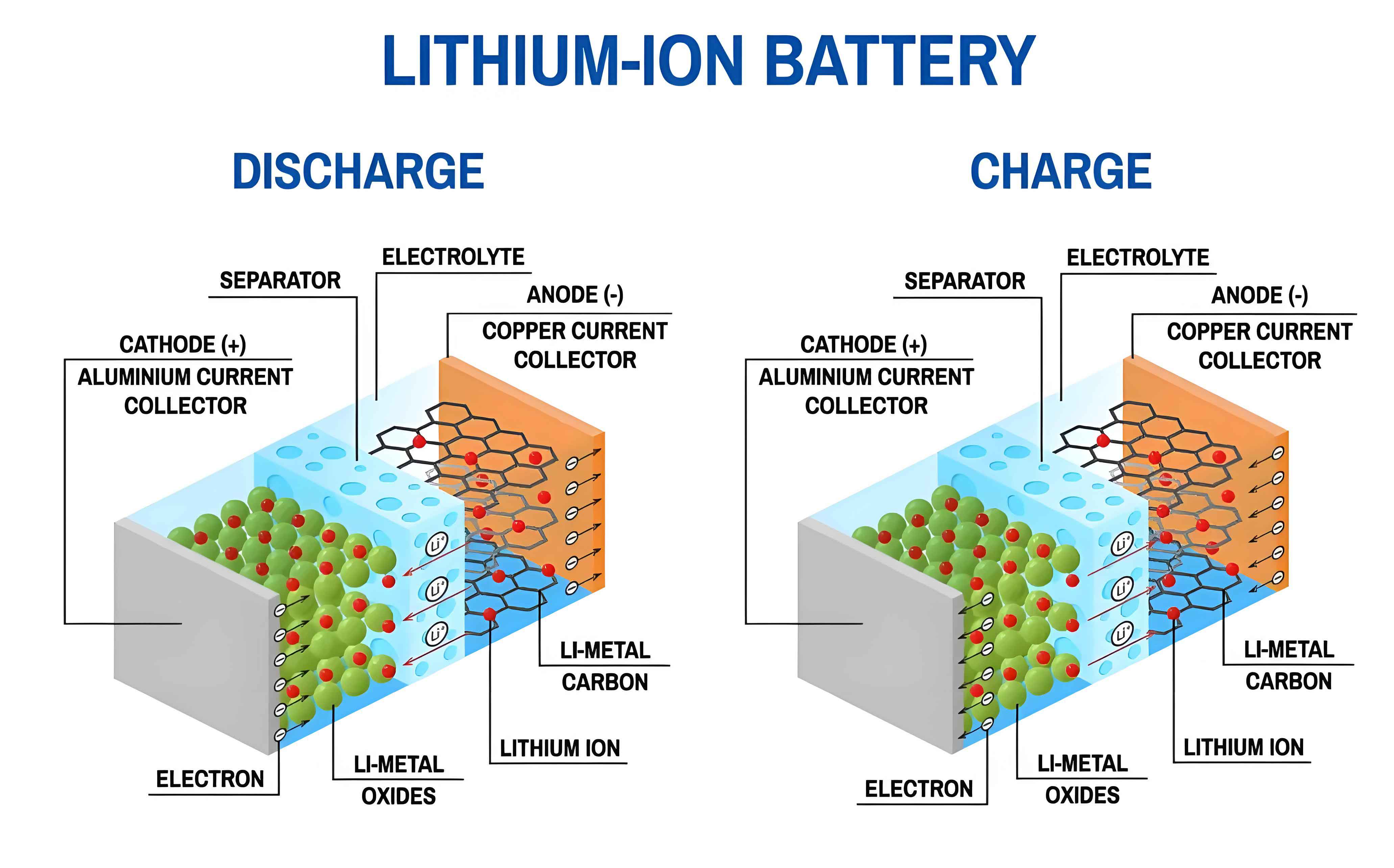
The genesis of TR within a li-ion battery lies in a complex chain of exothermic side reactions. When a cell is subjected to abusive conditions—thermal, electrical, or mechanical—its internal temperature rises. Beyond a critical threshold, the metastable solid-electrolyte interphase (SEI) layer on the anode begins to decompose, marking the onset of self-heating. This is characterized by the self-heating onset temperature (T1), typically where the temperature rise rate exceeds 0.02 °C/min. As heat accumulates, reactions intensify: lithium-intercalated graphite reacts with the electrolyte, the cathode electrolyte interface (CEI) decomposes, and the cathode material itself may decompose, releasing oxygen. The released oxygen fuels further reactions with the electrolyte and the anode. Concurrently, internal separators may melt or shrink, leading to large-area internal short circuits, which inject a massive and rapid joule heating pulse. The point where the temperature rise rate reaches 1 °C/s is defined as the thermal runaway triggering temperature (T2). Beyond T2, the reactions become self-sustaining and uncontrollable, driving the cell temperature to its peak (T3), which can exceed 800°C for some high-energy chemistries. The violent reactions produce substantial gas, causing internal pressure to build until the vent opens, ejecting a mixture of hot gases (e.g., CO, CO2, H2, electrolyte vapor), liquid droplets, and solid particles. This jet represents a potent vector for transferring heat and flammable material to adjacent cells. The sequence of key exothermic reactions can be summarized in the table below.
| Reaction Stage | Primary Reactions | Approximate Temperature Range |
|---|---|---|
| Stage 1: Initiation | Decomposition of the SEI layer on the anode. | 80°C – 120°C |
| Stage 2: Acceleration | Reaction between intercalated lithium and electrolyte; decomposition of the CEI layer. | 120°C – 200°C |
| Stage 3: Cathode Decomposition | Decomposition of cathode material (e.g., NCM, NCA) releasing oxygen; reaction of oxygen with electrolyte. | >200°C (varies by material) |
| Stage 4: Thermal Runaway | Large-scale internal short circuit; violent reactions between all components (electrolyte, anode, cathode, binder). | >T2 (e.g., >180°C) |
The kinetics of these reactions are often described by the Arrhenius equation, where the heat generation rate ($\dot{Q}_{gen}$) from side reactions is a function of temperature (T) and the state of charge (SOC):
$$\dot{Q}_{gen} = \sum_i A_i C_i^n \exp\left(-\frac{E_{a,i}}{RT}\right)$$
where $A_i$ is the pre-exponential factor, $C_i$ is the concentration of reactants, $n$ is the reaction order, $E_{a,i}$ is the activation energy, and $R$ is the universal gas constant for reaction $i$.
The propagation of thermal runaway from a failed li-ion battery cell to its neighbors is governed by heat transfer. The primary pathways include:
1. Conduction: Direct heat transfer through physical contact between cell casings or through electrical connections (busbars, tabs).
2. Convection: Heat transfer via the hot gases and ejected jet from the venting cell.
3. Radiation: Heat transfer from the flames or the intensely hot surface of the TR cell.
The relative contribution of each pathway depends heavily on the module design and conditions. In tightly packed prismatic modules, conduction through the casing often dominates. For cylindrical cells with spacing, radiation and convection through heated air gaps become significant. In enclosed or semi-enclosed spaces, the accumulation and combustion of ejected gases can dramatically enhance convective and radiative heating.
The characteristics of TR propagation are influenced by a multitude of factors related to the cell, module design, and environment. Understanding these is crucial for designing safer battery systems.
| Factor Category | Specific Factor | Effect on TR Propagation |
|---|---|---|
| Cell Characteristics | Cathode Chemistry | High-nickel NCM/NCA cells have lower thermal stability and higher $T_3$, leading to faster, more severe propagation compared to LFP cells. |
| State of Charge (SOC) | Higher SOC means more active lithium and higher chemical energy, accelerating TR onset and propagation speed. | |
| Cell Format & Energy | Larger format (e.g., pouch, large prismatic) and higher energy cells release more total energy, posing a greater challenge for propagation mitigation. | |
| Module Design & Abuse | Triggering Method | Heating, overcharge, and internal short circuits can affect the initial heat release profile and jet direction, influencing the first propagation step. |
| Electrical Configuration | Parallel connections can allow electrical energy transfer from a failing cell to neighbors, potentially inducing internal shorts and accelerating propagation vs. series or open circuit. | |
| Cell Arrangement & Spacing | Tighter spacing reduces heat dissipation paths and increases conduction. Vertical stacks are susceptible to flame/jet impingement from below. | |
| Interstitial Material | The thermal properties (conductivity, heat capacity) of materials between cells critically determine heat transfer rates. | |
| Environmental | Ambient Pressure | Low pressure (e.g., high altitude, aerospace) can alter venting gas dynamics, combustion efficiency, and convective cooling, with complex effects on propagation speed. |
| Enclosure Ventilation | Confined spaces trap hot gases, increasing convective heating; ventilation can remove heat and flammable gases but may also supply oxygen for fire. |
The propagation process can be modeled by considering an energy balance on a recipient cell. The temperature increase is governed by the net heat flow into the cell minus its heat dissipation, plus its internal heat generation upon reaching critical temperatures:
$$m C_p \frac{dT}{dt} = \dot{Q}_{in,cond} + \dot{Q}_{in,conv} + \dot{Q}_{in,rad} – \dot{Q}_{diss} + \dot{Q}_{gen}(T, SOC)$$
where $m$ and $C_p$ are the cell mass and specific heat, $\dot{Q}_{in}$ terms represent heat inflow via different modes, and $\dot{Q}_{diss}$ is heat loss to the surroundings.
Preventing or mitigating TR propagation is the primary goal of battery safety engineering. Strategies focus on either enhancing heat removal from a triggered cell to prevent neighboring cells from reaching $T_1$, or blocking heat transfer to them. These strategies are often implemented through the Battery Thermal Management System (BTMS).
1. Active Cooling Systems:
These systems use forced fluid flow to remove heat. While designed for operational temperature control, they can also extract TR heat.
Air Cooling: Simple and low-cost, but its low heat capacity and conductivity make it generally ineffective at stopping propagation from a high-energy li-ion battery, though it can help dilute flammable gases.
Liquid Cooling (Cold Plates): More effective than air. Coolant flowing through plates attached to cells can absorb significant heat. However, stopping propagation often requires extremely high flow rates, making the system bulky and energy-intensive. The cooling power required can be estimated by the energy release rate of the TR cell.
Immersion Cooling: A direct liquid cooling method where cells are submerged in a dielectric fluid (e.g., mineral oil, engineered fluorocarbons). This offers excellent thermal coupling and can effectively suppress TR by rapidly absorbing heat and sometimes suppressing flames. Its major challenges include system weight, cost, and fluid compatibility.
2. Passive Materials-Based Strategies:
These methods do not require external power and are increasingly favored for propagation mitigation.
Phase Change Materials (PCMs): PCMs absorb large amounts of latent heat during melting, buffering temperature rise. Traditional paraffin-based PCMs are flammable—a major drawback. Research focuses on flame-retardant composites, inorganic PCMs, or encapsulating PCMs within protective shells to combine heat absorption with fire resistance.
Thermal Interface Materials (High Conductivity): Materials like graphite sheets or metal foils spread heat laterally away from a hot spot, improving overall module heat dissipation and reducing local peak temperatures. However, they can also facilitate unwanted heat transfer if not designed carefully.
Thermal Barrier/Insulation Materials: These are crucial for blocking heat transfer. Materials like silica aerogels, ceramic fibers, or intumescent coatings placed between cells provide high thermal resistance. Their lightweight and excellent high-temperature stability make them particularly promising. The effectiveness of an insulation layer depends on its thermal resistance $R_{th} = L / k$, where $L$ is thickness and $k$ is thermal conductivity. A key design goal is to achieve sufficient $R_{th}$ to keep adjacent cells below $T_1$ despite the heat flux from a TR cell.
3. Hybrid Strategies:
Combining multiple approaches often yields superior results, leveraging the strengths of each. Common combinations include:
PCM + Insulation: PCM absorbs the bulk of the initial heat pulse, while the insulation layer blocks residual conductive heat transfer.
Insulation + Cold Plate: Insulation blocks direct cell-to-cell heat transfer, while the cold plate manages the overall module temperature rise by dissipating heat to the environment.
Functional Composite Barriers: Advanced materials combine a heat-absorbing filler (like a hydrate salt) within an insulating matrix (like ceramic fiber), creating a single component that both absorbs and blocks heat.
The following table compares the core characteristics of these mitigation strategies.
| Strategy | Mechanism | Advantages | Disadvantages/Challenges |
|---|---|---|---|
| Active Liquid Cooling | Forced convective heat removal. | High heat removal capacity; precise temperature control. | High parasitic power; system complexity; potential leakage; may be overwhelmed by TR. |
| Immersion Cooling | Direct contact cooling & flame suppression. | Excellent thermal performance; can quench TR. | High cost and weight; fluid maintenance; compatibility issues. |
| PCMs | Latent heat absorption. | Passive, high energy density; simple. | Low thermal conductivity; flammability (organic); volume change; potential leakage. |
| High-k Materials | Lateral heat spreading. | Improves uniform cooling; passive. | May aid propagation if misapplied; adds weight/cost. |
| Insulation Materials | Blocking heat transfer. | Highly effective at blocking heat; lightweight; passive. | Must withstand high temperatures; integration into compact design. |
| Hybrid Systems | Combination of above. | Synergistic effects; balanced performance. | Increased design complexity and cost. |
In conclusion, thermal runaway propagation remains a critical safety challenge for high-energy li-ion battery packs. The process is initiated by a complex chain of exothermic reactions within a single cell and propagates through combined conduction, convection, and radiation. Its severity is modulated by cell chemistry (like high-nickel NCM), state of charge, module design (electrical connections, spacing), and environmental conditions. While traditional active cooling systems have limitations in handling the intense heat of a li-ion battery TR event, passive strategies—particularly advanced insulation materials like aerogels and non-flammable PCM composites—show great promise for blocking heat transfer. The future of safe li-ion battery design lies in multi-physics modeling that accurately captures the coupled electrochemical, thermal, and fluid dynamic processes during TR, and in the development of intelligent, multi-functional materials and hybrid systems that can effectively decouple cells thermally without compromising performance. As energy densities continue to rise, prioritizing these safety-focused engineering solutions is not just prudent but essential for the sustainable future of electrochemical energy storage.