
The relentless growth of cloud computing, big data analytics, and artificial intelligence has cemented the data center’s role as the central nervous system of the digital economy. This critical infrastructure demands unprecedented levels of power reliability and energy efficiency. For decades, valve-regulated lead-acid (VRLA) batteries have been the default choice for Uninterruptible Power Supply (UPS) systems, providing the essential bridge during power transitions. However, their limitations—bulky size, limited cycle life, environmental concerns, and performance degradation in temperature extremes—have become increasingly apparent. In this context, the li ion battery has emerged as a transformative technology, offering a compelling suite of advantages for data center backup power. Yet, its adoption is inextricably linked to a rigorous discussion on safety, specifically the management of thermal runaway risks. As an engineer deeply involved in the design and evaluation of critical power systems, I have observed this technological shift firsthand. This article explores the fundamental characteristics of li ion battery technology, analyzes its application within data center UPS systems, and details the multifaceted safety framework essential for its secure deployment.
Fundamental Characteristics and Safety Imperatives of Li-ion Batteries
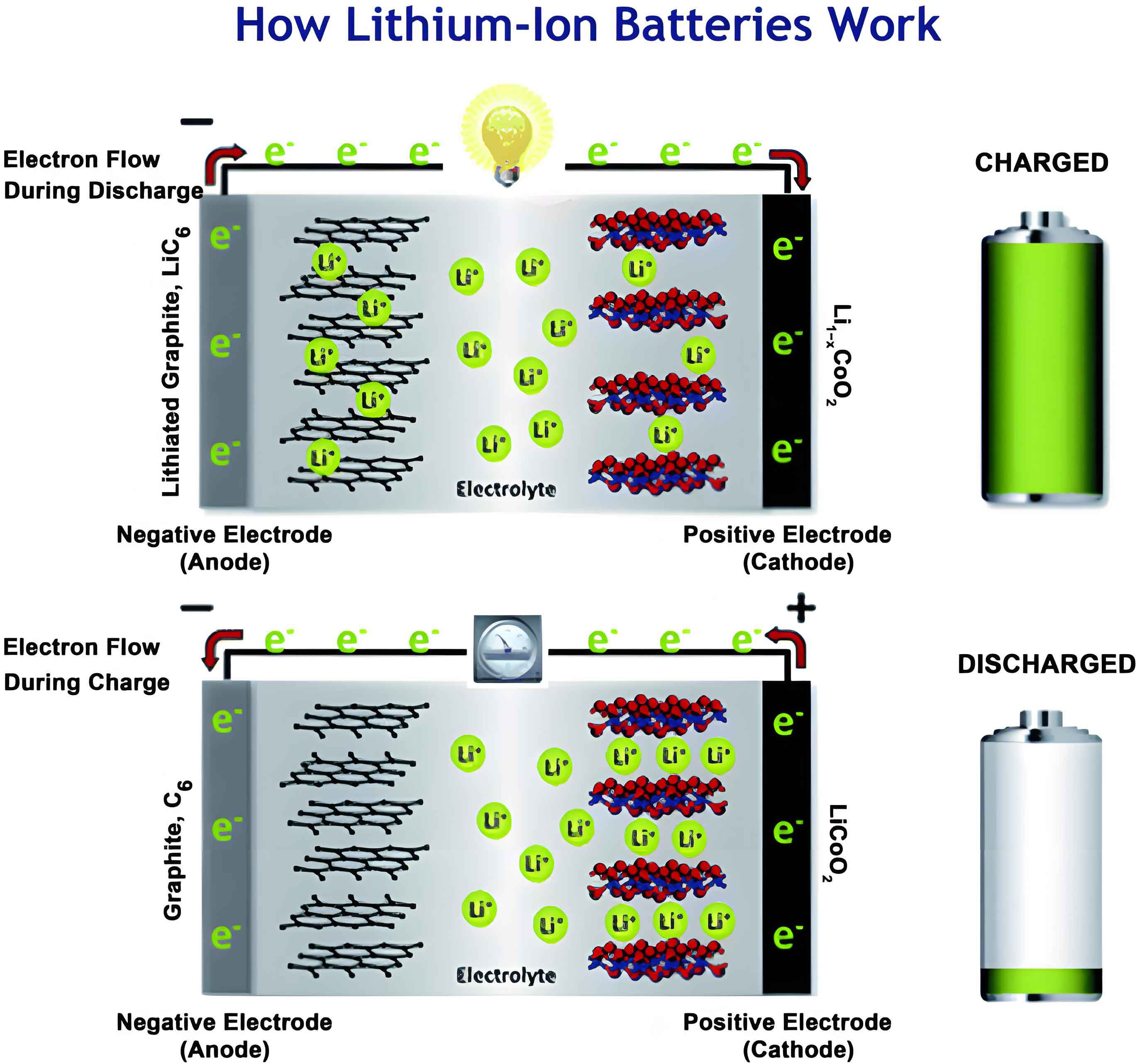
At its core, a li ion battery operates on the principle of lithium-ion shuttling between a cathode and an anode through an electrolyte. During charging, lithium ions are extracted from the cathode material (de-intercalation), travel through the electrolyte, and are inserted into the anode material (intercalation). The process reverses during discharge. The general reaction can be conceptually summarized, though it varies by chemistry. For a common cathode material like Lithium Iron Phosphate (LFP), the reactions are:
Cathode (during charging): $$ \text{LiFePO}_4 \rightarrow \text{FePO}_4 + \text{Li}^+ + e^- $$
Anode (during charging): $$ \text{C} + \text{Li}^+ + e^- \rightarrow \text{LiC}_6 $$
The discharge reactions are the exact reverse. This “rocking chair” mechanism is highly efficient and reversible, forming the basis for the technology’s high energy density and long cycle life.
For data center applications, the dominant li ion battery chemistry is Lithium Iron Phosphate (LFP). Its key attributes—excellent thermal stability, long cycle life, and tolerance to abuse—make it the preferred choice over Nickel Manganese Cobalt (NMC) or other ternary chemistries, which offer higher energy density but present a comparatively higher risk of thermal runaway. The advantages of deploying a li ion battery in a data center are substantial and can be quantified against traditional VRLA batteries.
| Characteristic | Li-ion Battery (e.g., LFP) | VRLA Battery |
|---|---|---|
| Energy Density (Wh/L) | 200 – 350 | 60 – 110 |
| Cycle Life (to 80% SOH) | 3,000 – 6,000 cycles | 200 – 500 cycles |
| Operational Temperature Range | 0°C to 60°C (optimal 15-35°C) | 20°C to 30°C (ideal) |
| Charge Acceptance / Rate | High. Can accept up to 1C charge current routinely. | Low. Typical charge current is 0.1C to 0.25C. |
| Self-Discharge Rate | <5% per month | ~3-5% per month |
| Maintenance Requirements | Virtually maintenance-free (sealed system). | Periodic checks for voltage, impedance, and connection integrity. |
| Environmental Footprint | Contains no heavy metals like lead or cadmium. | Contains lead and sulfuric acid; recycling is mandatory. |
However, the superior performance of the li ion battery is accompanied by critical limitations. The upfront capital expenditure (CapEx) remains higher, though the total cost of ownership (TCO) over a 10-year period often proves favorable due to longer life and reduced footprint. The paramount limitation is safety, specifically the risk of thermal runaway. This is a positive feedback loop where internal heat generation outpaces dissipation, leading to a chain of exothermic reactions. The triggering mechanisms are well-studied:
- Mechanical Abuse: Physical damage leading to internal short circuits.
- Electrical Abuse: Overcharging (plating lithium metal), over-discharging, or external short circuits.
- Thermal Abuse: Operation in excessive ambient temperatures.
The process often begins with the breakdown of the solid-electrolyte interphase (SEI) layer, followed by electrolyte decomposition, and can lead to cathode material breakdown and separator meltdown. A critical hazard is the generation of flammable vent gases (e.g., $$ \text{H}_2 $$, $$ \text{CO}$$, and various hydrocarbons). The energy released during this process, represented simplistically as the sum of reaction enthalpies, can be significant:
$$ Q_{\text{total}} = \sum \Delta H_{\text{rxn}} $$
Preventing this condition is the central goal of li ion battery safety design. Standards such as GB 51048 (Design Code for Electrochemical Energy Storage Power Stations) and emerging industry consortium standards have established rigorous requirements. These mandate comprehensive safety measures for li ion battery installations, including dedicated fire compartments, advanced gas detection (for $$ \text{H}_2 $$ and $$ \text{CO} $$), and specialized suppression systems like water mist, aerosol, or liquid immersion cooling that can provide sustained cooling to prevent cell-to-cell propagation.
Analysis of Li-ion Battery Integration in Data Center UPS Systems
The integration of a li ion battery into a data center UPS is not a simple swap for VRLA. It necessitates a re-evaluation of the entire power backup subsystem, from physical architecture to management philosophy. The inherent differences between the two technologies force a paradigm shift.
First, the performance gap is transformative. A li ion battery pack can be up to 70% smaller and lighter for the same kWh capacity. Its wider operational temperature tolerance reduces cooling energy overhead in the battery room. Most importantly, its charge acceptance rate allows for dramatically faster recharge times. If a VRLA battery requires 8-12 hours to recharge after a discharge, a li ion battery can often accomplish this in 1-2 hours, significantly improving system resilience during repeated utility disturbances. The charging profile itself is different: while VRLA uses primarily constant-voltage methods, li ion battery systems require precise Constant Current-Constant Voltage (CC-CV) control governed by the Battery Management System (BMS).
This leads to the second major difference: the complexity and criticality of the Battery Management System (BMS). A VRLA BMS is relatively simple, monitoring basic parameters like string voltage and overall current. In contrast, a li ion battery BMS is an intelligent, multi-layered safeguard. Its functions are fundamental to safety and longevity:
- Cell Monitoring: Precise measurement of every cell’s Voltage ($$ V_{cell} $$), Temperature ($$ T_{cell} $$), and sometimes internal impedance.
- State Estimation: Calculating key states using models and algorithms:
- State of Charge (SOC): $$ \text{SOC}(t) = \text{SOC}(t_0) – \frac{1}{C_{\text{nominal}}} \int_{t_0}^{t} \eta I(\tau) d\tau $$, where $$ \eta $$ is coulombic efficiency and $$ C_{\text{nominal}} $$ is the battery’s rated capacity.
- State of Health (SOH): Often defined as $$ \text{SOH} = \frac{C_{\text{current}}}{C_{\text{nominal}}} \times 100\% $$, indicating capacity fade.
- State of Power (SOP): Estimating the maximum safe charge/discharge power based on voltage, SOC, and temperature limits.
- Safety Protection: Enforcing strict limits on voltage, current, and temperature, and activating isolation controls if thresholds are breached.
- Balance Management: Actively or passively equalizing cell voltages to prevent drift that can reduce usable capacity and create unsafe conditions.
- Communication: Providing comprehensive data and alarm interfaces to the UPS controller and facility monitoring system.
A crucial and often misunderstood concept is the distinction between a UPS backup li ion battery and an electrochemical energy storage system (ESS) for applications like peak shaving or energy arbitrage. While they share core technology, their design objectives create fundamental incompatibilities:
| Aspect | UPS Backup Li-ion Battery | Electrochemical ESS |
|---|---|---|
| Primary Duty | Provide high-power, short-duration backup (seconds to minutes). | Provide energy for long-duration cycling (hours of discharge). |
| Discharge Rate (C-rate) | High (e.g., 3C to 6C for short bursts). | Low (e.g., 0.25C to 0.5C for sustained output). |
| Cycle Depth & Frequency | Infrequent, shallow to moderate depth discharges. | Daily, deep discharge cycles. |
| Cell Design Optimization | Optimized for high power density and pulse performance. | Optimized for high energy density, long cycle life at low C-rates. |
| Thermal Load Profile | Short, intense thermal pulses during discharge. | Long, sustained, lower-level thermal load. |
Attempting to use a power-optimized UPS li ion battery for daily energy arbitrage will drastically shorten its life and may void warranties. Conversely, an energy-optimized ESS li ion battery may not deliver the instant high-power surge required for a UPS transfer. The thermal management system designed for the brief load of a backup event is likely inadequate for the prolonged discharge of an ESS, creating a potential overheating hazard. Therefore, these applications require purpose-built systems; convergence is not advisable without a complete, integrated redesign of the cell, BMS, and thermal management.
Prospects, Challenges, and a Forward Look
The trajectory for the li ion battery in data centers is one of continued adoption, driven by the inexorable demands for density, efficiency, and sustainability. The safety paradigm is maturing from mere reaction to proactive, predictive management. The future lies in enhancing the intrinsic safety of the cell and the intelligence of the system surrounding it.
Immediate challenges remain. Standardization of safety protocols, BMS communication interfaces, and fire suppression methods across vendors and regions is still evolving. The high initial CapEx, despite a compelling TCO, can be a barrier. Furthermore, as systems age, accurately predicting end-of-life and managing the risks associated with aging cells—increased impedance, gas generation—requires more advanced analytics.
The research and development horizon is active with promising avenues. Solid-state batteries, which replace the flammable liquid electrolyte with a solid conductor, promise a fundamental leap in safety and energy density. Advanced BMS algorithms incorporating machine learning are moving from simple state estimation to predictive failure analytics, identifying subtle precursors to thermal runaway or capacity fade. Integration with the data center’s Building Management System (BMS) and Distributed Energy Resource (DER) platforms will enable more dynamic and resilient power management strategies, though always within the strict safety boundaries defined for backup power.
For data center operators and designers, the path to secure li ion battery adoption is clear. It involves a layered safety strategy:
| Layer | Focus | Example Measures |
|---|---|---|
| Cell & Pack Design | Prevent initiation. | Use LFP chemistry; incorporate flame-retardant additives; robust mechanical design. |
| BMS & Electrical Controls | Detect and contain abnormalities. | Precision monitoring; strict voltage/temperature limits; active balancing; fault isolation. |
| System & Enclosure | Mitigate propagation. | Fire-rated battery cabinets; module-level or rack-level suppression (e.g., aerosol, fine water mist). |
| Room & Facility Design | Manage consequences. | Dedicated, ventilated rooms; flammable gas detection; structural fire protection; water supply for sustained cooling. |
| Operations & Procedures | Sustain safety over lifecycle. | Clear SOPs for testing and maintenance; staff training; monitoring SOH trends; established decommissioning plan. |
In conclusion, the li ion battery represents a significant technological advancement for data center power resilience. Its advantages in footprint, efficiency, and lifecycle are undeniable. The key to unlocking its full potential lies not in avoiding its risks, but in meticulously engineering and managing them through a defense-in-depth approach. By combining robust cell chemistry, intelligent management systems, and purpose-built facility designs, the data center industry can confidently integrate li ion battery technology, securing both its critical operations and its path toward a more efficient and sustainable future.