
The pursuit of “carbon peak” and “carbon neutrality” goals has placed electrochemical energy storage, particularly li ion battery technology, at the forefront of the global energy transition. The performance and longevity of li ion battery systems are critical determinants for the economic viability of large-scale energy storage projects. A fundamental challenge limiting the cycle life of conventional li ion battery cells is the irreversible consumption of active lithium during the initial charge-discharge cycles and throughout prolonged cycling. This loss primarily occurs during the formation of the Solid Electrolyte Interphase (SEI) on the anode surface and its subsequent repair. Prelithiation, a technique designed to compensate for this initial lithium loss by introducing an additional lithium source, has emerged as a pivotal strategy for enhancing the initial Coulombic efficiency (ICE) and extending the cycle life of li ion battery cells.
While significant academic research has elucidated the mechanisms and explored various prelithiation methodologies, a comprehensive understanding of the technological development from an industrial and commercialization perspective is equally crucial. Patent analysis serves as a powerful tool to map the innovation landscape, identify key players, trace technological trajectories, and gauge the readiness of various prelithiation routes for mass production. This analysis, conducted from a first-person perspective, delves into the patent data surrounding li ion battery prelithiation technology to uncover its development trends, main contributors, technological focus areas, and the specific pathways that show the strongest industrial momentum.
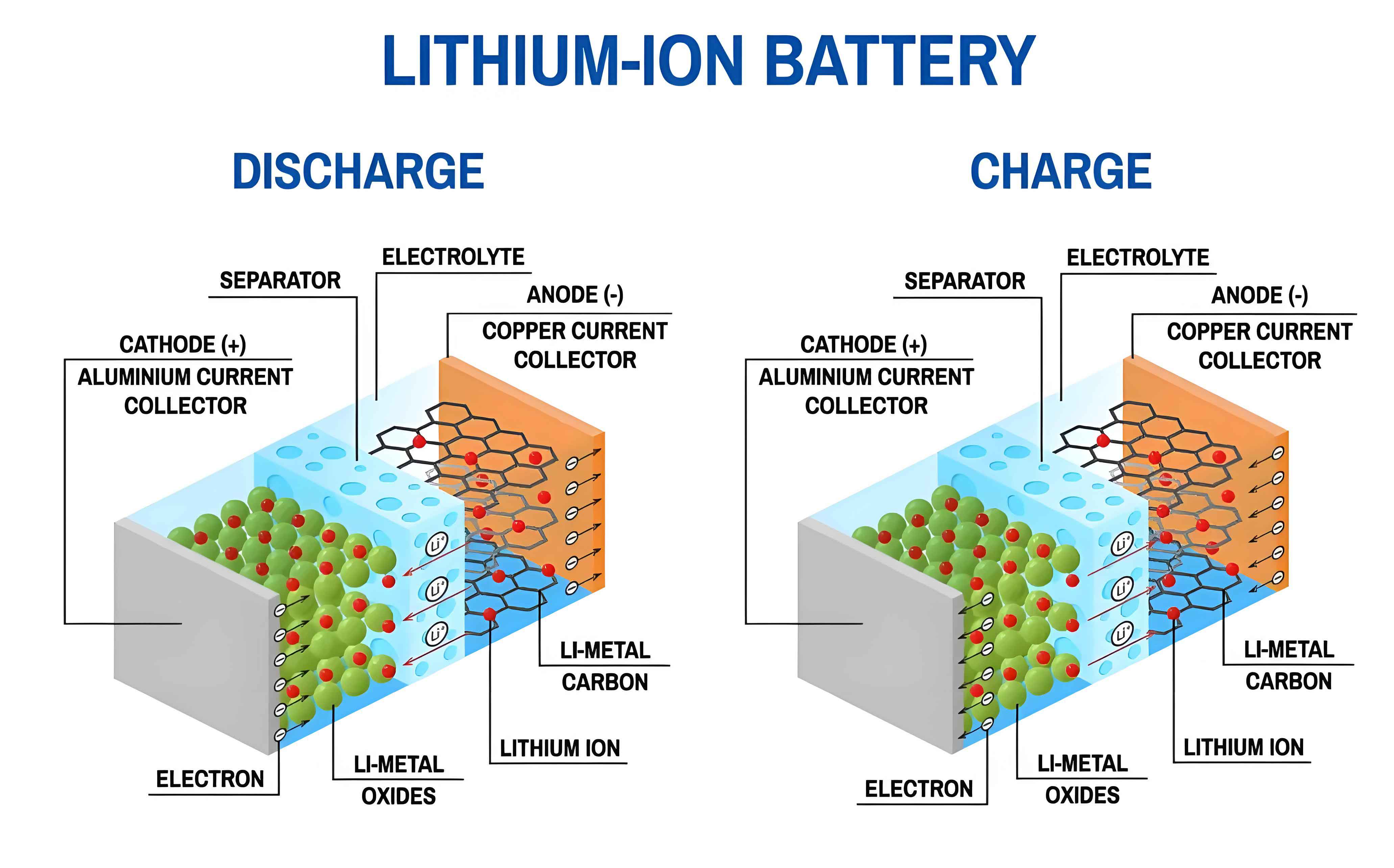
The fundamental need for prelithiation in a li ion battery stems from the unavoidable lithium depletion during operation. The first charging process leads to electrolyte reduction on the anode (typically graphite or silicon-based materials), forming the SEI layer. This process irreversibly consumes lithium ions from the cathode. Furthermore, during long-term cycling, the SEI layer undergoes dynamic breakdown and reformation, continuously depleting the limited inventory of active lithium in the cell. This manifests as a gradual capacity fade. The total irreversible capacity loss ($Q_{irr}$) can be conceptualized as:
$$ Q_{irr} = Q_{SEI, formation} + \sum_{n=1}^{N} Q_{SEI, repair}(n) $$
where $Q_{SEI, formation}$ is the lithium consumed during the initial SEI formation and $Q_{SEI, repair}(n)$ is the lithium consumed during the repair at cycle $n$ over the total cycle life $N$. Prelithiation aims to introduce an extra lithium reservoir, $Q_{pre}$, into the cell to offset this loss:
$$ Q_{available} = Q_{cathode} + Q_{pre} – Q_{irr} $$
where $Q_{available}$ is the effective reversible capacity of the cell and $Q_{cathode}$ is the lithium inventory from the main cathode material. By carefully controlling $Q_{pre}$, the initial efficiency and long-term cycling stability of the li ion battery can be significantly improved.
Patent Trends and Growth Trajectory
An analysis of global patent filings related to li ion battery prelithiation reveals a distinct three-phase evolutionary pattern, underscoring its transition from a niche concept to a mainstream research and development focus.
| Phase | Time Period | Characteristics | Annual Application Volume |
|---|---|---|---|
| Technology Infancy | 1995 – 2012 | Sporadic foundational patents, primarily from the US and China. | Single digits |
| Steady Growth | 2012 – 2017 | Increased research activity, consistent year-over-year growth. | Tens of applications |
| Rapid Acceleration | 2017 – Present | Exponential growth, high industry engagement, diverse innovation. | Hundreds of applications (peaking ~400/year) |
The data indicates that patent applications entered a period of explosive growth around 2017. This inflection point correlates with the intensifying demand for higher-energy-density and longer-cycle-life li ion battery for electric vehicles and grid storage. The annual filing volume surpassed 400 patents in recent years, demonstrating that prelithiation is no longer merely an academic pursuit but a technology perceived as critical for next-generation li ion battery products. Notably, invention patents constitute over 94% of the total filings, highlighting the substantive, novel technological advancements being pursued rather than mere design modifications.
Geographical Distribution of Innovation
The geographical origin of patents provides insight into regional technological leadership and industrial focus. The innovation landscape for li ion battery prelithiation is highly concentrated, with one region dominating the patenting activity.
The distribution is heavily skewed, with China accounting for approximately 88.5% of the total global patent applications related to li ion battery prelithiation. The United States follows distantly with about 6.7%, while South Korea and Japan hold shares of roughly 1.9% and 1.2%, respectively. This overwhelming dominance by China reflects its massive investment and strategic positioning within the entire li ion battery supply chain, from raw materials to cell manufacturing. It underscores the nation’s focused effort to master and advance core technologies like prelithiation that are essential for maintaining competitiveness in the global li ion battery market.
Key Players and Inventor Networks
Identifying the main patent assignees and inventor networks helps pinpoint the organizations driving technological progress and clarifies the divide between academic research and industrial development. The profile of top applicants is particularly revealing.
The list of top 10 patent assignees is overwhelmingly dominated by li ion battery cell manufacturers and specialized material suppliers. Only one entry among the top ten is a university/research institution. This composition sends a clear signal: prelithiation technology for li ion battery is intensely practical and is being aggressively developed by industrial entities with clear commercialization pathways in mind. The leading assignee, a major Chinese battery manufacturer, holds a significantly larger portfolio and employs a much broader team of inventors in this field than its peers, suggesting a substantial and sustained institutional commitment to mastering prelithiation technology for li ion battery applications.
The growth in the number of unique applicants and inventors has been exponential since 2014. The number of entities filing patents in this area has increased from a handful to several hundred annually, and the community of inventors has grown to over 1,500 individuals. This expanding ecosystem indicates that knowledge and research efforts are diffusing widely, moving beyond a few pioneering labs or companies. It suggests the technology is maturing and attracting diverse problem-solving approaches from across the li ion battery industry.
Technological Domain Analysis
Examining the International Patent Classification (IPC) codes associated with prelithiation patents reveals the multidisciplinary nature of the research and the primary technical challenges being addressed. The innovation spans from fundamental chemistry to applied engineering.
The vast majority of patents fall under the H01M (processes or means for the direct conversion of chemical energy into electrical energy) subclass, which is expected for battery-related inventions. A deeper look at the primary technical subgroups within this and other classes shows a focused effort on specific aspects of li ion battery design and manufacturing impacted by prelithiation.
| Primary IPC Subgroup | Technical Focus Area | Examples of Innovation |
|---|---|---|
| H01M10/0525 (Rocking-chair batteries, i.e., batteries with lithium insertion or intercalation in both electrodes) |
Full cell design and integration of prelithiation components. | Methods for assembling cells with prelithiated anodes or cathodes containing additives. |
| H01M4/62 (Selection of inactive substances as ingredients for active masses) |
Material composition of electrodes, specifically additives. | Development of novel prelithiation additives (e.g., Li5FeO4, Li2NiO2), conductive agents, or binders compatible with prelithiation chemistry. |
| H01M4/36 (Selection of substances as active materials, active masses, active liquids) |
Active material selection and modification. | Use of lithium-rich cathode materials or prelithiated silicon/graphite composite anodes. |
| H01M10/42 (Methods or arrangements for servicing or maintenance) |
Manufacturing and conditioning processes. | Electrochemical, chemical, or physical prelithiation processes for electrodes; formation protocols. |
An analysis of highly cited “core” patents reveals a similar concentration in these areas, but also highlights key foundational work, often originating from the United States, on electrode materials (H01M4/38 for elemental or alloy anodes like silicon) and general manufacturing methods. This indicates that while China files the highest volume, seminal inventions that shape the direction of the field, particularly for challenging anode materials, have strong contributions from other regions. The convergence of patents around material science (C01, C07), electrochemical engineering (H01M), and process technology (B01) confirms that advancing li ion battery prelithiation requires a deeply interdisciplinary approach.
Deep Dive: The Cathode Prelithiation Additive Route
Among the various prelithiation strategies, the integration of lithium-rich cathode additives has gained the most industrial traction for current-generation li ion battery. This route offers superior compatibility with existing electrode manufacturing processes (slurry casting), minimizing the need for drastic changes to production lines. The additive is mixed with the active cathode material, conductive carbon, and binder. During the first charge, the additive decomposes at a specific voltage, releasing lithium ions into the cell to compensate for the SEI formation loss. The ideal additive should have a high specific capacity, decompose within the stable voltage window of the electrolyte, and release minimal or benign gaseous by-products.
Two materials have emerged as the leading candidates for cathode prelithiation additives in the li ion battery industry: Lithium Iron Oxide (Li5FeO4, LFO) and Lithium Nickel Oxide (Li2NiO2, LNO). Their properties and the focus of related patent activity are summarized below.
| Parameter | Li5FeO4 (LFO) | Li2NiO2 (LNO) |
|---|---|---|
| Theoretical Capacity | ~867 mAh/g | ~486 mAh/g |
| Decomposition Voltage | ~3.5V – 4.0V (vs. Li/Li+) | ~3.5V – 4.3V (vs. Li/Li+) |
| Key Reaction | Li5FeO4 → LiFeO2 + 2 Li+ + 2 e– + O2↑ | Li2NiO2 → LiNiO2 + Li+ + e– |
| Primary Challenge | Oxygen gas evolution during decomposition, leading to potential cell swelling. | High sensitivity to moisture and CO2 (poor air stability), leading to handling difficulties and slurry gelation. |
| Patent Focus Areas |
|
|
The patent landscape for these additives vividly illustrates the industry’s problem-solving approach. For LFO, a significant portion of inventions aims to mitigate its inherent issue of oxygen generation. Patents describe strategies like metal-ion doping (e.g., with Co, Mn) or the use of fluorine-substituted compounds (e.g., Li5FeO4-xFx) to modify the decomposition pathway and reduce gas evolution. Other patents focus on coating LFO particles with conductive carbon or stable lithium salts (e.g., LiF) to improve electronic conductivity and surface stability against moisture.
For LNO, the patent thrust is overwhelmingly on overcoming its air instability. Innovations center on creating core-shell structures where the LNO particle is encapsulated by a protective layer—such as TiO2, Al2O3, or specific organic compounds—that acts as a barrier against H2O and CO2 during storage and electrode processing. The general reaction for a coated additive can be simplified as the additive’s own reaction, but with enhanced stability ($S$):
$$ \text{Coated-Additive} \xrightarrow[\text{Charge}]{\text{Stable in Air}} \text{Decomposition Products} + x\text{Li}^+ + xe^- $$
where the coating improves the parameter $S$. The volume of patenting activity around these specific material-level solutions confirms that cathode additive prelithiation is viewed as the most readily implementable technology for boosting the performance of commercial li ion battery systems in the near term.
Conclusions and Future Trajectory
The patent analysis of li ion battery prelithiation technology paints a picture of a field in a state of vigorous, industry-driven expansion. The transition from a steady growth phase to a period of rapid acceleration after 2017 marks the point where the technology’s potential for solving critical li ion battery limitations became widely recognized by commercial entities. The overwhelming concentration of patent filings in China highlights its strategic drive to control this value-adding technology, while the composition of top assignees—predominantly cell and material manufacturers—underscores the intensely practical and commercial nature of current development efforts.
Technologically, the landscape is characterized by a multi-front effort. While research spans anode-focused and cathode-focused strategies, the patent data reveals a clear industrial bias towards cathode additive prelithiation, specifically concerning LFO and LNO materials. The innovation here is deeply material-science oriented, focusing on surface engineering, doping, and compositing to solve inherent drawbacks like gas evolution and air sensitivity. The overarching goal is to transform these promising lithium donors into robust, reliable, and easily processable components for standard li ion battery manufacturing.
Looking ahead, several key challenges and opportunities can be inferred. First, the relative scarcity of high-impact core patents from the region with the highest filing volume suggests an opportunity to shift focus from quantity to groundbreaking, fundamental inventions. Second, while cathode additives lead in near-term applicability, anode prelithiation (e.g., for silicon-dominant anodes) remains essential for the next leap in li ion battery energy density. Patents in this area are more complex, often involving electrochemical or chemical treatment steps, indicating a need for parallel development in compatible process engineering. Finally, the cross-disciplinary nature of the patents hints at future convergence trends—where advancements in in-situ monitoring, advanced binder systems, and machine-learning-optimized formation protocols will integrate with prelithiation materials to create holistic li ion battery performance enhancement solutions.
In conclusion, prelithiation has firmly established itself as a critical technological frontier for the advancement of li ion battery. The patent trajectory indicates it is moving decisively from the laboratory into the factory. The focused innovation on solving the practical shortcomings of specific additive materials demonstrates an industry on the cusp of widespread implementation, paving the way for the next generation of longer-lasting, higher-efficiency li ion battery for a sustainable energy future.